Analysis: Austrian officials warn of increased spying against military targets
April 26, 2026 9 Comments
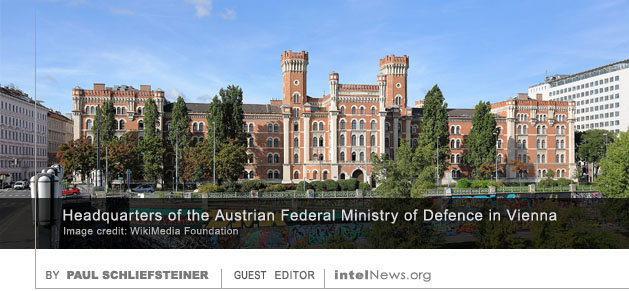 THE AUSTRIAN DEFENSE INTELLIGENCE Agency, the Abwehramt (AbwA), as well as the Austrian Chief of the General Staff, have publicly warned in recent weeks that intelligence targeting of the Austrian military, the Bundesheer, has increased markedly. There has not only been a significant rise in unauthorized drone flights near and over military installations, but also instances of individuals gathering information through vehicular-based surveillance outside facilities. Traditional recruitment methods by foreign intelligence services have also been observed—although no public disclosure has emerged on how frequent these attempts are.
Reinhard Ruckenstuhl, head of the AbwA, notes in his contribution to the Risk Monitor 2026 – The End of Order, which provides brief risk assessments for public consumption, that “[t]he armament and defense efforts of Austria and its neighboring countries […] represent particularly attractive targets for foreign military intelligence services.” He states that, while technological developments open new avenues for gathering information and facilitating espionage, human agents and sources remain important, even “en vogue,” as he puts it. Here he identifies a problem since “[i]n Austria, [foreign agents] are predominantly deployed under diplomatic cover. In the case of this type of cover, they particularly benefit from the strong presence of international organizations and the respective national missions in Austria.”
Ruckenstuhl continues by specifically naming Russia, noting that its intelligence services are “increasingly relying on civilians recruited digitally to carry out their missions.” These assignments “range from simple tasks such as carrying out socially polarizing actions to spying on military support for Ukraine to specific acts of sabotage.” The individuals recruited in this way do not receive any training. Although not mentioned in his assessment, it is now a widely held view in German-speaking Europe that it is part of the calculus of the Russian intelligence services, that such individuals will be  caught sooner rather than later. This has led to them being labeled “Wegwerfagenten” (“throwaway agents”). While Ruckenstuhl does not address this aspect, he clearly states that the success of this method will likely lead other (antagonistic) intelligence services to adopt similar approaches, which he describes as a “non-professionalization.” As a result, he concludes that “this confronts Austrian intelligence services with challenges that will have to be met with equally adapted methods backed by an appropriate legal basis.” Ruckenstuhl finishes with what seems—in the eyes of this author—like a thinly veiled cautionary note to executive and legislative decision-makers when he notes that, noting: “At the same time, the penalties for foreign intelligence operations in Austria lag behind those in other European countries, thereby limiting their deterrent effect. Austria will therefore remain an important hub and safe haven for foreign intelligence services.”
This sentiment was echoed by Rudolf Striedinger, Chief of the General Staff of the Austrian Armed Forces, when asked about foreign intelligence activities targeting the Bundesheer and Ruckenstuhl’s assessment in the Risk monitor 2026: “Our country is still something of a paradise for spies. This is partly due to our legislation. You can see this in Austria in the large number of Russian and other embassy staff members who clearly have a background in espionage. So, the potential is definitely there.” Striedinger explained that, because Austria is closely interconnected not only with other European Union (EU) member states but also with the North Atlantic Treaty Organization (NATO)—of which it is not a member but cooperates with at various levels—its armed forces use very similar or identical weapons systems and methods. Consequently, intelligence gathered on the Bundesheer may provide valuable insights into the development and current procedures of Western armed forces more broadly. In response to this intensified unwanted interest, the AbwA has launched a major awareness campaign within the Bundesheer, and soldiers on guard duty have been specifically instructed on what to watch for and immediately report. Striedinger is well aware of the challenges the Austrian military faces regarding foreign intelligence, since he was Ruckenstuhl’s predecessor as chief of the AbwA before becoming Chief of the General Staff.
In the view of this author, the remarks by these two high-ranking Austrian generals are noteworthy for two reasons. First, both explicitly name Russia as a foreign actor targeting Austria. This is likely part of Austria’s broader effort—also reflected in its Intelligence Community—to signal to Western, particularly European, partners that the country is firmly in their camp and committed to shared values. It may also be part of a broader attempt by Austria’s security institutions to “clean house” or, perhaps more accurately, to restore their standing after several incidents and revelations led to the  country being labeled a “den of (Russian) spies”—and worse by some. While, in retrospect, some of these assessments appear exaggerated relative to the actual scale of legal issues and cases, Austria’s international reputation has nevertheless suffered in recent years.
Second, these public statements may form part of a broader push by counterintelligence and security institutions to prompt political action—particularly to tighten criminal law. This has long been a demand of the Austrian Intelligence Community, especially the domestic service, the Direktion Staatsschutz und Nachrichtendienst (DSN).
This push may have gained traction: it was recently reported that the Social Democratic-led Ministry of Justice has provided the other two governing parties, the conservative People’s Party (ÖVP) and the liberal New Austria and Liberal Forum (NEOS), with a draft introducing more comprehensive criminal offenses related to intelligence gathering and other activities by foreign services. While the Ministry has confirmed the existence of the draft, the actual legal wording has not yet been publicized, and the amendment remains under negotiation among the governing parties. It is therefore not yet possible to make a reliable prediction about how Austria’s legal framework on espionage may change in the near future—although such changes now appear more likely than ever.
► Author: Paul Schliefsteiner* | Date: 27 April 2026 | Permalink
* Paul Schliefsteiner is the Director of the Austrian Center for Intelligence, Propaganda and Security Studies (ACIPSS) and the Editor of the Journal for Intelligence, Propaganda and Security Studies (JIPSS). He studied History, Philosophy and Law at the University of Graz, as well as International Security Studies at the University of the Bundeswehr Munich and the George C. Marshall Centre in Garmisch-Partenkirchen. He was previously a guest researcher at the Institute for Peace Preservation and Conflict Research at the Defence Academy of the Austrian Armed Forces in Vienna
 About intelNews








I noticed “The individuals recruited in this way do not receive any training.” In Cold War parlance this included Soviet/Russian intelligence persuading untrained “useful idiots” to carry out what are now termed Agent of Influence [1] campaigns.
Such Russian hybrid warfare has vastly greater impact in the US setting than in Austria.
Long-term Russian intelligence objectives include finding well placed, senior, US figures to:
A. Split the Western Alliance (most usefully NATO) Tick-Achieved and
B. Cause major social and security disharmony within the “Main Enemy” the USA Tick-Achieved – one need only mention violent, mass, ICE operations.
If the senior US figure, in decades gone by, has frequently become bankrupt, he long appreciatiates excessive Russian payments for his Manhattan real estate [2] and increasingly, covert Russian purchases of Trump family CryptoCurrency – then a result favourable to Russia [3] then and now, is being achieved.
[1] https://en.wikipedia.org/wiki/Agent_of_influence
[2] https://en.wikipedia.org/wiki/The_Trump_Organization#Financing
[3] https://youtu.be/3zHsFxQYjz4?si=E1O7yUony2edWrXA
Historically, has increased espionage activity foretold military conflict in any timeframe, any research on that?
Hi Anonymous at April 27, 2026 at 14:00
I think, given successful espionage almost by definition remains Secret, from all but friendly spies, research on your question is elusive.
Although philosophically successful espionage may reduce the miscalculations that lead to war. Case in point:
but
Since Feb 2026 lifting of many sanctions on Russian oil and gas has boosted Russia’s main money earner – as though Trump and his buddy Putin planned Iran’s Hormuz blockage all along.
Thank you Pete. That leads me to a couple more questions; was the ‘poor expionage’ by Mossad and the CIA intentional, just like poor espionage regarding weapons of mass desctruction in the time leading up to the invasion of Iraq was perhaps intentional? Is there any ‘neutral espionage’ or is it allways tainted by power players such as those who profit from war, be it politicians or weapons manufacturers to name just a couple possibilities? In other words is there any profit in neutral accurate intel reports?
Hi Anonymous at April 29, 2026 at 12:42
I suspect you’re a journalist or writing a book – reliant on the unwitting assistance of those who might have been spooks.
To that end I recommend you read Tracy Walder’s “The Unexpected Spy: From the CIA to the FBI, My Secret Life Taking Down Some of the World’s Most Notorious Terrorists”
A highly entertaining account of a young woman who went straight from her college sorority to the CIA, where she hunted terrorists and WMDs.
Cheers Pete
So the reports on Iran nuclear program was not secret, anymore than the wmd program of Iraq. So it had the ghist of intel but really was not because it was leaked to world news.
Unlike Iraq that lost its WMD/nuclear precursors years before the 2003 invasion of Iraq – Iran has been seriously developing a nuclear capability for decades and continues to.
See my article here https://gentleseas.blogspot.com/2014/01/iranian-nuclear-program-iranian.html where I detected data/questions from nuclear scientists at Isfahan (nuclear “central” in Iran).
Iran realizes it cannot be invaded if it has nuclear weapons. Also there are fewer reasons for Iran to continue to battle Israel and the US unless Iran has a nuclear capability to defend.
@Pete747303e046b1699
Iran doesn’t need nuclear weapons for defence of the homeland.
Iran cannot be invaded simply by the virtue that the west & Israel simply do not have ground forces required for such an idiotic undertaking.
Even Israel balked at sending in ground forces last month when Trump tried to bluff a ground invasion was an option when he moved elements of the 82nd and a MEU into the theater.
Think about it. Even Israel knows there is zero chance for a successful invasion of Iran which is why they’ve resorted to assassination.
And where would the massing of troops for such an invasion take place? Iraq would not allow it. Nor could the west use Syria. Kuwait is too small and such an invasion would require simultaneous advances via several different axis of attack. Nor would Pakistan or Afghanistan.
Not to mention Iran’s massive population. Of which there are 30m plus men of military age. It is absolutely clear that Iran would throw millions to their death in human wave attacks.
Imagine the size of the western military force to try and take on ten million plus conscripts.
The sheer act of assembling a force in the Persian gulf would also lay it open to be utterly ripped to shreds by Iranian drone and missile attacks. As we saw Iran can Europe now (not to mention Diego Garcia).
And the absolute waste of the THAAD and Patriot missiles by the gulf states has depleted magazines across the board. Yes the Ukrainians have organised the these countries air defence systems but there is no way that they can stop the refineries and desalination plants from being laid to waste. Tens of millions would die if those desalination plants were destroyed.
That said, Iran’s aspiration for a nuclear weapon made it a danger to Israel. The irony is that by killing Khamenei and bombing Iran so ruthlessly they’ve all but guaranteed Iran will push forward with making a nuclear weapon.
I can see the Iranian doctrine, being published using lego characters rapping, promising nuclear retaliation in the event of the leadership being attacked again.
What annoys me about Netanyahu and the Trump regime is that although they talk a big game they’ve blown their wad on a campaign that has failed in its core aims.
Iran still has its enriched Uranium. They still have hundreds of launchers and thousands of missiles. Their drone production facilaties and imports, and intelligence, from Russia have given them precision weapons and the cordinates and intel required to target critical assets in the kill chain.
What’s that old saying; You come at the king, you best not miss.
They came at Iran. Not only did they fail but now they’ve given Iran the moral justification for turning the strait into another Suez replete with mafia level ‘toll’ fee. The Iranian people 3 months ago were about to rebel but now because of Trump and Netanyahu’s utter incompetence they’ve now completely justified the bat crap crazy propaganda and narrative the regime put out for decades about how dangerous Israel and the US were.
They’ve single handily made everything far worse. Whilst deeply fracturing the western alliance and NATO.
Like said at the beginning. with losers like this Iran doesn’t need nuclear weapons…….
Hi 1984 on May 3, 2026 at 23:48
The nuclear weapons countries (five being the “legal” P5, others illegal) have spent $100s Billions on their nuclear weapons programs – for reasons these countries think crucial to their national defense – including deterrence.
Cheers Pete