Spy equipment discovered near Russian military base in Syria
April 1, 2013 10 Comments
 By JOSEPH FITSANAKIS | intelNews.org |
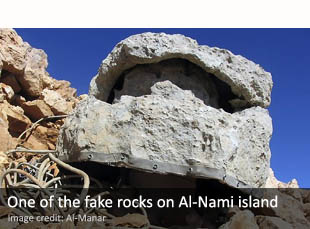
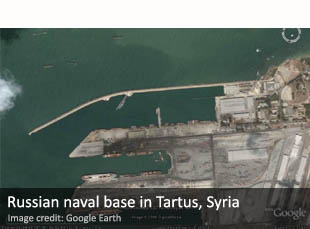
Sophisticated intelligence-collection devices hidden inside faux boulders have been discovered on an island situated across from a Russian naval base in Syria. The devices were found on Al-Naml, an uninhabited islet of only 150 square meters, which overlooks the Syrian port of Tartus, site of a major Russian naval military facility. According to Al-Manar, a satellite television station affiliated with the Lebanese Shiite militant group Hezbollah, the fake boulders were carefully placed on Al-Naml by Israeli commandos during a nighttime operation. Television images showed a system of satellite dishes and cameras, which appear to be connected to custom-made batteries via a series of cables. The imitation boulders, which conceal the electronic surveillance devices, seem to have been carefully designed in order to blend in with the surrounding rocks and brushes on Al-Nami. Al-Manar said on its website that at least three such devices were “discovered by local fishermen”. It added that the camouflaged contraptions appear to be aimed at tracking the movements of Russian vessels sailing to and from Tartus. Moreover, the devices appear to be capable of transmitting pictures of vessels to Israel in real time, via satellite. The naval base at Tartus was first leased to the Soviet Navy by the Syrian government in 1971. In response, the Kremlin forgave a multi-billion dollar debt owed by Damascus. Today, Tartus constitutes Russia’s sole military facility situated outside the regions of the former Soviet Union. It is also Russia’s only naval base in the Mediterranean, and many strategic analysts consider it as the primary geopolitical justification behind Moscow’s support for the regime of Syrian President Bashar al-Assad. Read more of this post







 intelNews.org
Russia, Iraq, Iran, Syria, sign intel-sharing agreement against Islamic State
September 30, 2015 by Joseph Fitsanakis 1 Comment
Iraqi officials said on Sunday that the intelligence-sharing agreement had been forged by Moscow, which was “increasingly concerned about the presence of thousands of terrorists from Russia undertaking criminal acts” as members of the Islamic State. The announcement of the agreement comes as Russia has been reinforcing its military presence in Syria, by deploying troops in Latakia. Security observers have interpreted the move as a strong message by the government of Russian President Vladimir Putin that it is prepared to safeguard the regime of Syrian President Bashar al-Assad. The latter also enjoys strong support from Iran, which has poured billions of dollars in aid to support the regime in Damascus, and has deployed hundreds of Hezbollah advisers and militia members in defense of Assad.
Speaking from Baghdad, Colonel Steve Warren, the American spokesman for the Western-led military campaign against the Islamic State, said that Washington was respectful of Iraq’s need to enter into security agreements with other regional governments. But he added that the US objected to the Syrian government’s role in the intelligence-sharing agreement, because it was “brutalizing its own citizens”. The US government has also protested against the Russian government’s expansion of its base in Tartus and its increased military presence in Latakia. But, according to Foreign Policy, US officials have privately expressed support for the move, saying that “it could, in the short term, help rein in the Islamic state”.
► Author: Joseph Fitsanakis | Date: 30 September 2015 | Permalink
Filed under Expert news and commentary on intelligence, espionage, spies and spying Tagged with intelligence cooperation, Iran, Iraq, Iraqi Joint Forces Command, Latakia, Russia, Syria, Tartus