Freed Russian scientist convicted for spying maintains innocence
November 27, 2012 3 Comments
 By JOSEPH FITSANAKIS | intelNews.org |
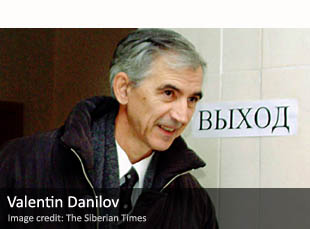
A Russian scientist who was pardoned last week, after spending nearly a decade behind bars for allegedly spying for China, has dismissed the charges against him as “pure fantasy”. Physicist Valentin Danilov was arrested by the FSB, the Russian Federal Security Service, in February of 2001 and charged with conducting espionage in the service of the Chinese space program. At the time of his arrest, Danilov headed the Thermo-Physics Center at Russia’s Krasnoyarsk State Technical University (KSTU), located in Siberia’s third largest city. For several years leading up to his arrest, he conducted research on the impact of solar activity on the condition and performance of space satellites. During his lengthy trial, Danilov admitted selling to the Chinese information on satellite technology belonging to the Russian government. But his defense team argued that the information in question had already been declassified and available in public sources since the early 1990s. Eventually, in November of 2004, a Russian Federal court found Danilov guilty of treason and sentenced him to 14 years in prison. He was supposed to be released in 2017. Earlier this month, however, a court in Krasnoyarsk found that, since Danilov had served most of his prison sentence in good behavior, and since his health was weak, he would be released early. In his first public interview since his release, Danilov, 66, has said he intends to take his case against the Russian government to the European Court of Human Rights. Speaking to reporters as soon as he emerged from prison, the Russian scientist said: “I would truly appreciate it if someone finally told me what state secret I sold”. He went on to comment directly on Russian President Vladimir Putin: “Everybody would be the same as him in his place, because it is the court that makes the czar”, he said, employing a traditional Russian proverb. Read more of this post







 intelNews.org
Are Kremlin’s spies targeting Russian scientists with foreign links?
December 20, 2012 by Joseph Fitsanakis Leave a comment
Back in November, we reported on the case of Valentin Danilov, a Russian physicist who spent nearly a decade in prison, allegedly for spying on his country on behalf of China. What is interesting about Danilov is that, even after his release from prison, following a pardon issued by the administration of Russian President Vladimir Putin, he fervently maintains his innocence. He is not alone; many Russian scientists and human rights campaigners have argued for years that Danilov should never have been convicted. In some cases, activists accuse the Kremlin of persecuting Danilov for political reasons, namely to reinforce Russian President Vladimir Putin’s “attempts to intimidate academics with ties to other countries”. A well-written analysis by Time magazine’s Simon Shuster argues that Danilov’s story is not unique in Russia. There have been at least a handful of similar cases in the last decade, all involving Russian scientists with links to foreign countries or organizations. Shuster mentions the example of nuclear expert Igor Sutyagin, former division head in the Russian Academy of Sciences’ USA and Canada Institute, who served 11 years of a 15-year sentence for allegedly passing state secrets to a CIA front company. Sutyagin, who now lives in London, United Kingdom, was one of four jailed Russians expelled to the West in exchange for the repatriation of ten Russian illegals captured by the FBI in the summer of 2010. But he maintains he was never a spy, and claims that all of the information he gave to the two Americans who employed him, in return for money, came from open sources. Undoubtedly, observers are free to draw different conclusions about either Danilov or Sutyagin. But the question that Shuster poses is, at a time when virtually no field of scientific research can develop without international collaboration, is Moscow being overly suspicious of its academics, and is this hampering Russian science as a whole? Read more of this post
Filed under Expert news and commentary on intelligence, espionage, spies and spying Tagged with academic research, Analysis, Denis Andreyuk, Igor Sutyagin, Russia, Russian Association for the Advancement of Science, scientific intelligence, Valentin Danilov