Opinion: Saudi Arabia will not go to war with Iran, but it may pay others to do so
September 25, 2019 1 Comment
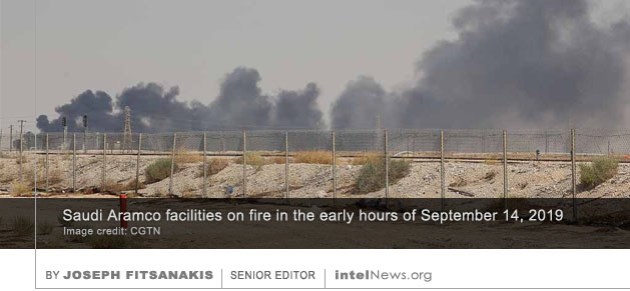 Ever since a barrage of drone and missile attacks struck Saudi Arabia on September 14, many have wondered whether the oil kingdom will go to war with Iran. Riyadh has directly accused the Islamic Republic of being behind the attacks. But the speculation about a possible war is baffling, argues Nesrine Malik in a well-argued article published last Sunday in Britain’s Guardian newspaper. Saudi Arabia does not “go to war”, she says —it pays others to do so on its behalf.
The war in Yemen is a perfect example, argues Malik. Even though the Saudi monarchy is leading the foreign military involvement in that war, Saudi Arabia is supplying almost no ground troops in that war. There are only Saudi commanders who are managing groups of mercenaries from Morocco, Jordan and Egypt. A large portion of the Saudi-led force consists of Sudanese child soldiers, whose families are paid handsomely for supplying the oil kingdom’s force in Yemen with what Malik describes as “cannon fodder”. The Saudi commanders communicate their battle orders to their hired troops via satellite phones and use unmanned drones and high-flying planes to attack the predominantly Shiite Houthi rebels. That largely explains the high civilian toll in that war.
Meanwhile, the United States government announced last week that it will be sending several hundred troops to the oil kingdom and will be beefing up its air defense systems. But Malik wonders why it is that Saudi Arabia, which has been the world’s largest weapons importer since 2014, and whose 2018 arms purchases accounted for 12 percent of global defense spending last year, requires the presence of American troops on its soil for its protection. The answer is simple, she says: the Saudi regime purchases weapons, not to use them, but to make Wester defense industries dependent on its purchasing power. In other words, the Saudi monarchy buys Western weapons for political reasons. These purchases enable it to get away with its abysmal human-rights record at home, as well as its kidnappings and assassinations abroad.
In the meantime, says Malik, if Saudi Arabia goes to war against Iran, it will do so the way it always does: it will hire proxies —including the United States— to fight on its behalf.
► Author: Joseph Fitsanakis | Date: 25 September 2019 | Permalink
 United States officials are considering increasing substantially America’s intelligence-sharing with Saudi Arabia following last weekend’s drone attacks that halved the Kingdom’s oil production and shook global markets. The attacks occurred in the early hours of Saturday, September 14, at two refineries located in eastern Saudi Arabia. The refineries are owned by Aramco, Saudi Arabia’s government-owned oil conglomerate, and are part of the world’s largest crude oil processing facility. The massive fires caused by the attacks were contained within hours and no casualties were reported. But the facilities had to cease operation so that repairs could be completed. This cut Saudi Arabia’s oil production by close to 50 percent, which amounted to a 5 percent reduction in global oil production. The impact on the world’s financial markets was immediate: by Monday morning, oil prices had seen their most significant one-day surge since the 1991 Gulf War.
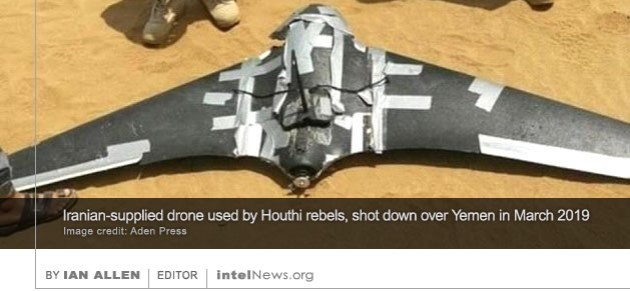 The current wars in the Middle East, especially the ongoing conflict in Yemen, are proof that the use of small drones in insurgencies is now a permanent phenomenon of irregular warfare, according to experts. Drones have been
  Weapons supplied to the Saudi and Emirati governments by the United States and other Western nations are ending up in the hands of al-Qaeda-linked Sunni militias in Yemen, according to two separate investigations. The weapons are being supplied to the militaries of Saudi Arabia and the United Arab Emirates by the West on the understanding that they will be used in the war in Yemen. The war has been going on since 2015, when a alliance of rebel groups from Yemen’s Shiite communities formed the Houthi movement, which quickly seized control of much of the country. The Houthis effectively toppled the government, prompting a reaction by a coalition of Sunni Arab states, which see the Shiite movement as an Iranian front. In an effort to restore Yemen’s Sunni-dominated government, Western countries have supplied Saudi Arabia and the United Arab Emirates with more than $5 billion-worth of weaponry.
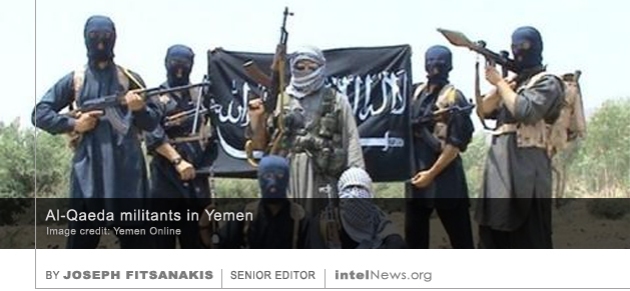 Yemeni militias backed by Saudi Arabia, the United States and the United Arab Emirates are actively paying off al-Qaeda-allied factions to abstain from the fighting, and are recruiting al-Qaeda members to fight against Shiite rebels, according to a new investigative report. Ever since 2015, when the civil war in Yemen broke out, the US, along with its Arab allies UAE and Saudi Arabia, has supported Sunni troops in their war against Shiite Houthi rebels. The latter are believed to be supported by Iran, and the US-backed coalition is engaged in an effort to curtail what it sees as Iranian expansionism in the Middle East.






 intelNews.org
Germany arrests mercenaries who tried to sell their services to Saudi Arabia
October 21, 2021 by Joseph Fitsanakis Leave a comment
AUTHORITIES IN GERMANY HAVE pressed terrorism charges against two former soldiers, who tried to establish a mercenary army and place it in the service of Saudi Arabia, with the ultimate goal of fighting in Yemen. The two men were arrested following police raids in the southern German city of Munich and the southwestern district of Breisgau-Hochschwarzwald, near Switzerland. They were identified in a government press release only as “Arend-Adolf G.” and “Acim A.”, in accordance with strict German privacy laws.
German government prosecutors described the two former soldiers as the “ringleaders” of a plan to recruit up to 150 men with prior military and law enforcement experience. Their ultimate goal was to establish “a private army” that would offer its services to the government of Saudi Arabia. The two alleged ringleaders allegedly hoped that the oil kingdom wound task them with carrying out illegal operations in Yemen. This would allow Riyadh to deny any involvement in these operations, if the German mercenaries were captured while fighting in Yemen.
Saudi Arabia has been involved in the Yemeni Civil War since 2015. Riyadh’s involvement seeks to support the country’s Sunni-dominated government against the Shia-majority Houthi separatists. The Yemeni government is also supported by the United Arab Emirates and Qatar, while the United States has at times assisted the Saudi effort. The Houthi movement is believed to receive assistance from Iran. Over 100,000 people, most of them civilians, have perished so far in the war, which has been raging since 2014.
German government prosecutors allege that the two mercenary ringleaders hoped to convince the Saudi government to compensate each member of their private army with over $45,000 per month for their services. However, their efforts to attract the attention of the Saudi government and intelligence agencies were unsuccessful. Instead, they drew the attention of the German Military Counterintelligence Service, which alerted the police. The two men are now awaiting their pre-trial hearing, which is expected to take place next week.
► Author: Joseph Fitsanakis | Date: 21 October 2021 | Permalink
Filed under Expert news and commentary on intelligence, espionage, spies and spying Tagged with Germany, mercenaries, Military Counterintelligence Service (Germany), News, Saudi Arabia, Yemen, Yemeni Civil War