In a surprise move, Iran releases Washington resident accused of espionage

Nizar ZakkaIran has announced that it will release a Lebanese national and United States permanent resident, who has served nearly half of his 10-year prison sentence for allegedly spying for Washington. Nizar Zakka, 52, was born in Lebanon but was schooled in the US, where he lived permanently until 2015. In September of that year, Zakka traveled to the Iranian capital Tehran at the invitation of the government of Iran, where he spoke at a conference on Internet-based entrepreneurship. He attended the event as an information technology expert who worked for companies like Cisco and Microsoft before setting up his own company called IJMA3. Based in Washington, DC, IJMA3 lobbies investors to help build online networks in the Middle East in order to develop the region economically, socially and politically.

But on September 18, 2015, as Zakka was traveling to the Imam Khomeini International Airport in Tehran for his return flight, he was detained by Iranian security officers and never made it out of the country. A year later, he was convicted of spying for the US and sentenced to 10 years in prison. The court also handed him a $4.2 million fine, allegedly for “collaborating with a government that was hostile to Iran”. Iran’s state-run media said Zakka was a “treasure trove” of intelligence on the American military. But the Lebanese IT expert denied all charges leveled against him. He said he was tortured during his interrogation and he went on frequent hunger strikes to protest his innocence and the conditions of his detention. Throughout his imprisonment, the Lebanese government pressured Iran for his release. The US also raised the issue through Congress and the Department of State. But Washington’s ability to influence Iran was limited, as it does not have diplomatic relations with Tehran.

On Tuesday, however, Lebanon’s Ministry of Foreign Affairs said it had received word from Iran’s ambassador to Lebanon that Zakka would be released soon. The Iranians reportedly said they decided to release Zakka following personal interventions by Lebanon’s Prime Minister Saad Hariri and the country’s President Michel Aoun. Additionally, said the Iranian ambassador, Zakka would be released as “a goodwill gesture” during Eid al-Fitr, a Muslim holiday that marks the end of Ramadan, the Islamic holy month of fasting. The statement added that Iran’s President Hassan Rouhani was “ready to receive a Lebanese delegation at any time for the extradition of the Lebanese prisoner Nizar Zakka”.

Author: Ian Allen | Date: 05 June 2019 | Permalink

Analysis: Yemen conflict shows small-drone warfare ‘is here to stay’, say experts

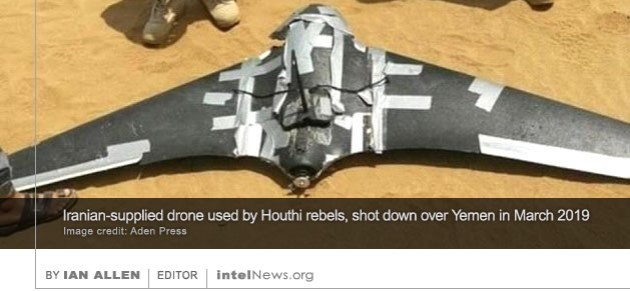
DroneThe current wars in the Middle East, especially the ongoing conflict in Yemen, are proof that the use of small drones in insurgencies is now a permanent phenomenon of irregular warfare, according to experts. Drones have been used in warfare in the Middle East for almost 20 years —including by outside powers like the United States. But National Public Radio’s Geoff Brumfiel reports that the wars in Iraq and Syria, and especially the war between the Yemeni government and Houthi rebels, clearly demonstrate that we have entered “a new era of drone warfare”.

The use of off-the-shelf small drones has been increasing since 2010, with the Syrian Civil War having served as a testing ground for military uses of drones by all sides involved in the conflict. Belligerents quickly realized that the use of drones —whether remotely operated from the ground, or guided by GPS coordinates— could provide useful air power “for a fraction of the cost of fighter jets” employed by national militaries, according to Brumfiel. He quotes numerous drone warfare expects who agree that the ongoing Yemeni Civil War provides the clearest sign yet of the proliferation of drones for military and paramilitary purposes. The Houthi rebels have employed drones to attack government targets and targets such as air fields, oil installations and military bases in neighboring Saudi Arabia. Most of these drones, and the knowledge of how to modify them for military use, are given to the Houthis by Iran, according to RAND Corporation expert Ariane Tabatabai, who is quoted in Brumfiel’s article.

Iran has been developing military drone technology since the 1980s, but did not begin to employ drones outside of its airspace until 2015. The change was prompted by the emergence of the Islamic State emerged as a major Sunni threat to Shiite populations in the region. Iranian drones are now everywhere, from Iraq and Syria to Yemen. These drones, including drones used by the Houthis, are major sources of concern for conventional armies, because they are difficult to detect and destroy, according to Center for a New American Security researcher Nicholas Heras. He told Brumfiel that small drones are difficult to locate by radar, and their flight paths are far more flexible than those of airplanes. Additionally, those drones controllers can use GPS systems to “navigate through holes” in air defenses, said Heras.

Author: Ian Allen | Date: 30 May 2019 | Permalink
Islamic State announces new overseas province in India for the first time

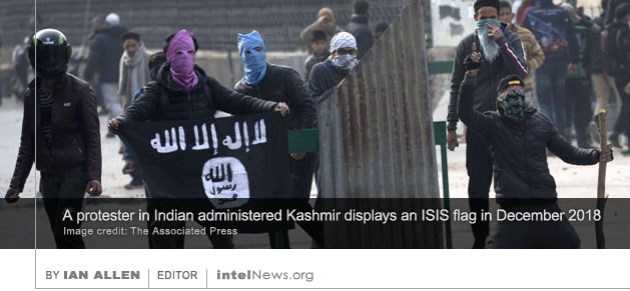
ISIS IndiaThe group calling itself the Islamic State has announced the establishment of a new overseas province in India’s Jammu and Kashmir state. The announcement was made over the weekend by Amaq, which serves as the news agency of the Islamic State. According to the news release, the Islamic State (known also as the Islamic State of Iraq and Syria) has named the new province “wilayah al-Hind” (province of Hind), and said it is based in the Muslim-majority Kashmir Valley, which is located in one of the three administrative divisions of the Indian administered state of Jammu and Kashmir.
The Amaq report surfaced following an armed clash between a group of Islamist militants and Indian security forces in Amshipora, a village in the district of Shopian, which is in the foothills of the northern Himalayan Mountains. At least one Islamist militant was killed in the armed confrontation, which reportedly lasted two hours. Indian authorities identified the dead militant as Ishfaq Ahmad Sofi, and said he had pledged allegiance to the Islamic State. The Amaq statement alleged that the militants in Amshipora had “inflicted casualties” on the security forces, but the claim was denied by the Indian government. The Reuters news agency spoke with Rita Katz, an Israeli analyst who directs the SITE Intelligence Group in the United States. She said that the announcement of a new Islamic State province “should not be written off”, but added that “the establishment of a province in a region where [the Islamic State] has nothing resembling actual governance is absurd”.

Writing in the Hong-Kong-based Asia Times, Prakash Katoch, a retired lieutenant general in the Indian Army’s Special Forces, said that the announcement of a wilayah in India was a first for the Islamic State. He warned that after announcing a province in Indian Kashmir, the Islamic State “may also attempt to increase its presence in other Indian states” with a significant Muslim presence, such as Kerala or West Bengal. Katoch noted that “a number of young men and women from Kerala” had been identified as having joined the Islamic State in 2016 and 2017. Several of them even traveled to Syria to fight for the Sunni Islamist group, he added.

Author: Ian Allen | Date: 14 May 2019 | Permalink

‘Unusual’ high-level meeting held at CIA headquarters to discuss Iran, say sources

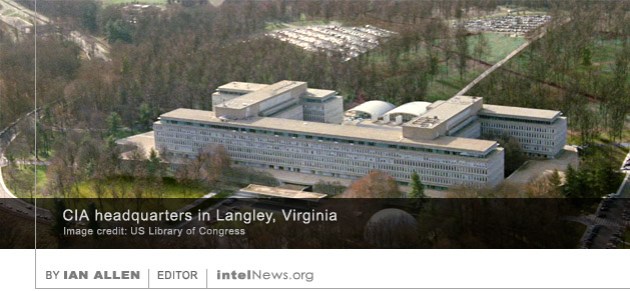
CIA headquartersAn untypical high-level meeting was convened at the headquarters of the United States Central Intelligence Agency last week to discuss Iran, according to NBC News. The meeting, which NBC described as “highly unusual” was convened by President Donald Trump’s National Security Adviser John Bolton. Participants allegedly included Secretary of State Mike Pompeo, Acting Secretary of Defense Patrick Shanahan, Director of National Intelligence Dan Coats, CIA Director Gina Haspel, and Chairman of the Joint Chiefs of Staff General Joe Dunford. Citing “six current US officials”, NBC said the meeting was held at 7 a.m. on Monday, April 29, in Langley, Virginia.

The list of participants refers to a high-level national security meeting. These are almost always held at the White House —typically in the Situation Room— says NBC. In general, it is extremely rare for senior White House officials, like Bolton, or members of the Cabinet, like Pompeo, to participate in meetings at CIA headquarters. It is also worth noting that, according to NBC’s sources, the meeting was not related to Washington’s recent decision send the USS Abraham Lincoln carrier strike group to the Middle East. This leaves two options, according to the NBC report: first, that the meeting concerned a “highly sensitive covert action” involving Iran or an Iranian proxy, such as the Lebanese Hezbollah. It could have been an update on an existing CIA operation, or a description of options for an impending operation. Alternatively the meeting could have been called due to a disagreement between the CIA and the White House about the results of an intelligence assessment or estimate about Iran.

NBC said it contacted the National Security Council to inquire about the April 29 meeting, but a spokesperson refused to comment. Meanwhile, Pompeo abruptly canceled the final leg of a four-nation tour of Europe on Thursday and returned to Washington, reportedly in light of heightening tensions between Washington and Tehran. Also on Thursday, the Iranian government described the Trump administration’s decision to deploy the USS Abraham Lincoln carrier strike group to the Middle East as “an action of psychological warfare” against the Iranian people. Late on Thursday, President Trump urged Iran to reach out to him: “What I would like to see with Iran, I’d like to see them call me”, said the US leader during a press conference at the White House. Iranian officials did not immediately respond to his comments.

Author: Ian Allen | Date: 10 May 2019 | Permalink

German spies dismiss US warnings about Huawei threat to 5G network

Huawei 2German intelligence officials appear to be dismissing Washington’s warning that it will limit security cooperation with Berlin if China’s Huawei Telecommunications is allowed to build Germany’s 5G network. The company, Huawei Technologies, is a private Chinese venture and one of the world’s leading telecommunications hardware manufacturers. In recent years, however, it has come under scrutiny by some Western intelligence agencies, who view it as being too close to the Communist Party of China. More recently, Washington has intensified an international campaign to limit Huawei’s ability to build the infrastructure for 5G, the world’s next-generation wireless network. Along with Britain, Australia and Canada, the US is concerned that the Chinese telecommunications giant may facilitate global wiretapping on behalf of Beijing’s spy agencies.

In the past several months the United States has repeatedly warned Germany that intelligence sharing between the two countries will be threatened if the Chinese telecommunications giant is awarded a 5G contract by the German government. In March, Washington informed German officials that intelligence cooperation between the two allies would be severely impacted if Chinese telecommunications manufacturers were given the green light to build Germany’s 5G infrastructure. The warning was allegedly included in a letter to Peter Altmaier, Germany’s Minister of Economic Affairs and Energy, written by Ambassador Richard Grenell, America’s top diplomat in Germany. The letter urged the German government to consider rival bids by companies belonging to American allies, such as the Swedish telecommunications equipment manufacturer Ericsson, Finland’s Nokia Corporation, or the South Korean Samsung Corporation.

But a report by Bloomberg on Wednesday said that German authorities were not convinced by Grenell’s argument. Citing “four people with knowledge on the matter”, the news agency said that Germany’s intelligence community see Washington’s warnings as “political grandstanding”. The US and Germany “need each other’s resources to tackle global conflicts” and “rely on each other too much to risk jeopardizing crucial data sharing”, said the report. The anonymous officials told Bloomberg that Germany does benefit from America’s “vast array” of intelligence. However, German spy agencies also provide their American counterparts with crucial intelligence from several regions of the world, they said. The US Department of State did not comment on the Bloomberg report. The Chinese government has repeatedly dismissed allegations that Huawei poses an espionage threat to Western nations.

Author: Ian Allen | Date: 18 April 2019 | Permalink

One dead after masked gunmen with AK-47s raid Austrian Airlines plane in Tirana

Tirana Airport

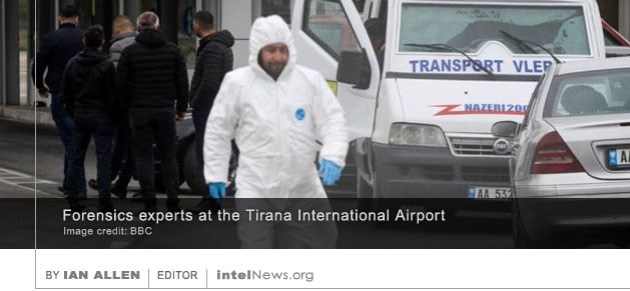
At least two members of an armed gang remain at large after raiding an Austrian Airlines plane on the runway of the Tirana International Airport in Albania, and managing to get away with an estimated $11 million in cash. To defend against bank robberies —a regular occurrence in crime-ridden Albania— the Bank of Albania does not accept large cash deposits. Consequently, branches of foreign-owned banks that operate in Albania export their hard-currency deposits abroad via regular flights to Vienna, Austria.

On Tuesday, as the Austrian Airlines airplane was preparing to take off from the Tirana International Airport, a white van bearing the logo of the General Directorate of Taxation —the revenue collection agency of the Albanian Government— smashed through the gate used by the airport’s emergency services and drove up to the airplane. Three masked men dressed in military fatigues exited the van and reportedly threatened the luggage handlers with AK-47 rifles. They then forced open the cargo doors of the plane and removed several bags full of hard currency. In less than four minutes, they started to drive back toward the emergency gate, when they were confronted by a police patrol that opened fire on them. One of the robbers was reportedly shot in the head and died instantly.

On Wednesday, police identified the dead robber as Admir Murataj and said that he had been the mastermind of the operation. By the end of Wednesday, police had arrested four men and questioned at least 40 other people in connection with the robbery. Initial reports said that the robbers had left the scene of the crime with about $2.8 million in cash, but subsequent reports said that as much as $11 million had been stolen. Investigators said that the robbers must have had inside knowledge about the Austrian Airlines plane and its cargo. A spokesperson for Austrian Airlines said that there would be no further transfers of cash from Albania to Austria following the robbery.

Author: Ian Allen | Date: 11 April 2019 | Permalink

US prosecutors to use secret surveillance evidence in Huawei lawsuit

Huawei 2Prosecutors in the United States have informed lawyers representing the Chinese telecom- munications firm Huawei that they intend to use evidence obtained through secret surveillance in a lawsuit against the company. The case involves the arrest of Meng Wanzhou by Canadian authorities in December of last year. Meng, 47, is Huawei’s deputy chair and chief financial officer, and is the daughter of Ren Zhengfei, a former officer in the Chinese People’s Liberation Army, who founded the telecommunications giant in 1988. She was detained on December 1 in Vancouver at the request of the US, which claims it has evidence that she “tried to evade the American embargo against Iran”. On March 1, the Canadian Department of Justice formally commenced Meng’s extradition process to the US, which Huawei’s lawyers are currently seeking to prevent.

In a lawsuit brought by US government prosecu- tors against Huawei, the Chinese telecom- munications firm is accused of having conspired to defraud several multinational banks by misrepresenting its relationship with a company called Skykom Tech. Washington says that the company is in fact a front used to conceal illicit activities conducted by the Islamic Republic of Iran. American government prosecutors claim that Huawei worked with Skykom Tech to evade US-imposed economic sanctions on Iran. At a Thursday morning hearing in a federal court in Brooklyn, New York, Assistant US Attorney Alex Solomon said that US authorities had used “secret surveillance” to collect evidence against Huawei. He also said that the evidence had been obtained under a US Foreign Intelligence Surveillance Act (FISA) warrant, which is issued by a secret court and usually pertains to counterintelligence investigations —i.e. when a target is suspected of spying against the US.

Solomon said that the evidence against Huawei was “obtained […] from electronic surveillance and physical search”. He did not elaborate, but added that US government’s legal team had notified Huawei that it planned to use the FISA evidence in court. Last month Huawei rejected all charges filed against it. The company has not yet commented on the FISA evidence. The next date in the court case has been scheduled for June 19, 2019.

Author: Ian Allen | Date: 05 April 2019 | Permalink

US Homeland Security Department accused of disbanding homegrown terrorism unit

Department of Homeland Security DHSSome employees of the United States Department of Homeland Security claim that a unit specializing on homegrown and domestic terrorism was inexplicably disbanded, leaving America vulnerable to attack. The allegations were published on Tuesday on the website of The Daily Beast, an investigative news and opinion website. In a leading article published on the site, reporter Betsy Woodruff cites “current and former DHS officials” with knowledge about the Office of Intelligence and Analysis (I&A), which is the intelligence wing of the DHS.

Woodruff claims that, until recently, I&A employoed a team of analysts that worked on potential threats from domestic terrorism activity and homegrown violent extremist individuals or groups. They then shared their reports with law enforcement on the state and local level, which is DHS’s mission. But in August of 2017, when David Glawe assumed the post of Under Secretary of Homeland Security for Intelligence and Analysis, I&A experienced a major reorganization. The article alleges that Glawe —who was appointed by President Donald Trump— did away with the I&A unit that monitors domestic militancy, including far-right radicalization. Ever since that move, I&A have “significantly reduced their production [of analysis] on homegrown violent extremism and domestic terrorism”, according to a DHS official quoted in The Daily Beast piece. The I&A’s reduction in output has “generated significant concern at headquarters given the growth in right-wing extremism and domestic terrorism we are seeing in the US and abroad”, said another DHS official.

But in a written response to the website’s allegations, Glawe dismissed the claims as “patently false and the exact opposite of what we have done”. He went on to state that I&A has “significantly increased tactical intelligence reporting on domestic terrorists and homegrown violent extremists since 2016”. Referring to The Daily Beast’s claims, Glawe said that “those pushing such a narrative either do not understand intelligence collection efforts or don’t care about the truth”.

Author: Ian Allen | Date: 04 April 2019 | Permalink

Documents show ISIS plans sleeper cell attacks in Middle East, Europe

Islamic State - IADocuments acquired from retreating Islamic State fighters in Syria appear to show that the militant group is planning a series of high-profile attacks in Europe and the Middle East, using newly formed sleeper cell units. The information was revealed over the weekend by the British newspaper The Sunday Times. The London-based broadsheet said that the information was found last month in flash drive, which was left behind by retreating Islamic State forces in Syria, and acquired by Kurdish militia forces. The flash drive was found to contain dozens of internal documents belonging the militant group, which is also known as Islamic State of Iraq and Syria (ISIS).
Among them, said The Times, are several memoranda authored by an ISIS leader and operations planner known as Abu Taher al-Tajiki. In his memoranda, al-Tajiki informs the group’s senior leadership that he commands numerous fighters who are willing and able to carry out strikes “far away” from the Islamic State’s strongholds in the Middle East and Africa. He states that he is in regular communication with them and that they are awaiting instructions to “undertake the operations”. Al-Tajiki then calls for the creation of a Foreign Relations Office under the Islamic State’s Department of Operations, which would be tasked with launching attacks throughout Europe. He adds that the new Office can also count on the assistance of computer hackers and other technically literate Islamic State members. In another memorandum, al-Tajiki suggests the creation of what he calls “crocodile cells” in Syria and Iraq. These cells will “lurk beneath the surface” and “attack at the right moment to assassinate the enemies of Allah”, says al-Tajiki.

The Times report comes as experts warn that the Islamic State retains significant financial power, despite the loss of its territories in the Middle East. In a well-informed article in The Atlantic, David Kenner reports from Beirut that the Islamic State without its territories is a double-edged sword. On the one hand, the group cannot rely on taxation and oil revenues that used to enrich its coffers by $1 million per day during the height of its power. On the other hand, argues Kenner, the loss of its territory has freed the Islamic State from the costs associated with state-running and allows it to devote its financial resources “exclusively to terrorist activity”. These resources —cash and other assets— are formidable, says Kenner. In the words of Howard Shatz, senior economist at the Rand Corporation and an expert on ISIS’ finances, we “don’t know where it all went” after ISIS lost its territory. We do know that much of it has been invested in “legitimate commercial enterprises”, says Shatz, with the help of profit-oriented middlemen with access to markets that are as far away as Southeast Asia and the Caribbean. A lot of it is hidden in suitcases and boxes throughout Iraq, Syria and Turkey. All of it is intended to be used to fund terrorist attacks, warns Kenner.

Author: Ian Allen | Date: 25 March 2019 | Permalink

Russians use front-company to access US federal employees’ contact info, says report

EFIS EstoniaRussian spy agencies use front companies to purchase directorates that contain the contact details of United States government employees, according to a new intelligence report. The contact details are contained in multi-page directories of Congressional staff members and employees of US federal agencies. They are published every January by a specialist vendor called Leadership Connect with the cooperation of a Washington, DC-based provider of publishing services. The directories contain the names, job titles, professional addresses and telephone numbers of US government employees.
But according to the Estonian Foreign Intelligence Service (EFIS), copies of the directorate are purchased every year by the Russian intelligence services, such as the Federal Security Service (FSB) and the Foreign Intelligence Service (SVR). The two Russian spy agencies allegedly use a front company in order to purchase copies of the directory. In reality, however, the purchases are made on behalf of Russian intelligence units, such as Military Unit 71330 of the FSB. This allegation is contained in the 2019 security environment assessment, which was published this week by the EFIS. Titled International Security and Estonia, the report is an overview of the main threats to Estonia’s internal security and a description of how these threats relate to international developments.

The directories, says EFIS, are not classified. On the contrary, they contain information that is publicly available in the US. However, the job descriptions and contact information of US federal employees are difficult to access in a collected format. The directories are therefore useful to Russian intelligence, which routinely tries to access large quantities of open-source information from foreign countries. Russian spy agencies are known to incorporate this open-source information into recruitment or surveillance plans that target specific individuals or foreign government agencies. They also use them to fill gaps in intelligence collection about specific agencies or parts of agencies, according to Robert Dannenberg, a former CIA officer who spoke to Yahoo News about the EFIS report.

Author: Ian Allen | Date: 14 March 2019 | Permalink

US warns Germany it will end intelligence sharing if Huawei is given 5G contract

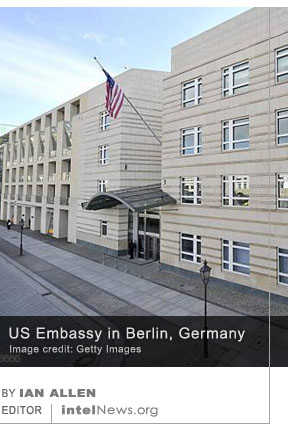
US embassy Berlin GermanyThe United States has warned Germany that intelligence sharing between the two countries will be threatened if the Chinese telecommunications giant Huawei is awarded a contract to build Germany’s 5G network. The company, Huawei Technologies, is a private Chinese venture and one of the world’s leading telecommunications hardware manufacturers. In recent years, however, it has come under scrutiny by some Western intelligence agencies, who view it as being too close to the Communist Party of China. More recently, Washington has intensified an international campaign to limit Huawei’s ability to build the infrastructure for 5G, the world’s next-generation wireless network. Along with Britain, Australia and Canada, the US is concerned that the Chinese telecommunications giant may facilitate global wiretapping on behalf of Beijing’s spy agencies.
But some American allies, including Spain, France and Germany, are not satisfied with Washington’s arguments and claim that the United States is eyeing the financial benefits that would arguably come from its domination of the global digital superhighway. German officials, in particular, have told their American counterparts that Berlin has not seen any evidence that Huawei’s telecommunications hardware come with hidden interception features. Moreover, Germany says that it plans to subject Huawei’s systems to rigorous security tests before using them. On Friday, Washington increased its pressure on Berlin by informing German officials that intelligence cooperation between the two allies would be severely impacted if Chinese telecommunications manufacturers are given the green light to build Germany’s 5G infrastructure.

According to The Wall Street Journal, the warning was included in a letter signed by Ambassador Richard Grenell, America’s top diplomat in Germany. It was allegedly sent to Peter Altmaier, Germany’s Minister of Economic Affairs and Energy. The paper says that Grenell suggests in his letter that Berlin should consider rival bids by companies belonging to American allies, such as the Swedish telecommunications equipment manufacturer Ericsson, Finland’s Nokia Corporation, or the South Korean Samsung Corporation, which is the world’s leading telecommunications hardware manufacturer. The Wall Street Journal did not reveal how it acquired Grenell’s letter, nor did it say whether the German government responded to it.

Author: Ian Allen | Date: 12 March 2019 | Permalink

India, Pakistan used terrorist groups to attack each other, says Pakistan ex-president

Jaish-e-MohammedThe government of Pakistan employed terrorist groups to attack India, according to Pakistan’s former president, Pervez Musharraf, who also accused India of doing the same. Musharraf, 75, took power in Pakistan in 1999 through a coup d’état supported by the country’s military leadership. The four-star Army general ruled as Pakistan’s 10th president until 2008, when he resigned from power to avoid being impeached. He currently lives in exile in the United Arab Emirates and is wanted in Pakistan for alleged crimes, including high treason. His critics accuse him of arresting several judges in 2007 and suspending the country’s constitution.
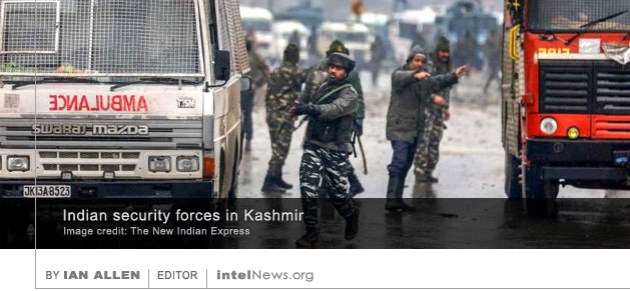
On Tuesday, Musharraf spoke on the flagship news program of Hum News, a 24-hour news channel headquartered in the Pakistani capital Islamabad. Speaking in Urdu on a phone line from Dubai, Musharraf praised the current Pakistani government of President Imran Khan for launching a crackdown on Jaish-e-Mohammed (JeM) the militant group that is believed to be responsible for killing more than 40 Indian soldiers in Indian-administered Kashmir. The attack sparked a tense standoff between India and Pakistan, as the two countries engaged in aggressive military maneuvers against each other. “This constitutes a step forward”, said Musharraf, referring to the JeM crackdown. “It is a terrorist organization and they tried to assassinate me with a suicide attack”, he added, referring to an attack on his presidential convoy in 2003, which has been blamed on JeM.

In early 2002, Musharraf officially banned the JeM and arrested some of its leaders, after the group participated in two high-profile attacks in Indian Kashmir. But all JeM leaders were eventually freed, after the courts decided that the government had failed to provide sufficient evidence of their participation in terrorism. Musharraf told Hum News that he eventually lost interest in cracking down on JeM. When asked by the reporter why his government did not take further action against the group, Musharraf said that “those were different times”. Instead of stopping groups like JeM, both Pakistan and India used them to carry out a “clandestine struggle” against each other, said Musharraf. Groups like JeM “carried out bombings in each other’s territory”, said the former president, adding that Pakistan’s “intelligence agencies were involved in it”. Both India and Pakistan thus used militant groups, including JeM to carry out “tit-for-tat” operations targeting each other, he concluded. The former Pakistani leader went on to say that he was “very pleased to see the [Pakistani] government adopting a strict policy” against JeM.

Author: Ian Allen | Date: 08 March 2019 | Permalink

Libya gave French ex-president Sarkozy $8 million, says Gaddafi’s spy chief

Abdullah al-SenussiA senior intelligence advisor to Libya’s late ruler Muammar al-Gaddafi has reportedly told French investigators that the Libyan government gave $8 million to the election campaign of France’s ex-President Nicolas Sarkozy. Sarkozy’s 30-year political legacy has been marred by a series of financial scandals, for which he is currently under investigation. In March of last year, the former French president issued strong denials of accusations that he accepted an illicit multi-million monetary donation from Gaddafi during his 2007 campaign for the presidency. During a 20-minute television interview, Sarkozy described the investigation into the allegations that he acted as an agent of influence for Libya as “a waste of time”, arguing that it was over an alleged donation of less than $45,000, which represented a tiny fraction of his campaign budget.
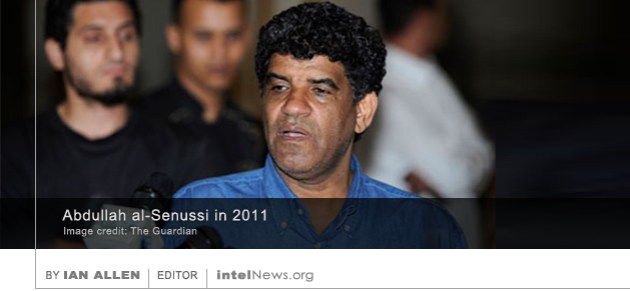
But according to the French investigative news website Mediapart, a team of French judges was told by Gaddafi’s former spy chief that Sarkozy was given millions of dollars in secret by the Libyan state. Abdullah al-Senussi, who oversaw the Libyan intelligence agencies under Gaddafi, reportedly told the French investigators that the funding was part of a secret deal between the two parties. In 1979, Senussi married the sister of Gaddafi’s wife and remained a trusted confidante of the Libyan leader until his violent death in 2011. According to Mediapart, he told the French judges that he personally supervised the transfer of funds to Sarkozy’s election campaign. He said that the payments entered the campaign’s coffers via a French government minister who received the funds from Libyan agents in two separate installments in 2006. In return, Sarkozy promised to help reinstate Gaddafi’s international image if he was elected president. He also promised to impede attempts by Western countries to arrest Gaddafi and some of his senior government aides —including Senussi— for terrorist crimes. Senussi allegedly said that Sarkozy himself promised him that his international arrest warrants would be quelled with the help of the French president’s personal lawyers. Sarkozy later hosted Gaddafi in Paris in a lavish setting in 2007.

Mediapart said that it accessed Senussi’s testimony before the French judges after getting hold of extracts from his formal statements during his interviews. It added that the information provided by Senussi appears to confirm similar claims made by other witnesses in the investigation about Sarkozy’s alleged illegal campaign funding. The former French president is currently involved in a separate legal dispute concerning alleged illegal spending during his failed campaign for the presidency in 2012.

Author: Ian Allen | Date: 21 February 2019 | Permalink

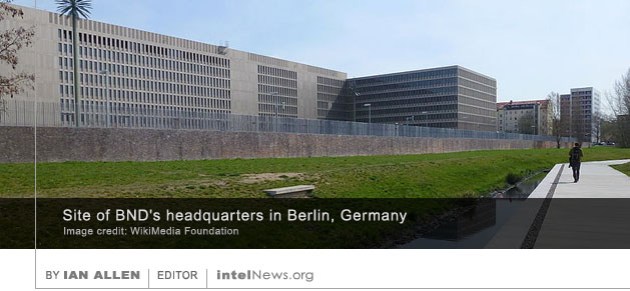
German chancellor inaugurates world’s largest spy agency headquarters in Berlin

BND GermanyThe chancellor of Germany has officially inaugurated the largest headquarters of any spy agency in the world. Last Friday, Angela Merkel led the public ceremony that marked the opening of the Zentrale des Bundesnachrichtendienstes, which is the new headquarters of the German Federal Intelligence Service. Known by the initials BND, the agency operates as Germany’s primary foreign intelligence service. It employs close to 7,000 people in more than 300 locations around the world, and its annual budget is approximately €1 billion ($1.13 billion).
Until recently, the BND was headquartered in the outskirts Munich, in the southern German state of Bavaria. But as of last week, the spy agency has officially moved to its new headquarters in downtown Berlin. The massive new complex is located in the German capital’s affluent Mitte district, just a stone’s throw from a section of what used to be the Berlin War —a major symbol of the Cold War. The new complex spans 3 million sq. ft., making it the largest headquarters of any intelligence agency in the world. The United States Central Intelligence Agency’s headquarters at Langley, Virginia, comes a close second. Construction on the site in Mitte began in 2006 and was initially scheduled for completion in 2011, but was finally finished in 2017, 12 years after it began. It cost approximately €1 billion ($1.13 billion). British newspaper The Guardian reports that the new complex consists of 20,000 tons of steel and has 14,000 windows and 12,000 doors. The land on which the new BND headquarters is built used to be the site of police barracks, until it was heavily damaged by bombing carried out by the Allied forces in 1945. Following the partition of Germany, East German authorities built a sports complex and stadium on the site, which was demolished in 1999, in preparation for Germany’s unsuccessful bid to host the 2000 Summer Olympic Games.

According to reports in the German media, just over 3,000 BND employees have already relocated from Munich to the new BND headquarters, while another 800 are expected to relocate there in the coming year. During her speech on Friday, Chancellor Merkel said that the world was becoming “increasingly confusing”, which made the need for a “strong and efficient [German] foreign intelligence service […] more urgent than ever”. Interestingly, the new complex features a sizeable visitor’s center that is open to the public, making the BND the world’s first foreign intelligence agency with a public-access visitors’ facility.

Author: Ian Allen | Date: 13 February 2019 | Permalink

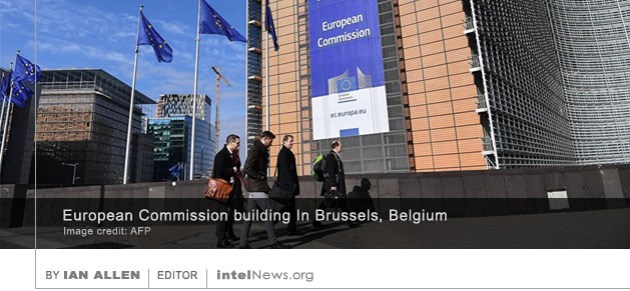
Hundreds of foreign spies in Brussels, European diplomatic agency warns

European Commission buildingThe European Union’s diplomatic agency has warned officials who are active in Belgium to watch out for “hundreds of spies” from various foreign countries, according to a German news report. The report appeared last weekend in Germany’s Welt am Sonntag newspaper, which cited a report from the European External Action Service (EEAS). Based in Brussels, the EEAS operates as the European Union’s diplomatic agency and is headed by Federica Mogherini, an Italian former government minister who has been serving as the European Union’s High Representative for Foreign Affairs and Security Policy since 2014.


According to Die Welt, the EEAS estimates that “approximately 250 Chinese and 200 Russian spies” are operating in Brussels. Most of these intelligence officers are allegedly embedded in their countries’ embassies, trade missions, cultural centers and other outreach facilities in the Belgian capital. There are also many intelligence operatives from Western agencies, including those of the United States, as well as from Iran, Turkey and Morocco, among other foreign nations. The report in Die Welt adds that the EEAS advised European Union diplomats to avoid certain establishments in the European Quarter of Brussels, which are believed to be heavily frequented by international spies. Among them are “a popular steakhouse and café” that are “within walking distance of the Berlaymont building” —the headquarters of the European Commission. The same building houses the offices of the EEAS.

Such warnings are not new. In June of last year, Peter Gridling, head of Austria’s main counterintelligence agency, said during a rare public appearance that Vienna —the spy capital of the world— no longer topped the list of preferred destinations for the world’s spies. He said that the Austrian capital had been overtaken by Brussels as the spy capital of Europe and added that, according to his agency’s calculations, there was a greater density of spies in Brussels than in any other European capital. When asked to specify the number of foreign intelligence operatives that are active in Vienna, Gridling said it was “in the neighborhood of hundreds of people, but certainly fewer than 1,000”. In 2012, Alain Winants, former Director of Belgium’s State Security Service (SV/SE), claimed that Brussels was home to more spies than any other city in the world.

Author: Ian Allen | Date: 12 February 2019 | Permalink