Nuclear black market thriving in Eastern Europe despite efforts to stop it

MoldovaThe United States Federal Bureau of Investigation is assisting authorities in some of Europe’s poorest states in their efforts to stop criminals with Russian connections from selling radioactive material to foreign terrorist organizations. The Associated Press said earlier this month that joint efforts by the FBI and Eastern European governments have frustrated at least four attempts to sell stolen radioactive material in the black market since 2010.

In one case, which involved a criminal gang in the former Soviet Republic of Moldova, the smugglers were trying to sell radioactive material to representatives of the Islamic State in Iraq and Syria. The Associated Press said it spoke to law enforcement and judicial authorities in Moldova, who have set up a small team of detectives to investigate the nuclear black market. The Moldovans told the Associated Press that they were working with the FBI, and even shared some of their investigative case files with the news agency.

In another recent case, which was cracked by authorities in February of this year, a smuggler in Moldova tried to sell a significant quantity of cesium, a radioactive metal typically extracted from the waste produced by nuclear reactors. According to the Moldovans, the quantity of the fission product was “enough to contaminate several city blocks”. Additionally, the Moldovan investigators told the Associated Press that the smuggler was specifically seeking a buyer from the Islamic State.

In yet another case, a joint US-Moldovan investigation targeted Alexandr Agheenco, a mysterious Russian-born smuggler, who in the spring of 2011 said he had access to bomb-grade uranium. According to Moldovan investigators, a middleman working for Agheenco told a prospective buyer from Sudan that he would be willing to sell an unspecified quantity of uranium, as well as “blueprints for a dirty bomb”. Although the sale was prevented by the US-Moldovan investigators, Agheenco managed to escape.

According to the Moldovans, the worsening relations between Washington and Moscow are making it more difficult for investigators from the two countries to share intelligence on nuclear smuggling rings. As a result, smugglers are finding it easier to operate across Eastern Europe and parts of the former Soviet Union. Many leading black-market operatives manage to avoid capture and prosecution, while even those arrested are usually able to evade lengthy convictions, which means that they quickly return to nuclear smuggling, reports the Associated Press.

Author: Joseph Fitsanakis | Date: 30 October 2015 | Permalink | News tip: J.B.

Declassified files shed light on 1956 disappearance of MI6 agent

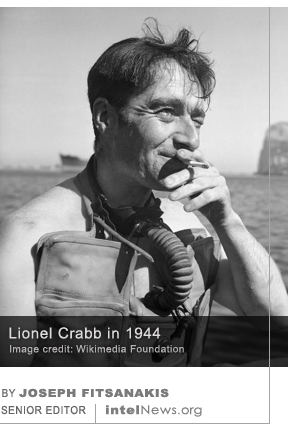
Lionel CrabbA set of newly released files from the archives of the British Cabinet Office shed light on the mysterious case of a highly decorated combat swimmer, who vanished while carrying out a secret operation against a Soviet ship. The disappearance happened during a historic Soviet high-level visit to Britain in 1956. In April of that year, First Secretary of the Communist Party of the USSR, Nikita Khrushchev, and Nikolai Bulganin, Chairman of the Council of People’s Commissars, arrived in Britain aboard Russian warship Ordzhonikidze, which docked at Portsmouth harbor. Their eight-day tour of Britain marked the first-ever official visit by Soviet leadership to a Western country. But the tour was marred by a botched undersea operation led by Britain’s Secret Intelligence Service, known commonly as MI6. The operation, which aimed to explore the then state-of-the-art Ordzhonikidze, ended in the disappearance of MI6 diver Lionel “Buster” Crabb. The body of Crabb, one of several MI6 operatives involved in the operation, was never recovered.

Now a set of documents released by the Cabinet Office, a British government department tasked with providing support services to the country’s prime minister and senior Cabinet officials, show that the operation had been mismanaged by MI6 from the start. According to The Daily Telegraph, the documents show that miscommunication between the British Foreign Office and MI6 caused the latter to believe that the operation to target the Ordzhonikidze had been authorized by the government, when in fact no such thing had ever occurred.

Moreover, MI6 had housed Crabb and other operatives in a Portsmouth hotel, where the agency’s handler had provided the front-desk clerk with the real names and addresses of the underwater team members. The documents also reveal that several of Crabb’s relatives and friends had been told by him that he would be diving in Portsmouth on the week leading up to his death. Those who knew included one of Crabb’s business partners, with whom he operated a furniture outlet. The partner apparently told the authorities that he was contemplating “consulting a clairvoyant, Madame Theodosia”, in an effort to discover the fate of his missing business partner.

After Crabb disappeared, British government officials were convinced that he had been abducted or killed by the Soviets and that the KGB was in possession of his body. Should the Soviets decide to disclose the existence of the MI6 operation to the world, there would be “no action that [MI6] could take [that] could stave off disaster”, said one British government memo. As intelNews has reported before, n 2007, Eduard Koltsov, a retired Russian military diver, said he killed a man he thinks was Crabb, as he was “trying to place a mine” on the Soviet ship.

Author: Joseph Fitsanakis | Date: 28 October 2015 | Permalink
UK to probe role of high-ranking IRA informant in 24 murder cases

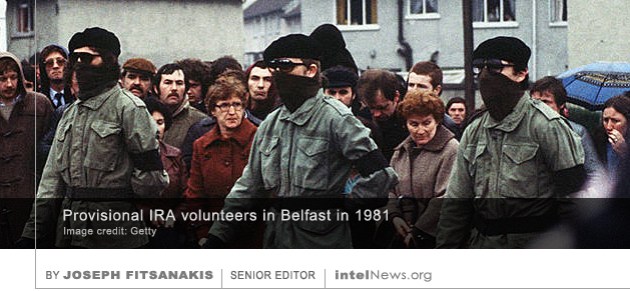
Provisional IRAAuthorities in Northern Ireland have launched an official investigation into the alleged involvement of a British government informant in dozens of murders perpetrated by Irish republican militants. The informant, codenamed STAKEKNIFE in British government documents, has been identified by some as Freddie Scappaticci, the grandson of an Italian immigrant to Northern Ireland, who in the early 1970s joined the Provisional Irish Republican Army (IRA). Eventually, Scappaticci was put in charge of the Provisional IRA Northern Command’s Internal Security Unit. The unit was tasked with counterintelligence operations, which involved detecting, capturing and eliminating suspected British government spies inside the IRA.

Unbeknownst to the IRA, however, Scappaticci was himself an informant for the Royal Ulster Constabulary’s Special Branch. He is believed to have been paid up to £80,000 a year to provide information to the British government about the IRA’s activities. STAKEKNIFE’s reputed work for the British government was first publicized in 2003 by another British government informant in the IRA, Kevin Fulton. But Scappaticci, who is known in republican circles as ‘Scap’, denies he was STAKEKNIFE, and the claims about him and his activities have been surrounded by an air of mystery.

Last year, however, families of those killed by the IRA’s Internal Security Unit took advantage of Fulton’s claims. They argued that, if STAKEKNIFE was indeed a British government informant, and if he was personally involved in the murder of alleged IRA informants, then the British authorities technically allowed him to get away with murder in order to protect his secret identity. The government, therefore, technically colluded in the murders and should be held responsible.

The Police Ombudsman of Northern Ireland investigated these claims and communicated his findings to the Director of Public Prosecutions (DPP). The latter recently described the STAKEKNIFE investigation as “perhaps the most significant case” in his time as DPP. He has now ordered the Police Service of Northern Ireland to launch a formal inquiry into the matter and to start inviting witness testimonies. It is reputed that Northern Ireland First Minister, Martin McGuinness, who is said to have been close to Scappaticci during his tenure in the IRA, will be among the first witnesses called on to testify as part of the investigation.

Author: Joseph Fitsanakis | Date: 22 October 2015 | Permalink

EU parliament member loses immunity over claims he spied for Russia

European ParliamentIn a historic first, the parliament of the European Union (EU) has waived the immunity of one of its elected members over “reasonable suspicions” that he may have spied for Russia. The member of the European Parliament (MEP) is Béla Kovács, 55, who belongs to the far-right Movement for a Better Hungary. Founded in 2003, the party, known as Jobbik (movement, in Hungarian), has called for Hungary to leave the EU and instead join the Eurasian Union, an economic and political alliance led by Russia. In the 2014 parliamentary elections, Jobbik won just over 20% of the popular vote, placing third nationwide. The result was a marked difference from its performance in 2006, when it had barely received 2.2% of the vote share.

The party’s ideological proximity to Moscow, as well as its radical views on minorities and Jews, have added to its notoriety, causing many to denounce it as the EU’s most far-right political grouping. The party’s troubles grew further in September 2014, when the Hungarian public prosecutor officially requested form the European Parliament that it suspends Kovács’ immunity so that the Budapest-born politician, whose father is Russian, could be investigated for alleged ties to Russian intelligence. The EU parliament said it would consider the matter.

Meanwhile, Hungarian media published several allegations about Kovács’ alleged ties to Moscow, which, some reports suggested, date to the late 1970s. Other reports stated that Kovács’ Russian spouse, Svetlana Izstosina had been an agent of the KGB during the Cold War and that she operated as a courier for Moscow. In another bizarre twist, one report suggested that Izstosina was legally married to two other men, one of whom was a nuclear physicist working at the Lomonosov Moscow State University. Some Hungarian newspapers alleged that the government in Budapest was in possession of secret recordings of conversations between Kovács and Russian diplomats, which allegedly took place in the past six years.

An EU Parliament spokesperson told Bloomberg last week that the waiver of Kovács’ immunity did “not entail […] a judgment as to [the Hungarian MEP’s] guilt or innocence”. She added that she knew of no other cases where an MEP had been stripped of his immunity over allegations of espionage. If found guilty of spying for Moscow, Kovács could face up to eight years behind bars.

Author: Joseph Fitsanakis | Date: 19 October 2015 | Permalink

Iraq now using Russian intelligence in war against Islamic State

Baghdad IraqThe Iraqi government is now using intelligence supplied by the Russian military in its war against the Islamic State, according to officials in Baghdad. As intelNews reported in September, the Iraqi Joint Forces Command announced it had entered a formal intelligence-sharing agreement with the governments of Russia, Syria and Iran. The purpose of the collaboration was to defeat the Islamic State, the Sunni militant group that currently controls a third of Iraq’s territory and much of neighboring Syria. Many were surprised by last month’s announcement, as it was the first time that Iraq, an American ally, had entered an alliance with Washington’s Cold-War adversary Russia, as well as with Iran and Syria, two countries with which the United States has no diplomatic relations.
According to US media reports, the headquarters of the intelligence-sharing center is located in Baghdad’s so-called Green Zone, where US forces were stationed until 2012. Each of the member states has six officers at center, who are given intelligence by their respective countries’ militaries with the intent of sharing it with the other three participating militaries. In addition to these officers, there are two Russian one-star generals stationed at the center, according to The Washington Times, which cited “an Iraqi official who asked not to be identified”.

Back in September, when the four-partite agreement was announced, the US said it respected Iraq’s freedom to enter into security pacts with regional governments, but warned that Syria was a major violator of human rights and should not be part of the intelligence-sharing treaty. On Tuesday, White House press secretary Josh Earnest said he could see no reason why Baghdad would want to enter into an intelligence-sharing agreement with Moscow, given that the US-led coalition had been sharing intelligence with Iraq for over a year. The coalition’s intelligence collaboration with Baghdad had “worked effectively with the Iraqis to make progress against [the Islamic State] inside of Iraq”, he said.

Author: Joseph Fitsanakis | Date: 15 October 2015 | Permalink

UK police to end 24/7 surveillance of embassy that houses WikiLeaks founder

Embassy of Ecuador in LondonPolice in London will no longer physically monitor the embassy of Ecuador in the British capital, where WikiLeaks founder Julian Assange has been living for over two years, fighting against extradition to Sweden. Assange was granted political asylum by the government of Ecuador in June of 2012, after Swedish authorities charged him with rape. But the Australian-born Assange claims that the charges are part of a plot to extradite him to the United States, where he is wanted for having leaked hundreds of thousands of documents belonging to the Department of Defense and the Department of State.
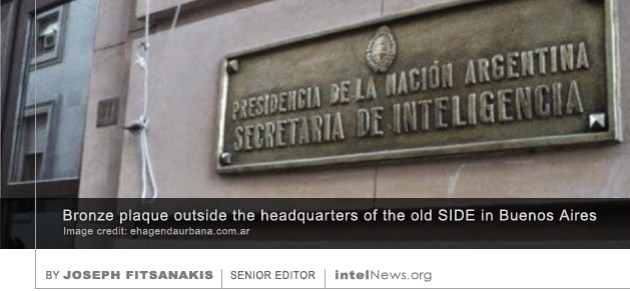
Acting on a request from the Swedish government, London’s Metropolitan Police Service, known informally as Scotland Yard, has been patrolling the streets around the embassy 24 hours a day, in order to prevent Assange from being smuggled out of the building by Ecuadorean officials. Standard diplomatic protocol prevents British authorities from entering the embassy, which is technically considered Ecuadorean territory.

On Monday, however, the Metropolitan Police said they would cease their 24/7 patrols around the Ecuadorean embassy, which is located in London’s fashionable Knightsbridge district. According to a police official, constant physical surveillance of the embassy was “no longer proportional” to Assange’s charges, which meant that Scotland Yard would be unable to continue “to commit officers to a permanent presence”. The official said that the decision had been taken after consultation with the British Home Office, and that the reasons for the change in policy were primarily financial. According to reports by the British government, the intensive monitoring of the Ecuadorean embassy has cost the British taxpayer in excess of £11 million, which amounts to nearly $18 million. The resulting strain on policing resources has prompted some British politicians to dismiss Scotland Yard’s operation as a misuse of taxpayer funds.

However, Scotland Yard said it would substitute overt physical surveillance of the Ecuadorean embassy with “a number of overt and covert tactics to arrest” Assange if he tries to leave the building. It did not elaborate on that statement. Last summer, the Swedish government dropped three of the four charges against the WikiLeaks founder. The remaining charge is expected to expire in August 2020.

Author: Joseph Fitsanakis | Date: 14 October 2015 | Permalink

Argentina says fugitive ex-spy official hiding in the United States

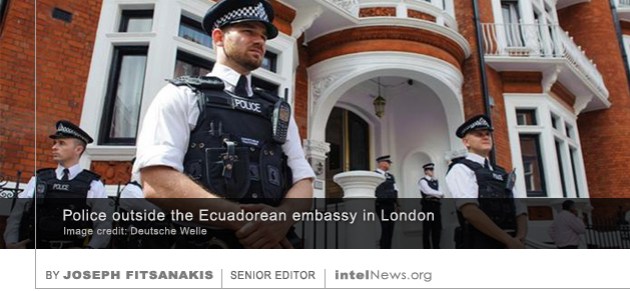
SIDE ArgentinaAn Argentine former senior intelligence official, who is wanted in connection with the murder of a federal prosecutor in Buenos Aires, is hiding in the United States, according to the President of Argentina, who says Washington should extradite him. Antonio Horacio Stiuso, better known as Jaime Stiuso, rose through the ranks of Argentina’s Secretaría de Inteligencia del Estado (SIDE) to become its director of counterintelligence. In 2012, Argentine President Cristina Fernández de Kirchner appointed Stiuso to chief operating officer of SIDE, working directly under the agency’s director. However, Stiuso was fired in a massive agency shake-up in February of this year, when the government suddenly dissolved SIDE and replaced it with a new agency, called Agencia Federal de Inteligencia.

The radical reorganization was prompted by the death of federal prosecutor Alberto Nisman, whose body was discovered in his Buenos Aires apartment on January 19. Nisman had caused international headlines in the week before his death, after launching a criminal complaint against President Kirchner and several other notable personalities of Argentine political life. Nisman accused them of having colluded with the government of Iran to obstruct an investigation into the bombings of the Israeli embassy and a Jewish cultural center in Buenos Aires in the mid-1990s. A dozen people died in the bombing of the embassy, while another 85 were killed two years later, when the Asociación Mutual Israelita Argentina community center in the Argentine capital was bombed.

But President Kirchner accused SIDE of feeding Nisman fabricated information implicating her and her government minsters in a fictional collusion with the Islamic Republic, and then killing him in order to destabilize her rule. She proceeded to dissolve SIDE and charge its leadership with involvement in Nisman’s killing. According to the Argentine government, Stiuso fled Buenos Aires for Brazil, from where he flew to Miami, Florida, on February 19, using an Italian passport. According to Reuters, President Kirchner said Washington had failed to answer “repeated enquiries” about Stiuso’s whereabouts, and suggested that the former spy official may have been working for American intelligence agencies all along.

Author: Joseph Fitsanakis | Date: 13 October 2015 | News tip: R.W. | Permalink

Portugal detains ex-CIA operative wanted for 2003 kidnapping

Sabrina De SousaA former officer in the United States Central Intelligence Agency, who is wanted by Italian authorities for her alleged role in the abduction and rendition of a suspected Islamist militant in Italy, has been arrested by police in Portugal. Sabrina De Sousa, 59, was an accredited diplomat stationed at the US consulate in Milan, Italy, when a CIA team kidnapped Hassan Mustafa Osama Nasr from a Milan street in broad daylight. Nasr, who goes by the nickname Abu Omar, is a former member of Egyptian militant group al-Gama’a al-Islamiyya, and was believed by the CIA to have links to al-Qaeda. Soon after his abduction, Nasr was renditioned to Egypt, where he says he was brutally tortured and raped, and held illegally for years before being released without charge.
Upon Nasr’s release from prison, Italian authorities prosecuted the CIA team that abducted him. They were able to trace the American operatives through the substantial trail of evidence that they left behind, including telephone records and bill invoices in luxury hotels in Milan and elsewhere. In 2009, De Sousa was among 22 CIA officers convicted in absentia in an Italian court for their alleged involvement in Nasr’s abduction. Since the convictions were announced, the US government has not signaled a desire to extradite those convicted to Italy to serve prison sentences. However, those convicted are now classified as international fugitives and risk arrest by Interpol and other law enforcement agencies, upon exiting US territory.

According to The Associated Press, Vice News and Newsweek, De Sousa was arrested at the Portela Airport in Lisbon, Portugal, on Monday. She is believed to have spent two nights in jail before being released on Wednesday. However, De Sousa’s passport was seized by Portuguese authorities, who are now trying to decide whether to extradite her to Italy to face charges for helping kidnap Nasr in 2003, and for failing to appear in court in 2009. Shortly after her conviction, De Sousa told American media that the CIA operation against Nasr in Italy “broke the law”, but had been authorized by the leadership of the CIA. The latter, she said, “abandoned and betrayed” those who carried out Nasr’s abduction, leaving them “to fend for themselves”.

In 2013, another convicted CIA operative, Robert Seldon Lady, who is believed to have been the CIA’s station chief in Milan at the time of Nasr’s kidnapping, was detained while attempting to enter Panama from Costa Rica at a remote jungle border-crossing. Costa Rican authorities said later that “a check on his passport [had] triggered an INTERPOL alert”. However, he was released a day later. According to the Panamanian foreign ministry, Lady was released because “Panama did not have an extradition treaty with Italy and because documentation sent by Italian officials was insufficient”.

Author: Joseph Fitsanakis | Date: 05 October 2015 | Permalink

Russian spy service accused of role in Norwegian journalist’s firing

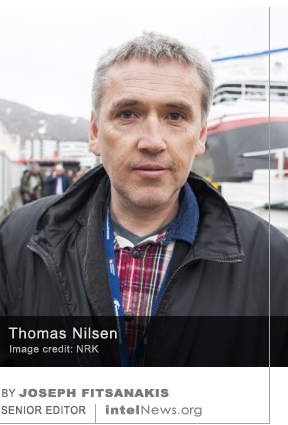
Thomas NilsenNorway’s state broadcaster has alleged that the Russian intelligence service pressured a Norwegian newspaper to fire one of its journalists who covered fossil fuel exploration in the Arctic Ocean. Last week, journalist Thomas Nilsen was fired by The Barents Observer, a Norwegian government-run newspaper that covers developments in the Arctic. Headquartered in the northern Norwegian town of Kirkenes, The Barents Observer publishes daily news in English and Russian from the four countries that border the region, namely Norway, Sweden, Finland and Russia. It is owned by the Norwegian Barents Secretariat (NBS), a government-owned agency that aims to encourage collaboration between Norway and Russia, two countries that share fishing, fossil fuel and mining interests in the Barents Sea.

Since the end of the Cold War, the NBS has funded collaborative projects between Norway’s state-owned oil company Statoil, and its Russian equivalent, Rosneft, which aim to promote offshore oil exploration in the Barents region. The move reflects a recognition by the Norwegian government that close relations with Russia are vital for Norwegian interests. But Nilsen is one of many Norwegian investigative journalists who have challenged Oslo’s collaboration with Moscow in Arctic oil exploration. Last year, Mikhail Noskov, Russia’s consul in Kirkenes, spoke publicly against Nilsen’s reporting, which he described as “damaging to the bilateral relations between Norway and Russia”. He also reportedly contacted the offices of The Barents Observer to complain about Nilsen’s articles.

Last week, when Nilsen was fired, staff at the newspaper protested that his removal from the paper had been ordered by the government in Oslo and described it as a clear case of government censorship. But on Saturday, Norway’s state-owned NRK broadcaster said that Nielsen had been fired following pressure from the Russian Federal Security Service, known as FSB. Citing an unnamed Norwegian government source, NRK reporter Tormod Strand alleged that the FSB had threatened that cooperation between Russia and Norway in the Arctic would be negatively affected if Nilsen was not removed from his post. The NRK contacted the embassy of the Russian Federation in Oslo, where a spokesman denied that Moscow had intervened in any way in Nilsen’s firing. An official from the Norwegian government told the station that he had seen no evidence showing that Tormod’s allegations were factual.

China announces arrests of Japanese citizens on espionage charges

Liaoning ChinaAuthorities in China announced last week the arrests of two Japanese citizens accused of spying for the national intelligence agency of Japan. According to a spokesman from the Chinese Ministry of Foreign Affairs, the two men were been arrested last May “on suspicion of carrying out espionage activities” for Japan’s Public Security Intelligence Agency. Administered by Japan’s Ministry of Justice, the Public Security Intelligence Agency is tasked with protecting the country’s internal security by collecting intelligence both within and without Japan. The Agency has a long history of organizing human intelligence operations in mainland China.
Following China’s announcement last week, Yoshihide Suga, Japan’s Chief Cabinet Secretary, who serves as the government’s press secretary, denied that the two men had links with Japanese intelligence. But the Tokyo-based Kyodo news agency reported on Saturday that the two men had admitted that they had links with the Public Security Intelligence Agency. Citing unnamed Chinese and Japanese diplomats, Kyodo said the two men were on a mission to collect intelligence about Chinese military facilities, as well as to spy on Chinese military activities in the border regions between China and North Korea. The news agency said that both men were civilians and did not have diplomatic credentials. One of them is believed to be a 51-year-old who travels regularly to China. He was reportedly captured in the vicinity of a military facility in China’s eastern coastal province of Zhejiang. The other man was described by Kyoto as a 55-year-old North Korean defector to Japan; he was detained in the northeast province of Liaoning (photo), near China’s border with North Korea.

Kyoto said it contacted the Public Security Intelligence Agency, but a spokesman said he was not in a position to comment on the arrest of the two alleged spies. This is the third instance of arrests of Japanese spies in China on espionage charges since 2005. In the summer of that year, Beijing expelled two Japanese nationals for allegedly stealing military secrets. Five years later, four Japanese citizens were detained in Shijiazhuang, reportedly for spying on a Chinese military base there. All were released within a year of their capture.

Author: Joseph Fitsanakis | Date: 05 October 2015 | Permalink

Iran, Hezbollah to launch ground assault on Syria rebels, says Reuters

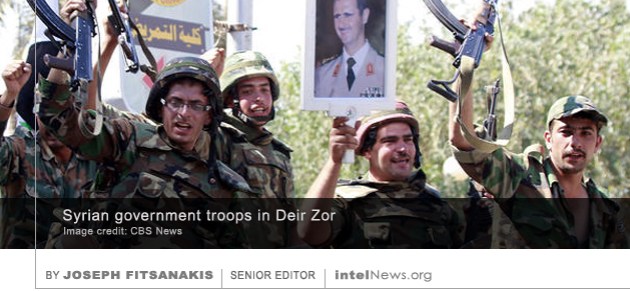
Syrian troopsHundreds of ground troops from Iran and Lebanon have been entering Syria in the past two weeks and are about to launch a large-scale ground attack against rebel groups, according to Reuters. The news agency quoted Lebanese sources “familiar with political and military developments in the conflict”. One source said that the Russian airstrikes in Syria, which began earlier this week, are the first phase of a large-scale military offensive against the Islamic State and other anti-government forces operating on the ground.
The Lebanese official told the news agency that hundreds of Iranian “soldiers and officers” had arrived in Syria in September. These forces “are not advisors”, said the source; rather, they have entered Syria “with equipment and weapons, specifically to participate in this battle. And they will be followed by more”, said the source, adding that some “Iraqis would also take part in the operation”, without specifying whether these would be regular troops or Iraqi Shiite militias. According to Reuters, the operation will be supported by Russian airstrikes and aims to recapture territory that is currently in the hands of various rebel groups, including the Free Syrian Army, Jabhat al-Nusra, and the Islamic State.

Last week it was reported that the governments of Russia, Iraq and Iran had entered a formal intelligence-sharing agreement with Syria, in an effort to defeat the forces fighting against the regime of Syrian President Bashar al-Assad. According to the Baghdad-based Iraqi Joint Forces Command, the agreement entails the establishment of a new intelligence-sharing center in the Iraqi capital. It will be staffed with intelligence analysts from all four participating countries, who will be passing on shared information to their respective countries’ militaries. The announcement of the agreement came as Russia continued to reinforce its military presence in Syria by deploying troops in Latakia.

Author: Joseph Fitsanakis | Date: 2 October 2015 | Permalink

CIA pulled officers from Beijing embassy following OPM database hack

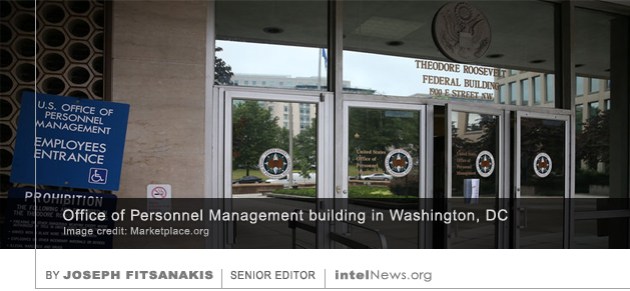
Office of Personnel ManagementThe Central Intelligence Agency (CIA) pulled a number of officers from the United States embassy in Chinese capital Beijing, after a massive cyber hacking incident compromised an American federal database containing millions of personnel records. Up to 21 million individual files were stolen in June of this year, when hackers broke into the computer system of the US Office of Personnel Management (OPM), which handles applications for security clearances for agencies of the federal government. The breach gave the unidentified hackers access to the names and sensitive personal records of millions of Americans who have filed applications for security clearances —including intelligence officers.
According to sources in the US government, the records of CIA employees were not included in the compromised OPM database. However, that is precisely the problem, according to The Washington Post. The paper said on Wednesday that the compromised OPM records contain the background checks of employees in the US State Department, including those stationed at US embassies or consulates around the world. It follows that US diplomatic personnel stationed abroad whose names do not appear on the compromised OPM list “could be CIA officers”, according to The Post. The majority of CIA officers stationed abroad work under diplomatic cover; they are attached to an embassy or consulate and enjoy diplomatic protection, which is typically invoked if their official cover is blown. However, they still have to present their credentials and be authorized by their host country before they assume their diplomatic post. The CIA hopes that foreign counterintelligence agencies will not be able to distinguish intelligence personnel from actual diplomats.

Although the US has not officially pointed the finger at a particular country or group as being behind the OPM hack, anonymous sources in Washington have identified China as the culprit. If true, The Post’s claim that the CIA pulled several of its officers from the US embassy in Beijing would add more weight to the view that the Chinese intelligence services were behind the cyber theft. The paper quoted anonymous US officials who said that the CIA’s decision to remove its officers from Beijing was directly related to the OPM hack, and it was meant to safeguard their personal security, as well as to protect CIA programs currently underway in China.

Author: Joseph Fitsanakis | Date: 1 October 2015 | Permalink

Russia, Iraq, Iran, Syria, sign intel-sharing agreement against Islamic State

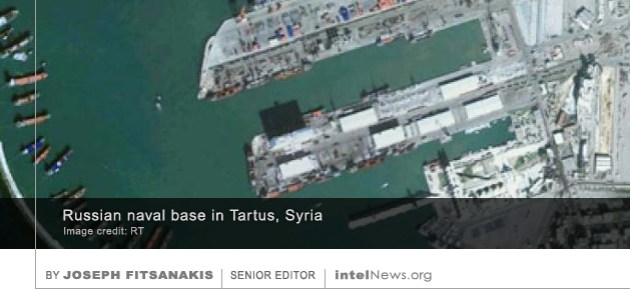
Tartus SyriaThe governments of Russia, Syria and Iran have entered a formal intelligence-sharing agreement with Iraq, in an effort to defeat the Islamic State, it has been announced. Intelligence-sharing has been practiced for a while between Russia, Syria and Iran; but this is the first time that Iraq, an American ally, has entered the alliance. According to the Baghdad-based Iraqi Joint Forces Command, the agreement entails the establishment of a new intelligence-sharing center in the Iraqi capital. It will be staffed with intelligence analysts from all four participating countries, who will be passing on shared information to their respective countries’ militaries.
Iraqi officials said on Sunday that the intelligence-sharing agreement had been forged by Moscow, which was “increasingly concerned about the presence of thousands of terrorists from Russia undertaking criminal acts” as members of the Islamic State. The announcement of the agreement comes as Russia has been reinforcing its military presence in Syria, by deploying troops in Latakia. Security observers have interpreted the move as a strong message by the government of Russian President Vladimir Putin that it is prepared to safeguard the regime of Syrian President Bashar al-Assad. The latter also enjoys strong support from Iran, which has poured billions of dollars in aid to support the regime in Damascus, and has deployed hundreds of Hezbollah advisers and militia members in defense of Assad.

Speaking from Baghdad, Colonel Steve Warren, the American spokesman for the Western-led military campaign against the Islamic State, said that Washington was respectful of Iraq’s need to enter into security agreements with other regional governments. But he added that the US objected to the Syrian government’s role in the intelligence-sharing agreement, because it was “brutalizing its own citizens”. The US government has also protested against the Russian government’s expansion of its base in Tartus and its increased military presence in Latakia. But, according to Foreign Policy, US officials have privately expressed support for the move, saying that “it could, in the short term, help rein in the Islamic state”.

Author: Joseph Fitsanakis | Date: 30 September 2015 | Permalink

Russia and Estonia conduct Cold-War-style spy swap

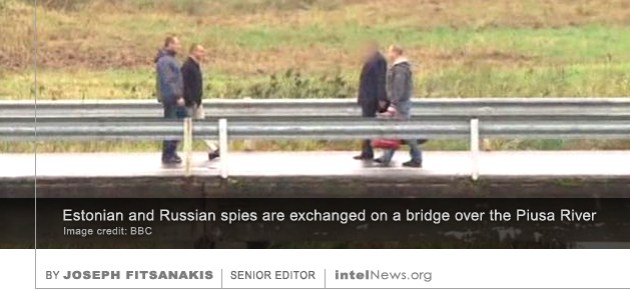
Estonia Russia spy-swapThe Russian and Estonian intelligence services have exchanged two men accused by each country of spying for the other, in a rare public example of what is commonly referred to as a ‘spy-swap’. The exchange took place on Saturday on a bridge over the Piusa River, which forms part of the Russian-Estonian border, separating Estonia’s Polva County from Russia’s Pskov Oblast.

Russia’s Federal Security Service (FSB) said that it had handed to the Estonian government a man going by the name of Eston Kohver. Last year, Estonian officials accused Moscow of abducting Kohver, an employee of the Internal Security Service of Estonia, known as KaPo, from the vicinity of Luhamaa, a border-crossing facility in southeastern Estonia. But the Russian government said that Kohver had been captured by the FSB on Russian soil and was found to be carrying a firearm, cash and spy equipment “relating to the gathering of intelligence”.

Kohver was exchanged for Aleksei Dressen, a former Estonian KaPo officer who was arrested in February 2012 along with his wife, Viktoria Dressen, for allegedly spying for Russia. The Dressens were caught carrying classified Estonian government documents as Viktoria was attempting to board a flight to Moscow. Aleksei Dressen was sentenced to 16 years in prison, while Viktoria Dressen to six, for divulging state secrets. Russian media have since reported that Dressen had been secretly working for Russian counterintelligence since the early 1990s.

Soon after the spy- swap, KaPo Director Arnold Sinisalu told a press conference that the exchange had been agreed with the FSB following “long-term negotiations”, during which it became clear that “both sides were willing to find a suitable solution”. Kohver, sitting alongside Sinisalu, told reporters that it felt “good to be back in my homeland”.

Author: Joseph Fitsanakis | Date: 28 September 2015 | Permalink

UPDATED: Pentagon admits US-trained Syrian rebels joined al-Qaeda

Jabhat al-NusraAfter issuing successive denials earlier in the week, United States officials have now confirmed reports that a group of Syrian rebels trained by the American military surrendered to an al-Qaeda affiliate in Syria almost as soon as they were deployed there from bases in Turkey. Early this week, the United States Central Command (CENTCOM) confirmed that 71 fighters calling themselves the New Syrian Force (NSF) had entered Syria to fight the Islamic State. The NSF group is part of a larger force calling itself Division 30, which consists of what Washington calls “moderate” Syrian rebels that have US support. Around two hundred fighters have been trained in Turkey by the US Pentagon under a $500 million program aimed to build a 5,400-strong rebel force to combat the Islamic State, which today controls much of Syria and Iraq.

But soon after the NSF group entered Syrian territory, a man claiming to be its commander issued a statement saying his group of rebels had denounced the US and broken off from Division 30. Major Anais Ibrahim Obaid, more commonly known as Abu Zayd, said in his statement that the NSF would continue to fight the Islamic State, but would do so independently. Shortly afterwards, a statement from Jabhat al-Nusra (also known as al-Nusra Front), al-Qaeda’s affiliate in Syria, claimed that Major Obaid and his men had surrendered their weapons to them. According to the statement, issued by Jabhat al-Nusra commander Abu Fahd al-Tunisi, the NSF had surrendered its ammunition, weaponry and several pick-up trucks in exchange for safe passage though al-Nusra-controlled territory. He also claimed that Major Obaid had said he had tricked his American trainers in order to receive weapons from them.

On Wednesday, the US Department of Defense had rejected claims that the NSF had surrendered to al-Qaeda. Pentagon spokesman Captain Jeff Davis told reporters that the US had “no information to suggest that [such claims were] true”. A brief statement issued by CENTCOM insisted that “all coalition-issued weapons and equipment are under the positive control of NSF fighters”. No further information on the matter has been released by the US government. On Friday, however, a Pentagon spokesman admitted that “the NSF unit now says it did in fact provide six pick-up trucks and a portion of their ammunition to a suspected al-Nusra Front” group.

This development marks the second major setback for Division 30 in recent months. In August, when the group sent its first team of 54 fighters to Syria, al-Nusra forces quickly attacked and kidnapped many of them. Last week, CENTCOM commander General Lloyd Austin told the US Congress that the Division 30 training program had only managed to produce around 200 fighters, a far cry from its intended 5,400. Of those, said General Austin, only about a handful were still active inside Syria.

Author: Joseph Fitsanakis | Date: 25 September 2015 | Permalink