Obama delegation switches hotels allegedly due to espionage fears
September 14, 2015 Leave a comment
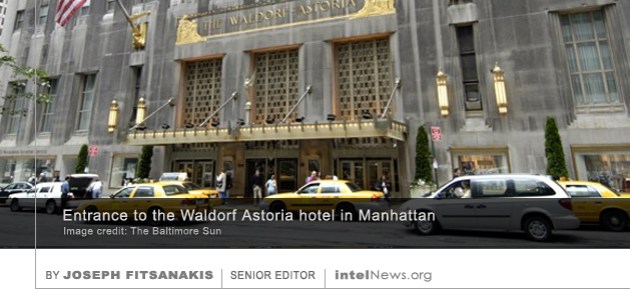 The president of the United States and his delegation will be housed at a different hotel during a United Nations General Assembly meeting later this month, allegedly due to concerns over Chinese espionage activity. Since the late 1940s, the American president and his diplomatic entourage have resided at the Waldorf Astoria for several days in September, while attending the annual UN General Assembly in New York. The luxury hotel, which is located on Park Avenue on the island of Manhattan, has also served since 1947 as the residence of the US ambassador to the UN. That is also why the American delegation is usually hosted there, courtesy of the ambassador. This year, however, President Barack Obama and his sizeable delegation will be staying at the New York Palace Hotel, located at the corner of Manhattan’s 50th Street and Madison Avenue. The announcement was made last week by the White House and the US Department of State.
According to The Associated Press and The New York Times, the decision to relocate the American high-level delegation is primarily due to security concerns. The reports cited well-placed sources in the US government as stating that the relocation was prompted by the sale last year of the Waldorf Astoria to the Chinese firm Anbang Insurance Group. The McLean, VA-headquartered Hilton Worldwide Holdings, Inc., which sold the hotel to the Chinese firm, pocketed nearly $2 billion from the transaction. Based on the terms of the agreement, the American company will continue to operate the Waldorf Astoria until 2114. But Anbang announced last spring that the hotel would be undergoing a massive renovation program, which, according to media reports, has alarmed American counterintelligence officials. The latter are concerned that Chinese intelligence technicians may use the renovation to install eavesdropping equipment in Waldorf Astoria’s rooms and compromise the hotel’s Internet network.
The US diplomatic exit from the Waldorf Astoria was first reported back in mid-June, but was not confirmed by the White House or the Department of State. Since that time, no American cabinet official, including Secretary of State John Kerry and Vice President Joe Biden, has stayed at the Waldorf. But President Obama’s upcoming trip renewed the media’s interest in the change of hotels, and US government officials finally confirmed that the Chinese-owned hotel had been dropped based “on several considerations, including space, costs and security”. A State Department official told reporters last week that the change took “into account changing circumstances”. The Times also reported that the US government is examining whether its ambassador to the UN will continue to be headquartered at the Waldorf.
► Author: Joseph Fitsanakis | Date: 14 September 2015 | Permalink
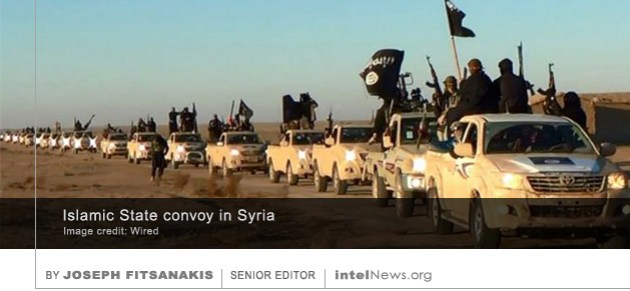 The United States Department of Defense is still probing claims that some of its officials doctored intelligence reports to give a falsely optimistic account of the campaign against the Islamic State. IntelNews has
 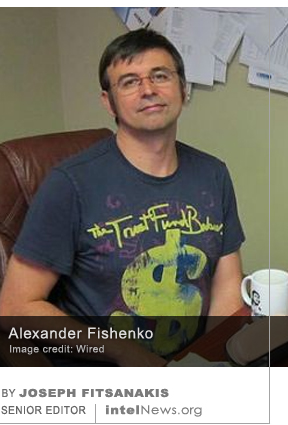 A resident of Texas, who is accused by United States authorities of setting up a front company in order to illegally acquire American technology on behalf of Russia’s intelligence services, has pleaded guilty to espionage charges. Alexander Fishenko, 49, was one of 11 people
 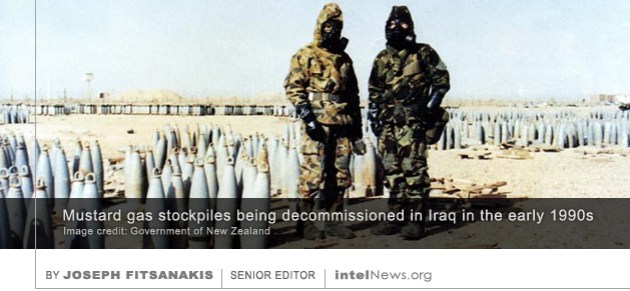 Germany’s foreign intelligence agency says it has evidence that the Islamic State is making use of chemical weapons in northern Iraq, according to media reports. The German Federal Intelligence Service, known as BND, says its operatives in the Middle East were able to collect biological samples from Kurdish fighters engaged in battles against the Islamic State forces. The samples pointed to chemical poisoning that most likely came from sulfur mustards, more commonly known as mustard gas. The chemical, which is banned from use in warfare by the 1993 Chemical Weapons Convention, causes skin irritation that gets progressively worse until sufferers develop debilitating blisters filled with yellow fluid.
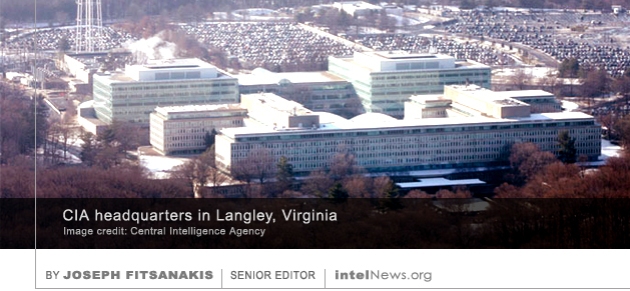 The United States Central Intelligence Agency had direct and unfiltered access to telecommunications data exchanged between German citizens, according to a new document that has surfaced in the German press. The program, codenamed GLOTAIC, was a collaboration between the CIA and Germany’s Federal Intelligence Service, known as BND. According to German newsmagazine Der Spiegel, which
  Fifty years after the 1965 Indo-Pakistani War, Pakistani former soldiers have spoken for the first time about their role in a secret effort by Pakistan to infiltrate India and incite a Muslim uprising. The conflict between India and Pakistan over Jammu and Kashmir is largely rooted in Britain’s decision to partition its former colonial possession into mainly Hindu India and Pakistan, a mostly Muslim state. As soon as the British withdrew in 1947, the two states fought a bloody war that culminated in a violent exchange of populations and led to the partition of Kashmir. Today India controls much of the region, which, unlike the rest of the country, is overwhelmingly Muslim. Indian rule survived an uprising by some of the local population in August 1965, which led to yet another war between the two countries, known as the 1965 Indo-Pakistani War.
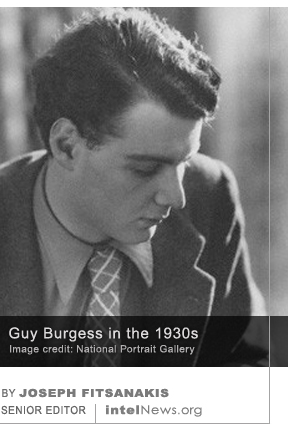 The life of Guy Burgess, one of the so-called ‘Cambridge Five’ double agents, who spied on Britain for the Soviet Union before defecting to Moscow in 1951, is
 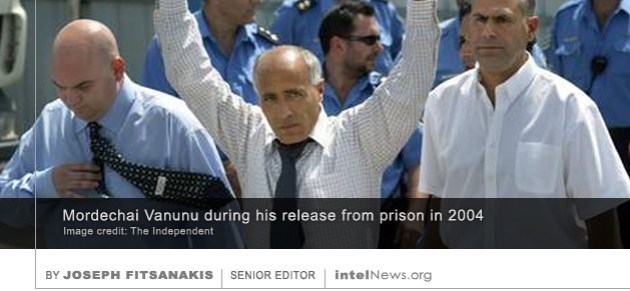 Israeli nuclear whistleblower Mordechai Vanunu, who spent 18 years in prison for revealing the existence of Israel’s nuclear program, has spoken for the first time about his 1986abduction by the Mossad in Rome. Vanunu was an employee at Israel’s top-secret Negev Nuclear Research Center, located in the desert city of Dimona, which was used to develop the country’s nuclear arsenal. But he became a fervent opponent of nuclear proliferation and in 1986 fled to the United Kingdom, where he revealed the existence of the Israeli nuclear weapons program to the The Times of London. His action was in direct violation of the non-disclosure agreement he had signed with the government of Israel; moreover, it went against Israel’s official policy of ‘nuclear ambiguity’, which means that the country refuses to confirm or deny that it maintains a nuclear weapons program.
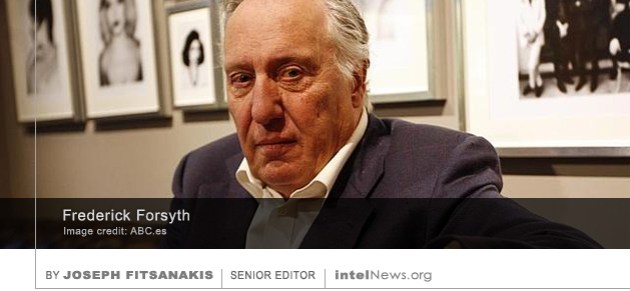 Frederick Forsyth, the esteemed British author of novels such as The Day of the Jackal, has confirmed publicly for the first time that he was an agent of British intelligence for two decades. Forsyth, who is 77, worked for many decades as an international correspondent for the BBC and Reuters news agency, covering some of the world’s most sensitive areas, including postcolonial Nigeria, apartheid South Africa and East Germany during the Cold War. But he became famous for authoring novels that have sold over 70 million copies worldwide, including The Odessa File, Dogs of War and The Day of the Jackal, many of which were adapted into film. Several of his intelligence-related novels are based on his experiences as a news correspondent, which have prompted his loyal fans to suspect that he might have some intelligence background.
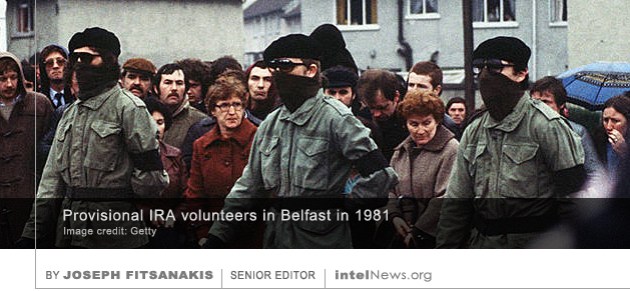 The Provisional Irish Republican Army, which fought British rule in Northern Ireland for decades, but officially disbanded in 2005, is still “broadly in place”, according to the head of the Police Service of Northern Ireland. On July 28, 2005, the Provisional IRA announced that was ceasing all paramilitary operations and disbanding as of 4:00 p.m. that day. The man who made the
 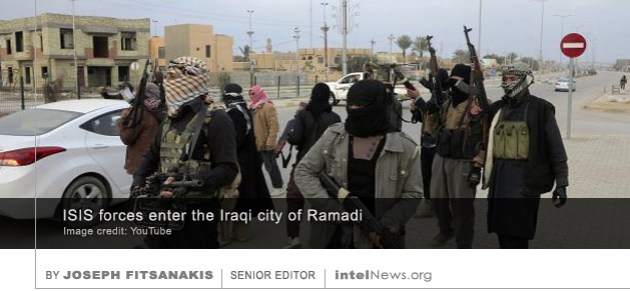 The United States Department of Defense is investigating claims that some of its officials doctored intelligence reports to give a falsely optimistic account of the campaign against the Islamic State.
 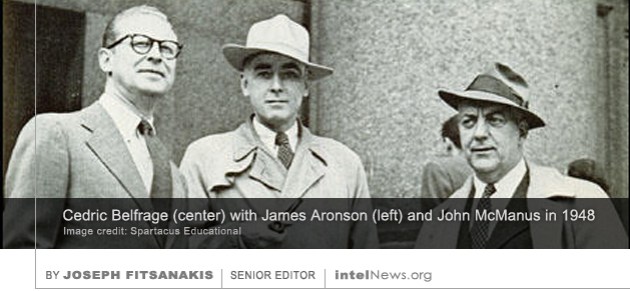 The British government has released a nine-volume file on an influential film critic who
 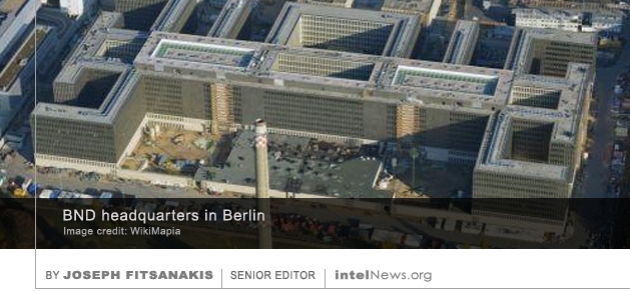 A German intelligence officer, who is accused of spying for the United States Central Intelligence Agency, has been
  General Hamid Gul, a controversial Pakistani spymaster who helped facilitate America’s covert involvement during the closing stages of the Soviet-Afghan war,








‘End of an era’ as feared Algerian spy chief is removed from office
September 16, 2015 Leave a comment
The general cultivated an aura of mystique, going to great pains to avoid publicity. His name did not appear in print until 2014, while a photograph of him was published for the first time in an Algerian paper on Sunday. According to The New York Times, Mediène’s many critics claim that he was able to hang on to power for so long by systematically “blackmailing politicians and other public figures” throughout his tenure. But the General’s removal from DRS was announced unexpectedly on Sunday, ostensibly in fulfilment of President Bouteflika’s stated goal of imposing more civilian control of the Algerian military. Mediène’s sudden removal follows the arrest in August of a number of other senior intelligence figures, including General Abdelkader Ait-Ouarabi, who served as DRS’s senior counterterrorism official for two decades under Mediène.
Many believe that the removal of DRS’ senior leadership was sparked by a widening rift between Bouteflika and Mediène. Last year, when Bouteflika announced that he would run for a fourth term, Mediène let it be known that he did not approve of the president’s decision. The ailing leader, who is 78, suffered a severe stroke in 2013, and has avoided public appearances since that time, giving rise to constant rumors about possible successors, or even machinations for coups by members of the armed forces. The Reuters news agency reported on Sunday that General Mediène has been replaced by General Athmane Tartag, who has served as President Bouteflika’s security advisor for several years.
► Author: Joseph Fitsanakis | Date: 16 September 2015 | Permalink
Filed under Expert news and commentary on intelligence, espionage, spies and spying Tagged with Abdelaziz Bouteflika, Abdelkader Ait-Ouarabi, Algeria, Athmane Tartag, Department of Intelligence and Security (Algeria), Islamic Salvation Front (Algeria), Mohamed Mediène, News