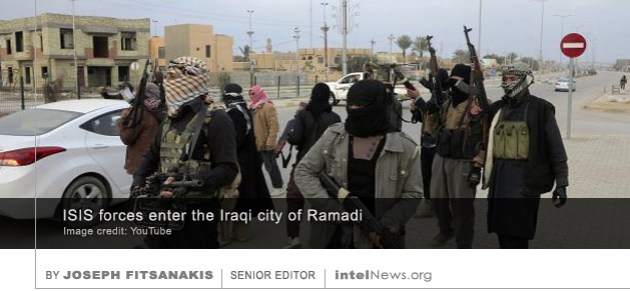
 The capture by Islamic State forces of the Iraqi city of Ramadi, on May 17, has given the organization a fortified urban base less than an hour’s drive from Baghdad. Its near-simultaneous takeover of the central Syrian city of Palmyra, points to the organization’s permanence and demonstrates its widening operational span, which now ranges from Western Libya to the Iranian border. Without an all-out war effort by outside forces, such as Iran, or the United States, it is difficult to see how the Islamic State could be stopped from permanently establishing itself as a major actor in the region, especially since no outside force appears willing to confront it directly.
On Tuesday, Iraqi government forces launched a major offensive to recapture Ramadi from the Islamic State —which is widely referred to in the West as the Islamic State of Iraq and Syria, or ISIS. Such an effort, however, will be extremely difficult and costly, both in terms of lives and material requirements. Ramadi is a sizable city of over 900,000 people —although several thousand civilians have left— and presents an attacker with an urban-warfare setting that can be extremely arduous to operate in. Moreover, Ramadi is a solidly Sunni city, with strong ties to the pre-2003 Iraqi military establishment that date back to the early days of Saddam Hussein’s rule. Even if they do not necessarily see eye-to-eye with ISIS, Ramadi’s Sunni inhabitants are bound to fight doggedly against the Iraqi army, which is currently dominated by Shiites. Thus, if ISIS decides to hold on to Ramadi for reasons of strategy, or to defend its prestige, it will be very surprising if the Iraqi army manages to recapture it. Even if ISIS is driven out of the city, most likely with significant Iranian and American assistance, there is no guarantee that the local population will be  pacified. Iraqi government forces will almost certainly face a protracted armed campaign by a mixture of heavily armed groups in the city. Some of these groups are led by ISIS, some are inspired by al-Qaeda, while others are motivated by a broader anti-Shiite sentiment, which is currently the predominant political ideology in Anbar Province.
On May 20, ISIS forces also captured the ancient Syrian city of Palmyra. The choice of target was neither spontaneous nor unexpected. Located right in the center of Syria, Palmyra forms one of two major land routes used by the government of Iran to transport military materiel to the regime of Syrian President Bashar al-Assad. Hezbollah, which, like Iran, supports the Syrian government in Damascus, also acquires Iranian weapons through that route. The second main route, which passes through Deir el-Zor, and Raqqah, is already controlled by ISIS. Therefore, the Syrian regime, which depends largely on Iranian support for its survival, simply has to retake Palmyra if it wants to win its war against ISIS. The Islamists know this, however, and they will persistently resist any attempt by the Syrian troops to regain control of the city. As is typical in these situations, time will be crucial here. The more time ISIS has on its hands, the better it will be able to fortify and defend Palmyra. The Syrian military will most likely resort to bombing the city from the air, but this is not as easy as it used to be, because ISIS now has formidable antiaircraft capabilities. Moreover, at some point land forces will have to be used, and that is precisely where ISIS has the upper hand in Syria.
On Sunday, United States Secretary of Defense Ash Carter told CNN that, in his view, Ramadi fell to ISIS because “the Iraqi forces just showed no will to fight”. Carter was right, except when he used the term “Iraqi forces”, he really meant Iraqi Shiites. There are currently almost no Sunnis left in the Iraqi Armed Forces. Most are unwilling to offer allegiance to a state that is dominated by Iran, which they see as not representing them, or indeed threatening their very existence. For that same reason, many Sunnis are now actively fighting in support of ISIS, or for Sunni tribes that  are aligned to it. Iraqi Sunnis believe that if they lose the fight against the Iraqi military they will be extinct as a people, which explains why they are fighting with more zeal and determination than their Shiite compatriots.
Meanwhile the international anti-ISIS alliance is plagued by too many disagreements and political bad blood to be effective. The United States wants ISIS to lose, but no American president would consider sending large numbers of US troops back in the Middle East, after the fiasco in Iraq. Additionally, Washington does not want to be seen to cooperate with what is perhaps ISIS’ most formidable adversary, namely Iran. Saudi Arabia is nominally against ISIS, but it also knows that if ISIS loses in their war against the Iranians, the latter will simply dominate the region, and nobody in Riyadh wants this. Like Saudi Arabia, Turkey is ostensibly against ISIS, but it is also against the Kurds, who are currently being assisted by Iran to fight ISIS. It is therefore not assisting the war effort as much as it could.
This fragmentation within the anti-ISIS front will continue. It seems that everyone in the region is waiting for a new administration to emerge in Washington after the 2016 national elections, in the hope that the US will engage more directly in the war effort. However, unless ISIS directly attacks the US in a 9/11-type attack, it is difficult to see Washington taking a more active stance in this chaotic and unpredictable war. It is difficult to see this amidst the bloody suffering of the local people, but this war is in essence a multifaceted chess game, in which there are no genuine alliances. Every actor involved appears to be trying to promote their own narrowly defined national interests.
► Author: Joseph Fitsanakis | Date: 26 May 2015 | Permalink: https://intelnews.org/2015/05/27/01-1704/
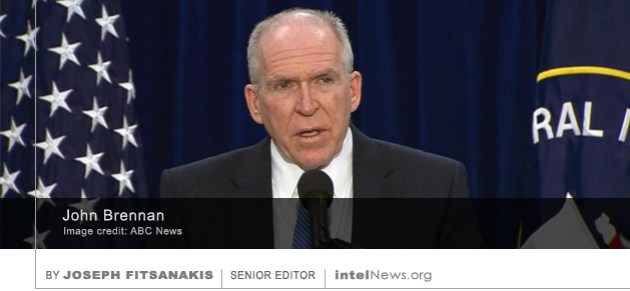 The director of the United States Central Intelligence Agency visited Israel in secret last week to discuss the Jewish state’s refusal to endorse an emerging deal with Iran over its nuclear program. Citing “two senior Israeli officials”, the Tel Aviv-based Israeli newspaper Haaretz said on Tuesday that CIA Director John Brennan arrived in Israel last Thursday. Although he was officially hosted by Tamir Pardo, director of Israeli intelligence agency Mossad, Brennan used the opportunity to hold secret meetings with several senior Israeli officials, said Haaretz. Among them were Prime Minister Benjamin Netanyahu, National Security Adviser Yossi Cohen, as well as Major General Hartzl Halevi, who heads Israel’s Military Intelligence Directorate.
 The Swiss federal government has rejected a multi-million dollar contract bid by one of the world’s largest broadband Internet service providers, saying it is foreign-owned and could serve as “a gateway for foreign spies”. The company, UPC Cablecom, is headquartered in Zurich, is subject to Swiss law, and is currently the largest broadband cable operator in Switzerland. However, in 2005 it became a subsidiary of the UPC Broadband division of Liberty Global Europe, an international telecommunications and television company based in London, England. It is therefore technically considered a foreign company according to Swiss law. In 2013, UPC Cablecom submitted a bid for a competitive contract to provide broadband Internet services to Swiss government agencies. But in January 2014, the company was informed by Swiss officials that such a contract could not be awarded to a foreign-owned telecommunications service provider such as UPC Cablecom.
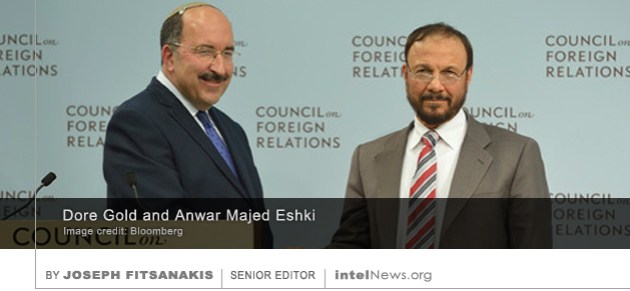 Representatives from Israel and Saudi Arabia have publicly admitted for the first time that they met secretly to discuss their common foe Iran, even though Saudi Arabia does not officially acknowledge Israel’s existence. The admission was made at a symposium held on Thursday at the Council on Foreign Relations, a foreign-policy think tank based in Washington, DC.
 A United States district judge has ordered the release of the last major piece of sealed evidence in one of the most important espionage cases of the Cold War. The case led to the execution in 1953 of an American couple, Julius and Ethel Rosenberg, who were convicted of conspiring to spy for the Soviet Union. The Rosenbergs were arrested in 1950 for being members of a larger Soviet-handled spy ring, which included Ethel’s brother, David Greenglass. Greenglass later told a US court that he firmly believed the USSR should have access to nuclear technology and actively tried to give Moscow information on the Manhattan Project. Greenglass agreed to testify for the US government in order to save his life, as well as the life of his wife, Ruth, who was also involved in the spy ring. He subsequently fingered Julius Rosenberg as a courier and recruiter for the Soviets, and Ethel as the person who retyped the content of classified documents before they were surrendered to their handlers. This piece of testimony from Greenglass was used as the primary evidence to convict and execute the Rosenbergs.
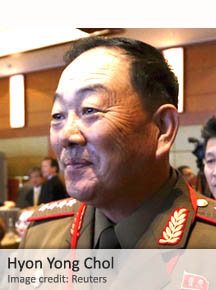
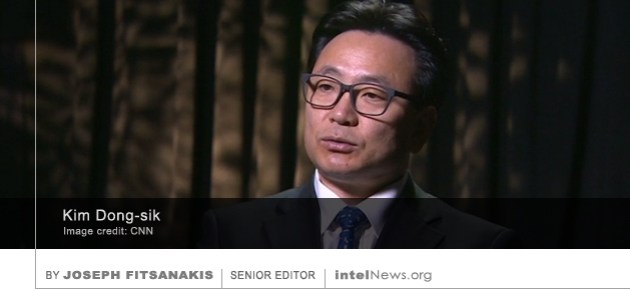 Two high-profile North Korean defectors, who used to work for the country’s spy agencies, have spoken publicly about the use of espionage by one of the world’s most impenetrable intelligence communities.
 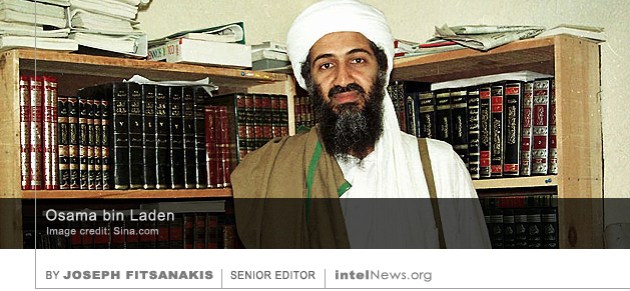 The release this week of material from Osama bin Laden’s personal stack of books and documents, which were confiscated from his Abbottabad compound, is timely as it is important. The decision by the United States Office of the Director of National Intelligence (ODNI) to declassify the documents was almost certainly in response to recent claims that bin Laden was being kept under house arrest by the Pakistani intelligence services at the time of his assassination. American journalist Seymour Hersh, who made the
 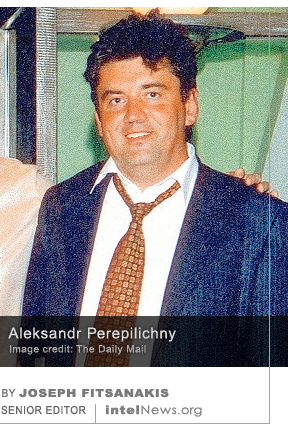 A Russian businessman, who died in London while assisting a Swiss probe into a massive money-laundering scheme, may have been poisoned with a substance derived from a highly toxic plant, an inquest has heard. Aleksandr Perepilichny was an influential Moscow investment banker until he fled Russia in 2009, saying that his life had been threatened after a disagreement with his business partners. A few months later, having moved to an exclusive district in Surrey, south of London, Perepilichny began cooperating with Swiss authorities who were investigating a multi-million dollar money-laundering scheme involving senior Russian government officials. The scheme, uncovered by a hedge fund firm called Hermitage Capital Management (CMP), and described by some as the biggest tax fraud in Russian history, defrauded the Russian Treasury of at least $240 million. The case made international
  A congratulatory letter sent by a senior Nazi official to
 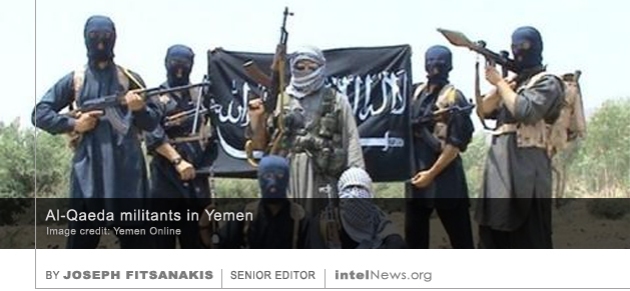 Al-Qaeda and its affiliates continue to pose the most serious unconventional threat to American security, despite the meteoric rise of the Islamic State of Iraq and al-Sham, according to a former senior official in the United States Central Intelligence Agency (CIA). Michael Morell, who was deputy director of the CIA, and served twice as the Agency’s acting director, did not deny that the Islamic State, also known as ISIS, poses a significant threat to the security of the US. However, the militant group “is not the most significant threat to the homeland today”, he said. Morell made the comment while









Israel denies using computer virus to spy on Iran nuclear deal
June 11, 2015 Leave a comment
However, Kaspersky said that among the more recent targets of the virus were “three luxury European hotels”, which appear to have been carefully selected among the thousands of prestigious hotels in Europe. The three appear to have only one thing in common: all had been patronized by diplomats engaged in the ongoing secret negotiations with Iran over the Islamic Republic’s nuclear program. Kaspersky was referring to the so-called P5+1 nations, namely the five permanent members of the United Nations Security Council plus Germany, who lead ‘the Geneva pact’. Israel has condemned the negotiations and has repeatedly expressed anger at reports that the Geneva pact is about to strike an agreement with Tehran over its nuclear program.
However, Israel’s deputy foreign minister flatly rejected Kaspersky’s allegations on Wednesday, calling them “pure nonsense”. Speaking on Israel Radio, Eli Ben-Dahan said Israel had “many far more effective ways” of gathering foreign intelligence and that it did not need to resort to computer hacking in order to meet its intelligence quotas. Israeli government spokespeople refused to comment on the allegations when asked late Wednesday.
► Author: Joseph Fitsanakis | Date: 11 June 2015 | Permalink: https://intelnews.org/2015/06/11/01-1713/
Filed under Expert news and commentary on intelligence, espionage, spies and spying Tagged with computer hacking, cybersecurity, Duqu, Eli Ben-Dahan, espionage, Iranian nuclear program, Israel, Kaspersky Lab