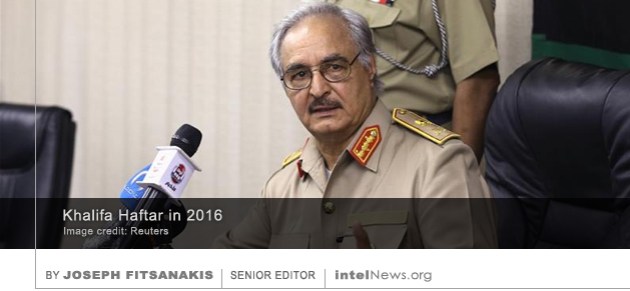
Israeli weapons, airpower, secretly given to Libyan warlord, source claims

Khalifa HaftarIsrael is secretly providing military assistance to Khalifa Haftar, commander of the Libyan National Army, one of the factions in the Libyan Civil War, according to a British-based publication. Libya has remained in a state of war since 2011, when a popular uprising backed by the West and its allies led to the demise of the country’s dictator, Colonel Muammar Gaddafi. Currently the strongest faction in the ongoing Libyan Civil War is the eastern-based Tobruk-led Government, which is affiliated with the Libyan National Army (LNA). The commander of the LNA is Field Marshal Khalifa Haftar, an old adversary of Colonel Gaddafi, who lived in the United States under Washington’s protection for several decades before returning to Libya in 2011 to launch his military campaign.
In February of 2011, shortly after the popular uprising erupted in Libya, the UN Security Council adopted Resolution 1970, which —among other things— forbids the export of war materiel to Libya. In June of this year, the United Nations accused Saudi Arabia and the United Arab Emirates of violating the embargo by providing secret military assistance to Haftar and the LNA. Now a new report in a British-based Arab news outlet claims that, in addition to Saudi Arabia and the Emirates, Israel too is helping the LNA. Allegedly, Tel Aviv has given the LNA war materiel and air power support, with the help of the United Arab Emirates.

Published in the London-based Al-Araby Al-Jadeed (The New Arab) newspaper, the report claims that the Libyan strongman has been holding secret meetings with Israel since 2015. The publication cites a high-ranking official in the LNA, who spoke on condition of anonymity “out of fear for his safety”. The source, who is reportedly close to Haftar, told the newspaper that he is personally aware of two meetings held between Haftar and agents of the Mossad, Israel’s intelligence agency, in 2015 and 2016. The LNA official said the meetings between the LNA and the Mossad were held in Jordan “in strict secrecy”under the supervision of the United Arab Emirates. Soon after the meetings, said the unnamed official, Israel began to provide the LNA with military aid, including night vision equipment and various sniper rifles. He also claimed that this is known to the LNA fighters on the ground, because there are Israeli markings on the rifles issued to them. The official also claimed that Israel may have secretly provided air cover during at least one of the LNA’s offensive in recent years.

The claim of collusion between Israel and the LNA is bound to raise popular pressure against the pro-LNA government in Egypt, which borders with Libya. It will also increase tension between the LNA and Algeria, which borders Libya from the west. According to The New Arab, the government of Algeria issued “a strong warning” against Israel’s involvement in Libya, following reports of secret cooperation between the LNA and Tel Aviv.

Author: Joseph Fitsanakis | Date: 08 August 2017 | Permalink

South Korea spy agency admits secret plan to influence 2012 election result

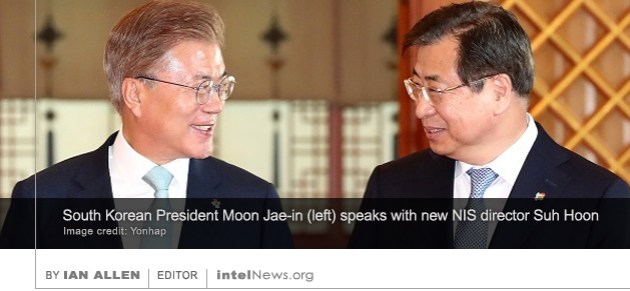
Moon Jae-in and Suh Hoon in South KoreaAn internal investigation has found that the intelligence agency of South Korea tried to steer the result of the 2012 presidential election in favor of the conservative candidate, and placed liberal politicians under surveillance in the run-up to the election. South Korea’s intelligence agency, the National Intelligence Service (NIS) has fallen into disrepute in recent years, after it was found to have secretly sided with conservative political candidates for public office.

In 2015, the NIS’ former director, Won Sei-hoon, was jailed for directing his staff to use social media to spread negative views of liberal politicians. He is now facing a second trial, after his conviction was overturned on appeal. Mr. Won headed the NIS from 2008 to 2013, during the administration of conservative President Lee Myung-bak. During the 2012 presidential elections, Won ordered a group of NIS officers to “flood the Internet” with messages accusing liberal political candidates of being “North Korean sympathizers”. One of those candidates, Moon Jae-in, of the left-of-center Democratic Party of Korea, is now the country’s president. Mr. Moon succeeded his main right-wing rival, Park Geun-hye, who resigned in March of this year following a series of financial scandals. She is now facing charges of bribery, abuse of power, leaking government secrets, and corruption.

An internal inquiry has now found that the NIS tried to manipulate the outcome of the 2012 presidential election with 30 dedicated teams of officers —some of whom were hired specifically for that purpose. A number of teams were in charge of creating fake social media accounts and using them to post negative views of Mr. Moon and positive views of his conservative rival, Mrs. Park. Other teams were tasked with creating the false impression that South Korea’s rival, North Korea, was supportive of Mr. Moon’s candidacy. The probe also found that the NIS launched similar —though on smaller scale— efforts to influence the outcome of parliamentary elections in 2011 and 2012. Additionally, the NIS placed a number of opposition politicians under surveillance.

Since his ascendance to power last spring, Mr. Moon has pledged that the NIS will be reformed and that it will stay out of domestic politics. In June of this year, Mr. Moon announced that the domestic intelligence wing of the NIS would be dissolved.

Author: Ian Allen | Date: 07 August 2017 | Permalink

CIA’s withdrawal from Syria could cause pro-US rebels to join Islamists, experts warn

Free Syrian ArmyThe decision by the White House to terminate American support for rebels in war-torn Syria could backfire by causing the suddenly unemployed fighters to join jihadist organizations, according to experts. The United States’ support for the rebels began in secret in early 2013, after the then US President, Barack Obama, instructed the Central Intelligence Agency to provide covert support to fighters in Syria. The CIA then joined forces with spy agencies from Britain, France, Saudi Arabia and the United Arab Emirates, to assist fighters affiliated with the Free Syrian Army. At that time, Washington saw the Free Syrian Army and forces affiliated with it as ideologically moderate. It also agreed with the group’s main aim, which was to topple the regime of Syrian President Bashar al-Assad.

Codenamed TIMBER SYCAMORE, the CIA program was designed to mirror a similar project run by the US military in support of local troops fighting the Islamic State. On the one hand, the White House wanted to use the CIA’s support for the FSA to weaken militarily the regime in Damascus. On the other hand, Washington hoped that the CIA’s involvement in the region would be able to control the influx of weapons, money and fighters that were streaming in from neighboring countries. Under TIMBER SYCAMORE, for over three years, CIA personnel trained Free Syrian Army fighters in irregular warfare, while also providing them with light weaponry including machine guns, sniper rifles and off-road vehicles.

But on July 19 of this year, US President Donald Trump abruptly ended the CIA program, which he called “dangerous and wasteful”. Some observers argued that the termination of TIMBER SYCAMORE was an attempt by the Trump administration to come to an agreement with Russia on Syria. It is believed that America’s local allies, such as Saudi Arabia and the United Arab Emirates, are also terminating their clandestine support for the Free Syrian Army, not wishing to go against the White House. This development, therefore, may signal the effective termination of substantial foreign support for the most important anti-Assad rebel group in Syria.

What does that mean for the fate of the Free Syrian Army and its thousands of fighters? Some experts say that their fate is uncertain, and warn that some of them may turn against their former benefactors. Writing in The Christian Science Monitor, Taylor Luck, said earlier this week that the Free Syrian Army reported 50 defections of its fighters in July. Some of these fighters, says Luck, are joining the Pentagon’s program in support of forces fighting the Islamic State, and are currently heading to the eastern and northern battlefronts. But many others are being tempted to join al-Qaeda affiliated groups, who are still fighting President Assad’s forces. Many do so for financial reasons, after seeing their CIA income suddenly disappear. Others, says Luck, are feeling very emotional and bitter against what they see as a betrayal by Washington. “We lost our brothers, our sisters, our children”, says one of these fighters, before vowing to fight Assad until the end. According to Luck’s report, Saudi Arabia and the United Arab Emirates are trying to come up with ways to continue to pay the Free Syrian Army rebels, in an attempt to stop them from joining rival jihadist groups.

Author: Ian Allen | Date: 04 August 2017 | Permalink

US Pentagon wasted $450 million in Afghan spy training program, says watchdog

Afghan National ArmyNearly half a billion of American taxpayers’ funds were wasted by contractors hired by the United States government to train Afghan intelligence personnel, according to a scathing report by a Congressional body. The funds were spent between 2010 and 2013 by the US Department of Defense, in order to train several thousand members and a few dozen aspiring trainees of the Afghanistan National Defense and Security Forces (ANDSF). Two companies, Legacy Afghanistan R&D and Afghanistan Source Operations Management, oversaw the training program. It was primarily executed by a contractor, Imperatis Corporation, and a subcontractor, New Century Consulting, at a total cost of $457 million to the US taxpayer.


But according to a new report, the four-year program was a monumental, multimillion dollar waste. The report was written by the Special Inspector General for Afghanistan Reconstruction (SIGAR). The body was established by the US Congress in 2008 to supervise the effectiveness of US government-funded reconstruction programs in Afghanistan. Dated July 2017, the SIGAR report says it is “almost impossible” to evaluate the effectiveness of the ANDSF intelligence-training program, because none of the contractors and subcontractors involved in it kept adequate training records. Based on the available information, the SIGAR report concludes that there is virtually “no indication of improvement in intelligence operations” by ANDSF as a result of the four-year training program.

Part of the reason for the poor value of the program is that “a significant portion” of the intelligence trainees enrolled in it performed below the minimum standards required. Additionally, few trainees actually completed the courses that were required prior to graduation. Shockingly, the US Pentagon paid the contractors in full despite the fact that they had failed to keep adequate records of their performance, an omission which legally entitled the Pentagon to refuse to payment. Even more incredibly, the SIGAR report also found that Imperatis Corporation billed the US taxpayer nearly $4 million between March and December of 2011 for training courses that had been canceled and were not being offered.

The training program’s subcontractor, New Century Consulting (owned by retired US Special Forces Colonel Tim Collins), was criticized two years ago in another SIGAR report for spending $130 million of US taxpayers’ funds on “unsupported” and “questioned” purchases. The program’s main contractor, Imperatis Corporation, went out of business in May 2016.

Author: Ian Allen | Date: 03 August 2017 | Permalink

Industrial espionage damages a country’s long-term productivity, study finds

StasiState-sponsored industrial espionage aimed at stealing foreign technical secrets may boost a country’s technological sector in the short run, but ultimately stifles it, according to the first study on the subject. The study is based on over 150,000 declassified documents belonging to the East German Ministry for State Security, known as Stasi. The now-defunct intelligence agency of communist-era East Germany was known for its extensive networks of informants, which focused intensely on acquiring technical secrets from abroad.

The history of industrial and economic espionage by governments is indeed extensive. It includes lucrative efforts by the United States to steal industrial production methods from Europe in the 19th century, and successful attempts by the Soviet Union to steal atomic technology from the American-led Manhattan Project in the 1940s. But there have been no systematic attempts to evaluate the effect of state-sponsored industrial espionage on the entire economy of the sponsoring nation –until now.

This new study –the first of its kind– was carried out by two economists, Erik Meyersson, from the Stockholm School of Economics in Sweden, and the Spain-based Albrecht Glitz of Pompeu Fabra Univeristy in Barcelona. The two researchers describe their preliminary findings in a working paper entitled: “Industrial Espionage and Productivity”, published by the Institute of Labor Economics in Bonn, Germany. Its findings are based on an analysis of nearly 152,000 declassified industrial-espionage-related communiqués sent by Stasi spies to their handlers between 1970 and 1988. The communiqués were examined with reference to their date of authorship and the content-descriptive keywords appended to them by the Stasi.

The report concludes that stealing industrial secrets can boost a nation’s economic activity in the short run. However, in the long run, a nation’s strategic focus on industrial espionage tends to impede homegrown research and development, and ultimately stifles technological productivity on a national scale. This is because “easy access to secrets” from abroad tends to “discourage both state and private investment in research and development”, according to Meyersson and Glitz. That is precisely what happened to East Germany, argues the report. The country’s total factor productivity (TFF –the growth of its output measured in relation to the growth in inputs of labor and capital) rose significantly as a result of its industrial espionage.That was especially noticeable in the digital electronics sector, where the output gap between East and West Germany was narrowed by a fourth. However, that trend was temporary, and East Germany was never able to develop an organic digital-electronics industry. Industrial espionage is like “research and development on cocaine”, professor Meyersson told Science, the magazine of the American Association for the Advancement of Science. “Maybe you can have a little bit of fun with it, but it’s not good for you in the long run”.

Author: Joseph Fitsanakis | Date: 01 August 2017 | Permalink

North Korean state now uses cyber attacks to steal cash, says report

North KoreaNorth Korea’s intelligence establishment has shifted its attention from spying for political gain to spying for commercial advantage –primarily to secure funds for the cash-strapped country, according to a new report. Since the 1990s, the Democratic People’s Republic of Korea (DPRK) has used computer hacking in order to steal political and military secrets from its rivals. But there is increasing evidence that Pyongyang is now deploying armies of computer hackers in order to steal cash from foreign financial institutions and internet-based firms. This is the conclusion of a new report by the Financial Security Institute of South Korea, an agency that was set up by Seoul to safeguard the stability of the country’s financial sector.

The report, published last week, analyzed patterns of cyber attacks against South Korean state-owned and private financial institutions that took place between 2015 and 2017. It identified two separate computer hacking groups, which it named Lazarus and Andariel. According to the report, both groups’ activities, which are complementary, appear to be directed by the government of North Korea. An analysis of the groups’ targets suggests that Pyongyang has been directing its computer spies to find ways to secure hard currency for use by the government. Foreign currency has been increasingly hard to come by in North Korea in recent years, due to a host of international sanctions that were imposed on the country as a form of pressure against its nuclear weapons program.

Several cyber security experts and firms have claimed in recent months that North Korea has been behind recent cyber attacks against international banking institutions. The DPRK has also been blamed for a 2014 attack against the Hollywood studios of the Japanese multinational conglomerate Sony. Regular readers of intelNews will recall our story in March of this year about comments made on the subject of North Korea by Rick Ledgett, a 30-year veteran of the United States National Security Agency. Speaking at a public event hosted by the Aspen Institute in Washington, Ledgett expressed certainty that the government of North Korea was behind an attempt to steal nearly $1 billion from Bangladesh Bank —the state-owned central bank of Bangladesh—in 2016. Eventually the bank recovered most of the money, which were made through transactions using the SWIFT network. But the hackers managed to get away with approximately $81 million.

More recently, cyber security experts have claimed that the government of North Korea has been behind attempts to hack into automated teller machines, as well as behind efforts to steal cash from online gambling sites. In April of this year, the Russian-based cyber security firm Kaspersky Lab identified a third North Korean hacker group, which it named Bluenoroff. The Russian experts said Bluenoroff directed the majority of its attacks against foreign financial firms. There are rumors that Pyongyang was behind the wave of WannaCry ransomware attacks that infected hundreds of thousands of computers in over 150 countries in May. But no concrete evidence of North Korean complicity in the attacks has been presented.

Author: Joseph Fitsanakis | Date: 31 July 2017 | Permalink

CopyKittens cyber espionage group linked to Iranian state, says report

CopyKittensA cyber espionage group that has alarmed security researchers by its careful targeting of government agencies has links to the Iranian state, according to a new report. The existence of the group calling itself CopyKittens was first confirmed publicly in November of 2015. Since that time, forensic analyses of cyber attacks against various targets have indicated that the group has been active since at least early 2013. During that time, CopyKittens has carefully targeted agencies or officials working for Jordan, Saudi Arabia, Turkey, Israel, the United States, and Germany, among other countries. It has also targeted specific offices and officials working for the United Nations.

Throughout its existence, CopyKittens has alarmed cyber security researchers by its strategic focus on political targets belonging to governments. The group’s methods of operation do not resemble those of most other hacker groups, which are usually crude by comparison. Now a new report by two leading cyber security groups claims that CopyKittens is linked to the Iranian state. The report was published on Tuesday as a joint effort by Japan’s Trend Micro and Israel’s ClearSky firms. The report analyzes several operations by CopyKittens, some conducted as recently as last April. It concludes that CopyKittens is “an active cyber espionage actor whose primary focus [is] foreign espionage on strategic targets”. Additionally, the report suggests that the group operates using “Iranian government infrastructure”.

According to the Trend Micro/ClearSky report, CopyKittens tends to use relatively simple hacking techniques, such as fake social media profiles, attacks on websites, or emails that contain attachments that are infected with malicious codes. However, its members appear to be “very persistent” and usually achieve their goal “despite lacking technological sophistication”. The security report did not directly address the political ramifications of implicating the Iranian government in the CopyKittens’ hacking operations. The Reuters news agency contacted Iranian officials at the United Nations about the CopyKittens report, but they nobody was available for comment.

Author: Ian Allen| Date: 26 July 2017 | Permalink

After Trump, NSA director backs away from joint US-Russian cyber unit proposal

NSA headquartersThe director of the United States National Security Agency appears to have backed away from a proposal to set up a joint American-Russian cyber security working group, with the aim of defending both countries from hackers. Earlier in July, US President Donald Trump said he was considering the establishment of what he described as “an impenetrable cyber security unit” that would be a joint project between the United States and Russia. The unit would have the task of defending both countries from cyber attacks aimed at hacking their election systems and other vital state functions. The US president said he had discussed the idea with his Russian counterpart, President Vladimir Putin, during the G20 summit in German city of Hamburg. Last week, a Russian official confirmed that Moscow and Washington were considering the creation of a working group that would examine the creation of a joint cyber defense force.

The announcements, however, were strongly criticized by Democrats in Congress. They were also not welcomed by several Republican lawmakers, who argued that such a move would not be sound policy on the part of the White House, given the ongoing controversy about alleged Russian meddling in the 2016 US presidential election. Eventually, President Trump appeared to abandon the plan. He tweeted that just because he had spoken about the idea with the Russian leader did not mean that such a plan was necessarily in the works. “The fact that President Putin and I discussed a Cyber Security unit doesn’t mean I think it can happen. It can’t”, wrote Mr. Trump.

On Saturday, the Director of the NSA, Admiral Mike Rogers, appeared to agree with Mr. Trump’s revised view that a joint US-Russian cyber unit was not high on Washington’s priority list. After delivering a speech at the Aspen Security Forum, hosted by the Aspen Institute in Colorado, Admiral Rogers was asked by a member of the audience to address the US president’s remarks. He prefaced his response by saying that he is “not a policy guy”. But he went on to “argue [that] now is probably not the best of time to be doing this”. The head of the NSA added that a joint cyber security project between Washington and Moscow is “something that you might want to build over time, were we to see changes in [Russia’s] behavior”. He did not specify what he meant by “changes in [Russia’s] behavior”.

Author: Ian Allen | Date: 24 July 2017 | Permalink

Dozens of Western ‘freelance fighters’ embedded with anti-ISIS forces in Syria

Kurdish YPG SyriaDozens of Western European and American citizens are participating in the ongoing takeover of Raqqa, the de facto capital of the Islamic State in Syria, despite being prohibited from doing so by their own governments, according to recent news reports. Much has been written about foreign fighters who enter Iraq and Syria in order to join the ranks of the Islamic State, the Sunni militant group that previously went by the name Islamic State of Iraq and Syria (ISIS). But relatively little attention has been paid to the thousands of foreign fighters who have traveled to the region to join the war against ISIS.

In late 2015, independent researcher Nathan Patin published “The Other Foreign Fighters”, a rare examination of Americans who had joined the various armed groups fighting ISIS in the region. Patin found that at least 200 Americans had attempted to travel to the region in order to join the fight against ISIS as ‘freelance fighters’. Roughly half of those had managed to embed themselves with armed —primarily Kurdish— groups, and saw action on the ground. In 2016, three British and Irish anti-ISIS volunteers were jailed by Iraqi authorities while attempting to return to Europe after having fought for the Kurdish People’s Protection Unit (YPG), a group that serves as the armed wing of the Kurdistan Workers’ Party (PKK) in northern Syria. The three were initially suspected of being foreign ISIS volunteers, but were released from prison in April of 2016, after the YPG verified their bona fides.

A recent report by The Los Angeles Times claims that there are still “several dozen” Western volunteers embedded with anti-ISIS militias in Syria. They are doing so in the face of warnings by European and American government agencies that freelance participation in the Syrian civil war is a potentially punishable offense. The Times cited “local estimates” and spoke to Daman Frat, a YPG commander stationed in the eastern outskirts of Raqqa, who said that “several foreign volunteers” were embedded in YPG units. Most, though certainly not all of them, said Frat, had prior military experience. According to the paper, at least three Western volunteers, one British and two American citizens, have died in recent days, as YPG forces are closing in on the de facto ISIS capital. The US Departments of State and Defense, which are tacitly in support of the YPG and other Kurdish groups operating in Syria, did not comment on The Los Angeles Times report.

Author: Joseph Fitsanakis | Date: 20 July 2017 | Permalink

US plans to beef up Cyber Command, separate cyberwar operations from NSA

PentagonThe White House will soon announce its decision to strengthen the United States Cyber Command and separate cyber war operations from intelligence functions, according to insider reports. For many decades, the National Security Agency has been in charge of protecting America’s cyber network and combating online threats. But in 2009, the Administration of US President Barack Obama established a brand new Cyber Command, proposing that the online environment represented a new theater of war. Since that time, the US Department of Defense has been campaigning in favor of strengthening the new Cyber Command and completely removing it from the patronage of the NSA –despite the fact that the latter is also a Pentagon agency.

According to media reports, US President Donald Trump has decided to follow the Pentagon’s suggestion. After several months of delay, his administration is now preparing to announce a major reinforcement of the US Cyber Command, and a formal separation between its functions and those of the NSA. According to the American news network PBS, which broke the news on Monday, the idea behind the move is to give the Cyber Command more operational autonomy and to allow it to establish its own mission statement, which will be distinct from that of the NSA. The latter is an intelligence organization, which means that it primarily seeks to exploit adversary networks for purposes of collecting information. Broadly speaking, therefore, the NSA finds operational adversary cyber networks far more useful than destroyed networks. That tends to clash with the goals of the US Cyber Command, whose tactical goals often center on launching destructive attacks on enemy networks. It is believed that the impending change will allow it to do so without the interference of the NSA.

According to PBS, which cited anonymous sources in its report, the details of the separation “are still being worked out”. Furthermore, some observers caution that the Cyber Command will continue to rely on NSA technology and expertise for years to come, until it is able to carry its own weight. There is even less discussion about the view of the NSA on the matter, which some claim is notably negative. However, the move appears to have been decided, and the Cyber Command’s budget will be increased by nearly 20% to $647 million in the coming year, reflecting its elevated role in US defense.

Author: Joseph Fitsanakis | Date: 19 July 2017 | Permalink

US spies confirm Qatar’s claims that its media were hacked by Emirates to spark crisis

Sheikh Tamim Bin Hamad al-ThaniAmerican officials appear to confirm Qatar’s allegations that its news media were hacked by its Gulf adversaries, who then used the fake news posted by hackers to launch a massive campaign against it. Tensions between Qatar and other Muslim countries have risen since late May, when the country’s state-controlled news agency appeared to publish an incendiary interview with Qatar’s Emir, Sheikh Tamim Bin Hamad al-Thani. In the interview, which appeared on May 24, the sheikh appeared to praise Saudi regional rival Iran as a “great Islamic power” and to express support for the militant Palestinian group Hamas. On the following day, Saudi Arabia, the United Arab Emirates, Egypt and Bahrain immediately banned all Qatari media —primarily Al Jazeera— from broadcasting in their territories and broke diplomatic relations with Doha. Later on, they declared a large-scale commercial embargo against the small oil kingdom. They have since threatened war unless Qatar changes its alleged support for Iran and for a number of militant groups in the region.

The Qatari government has dismissed the embargo as unjust and has claimed that Sheikh al-Thani’s controversial interview was fake, and was placed on the country’s state-owned news agency and social media as a result of a computer hack. It has also claimed to have evidence of a number of iPhones that were used from locations in Saudi Arabia and the Emirates to launch the hacks on its networks. Qatari officials have also said that an investigation into the incident is underway, but their claims have been criticized as outlandish by Qatar’s regional rivals.

Now, however, a report by The Washington Post claims that American officials have uncovered evidence that Qatar’s allegations of a computer hack are true. The paper cited “US intelligence and other officials” who spoke “on the condition of anonymity”. The officials said that US intelligence agencies recently became aware of a meeting of senior UAE state administrators that took place on May 23 in Abu Dhabi. At the meeting, the officials discussed a plan to hack Qatari news websites and social media, in order to post incendiary messages that could be used to spark a row between Qatar, the Saudi government and its allies. The alleged computer hacks is reported to have taken place on the following day. According to The Post, the only thing that US intelligence is unsure about is “whether the UAE carried out the hacks itself or contracted to have them done” by a third party.

The Post said that several US intelligence agencies, including the Central Intelligence Agency and the Federal Bureau of Investigation, refused to comment on its report. The paper received a response from the UAE embassy in Washington, DC, which said that the Emirates had “no role whatsoever in the alleged hacking described in the article”.

Author: Joseph Fitsanakis | Date: 18 July 2017 | Permalink

Senior Iraqi intelligence official rejects Russian claims that ISIS leader is dead

Abu Bakr al-BaghdadiA senior Iraqi intelligence official has rejected assurances given by Russia that Abu Bakr al-Baghdadi, the founder and leader of the Islamic State, is dead, insisting instead that the Iraqi-born cleric is alive in Syria. In mid- June, Russia’s Ministry of Defense said that, according to its sources, al-Baghdadi had been killed. Subsequently, many Russian officials and political figures appeared to confirm Moscow’s report. On January 23, Russian media quoted Viktor Ozerov, chairman of the Committee of National Defense of the Federation Council (the Russian Duma’s upper house) as saying that the likelihood that al-Baghdadi was dead was “close to 100 percent”. Last week, the British-based Syrian Observatory for Human Rights said it too was in a position to confirm that al-Baghdad had been killed, adding that the Islamic State had admitted as much in a statement issued to its senior commanders.

But Western governments, including the United States, have been reluctant to accept the Russian reports as accurate, saying that they prefer to wait for concrete proof of the Islamic State leader’s demise. On Sunday, the Iraqi government appeared to side with the skeptics. In an interview with the Baghdad-based daily Al-Sabah, senior Iraqi intelligence official Abu Ali al-Basri claimed al-Baghdadi was very much alive. Al-Basri, who supervises the Falcon Intelligence Cell, a US-trained counterterrorist unit operating under the Ministry of the Interior, said that the reports recently circulated about the rumored death of al-Baghdadi were “simply untrue”. He added that the founder of the Islamic State was “still living in Syria”, possibly at an Islamic State military facility on the outskirts of the organization’s de facto capital city of Raqqa.

Born in Iraq in 1971, al-Baghdadi has never been seen in public after his historic speech in June 2014, in which he proclaimed the creation of a so-called Islamic caliphate in Iraq and Syria. Speaking from the Grand Mosque in the old city of the Iraqi city of Mosul, which his forces had just conquered, al-Baghdadi issued a public call for supporters of the Islamic State around the world to join its ranks. But he never reappeared in public in the ensuing years, giving rise to occasional speculation that he may have been seriously wounded or even killed.

Author: Joseph Fitsanakis | Date: 17 July 2017 | Permalink

CIA whistleblower complains of seven-year inaction by Agency’s inspector general

CIAA contractor for the United States Central Intelligence Agency has complained in an interview that no action has been taken in the seven years since he revealed a “billion-dollar fraud” and “catastrophic intelligence failure” within the Agency’s ranks. John Reidy argues that his case illustrates the unreasonable delay that impedes investigations by whistleblowers like him inside the CIA. Individuals like him, he argues, are forced to seek justice through leaks to the media, something which could be avoided if the CIA’s Office of the Inspector General addressed concerns more promptly.

Reidy, 46, from Worcester in the US state of Massachusetts, joined the CIA in 2003, after graduating with a law degree from the University of San Francisco. But he left the agency soon after joining, initially to work for a security contractor before setting up his own company, Form III Defense Solutions. He continued to work with the CIA by subcontracting his services, focusing on Iran. Reidy’s company developed an intelligence study guide for Iran and advised the CIA on the use of human intelligence (known as HUMINT) in the Islamic Republic.

In 2010, Reidy submitted two complaints to the CIA’s Office of the Inspector General, the Agency’s internal watchdog that is tasked with investigating whistleblower allegations. The first issue related to what Reidy describes as large-scale “fraud between elements within the CIA and contractors”. The second issue involved a “massive [and] catastrophic” intelligence failure “due to a bungled foreign operation”. When he filed his concerns with the OIG, Reidy was hoping that attention would be given to his claims right away. However, seven years later, his case is still “gathering dust” at a CIA office, he says. When he realized that no progress had taken place in several years, a frustrated Reidy forwarded his case —which includes copies of 80 emails and nearly 60 other documents— to Senator Chuck Grassley, chairman of the US Senate Committee on the Judiciary. He also reached out to the McClatchy news service with his concerns.

The secrecy rules that apply to those who work for the US Intelligence Community prevent Reidy from disclosing details of the alleged fraud and intelligence failure, or from specifying the country in which these incidents took place —though it seems from his intelligence résumé  that they probably involve Iran. But in an interview with McClatchy news service, the intelligence contractor voiced grave concerns about the internal investigation process in the CIA. “I played by the rules [and] they are broken”, he said. “The public has to realize that whistleblowers [like me] can follow all the rules and nothing gets done”, added Reidy. He went on to warn that if the CIA does not improve its internal investigation system, leaks to the media “may grow worse”.

McClatchy contacted the CIA about Reidy’s concerns and was told by a spokesperson, Heather Fritz Horniak, that, “as a general matter, [the CIA does] not comment on ongoing litigation”.

Author: Joseph Fitsanakis | Date: 14 July 2017 | Permalink

Russian aid center in Serbia rejects claims that it is an intelligence base

Russian-Serbian Humanitarian CenterStaff at a Russian disaster relief center in southern Serbia have rejected claims by American officials that the facility operates as an espionage arm of Moscow’s foreign policy in the Balkans. The Russian-Serbian Humanitarian Center was built in 2012, at a cost of nearly $40 million, following an agreement between Belgrade and Moscow. Its stated mission is to “provide humanitarian emergency response in Serbia and other Balkan states” through the provision of humanitarian assistance to those in need and training local emergency response crews. The center is located in the outskirts of Serbia’s fourth largest city of Niš, not far from the country’s border with Kosovo, a former Serbian province that unilaterally declared independence in 2008. Serbia refuses to recognize Kosovo’s independence, a decision that is strongly backed by Russia. It is also close to the headquarters of the North Atlantic Treaty Organization’s peacekeeping force stationed in Kosovo, which houses 4,000 international troops, including 600 Americans.

Western officials have raised concerns that the disaster relief center is in reality an intelligence base, from which Russia conducts some of its espionage operations in the Western Balkans. It has also been suggested that the center could operate as a military base in a potential Russian military operation in the former communist state. In June, the United States Deputy Assistant Secretary of State for European and Eurasian Affairs, Hoyt Brian Yee, publicly described the compound as “the so-called humanitarian center” in Serbia. Speaking during a US Senate hearing on southeastern European politics, Yee said the Department of State was concerned about the center’s unofficial use. He also expressed reservations about Moscow’s request that the Serbian government grants the center diplomatic immunity, similar to that which covers the activities of the Russian embassy in Belgrade.

Moscow responded to American allegations of espionage by inviting local and international media representatives to the center on Wednesday. The center’s co-director, Viacheslav Vlasenko, told reporters that the center was “very open”, adding that its staff consisted of 15 Serbs and five Russians who were dispatched to Serbia from Russia’s Ministry of Emergency Situations, known as EMERCOM. Vlasenko said that Moscow’s request for diplomatic immunity for the center was solely aimed at reducing the annual taxes that the facility had to pay.

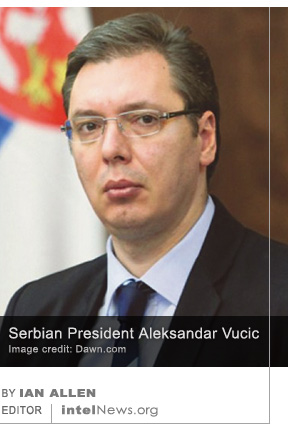
Regular readers of intelNews will recall allegations made last October by authorities in Serbia’s neighboring state of Montenegro —later repeated by Britain— that nationalists from Russia and Serbia were behind a failed plot to kill the country’s then-Prime Minister Milo Dukanović and spark a pro-Russian coup in the country. The allegations surfaced after 20 Serbians and Montenegrins were arrested by police in Montenegro on election day, October 16, as Montenegrins were voting across the Balkan country of 650,000 people. In response to allegations that the coup had been hatched in neighboring Serbia, Serbian Prime Minister Aleksandar Vučić said that he would not allow Serbia to “act as the puppet of world powers”, a comment that was clearly directed at Moscow. Russia has vehemently denied the allegations.

Author: Joseph Fitsanakis | Date: 13 July 2017 | Permalink

Russia allegedly planning to expel 30 American diplomats in a few weeks

US embassy in MoscowRussia is planning to expel approximately 30 American diplomats from its territory, and seize buildings and property belonging to the United States Department of State, according to Russian media reports. The expulsions will be in response to the expulsion last December of 35 Russian diplomats stationed in the US by the administration of President Barack Obama. In addition to expelling the diplomats, Washington also reclaimed two “recreational facilities” (in reality intelligence outposts) that were used by the Russians in New York and Maryland. The White House said that the expulsions were ordered in response to alleged efforts by Russia to interfere in the 2016 US presidential election.

Observers, including the present author, were confident at the time that the Kremlin would respond in kind. In a surprising move, however, the Russian President Vladimir Putin said he would not respond to Mr. Obama’s move, in the hope that US-Russian relations would improve with the arrival of the new president in the White House. He added that Russia reserved the right to retaliate at a later time. Moscow’s response was met with praise by the then-president-elect Donald Trump and his transition team.

But Russia’s hopes for warmer relations with the US under Mr. Trump’s leadership do not seem to be materializing. A recent article in the daily Russian newspaper Izvestia reported that the Kremlin thought it was “outrageous” that the Trump White House had not yet returned the two seized compounds to the Russian Ministry of Foreign Affairs and not rescinded the expulsions of the 35 diplomats and their families. It also claimed that President Putin raised the issue with his US counterpart during their July 7 meeting in the German city of Hamburg. The Moscow-based newspaper quoted unnamed senior Russian officials, who said that Russia was preparing to expel dozens of American diplomats and seize US diplomatic facilities soon.

It appears that Russia will wait until the upcoming meeting between the US Undersecretary of State Thomas Shannon and the Russian Deputy Foreign Minister Sergei Ryabkov, which has been scheduled for later this month in St. Petersburg. If no US assurances for the return of the compounds and diplomats are made at that time, Moscow will proceed with its tit-for-tat plan. When asked about Izvestia’s article, the Russian Minster of Foreign Affairs, Sergei Lavrov, replied that the Kremlin was “weighing specific measures” in response to last December’s expulsions of Russian diplomats from the US. However, Mr. Lavrov said he did not want to elaborate at the present time, while also refusing to deny the newspaper’s allegations.

Author: Joseph Fitsanakis | Date: 12 July 2017 | Permalink