ISIS threatens stability of former Soviet Republics, says Russian spy chief
May 22, 2019 1 Comment
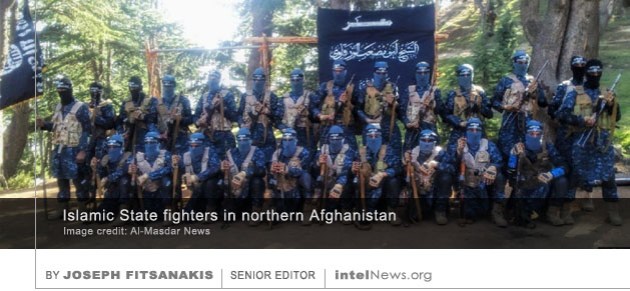
Thousands of Islamic State fighters are operating in Afghanistan’s northern border regions and are attempting to destabilize former Soviet Republics with substantial Muslim populations, according to Russia’s domestic spy chief. This warning was issued by Alexander Bortnikov, director of Russia’s Federal Security Service (FSB), which functions as Russia’s primary counter-terrorism agency. Bortnikov made these remarks during a visit to the capital of Tajikistan, Dushanbe, for a meeting of the heads of intelligence agencies of the Commonwealth of Independent States (CIS), an intergovernmental organization comprised of former Soviet Republics in the Eurasian region. The meeting was reportedly held behind closed doors, but Russia’s government-owned news agency TASS carried a summary of Bortnikov’s remarks.
The Russian intelligence chief said that, with the aid of the intelligence services of CIS states like Uzbekistan, Azerbaijan, Tajikistan, Kyrgyzstan, and others, the FSB was able to uncover and suppress eight Islamic State cells in the past year, which operated in the Central Asian region. However, the reach of the CIS countries does not extend to Afghanistan, said Bortnikov, where as many as 5,000 Islamic State fighters are congregating along the country’s border with three CIS states, namely Turkmenistan, Uzbekistan and Tajikistan. Many of these fighters are Turkmens, Uzbeks, Tajiks, Russians, and other citizens of CIS states, who previously fought with the Islamic State in Syria and elsewhere, and now form integral components of the Islamic State’s fighting force in Afghanistan and Pakistan. It appears that the Islamic State is now attempting to exploit the mountainous and porous borders of northern Afghanistan in order to destabilize neighboring countries, he said. These fighters intend to exploit “migrant and refugee flows [in Central Asia] in order to operate covertly from the Afghan battle zones to neighboring countries” and from there possibly to Russia, according to Bortnikov.
These covert activities of Islamic State fighters have already caused an escalation of tensions in the region and can be expected to continue to do so, as these groups radicalize and co-opt Muslim communities in CIS countries, noted Bortnikov. He added that popular responses to Islamist radicalization are prompting increasing incidents of “anti-Islamic terrorism”, which further-fuel religious and ethnic tensions in the region. As a reminder, last week the Islamic State announced that its so-called Khorasan Province fighters would be amalgamated into a new armed group calling itself Islamic State – Pakistan Province. Earlier this month, the group also proclaimed the establishment of a new overseas province in India’s Jammu and Kashmir state, called “wilayah al-Hind” (province of Hind). In addition to these two forces, there are currently an estimated 3,000 to 4,000 Islamic State fighters in Afghanistan’s Pashtun regions.
► Author: Joseph Fitsanakis | Date: 22 May 2019 | Permalink
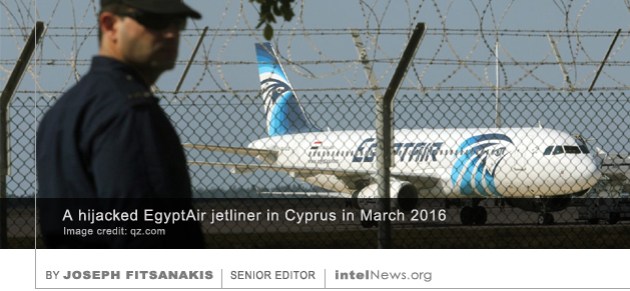 Egypt’s aviation minister has joined the head of Russia’s domestic security service, unnamed US intelligence sources, as well as a host of aviation security experts, in seeing terrorism as the most likely cause behind the EgyptAir MS804 air disaster. That is despite the absence of a clear ‘smoking gun’ and silence from the Islamic State, which leads many to still caution that the possibility of an accident should not be ruled out. The regularly scheduled flight departed Paris, France, late on Wednesday, heading for Cairo, Egypt. But it disappeared from radar screens just minutes after entering Egyptian airspace and is now believed to have crashed into the Mediterranean Sea.







 intelNews.org
Ukrainian spy agency sees plot to oust Putin, but West is skeptical of claim
March 23, 2022 by Joseph Fitsanakis Leave a comment
The initial claim of a coup was made by the Chief Directorate of Intelligence of the Ukrainian Ministry of Defense, which is Kyiv’s military intelligence agency. In a statement, the spy agency alleged that the coup against President Putin was being planned by “a group of influential figures […] among the Russian business and political elite”. The leaders of the group were “siloviki”—members of the Soviet intelligence and military nomenclature, who rose to power in the 1990s alongside Putin, according to the agency.
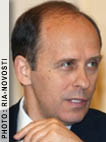
These siloviki were oligarchs, business magnates and politicians from the era of Boris Yeltsin, Putin’s predecessor in the Russian presidency. They were allegedly planning to depose Putin “as soon as possible” in a “palace coup” and replace him with his most senior intelligence advisor, Alexander Bortnikov (pictured). Bortnikov is a Soviet-era intelligence operative who today heads the Federal Security Service (FSB), Russia’s domestic security and counterintelligence agency.
There are reports that Putin blames the FSB’s substandard intelligence for the botched military campaign in Ukraine, and that he and Bortnikov have fallen out as a result. Meanwhile, several Yeltsin-era oligarchs have begun to voice criticism of the war in Ukraine—among them the banking magnate Mikhail Fridman, the metals mogul Oleg Deripaska, and Oleg Tinkov, who owns a network of banking and investment firms in Russia.
However, in a report published on Tuesday, the Voice of America, which is funded by the United States Department of State, said Western intelligence officials remained unconvinced of Ukraine’s claims about a possible coup in Moscow. The news service cited anonymous “Western intelligence sources” as saying they could not see men in Putin’s inner circle having the will or ability to turn against the Russian strongman. Moreover, Kremlin grandees like Bortnikov are not qualitatively different from Putin in how they think about Russian domestic and international strategy, the sources said.
► Author: Joseph Fitsanakis | Date: 23 March 2022 | Permalink
Filed under Expert news and commentary on intelligence, espionage, spies and spying Tagged with 2022 Russian invasion of Ukraine, Alexander Bortnikov, Chief Directorate of Intelligence (Ukraine), coup plots, News, Russia, Ukraine