Nazi official Heinrich Himmler’s daughter worked for West German intelligence
July 2, 2018 Leave a comment
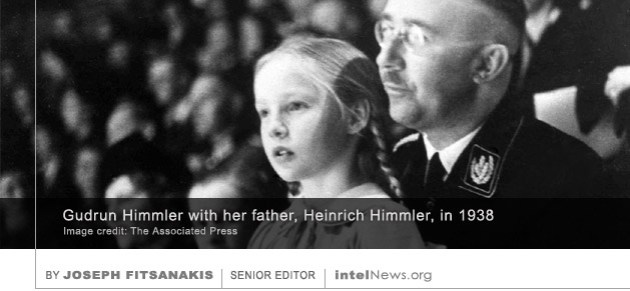 The daughter of Heinrich Himmler, who was second in command in the German Nazi Party until the end of World War II, worked for West German intelligence in the 1960s, it has been confirmed. Gudrun Burwitz was born Gudrun Himmler in 1929. During the reign of Adolf Hitler, her father, Heinrich Himmler, commanded the feared Schutzstaffel, known more commonly as the SS. Under his command, the SS played a central part in administering the Holocaust, and carried out a systematic campaign of extermination of millions of civilians in Nazi-occupied Europe. But the Nazi regime collapsed under the weight of the Allied military advance, and on May 20, 1945, Himmler was captured alive by Soviet troops. Shortly thereafter he was transferred to a British-administered prison, where, just days later, he committed suicide with a cyanide capsule that he had with him. Gudrun, who by that time was nearly 16 years old, managed to escape to Italy with her mother, where she was captured by American forces. She testified in the Nuremberg Trials and was eventually released in 1948. She settled with her mother in northern West Germany and lived away from the limelight of publicity until her death on May 24 of this year, aged 88.
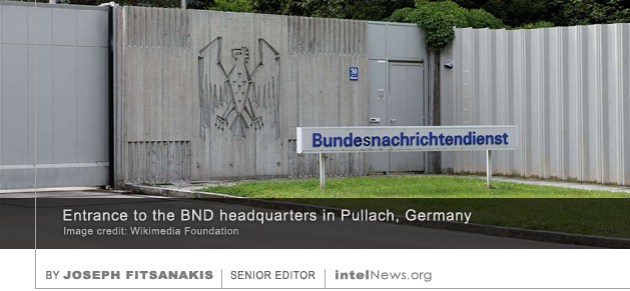
Late last Thursday, an article in the German tabloid newspaper Bild revealed for the first time that Burwitz worked for West Germany’s Federal Intelligence Service (BND) in the early 1960s. The BND continues to operate today as reunited Germany’s main external intelligence agency. According to Bild, Himmler’s daughter had a secretarial post at the BND’s headquarters in Pullach, where the spy agency was headquartered for most of its existence. The paper said that Burwitz managed to be hired by the BND by using an assumed name. In a rare public statement, the BND’s chief archivist, Bodo Hechelhammer, confirmed Bild’s allegations. The archivist, who serves as one of the BND’s official historians, told the newspaper that Burwitz “was an employee of the BND for a number of years, until 1963”, working “under an assumed name”. She was dismissed once the BND began to purge former Nazis from its staff, toward the end of the tenure of its first director, Reinhard Gehlen. Gehlen was a former general and military intelligence officer in the Nazi Wehrmacht, who had considerable experience in anti-Soviet and anti-communist operations. In 1956, in the context of the Cold War, the United States Central Intelligence Agency, which acted as the BND’s parent organization, appointed him as head of the organization, a post which he held from until 1968.
It is believed that Burwitz remained a committed Nazi until the end of her life. She doggedly defended her father’s name and insisted that the Holocaust was an Allied propaganda ploy. It is also believed that she was a prominent member of Stille Hilfe (Silent Help), an underground group of leading former Nazis, which was established in 1945 to help SS officers and other Nazi officials escape prosecution for war crimes. Several German experts on neo-Nazi groups have alleged that Burwitz continued to attend neo-Nazi events and SS reunions throughout Europe, some as recently as 2014. Burwitz is believed to have died in Munich.
► Author: Joseph Fitsanakis | Date: 02 July 2018 | Permalink
 Some North Atlantic Treaty Organization (NATO) member states obtained access to the Soviet Union’s so-called ‘Novichok’ nerve agents in the 1990s, through an informant recruited by German intelligence, according to reports. NATO countries refer to ‘Novichok-class’ nerve agents to describe a series of weaponized substances that were developed by the Soviet Union and post-Soviet Russia from the early 1970s to at least 1993. They are believed to be the deadliest nerve agents ever produced, but Moscow denies their very existence. A type of Novichok agent, described by British scientists as A234, is said to have been used in March of this year by the person or persons who
  Germany’s two most senior intelligence officials have dismissed suggestions by European officials and leaders, including the president of France, to create a Europe-wide intelligence agency. The numerous deadly attacks carried out by Islamic State supporters across Europe in recent years have given rise to calls from various quarters for the establishment of a new intelligence service that would combine resources from every member-state of the European Union. Last month, the European Union’s Commissioner for Migration, Home Affairs and Citizenship, Dimitris Avramopoulos,
  Germany’s most famous living spy is on trial this week for hiding assets totaling $50 million in offshore bank accounts. He claims the money was given to him by unspecified “Western intelligence agencies” for his services. Werner Mauss became widely known in 1997, when he was arrested in Colombia for using a forged passport. He had traveled to the Latin American country to secure the release of a German woman who had been kidnapped by leftist guerrillas. The Colombian authorities eventually released him, following heavy diplomatic pressure from the German government. But the German media began investigating his background, and it soon became apparent that he was working for the German Federal Intelligence Service.
 The foreign intelligence service of Germany spied on at least 4,000 targets in the United States from 1998 until 2006, according to a leaked document published yesterday by leading German newsmagazine Der Spiegel. The German investigative weekly said that the surveillance was carried out by the German Federal Intelligence Service, known as BND. The Hamburg-based magazine claimed to have in its possession a list of approximately 4,000 “selector keywords”, unique distinguishing terms, addresses or numbers that identify individual targets for surveillance. The list allegedly includes names, telephone or fax numbers, and email addresses of people that the BND had identified as worthy of individual attention between 1998 and 2006.
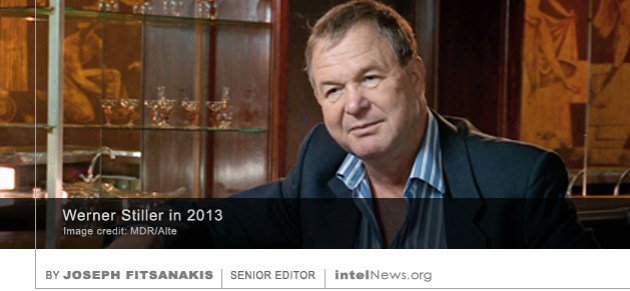 Werner Stiller, also known as Klaus-Peter Fischer, whose spectacular defection to the West in 1979 inflicted one of the Cold War’s most serious blows to the intelligence agency of East Germany, has died in Hungary. Stiller, 69, is believed to have died on December 20 of last year, but his death was not
  Earlier this week, it was
  German intelligence and security agencies have publicly rejected a direct request made by Turkey’s intelligence chief to gather information on Turks who are living in Germany and are critical of the Turkish government. The request reportedly relates to attempts by the Turkish government to round up its critics, following a failed military coup in July of last year. The government of Turkish President Recep Tayyip Erdoğan accuses members of the so-called Gülen movement of orchestrating the coup, which included an armed attack on the country’s parliament and the murder of over 200 people across Turkey. The Gülen movement consists of supporters of Muslim cleric Fethullah Gülen, who runs a global network of schools, charities and businesses from his home in the United States. The government of Turkey has designated Gülen’s group a terrorist organization and claims that its members have stealthily infiltrated state institutions since the 1980s.
 The Turkish government has sent an official request to German intelligence for assistance in cracking down on the members of the so-called Gülen movement, which Ankara claims is behind July’s failed coup plot. The movement consists of supporters of Muslim cleric Fethullah Gülen, who runs a global network of schools, charities and businesses from his home in the United States. The government of Turkey has designated Gülen’s group a terrorist organization and claims it has stealthily infiltrated state institutions since the 1980s. The administration of Turkish President Recep Tayyip Erdoğan accuses Gülen’s supporters of orchestrating the July 15 coup that included an armed attack on the country’s parliament and the murder of over 200 people across Turkey.
 A major parliamentary inquiry into the operations of Germany’s main intelligence agency has concluded that it spied on nearly 3,500 foreign targets in recent years, most of which belonged to allied countries. The inquiry was initiated by the German government in response to a number of recent public controversies involving the Bundesnachrichtendienst, Germany’s Federal Intelligence Service, known as BND.
 The senior executive body of the German government has approved draft legislation that reforms the country’s intelligence services, following revelations that Germany helped the United States spy on European states. The legislation is seen as a response by the German government to a number of recent public controversies involving the Bundesnachrichtendienst, Germany’s Federal Intelligence Service, known as BND.






 intelNews.org
German chancellor inaugurates world’s largest spy agency headquarters in Berlin
February 13, 2019 by Ian Allen 8 Comments
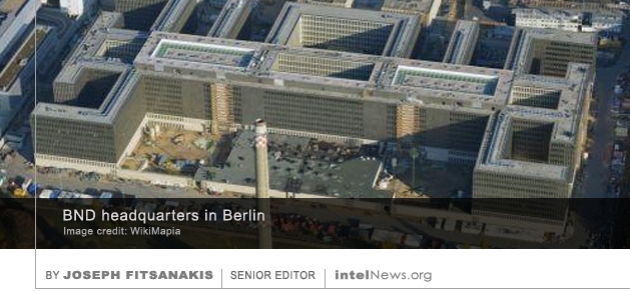
Until recently, the BND was headquartered in the outskirts Munich, in the southern German state of Bavaria. But as of last week, the spy agency has officially moved to its new headquarters in downtown Berlin. The massive new complex is located in the German capital’s affluent Mitte district, just a stone’s throw from a section of what used to be the Berlin War —a major symbol of the Cold War. The new complex spans 3 million sq. ft., making it the largest headquarters of any intelligence agency in the world. The United States Central Intelligence Agency’s headquarters at Langley, Virginia, comes a close second. Construction on the site in Mitte began in 2006 and was initially scheduled for completion in 2011, but was finally finished in 2017, 12 years after it began. It cost approximately €1 billion ($1.13 billion). British newspaper The Guardian reports that the new complex consists of 20,000 tons of steel and has 14,000 windows and 12,000 doors. The land on which the new BND headquarters is built used to be the site of police barracks, until it was heavily damaged by bombing carried out by the Allied forces in 1945. Following the partition of Germany, East German authorities built a sports complex and stadium on the site, which was demolished in 1999, in preparation for Germany’s unsuccessful bid to host the 2000 Summer Olympic Games.
According to reports in the German media, just over 3,000 BND employees have already relocated from Munich to the new BND headquarters, while another 800 are expected to relocate there in the coming year. During her speech on Friday, Chancellor Merkel said that the world was becoming “increasingly confusing”, which made the need for a “strong and efficient [German] foreign intelligence service […] more urgent than ever”. Interestingly, the new complex features a sizeable visitor’s center that is open to the public, making the BND the world’s first foreign intelligence agency with a public-access visitors’ facility.
► Author: Ian Allen | Date: 13 February 2019 | Permalink
Filed under Expert news and commentary on intelligence, espionage, spies and spying Tagged with Berlin, BND, Germany, News