Mexican drug cartel uses explosives-laden drones to attack police force
April 22, 2021 Leave a comment
 ONE OF MEXICO’S MOST powerful drug cartels has reportedly used drones to attack police officers with explosives, according to local media reports. If confirmed, this incident will mark the first recorded use of drones by a Mexican drug cartel to attack law enforcement.
There is little public information about the attack. It reportedly occurred in El Aguaje, a small community in the state of Michoacán, located 350 miles west of Mexico City. The region is the birthplace of drug kingpin Nemesio Oseguera Cervantes. Otherwise known as “El Mencho”, Cervantes heads the Jalisco New Generation Cartel (CJNG), one of Mexico’s most powerful. For the past month, the CJNG has engaged in a fierce and bloody war against a rival cartel, Cárteles Unidos (United Cartels) for control of the Michoacán region. The war has forced hundreds of residents to evacuate the area, according to local reports.
On Tuesday, a police unit was deployed along the Apatzingán-Aguililla highway to clear up a number of blockades that the cartels had put in place in order to impede each other’s operations. As they were clearing and repairing the highway, members of the police unit were reportedly attacked with at least two explosives-laden drones. Two officers were injured and were sent to hospital, but recovered fully and were released later on the same day.
No cartel has claimed responsibility for the attack. However, police sources said that the design of the drones used in Tuesday’s attack was very similar to two drones that were found in August of 2020 in Tepalcatepec, another city in the state of Michoacán. The drones were found inside an armored vehicle that CJNG members had abandoned during a failed attempt to raid Tepalcatepec, according to local media reports. The drones had built-in remote detonators and were attached to plastic containers that had been filled with C4 explosive and ball bearings, according to reports.
► Author: Joseph Fitsanakis | Date: 22 April 2021 | Permalink
 THE DIRECTOR OF AFGHANISTAN’S main intelligence agency warned on Monday that the Taliban are for the first time resorting to using drones in order to carry out attacks against the Afghan government. Groups such as the Islamic State in Syria, and Houthi rebels in Yemen, have been using modified drones to drop makeshift bombs on enemy targets since at least 2016. But the Taliban have not previously been known to make use of such weapons.
 An Australian far-right militant, who killed 51 people at two mosques in New Zealand in 2019, used a commercial drone to spy on his targets and plan his attack months in advance, according to newly released information. On March 15, 2019, Brenton Tarrant killed a total of 51 people at the Al Noor and Linwood mosques, in the city of Christchurch. Using an AR-15 rifle, Tarrant, 29, shot his victims one by one, before being stopped by police as he was on his way to a third mosque in the area.
 United States officials are considering increasing substantially America’s intelligence-sharing with Saudi Arabia following last weekend’s drone attacks that halved the Kingdom’s oil production and shook global markets. The attacks occurred in the early hours of Saturday, September 14, at two refineries located in eastern Saudi Arabia. The refineries are owned by Aramco, Saudi Arabia’s government-owned oil conglomerate, and are part of the world’s largest crude oil processing facility. The massive fires caused by the attacks were contained within hours and no casualties were reported. But the facilities had to cease operation so that repairs could be completed. This cut Saudi Arabia’s oil production by close to 50 percent, which amounted to a 5 percent reduction in global oil production. The impact on the world’s financial markets was immediate: by Monday morning, oil prices had seen their most significant one-day surge since the 1991 Gulf War.
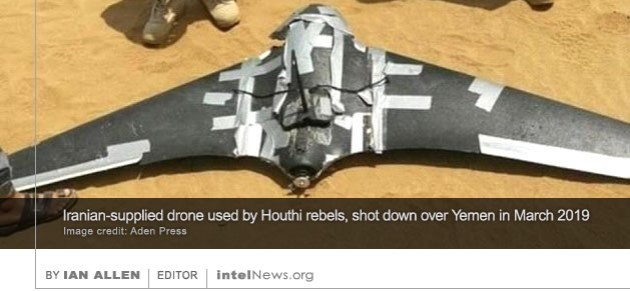 The current wars in the Middle East, especially the ongoing conflict in Yemen, are proof that the use of small drones in insurgencies is now a permanent phenomenon of irregular warfare, according to experts. Drones have been
  On the heels of chaotic scenes at Britain’s Gatwick Airport, which






 intelNews.org
US government report details first-ever drone attack on energy grid
November 5, 2021 by Joseph Fitsanakis 3 Comments
A REPORT ISSUED BY the United States government last month provides details of what is thought to be the first known attack on the country’s energy infrastructure by an unmanned aircraft system. The report appears in a Joint Intelligence Bulletin (JIB) dated October 28, 2021. The JIB is a collaborative intelligence product of the Department of Homeland Security, the Federal Bureau of Investigation and the National Counterterrorism Center.
The report documents an apparent drone attack that took place on July 16, 2020. The target of the attack was an electrical substation in the state of Pennsylvania. The document does not provide details about the geographic location of the attack, nor does it identify the substation that was targeted. It does, however, give details about the type of commercial drone that was used, which it identifies as a Chinese-built DJI Mavic 2. The DJI Mavic 2 is a compact quadcopter drone, which is popular among aerial photography enthusiasts in the United States. It costs between $1,300 and $4,450, depending on its design and amount of features.
The specific device used in the attack in Pennsylvania had been modified by its operator, most likely in order to cause a short circuit and damage the distribution lines or transformers it came in contact with. The device had a thick copper wire hanging from its body, which was attached with nylon cords. Additionally, the perpetrator of the attack had taken steps to anonymize the device, be removing its quality control markings and other identifying information from it. The camera and internal memory card, which are standard technical features of DJI Mavic 2 drones, had also been removed, according to the report. As a result, the operator of the device has not been identified.
The report concludes that illicit [drone] activity is expected “to increase over energy sector and other critical infrastructure facilities as use of these systems in the United States continues to expand”.
► Author: Joseph Fitsanakis | Date: 05 November 2021 | Permalink
Filed under Expert news and commentary on intelligence, espionage, spies and spying Tagged with 0 Canada's ex-intel boss slams new anti-terrorism measures, commercial drones, energy networks, News, terrorism, United States