Did domestic snooping by Canadian spy agency increase 26-fold in a year?
August 25, 2016 1 Comment
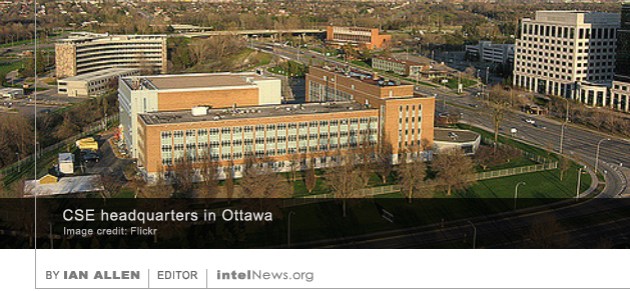 The volume of domestic communications that were intercepted by Canada’s spy agency increased 26 times between 2014 and 2015, according to a recently released report by a government watchdog. The same report states that intercepted information about Canadian citizens, which is given to Canada’s spy agency by the intelligence organizations of other Western countries, has increased so much that it now requires an elaborate mechanism to analyze it. When asked to explain the reasons for these increases, Canadian government officials said they could not do so without divulging secrets of national importance.
Information about these increases is contained in the latest annual report by the Office of the Commissioner of the Communications Security Establishment. The body was set up in 1996 to review the operations of the Communications Security Establishment (CSE). Founded in 1946, CSE is Canada’s primary signals intelligence agency. It is responsible for interception foreign communications while at the same time securing the communications of the Canadian government. The Office of the Commissioner monitors CSE’s activities and ensures that they conform with Canadian law. It also investigates complaints against the CSE’s conduct of and its officers.
Canadian law forbids the CSE from intercepting communications in which at least one of the parties participating in the exchange is located in Canada. If that happens, the message exchange is termed “private communication” and CSE is not allowed to intercept it, unless it gets written permission from Canada’s National Defense minister. Such permission is usually given only if the interception is deemed essential to protect Canadian national security or national defense. If a “private communication” is inadvertently intercepted, CSE is required to take “satisfactory measures” to protect the personal privacy of the participant in the exchange that is located inside Canada.
According to the CSE commissioner’s report for 2015, which was released in July, but was only recently made available to the media, CSE intercepted 342 “private communications” in 2014-2015. The year before, the spy agency had intercepted just 13 such exchanges. The report states that all 342 instances of interception during 2014-2015 were either unintentional or critical for the protection of Canada’s security. It further states that the reason for the huge increase is to be found in “the technical characteristics of a particular communications technology and of the manner in which private communications are counted”.
Canadian newspaper The Ottawa Citizen asked the CSE commissioner, Jean-Pierre Plouffe, to explain what he meant by “technical characteristics of a particular communications technology” in his report. His office responded that the commissioner could not explain the subject in more detail, because doing so would “reveal CSE operational capabilities” and thus hurt Canada’s national security. The newspaper also contacted CSE, but was given a similar answer. Some telecommunications security experts speculate that the increase in intercepted “private communications” may be due to exchanges in social media, whereby each message is counted separately.
► Author: Ian Allen | Date: 25 August 2016 | Permalink
 Canada says it will stop sharing certain types of intelligence with some of its closest international allies until it ensures that Canadian citizens’ information is not included in the data given to foreign spy agencies. The announcement follows an official admission, made earlier this week, that a Canadian intelligence agency failed to remove Canadian citizens’ data from information it shared with member-agencies of the so-called Five Eyes Agreement. The pact, which is sometimes referred to as the UK-USA Security Agreement, has been in existence since World War II. It provides a multilateral framework for cooperation in signals intelligence (SIGINT) between the United Kingdom, the United States, Canada, Australia, and New Zealand.









 intelNews.org
Election meddling by foreign powers already underway, says Canadian spy agency
April 9, 2019 by Joseph Fitsanakis 3 Comments
The foreign intelligence agencies behind the efforts to manipulate Canada’s electoral process have systematically attempted to “polarize Canadians or undermine Canada’s foreign policy goals”, says the report. These efforts will continue and intensify in the run-up to October, claims the report, and concludes by warning that Canadians should expect to “encounter some form of foreign cyber interference ahead of, and during, the 2019 federal election”. However, foreign cyber interference on the scale that was experienced in the months leading up to the 2016 presidential election in the United States is improbable, according to the CSE.
Meanwhile, in an unrelated development, the former director of the Canadian Security Intelligence Service (CSIS), Canada’s primary national intelligence service, said in an interview last week that Ottawa would have to be patient in dealing with Russia and —especially— China. Speaking at a public forum hosted by the Canadian International Council in Vancouver, Richard Fadden noted that neither China nor Russia wish to go to war with the West. What they want instead is to “fragment the West” and thus increase their own influence on the international scene, said Fadden, who directed the CSIS from 2009 to 2013. It would be fair for Canada to “poke back”, he said, but would have to be “careful how [to] do it”, he added. “We need to be realistic. We’re dealing with an emergent superpower and […] we’re going to have to be patient”, Fadden concluded.
► Author: Joseph Fitsanakis | Date: 09 April 2019 | Research credit: C.D. | Permalink
Filed under Expert news and commentary on intelligence, espionage, spies and spying Tagged with Canada, Communications Security Establishment (Canada), CSIS (Canada), News, Richard Fadden, social networking