US troops in Syria battle anti-Assad rebels once funded by the CIA
August 30, 2017 1 Comment
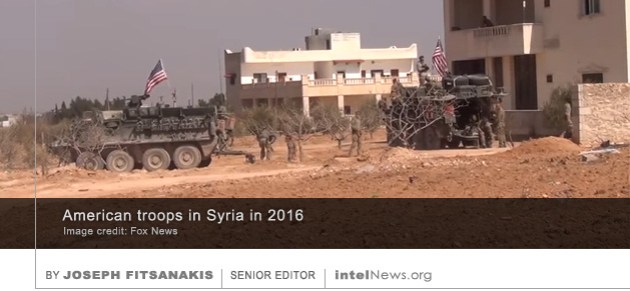 American troops deployed in Syria have exchanged fire with rebels that were until recently supported by the United States Central Intelligence Agency. In 2013, soon after the outbreak of the Syrian Civil War, the then-US President Barack Obama instructed the Central Intelligence Agency to provide covert support to fighters in Syria. Acting on the president’s directive, the CIA promptly joined forces with spy agencies from Britain, France, Saudi Arabia and the United Arab Emirates, to assist fighters affiliated with the Free Syrian Army. At that time, Washington saw the Free Syrian Army and forces affiliated with it as ideologically moderate. It also agreed with the group’s main aim, which was to topple the regime of Syrian President Bashar al-Assad.
Under the project, which was codenamed TIMBER SYCAMORE, CIA personnel trained Free Syrian Army fighters in irregular warfare, while also providing them with light weaponry including machine guns, sniper rifles and off-road vehicles. But on July 19 of this year, US President Donald Trump abruptly ended the CIA program, which he called “dangerous and wasteful”. It soon became apparent that many Free Syrian Army soldiers approached Turkey, seeking financial income and protection. By early August, there were reports from Syria that large groups of former Free Syrian Army troops were conducting raids in northern Syria in coordination with the Turkish military.
Early on Wednesday, a spokesman for the Combined Task Force Operation Inherent Resolve told reporters that US troops in Syria had come under fire by Turkish-commanded former Free Syrian Army units. The spokesman told reporters in Kuwait City that the rebels shot at US troops in the outskirts of Manbij, a northern Syrian city of about 70,000, located a few miles from the Turkish border. The American soldiers reportedly returned fire before seeking shelter from the assault. According to the US Pentagon, the Turkish government was promptly contacted by Inherent Resolve commanders, who described the incident as “not acceptable”. Washington alleges that its troops have come under fire “multiple times” in the past month. Some of the culprits are believed to be Turkish-controlled Syrian insurgents, including former members of the Free Syrian Army.
Turkey and the US are member states of the North Atlantic Treaty Organization. But the two countries do not follow a common policy on Syria. The US Pentagon supports Kurdish insurgents in Syria, which Turkey claims are connected with Kurdish separatists inside Turkey. Washington’s official position on Kurdish separatists is that they engage in terrorism against the Turkish state.
► Author: Joseph Fitsanakis | Date: 30 August 2017 | Permalink
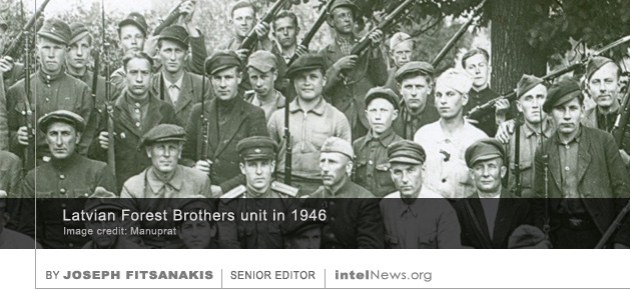 The role of the CIA in funding and helping to organize anti-Soviet groups inside the USSR has been known for decades. But, as intelNews explained in
 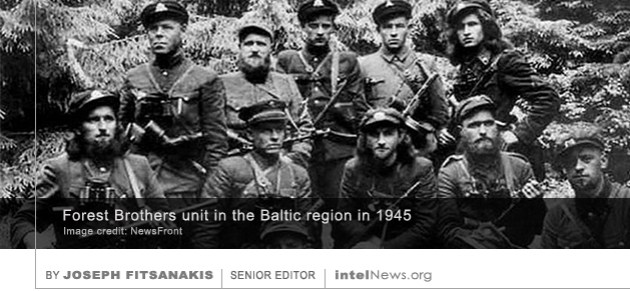 Recently declassified documents from the archive of the Central Intelligence Agency detail financial and material support given by the United States to groups of armed guerrillas in Soviet Latvia in the 1950s. The documents, initially marked ‘Top Secret’ but now declassified, show that the CIA was aware and supported the activities of an anti-Soviet guerrilla army known as ‘the Forest Brothers’. Known also as ‘the Forest Brethren’, the group was formed in the Baltic States in 1944, as the Soviet Red Army established Soviet control over the previously German-occupied states of Estonia, Latvia and Lithuania. The Soviet Union had previously occupied and annexed the three Baltic countries, in a failed attempt to pre-empt Germany’s eastward military expansion. Groups like the Forest Brothers consisted of the most militant members of anti-Soviet groups in the Baltic States, many of whom were ideologically opposed to Soviet Communism.
 The decision by the White House to terminate American support for rebels in war-torn Syria could backfire by causing the suddenly unemployed fighters to join jihadist organizations, according to experts. The United States’ support for the rebels began in secret in early 2013, after the then US President, Barack Obama, instructed the Central Intelligence Agency to provide covert support to fighters in Syria. The CIA then joined forces with spy agencies from Britain, France, Saudi Arabia and the United Arab Emirates, to assist fighters affiliated with the Free Syrian Army. At that time, Washington saw the Free Syrian Army and forces affiliated with it as ideologically moderate. It also agreed with the group’s main aim, which was to topple the regime of Syrian President Bashar al-Assad.
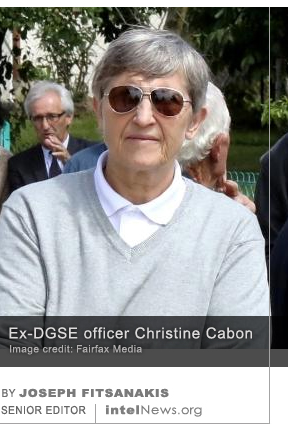 A French spy who infiltrated the environmentalist group Greenpeace and in 1985 helped bomb the organization’s flagship, the Rainbow Warrior, has spoken to the media for the first time. The British-based activist organization had purchased the trawler from the British government in 1977 and used it to carry out maritime research and other operations. In July 1985, the Rainbow Warrior, captained by the American environmental activist Peter Wilcox, was docked at the port of Auckland, New Zealand. It was being prepared to lead a flotilla of vessels to the French Polynesian atoll of Mororoa, in order to try to stop a planned nuclear test by the French military.
 Fifty years after the 1965 Indo-Pakistani War, Pakistani former soldiers have spoken for the first time about their role in a secret effort by Pakistan to infiltrate India and incite a Muslim uprising. The conflict between India and Pakistan over Jammu and Kashmir is largely rooted in Britain’s decision to partition its former colonial possession into mainly Hindu India and Pakistan, a mostly Muslim state. As soon as the British withdrew in 1947, the two states fought a bloody war that culminated in a violent exchange of populations and led to the partition of Kashmir. Today India controls much of the region, which, unlike the rest of the country, is overwhelmingly Muslim. Indian rule survived an uprising by some of the local population in August 1965, which led to yet another war between the two countries, known as the 1965 Indo-Pakistani War.
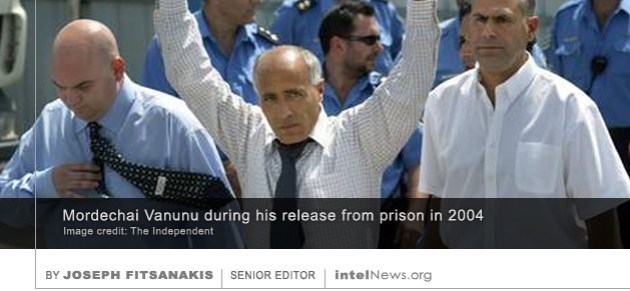 Israeli nuclear whistleblower Mordechai Vanunu, who spent 18 years in prison for revealing the existence of Israel’s nuclear program, has spoken for the first time about his 1986abduction by the Mossad in Rome. Vanunu was an employee at Israel’s top-secret Negev Nuclear Research Center, located in the desert city of Dimona, which was used to develop the country’s nuclear arsenal. But he became a fervent opponent of nuclear proliferation and in 1986 fled to the United Kingdom, where he revealed the existence of the Israeli nuclear weapons program to the The Times of London. His action was in direct violation of the non-disclosure agreement he had signed with the government of Israel; moreover, it went against Israel’s official policy of ‘nuclear ambiguity’, which means that the country refuses to confirm or deny that it maintains a nuclear weapons program.
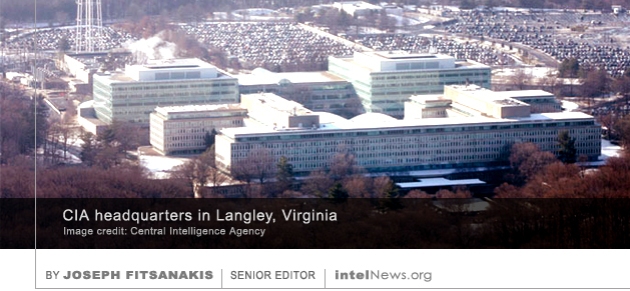 American Congressional lawmakers have voted to cut funding for the Central Intelligence Agency’s secret operations in Syria, in a surprise move that indicates growing concern on Capitol Hill with Washington’s strategy on the Syrian Civil War. The CIA’s involvement in the Syrian Civil War began in 2012, when US President Barack Obama







 intelNews.org
British intelligence already sees Kremlin behind ex-spy’s poisoning, say sources
March 6, 2018 by Joseph Fitsanakis 5 Comments
Since Skripal’s poisoning made headlines on Monday morning, the basic details of his story have been reported extensively. He is believed to have served in Soviet and Russian military intelligence for several decades, rising to the rank of colonel. But in 2004 he was arrested and eventually convicted by Russian authorities for spying on behalf of the British Secret Intelligence Service (MI6). He had served nearly 7 years of a 13-year sentence in 2010, when he was pardoned by then-Russian President Dmitry Medvedev and allowed to resettle in England with his immediate family. He did so in Salisbury, where he was found in a near-fatal state last Sunday, slumped on a street bench next to his equally catatonic daughter. Inevitably, the story brought back memories of the assassination of Alexander Litvinenko, a former officer in the Soviet and Russian intelligence services, who defected to Britain but was poisoned to death with a radioactive substance in 2006. His murder prompted London to expel four Russian diplomats from Britain, a move that was countered by Moscow, which also expelled four British diplomats from the country.
Despite the close parallels between Litvinenko and Skripal, the British government has not publicly blamed Russia for Sunday’s attempted killing. But according to The Times newspaper, officials at the Security Service (MI5), Britain’s counterintelligence agency, are already pointing to Russia as the culprit of the attempt on Skripal’s life. The London-based paper cited anonymous sources in Whitehall, the administrative headquarters of the British government, who said that MI5 experts were already briefing government officials about the details of the assassination attempt by Russian government agents.
Actions taken by the British government in the past 24 hours also point to Whitehall viewing the attempt on Skripal’s life as an operation sponsored by a state, most likely by Russia. The investigation of the incident is now being led by the counterterrorism branch of the Metropolitan Police Service in London. Additionally, samples of the victims’ tissue, as well as blood and other bodily fluids, have been sent for examination by toxicologists at the Ministry of Defence’s top-secret Science and Technology Laboratory in Porton Down. It also emerged last night that British Home Secretary Amber Rudd has called an emergency meeting of the British government’s Cabinet Office Briefing Rooms (COBR, also known as Cobra) group, which she chairs. The group consists of cabinet ministers, senior civil servants, and the leadership of the Metropolitan Police and the intelligence services, who meet to respond to developing emergencies of a national scale.
► Author: Joseph Fitsanakis | Date: 06 March 2018 | Permalink
Filed under Expert news and commentary on intelligence, espionage, spies and spying Tagged with assassinations, covert action, imprisoned spy swaps, News, Russia, Sergei Skripal, UK