July 31, 2015
by Joseph Fitsanakis
 In 2007 I wrote in my “National Security Agency: The Historiography of Concealment” that America’s leading signals intelligence agency had made a secret deal with Crypto AG, a Swiss-based manufacturer of cryptographical equipment. The agreement, which lasted for much of the Cold War, allegedly allowed the NSA to read the classified messages of dozens of nations that purchased encoding equipment from Crypto AG. As I expected, the claim drew criticism from individuals connected with Crypto AG, including company scientists, who argued that the Swiss manufacturer would never have agreed to a deal that undermined its professional reputation as a trusted and neutral vendor of cryptological devices. Now, however, the BBC has revealed two recently declassified NSA memos that appear to provide further proof of the deal.
My 2007 claim was based on a string of well documented allegations that surfaced in the early 1980s. While conducting research for his seminal book The Puzzle Palace, historian James Bamford came across references to Project BORIS, which involved a pact between the NSA and the Swiss company. To be precise, the deal appeared to have been struck between the Swiss inventor and Crypto AG founder Boris Hagelin and William F. Friedman, an American cryptologist who led the Armed Forces Security Agency, a forerunner of the NSA. The two men were united by a deep personal friendship, which was forged during World War II by their mutual hatred of Nazism.
Bamford’s claim was echoed in 1996 by Scott Shane and Tom Bowman, reporters for The Baltimore Sun. In a six-part investigative series about the NSA, the two journalists wrote that Friedman visited Hagelin during a trip to Switzerland in 1955 and asked for his help so that American could dominate its Cold War rivals. According to Shane and Bowman, Hagelin agreed and built a type of cryptological backdoor in Crypto AG’s devices, which allowed the NSA to read millions of messages for many decades. The company, of course, reacted furiously, saying that claims of a secret deal were “pure invention”.
On Thursday, however, BBC security correspondent Gordon Corera confirmed that a BBC investigation of 55,000 pages of documents, which were declassified by the NSA in April, claim to have found proof of the secret agreement. The declassified material, said Corera, contains two versions of the same NSA memorandum, as well as an earlier draft, which refer to a “gentleman’s agreement” between Friedman and Hagelin. Under the agreement, Crypto AG would inform the NSA about periodical changes to the technical specifications of its encoding machines. The company would also provide the American spy agency with detailed lists showing the precise models purchased by various national governments around the world. Furthermore, Crypto AG agreed not to sell the more advanced, customizable models of its equipment to countries viewed by Washington as directly adversarial. This, says the BBC, amounted to Crypto AG deceiving some of its customers, by offering them “watered-down versions” of its encoding devices.
Corera notes that there is no evidence in the memos that Crypto AG built any kind of back door in its devices for use by the NSA. Instead, by providing the American agency with detailed operational knowledge of the devices, it enabled American codebreakers to reduce the time and effort needed to break encoded messages intercepted by the NSA.
There are a couple of minor errors in Corera’s article. For instance, the “father of American code-breaking” is not Friedman, as he claims, but Herbert Yardley, who led the so-called Black Chamber (also known as the Cipher Bureau) in 1919, long before Friedman was in the picture. Additionally, he fails to mention Bowman’s contribution to Shane’s Baltimore Sun article, which was published in 1996, not 1995, as he writes. These minor errors aside, however, the BBC discovery is absolutely crucial for our understanding of cryptological history in the Cold War.
► Author: Joseph Fitsanakis | Date: 31 July 2015 | Permalink
 • Dutch spies helped Britain break Argentine crypto during Falklands War. Flowing from revelations made earlier this year that Swiss cipher machine company Crypto AG was owned by the CIA and its German counterpart the BND during most of the Cold War, an academic paper has described the Maximator alliance which grew from the Crypto AG compromise. Authored by Professor Bart Jacobs of Radboud University Nijmegen in the Netherlands, the article argues that Dutch spies operating as a part of the Maximator alliance helped Britain’s GCHQ break Argentinian codes during the Falklands War.
 Switzerland’s Federal Department of Finance has filed a criminal complaint “against persons unknown” over media reports that a leading Swiss-based cryptological equipment manufacturer was secretly owned by the United States Central Intelligence Agency (CIA).
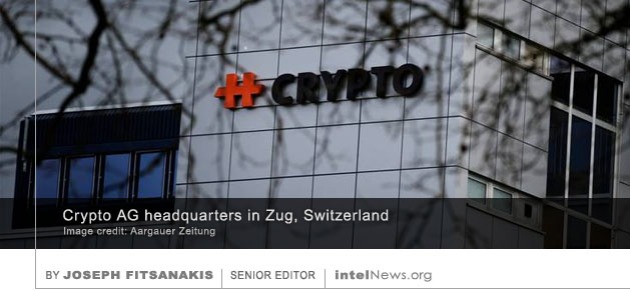 Switzerland is reeling from the shock caused by revelations last week that Crypto AG, the world’s leading manufacturer or cryptologic equipment during the Cold War, whose clients included over 120 governments around the world, was a front company owned by the United States Central Intelligence Agency.






 intelNews.org
Swiss intelligence chief to step down following dispute over Crypto AG spy scandal
May 13, 2021 by Joseph Fitsanakis 2 Comments
THE DIRECTOR OF SWITZERLAND’S spy service will step down once his mandate ends in August, allegedly over a dispute with the country’s governing council about the Crypto AG affair, which shook Swiss politics last year. Jean-Philippe Gaudin headed Switzerland’s Military Intelligence Service from 2008 to 2015. He then served as a defense attaché at the Swiss embassy in Paris, France, before being appointed by the then-Defense Minister, Guy Parmelin as director of the Federal Intelligence Service (FIS). Founded in 2010, the FIS performs both domestic and external intelligence functions in the Alpine state.
But, according to reports in the Swiss media, Gaudin is not expected to continue in his post once his mandate ends, on August 31. The reason seems to be tensions within the Swiss government over the so-called Crypto AG affair. The scandal centers on the world’s leading manufacturer of cryptologic equipment during the Cold War, Crypto AG, whose clients included over 120 governments around the world. In February of last year, The Washington Post and the German public broadcaster ZDF confirmed reports that had been circulating since the early 1980s, that Crypto AG was a front for American intelligence. According to the revelations, the Central Intelligence Agency and West Germany’s Federal Intelligence Service secretly purchased the Swiss company in the 1950s and paid off most of its senior executives in order to buy their silence.
The secret deal, dubbed Operation RUBICON, allegedly allowed the US and West Germany to spy on the classified government communications of many of their adversaries —and even allies, including Austria, Italy, Spain, Greece, Jordan, Saudi Arabia and the United Arab Emirates. The revelation about the secret deal shocked Swiss public opinion and embarrassed the government of a nation that bases its national identity and international reputation on the concept of neutrality.
Earlier this year, a parliamentary report into the Crypto AG affair concluded that Gaudin had essentially mishandled the case and had waited too long to inform the nation’s leadership about it. Gaudin’s behavior resulted in tension in his relationship with the Swiss Federal Council —a seven-member executive body that forms the federal government and serves as the collective decision-making body of the Swiss Confederation. According to reports, the spy chief’s relationship with Switzerland’s Defense Minister, Viola Amherd, is beyond repair, and the minister has been pushing for his resignation for several months.
In a statement released on Wednesday, the Swiss government gave no reason for Gaudin’s pending career change, saying only that the spy chief would move on to “new challenges” in the private sector. He will reportedly be replaced by Juerg Buehler, who will serve as interim director of the FIS until further notice. Neither the FIS nor Gaudin have made public comments about this sudden development.
► Author: Joseph Fitsanakis | Date: 13 May 2021 | Permalink
Filed under Expert news and commentary on intelligence, espionage, spies and spying Tagged with Crypto AG, FIS (Switzerland), Jean-Philippe Gaudin, Juerg Buehler, News, resignations, Switzerland, Viola Amherd