Cold-War-era Soviet spy George Blake issues rare statement from Moscow
November 15, 2017 2 Comments
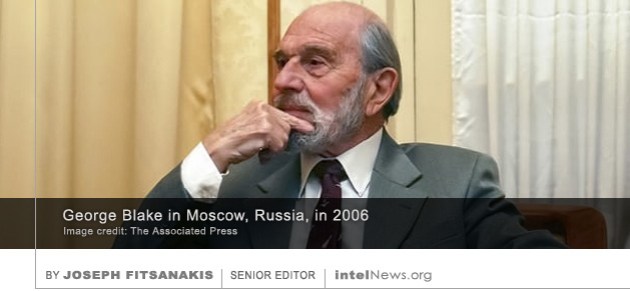 One of the Cold War’s most recognizable spy figures, George Blake, who escaped to the Soviet Union after betraying British intelligence, issued a rare statement last week, praising the successor agency to Soviet-era KGB. Blake was born George Behar in Rotterdam, Holland, to a Dutch mother and a British father. Having fought with the Dutch resistance against the Nazis, he escaped to Britain, where he joined the Secret Intelligence Service, known as MI6, in 1944. He was serving in a British diplomatic post in Korea in 1950, when he was captured by advancing North Korean troops and spent time in a prisoner of war camp. He was eventually freed, but, unbeknownst to MI6, had become a communist and come in contact with the Soviet KGB while in captivity. Blake remained in the service of the KGB as a defector-in-place until 1961, when he was arrested and tried for espionage.
After a mostly closed-door trial, Blake was sentenced to 42 years in prison, which at that time was the longest prison sentence ever imposed in Britain. However, he managed to escape in 1966, with the help of Irish republican prisoners in London’s Wormwood Scrubs prison, where he was serving his sentence. With the help of Soviet intelligence, Blake made his way to France and from there to Germany and East Berlin, hiding inside a wooden box in the back of a delivery van. He eventually resurfaced in Moscow, where he has lived ever since, in a small, government-provided dacha (Russian cottage) located on the outskirts of the Russian capital.
Last Friday, Blake issued a statement on the eve of his 95th birthday. The statement was posted on the SVR’s official website and published by several Russian news agencies. The convicted spy said that he placed his hopes for the peace of mankind on the “men and women” of Russia’s Foreign Intelligence Service —the main institutional descendant of the Soviet KGB. Blake praised the SVR’s officers as “heroes” who are engaged in “a true battle between good and evil” at a time when “the danger of nuclear war and the resulting self-destruction of humankind” is a real threat. The spy added that the prospect of nuclear annihilation has been “put on the agenda by irresponsible politicians”, in what Russian news agencies interpreted as a comment that was directed against United States President Donald Trump.
The end of Blake’s statement is followed by a second statement, written by the Director of the SVR, Sergei Naryshkin. Naryshkin, who was appointed to his current post by Russian President Vladimir Putin a year ago, congratulates Blake on his 95th birthday and calls him a “reliable old comrade” and “a man of great wisdom”. Blake is “a proficient teacher”, says Naryshkin, who has been a longtime role model for the officers of the SVR.
► Author: Joseph Fitsanakis | Date: 15 November 2017 | Permalink








 intelNews.org
George Blake, arguably the most prolific Soviet spy of the Cold War, dies at 98
December 28, 2020 by Joseph Fitsanakis 3 Comments
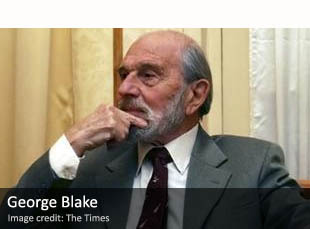
Blake was nearly 18 when German troops entered his native Holland, prompting him to join the local anti-Nazi resistance forces. A British subject thanks to his Egyptian Jewish father, who had acquired British citizenship by fighting in British uniform during World War I, Blake eventually made his way to London via neutral Spain and Gibraltar. Within two years, he had been recruited by the Secret Intelligence Service, or MI6, and by war’s end he was working in its Dutch Section.
Named after King George by his fiercely pro-British and royalist father, Blake drew no suspicion by his MI6 colleagues. He was hard-working and came across as a strict Calvinist, with strong religious leanings. But his view of the Soviet Union began to change at Cambridge University, where he had been sent by MI6 to learn Russian language and history. In 1950, while he was serving under official cover at the British embassy in Seoul, Korea, he was captured and detained for three years by North Korean forces. His ideological defection to communism appears to have taken place during his capture, during which he was given access to English-language Marxist literature and had long discussions with Soviet political instructors.
By 1953, when he was released by his captors and returned to a hero’s welcome in London, Blake was a committed communist. Less than a month following his release, he made contact with Nikolai Rodin (codename SERGEI) who was the KGB’s station chief in London. He began to spy for the Soviet Union, and did so for eight years, including during his stint as an MI6 case officer in Berlin. During that time, he is believed to have betrayed information that led to the detection of over 500 Western intelligence officers and assets operating behind the Iron Curtain, with as many as 44 of those losing their lives as a result. His career as a double spy ended in 1960, when he was betrayed by Polish defector Michael Goleniewski. Goleniewski’s debriefing by the United States Central Intelligence Agency helped Britain identify two Soviet moles inside its intelligence establishment, one of whom was Blake.
In 1960, after pleading guilty to espionage, Blake began serving a 42-year prison sentence in Britain’s Wormwood Scrubs maximum security prison complex. But in 1966 he was able to escape with the help of a group of Irish republican prisoners, and made contact with Soviet intelligence. He was eventually smuggled into East Germany and from there to Russia. Once there, he joined the KGB and served as a consultant and instructor until his retirement in the early 1990s. He learned to speak Russian fluently, married a Russian wife (his British wife having divorced him once he was convicted of espionage) and had a son.
Russian President Vladimir Putin issued a statement on Sunday, praising Blake’s espionage “in the cause of peace”, while the SVR described him as a model intelligence officer. A report published by RIA Novosti on Sunday said that the Moscow city council was considering a proposal to rename a street in the Russian capital after Blake.
► Author: Joseph Fitsanakis | Date: 28 December 2020 | Permalink
Filed under Expert news and commentary on intelligence, espionage, spies and spying Tagged with Cold War, defectors, espionage, George Blake, history, KGB, MI6, News, obituaries, UK