Is there such a thing as female HUMINT? New research highlights understudied topic
June 13, 2022 6 Comments
 ALTHOUGH INTELLIGENCE IS A traditionally male-dominated profession, the integration of women into the field has grown exponentially in our time. The area of human intelligence (HUMINT), i.e. the use of human handlers to extract secrets through the use of human agents, is among the areas of the profession that remain most resistant to the incorporation of women. Now new research from Germany is shedding light into the understudied topic of female approaches to HUMINT.
In an article published earlier this month in the International Journal of Intelligence and CounterIntelligence, Stephan Lau and Farina Bauer ask a number of important questions about the effective inclusion of women in HUMINT. The article is entitled “What About Her? Increasing the Actionability of HUMINT in Paternalistic Cultures by Considering Female Intelligence”. Lau is a member of the Faculty of Intelligence at the Federal University of Administrative Sciences in Berlin. Bauer, who holds a Master’s degree from the University of the Armed Forces in Munich, is a female HUMINT practitioner with Germany’s Bundeswehr (Federal Defense).
The article contains insights from Bauer’s experience as a HUMINT operative. It also shares data from surveys and interviews with 40 military HUMINT operatives in the Bundeswehr, who have served in male-dominated collection environments, such as Afghanistan, Iraq and Kosovo. A central question the authors focus on is “whether there is a gender-sensitive perspective regarding women as targets as well as females as operators in these theaters”. In attempting to answer that question, Lau and Bauer elaborate on the concept of “female intelligence collection”, namely “a gender-sensitive perspective in intelligence collection planning that not only recognizes females as targets of collection but also considers females as operatives”. This concept was partly behind the creation of female engagement teams (FETs), which have been pioneered in Afghanistan by American and other Western Special Operations Forces units in order to engage with local women.
The authors conclude that, despite the growth of FETs in the past decade, female targets in paternalistic societies remain “both untapped (i.e., not yet a standardized part of mission planning) and harder for operators to access”. Moreover, they recommend that FETs should not be the centerpiece of female intelligence collection, because it isolates women in the broader HUMINT environment and fails to combine male and female collection capabilities. They argue that “[f]emale-only teams are not the right answer to reform a male-dominated profession”. Instead, they propose the “integration of female and male operators in the same units by creating and supporting mixed teams”. These teams, they argue, would “increase the actionability of intelligence collection entities, even beyond military intelligence”.
► Author: Joseph Fitsanakis | Date: 13 June 2022 | Permalink
 WEST GERMAN SPIES INFILTRATED the trial of Adolf Eichmann, one of the architects of the Holocaust, in order to limit its damage on the reputation of senior West German politicians who had a Nazi past. Eichmann was the lead author of the system of mass deportation of Jews from ghettos in Nazi-occupied Europe to extermination camps, where millions of them were brutally killed. In 1960, after years of hiding, he was captured in Argentina by agents of the Mossad, Israel’s covert-action agency, and secretly transported to Israel, where he was put to trial and eventually hanged.
 GERMANY’S NEW CHANCELLOR, OLAF Scholz, warned that democracy “stands ready to defend itself”, after a special police unit uncovered an alleged assassination plot by anti-vaccine extremists in the city of Dresden. Dresden is located in the state of Saxony, which is considered a stronghold of anti-vaccine sentiment in Germany. It has one of the country’s highest COVID-19 infection rates and one of the lowest rates of vaccination among the local population.
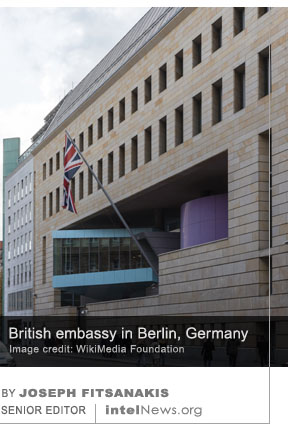 An employee of the British embassy in Berlin, who was arrested last week on suspicion of spying for Russia, drew the attention of the authorities after he stopped using his bank account, according to reports. The man, who was
 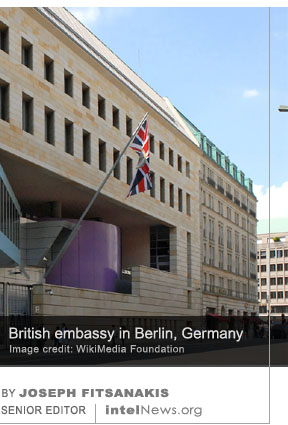 An employee of the British embassy in Berlin has been arrested by German authorities, who charged him with spying for the intelligence services of the Russian Federation, according to reports. The German newsmagazine Focus
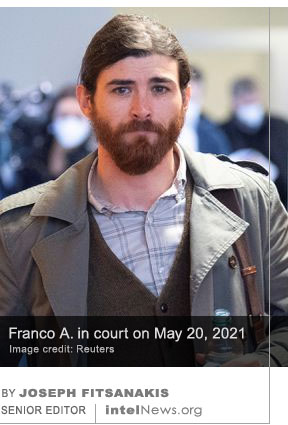 A GERMAN ARMY LIEUTENANT, who led a double life as a fake Syrian refugee, has gone on trial in Frankfurt, accused of planning to kill German politicians so as to provoke anti-Arab sentiment among Germans. The man has been identified by the German media as “Franco A.”, 32, due to strict German privacy laws. He lived in France, where he served in the Franco-German Brigade, an elite military force that combines units from the French and German armies, and is meant to symbolize Franco-German rapprochement in the postwar era.
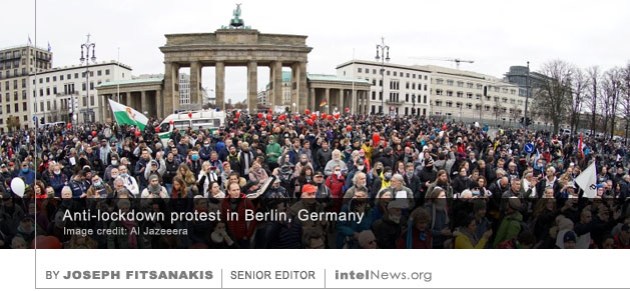 GERMANY’S DOMESTIC INTELLIGENCE AGENCY said on Wednesday it has begun monitoring groups associated with conspiracy theories surrounding COVID-19, who are “challenging the legitimacy of the state”. Germany is home to one of the most vocal anti-lockdown movements in the Western world, with public rallies against lockdown measures taking place nearly every week across the country. These rallies attract a peculiar mix of participants who come from a variety of backgrounds, including anti-vaccination proponents, various conspiracy theorists, and supporters of both far-left and far-right parties.






 intelNews.org
Germany ‘erroneously’ granted entry visa to known Russian intelligence officer
October 10, 2022 by Joseph Fitsanakis 1 Comment
According to the German newsmagazine Der Spiegel, it was in July of this year when the German Embassy in Moscow received an application for an entry visa to Germany by a Russian national. The application included an official invitation issued to the visa applicant by the Russian Consulate General in the eastern German city of Leipzig. However, the application prompted a strong counterintelligence warning by the Federal Office for the Protection of the Constitution (BfV), Germany’s domestic security agency. According to Spiegel, at least one more European intelligence agency warned against allowing the Russian national to travel to Western Europe. The reason for the warnings was that the visa applicant was known to operate internationally under diplomatic cover, on behalf of a Russian intelligence agency.
The counterintelligence warnings were examined and caused the visa application to be rejected. However, a month later the applicant submitted a second application for an entry visa to Germany. Remarkably, the German embassy approved the second application, after “no longer recogni[zing] any suspicion of espionage” in association with this case. One possible reason, according to Spiegel, was that Russian officials had applied pressure on the German government, asking for a review of the application. When the issue was raised in Berlin, an internal review was launched. It reportedly found that the espionage warnings had been “overlooked due to an [administrative] error”. The visa was thus promptly canceled. Der Spiegel claims it is “possible that the accidental visa issue was related to [Berlin] wanting to show good will to the Russian side”.
What does that mean? Back in April, Germany expelled 40 suspected Russian intelligence officers, in response to Russian war crimes in Ukraine. As expected, Russia promptly expelled an equal number of German diplomats in a tit-for-tat move. The Russian Foreign Ministry made sure to point out that it would respond in a similar fashion, should Berlin choose to expel more Russian diplomats in the future. Such an eventuality, according to Spiegel, would run the risk of decimating Germany’s diplomatic presence in Russia, given that its size is considerably smaller than that of Russia’s in Germany. Germany, in other words, is not prepared to risk a complete breakdown in its diplomatic relations with Russia.
Some claim, however, that the current arrangement between the two countries is being exploited by the Kremlin. Der Spiegel notes that, according to intelligence experts, no European country hosts more Russian intelligence officers under diplomatic cover than Germany. It is estimated that at least 100 bogus diplomats are currently stationed in Russia’s diplomatic facilities throughout Germany.
► Author: Joseph Fitsanakis | Date: 10 October 2022 | Permalink
Filed under Expert news and commentary on intelligence, espionage, spies and spying Tagged with diplomacy, espionage, Germany, News, Russia