Germany arrests alleged collaborator of intelligence officer who spied for Russia
January 31, 2023 1 Comment
 THE GERMAN GOVERNMENT ANNOUNCED last week the arrest of a man believed to have acted as a courier between Russian intelligence and another German spy, who was arrested in December and is awaiting trial. The new arrest is bound to attract even more international attention to this unfolding case of espionage, whose urgency has reportedly alarmed Western intelligence services.
On December 22, German authorities arrested a senior German intelligence official, who has been charged with treason and remains in custody. The official, named only as “Carsten L.”, in compliance with Germany’s strict privacy laws, worked in the signals intelligence (SIGINT) wing of the Federal Intelligence Service (BND). As Germany’s foreign intelligence agency, the BND is tasked with collecting intelligence on foreign targets, a mission that makes it broadly equivalent to the United States Central Intelligence Agency (CIA).
As intelNews reported earlier this month, Carsten L.’s seniority within the BND allowed him to access several compartmentalized areas of information, including secrets shared with the BND by other Western intelligence agencies. For this reason, it was reported that some Western intelligence officials were “most incensed” with this case. One source reported that British intelligence leaders were “considering whether they will continue to provide the BND with their most sensitive information”.
Now a second arrest has come to arguably add to the gravity of this case. On January 22, the German Federal Criminal Police Office announced the arrest of “Arthur E.”, who was captured at the Munich International Airport. Apparently, Arthur E. is a German citizen who has German-Russian background. According to the press release issued by the German government, Arthur E. was arrested through a collaborative effort between the BND and the United States Federal Bureau of Investigation (FBI). Apparently, the FBI became suspicious when Arthur E. attempted to frantically leave the United States after Carsten L.’s arrest. Read more of this post
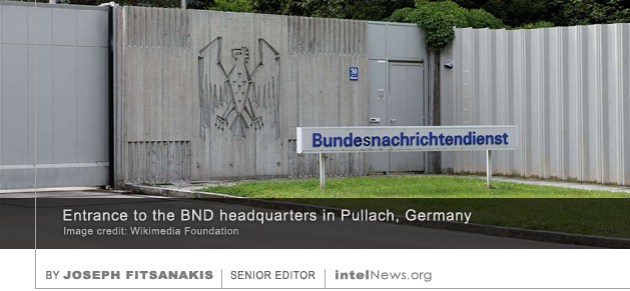 WESTERN INTELLIGENCE AGENCIES HAVE been alarmed by the arrest of a senior German intelligence official, who has been charged with spying for Russia, according to an expert in German intelligence. On December 22, the German government
 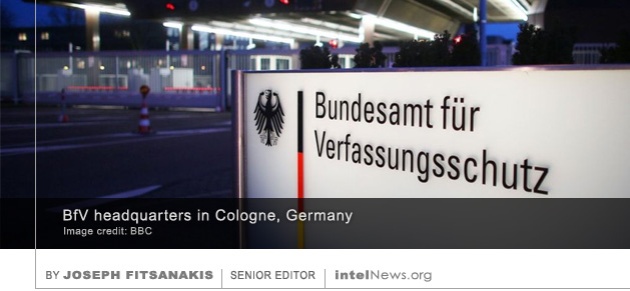 RUSSIAN FOREIGN INTELLIGENCE ACTIVITIES in Germany have increased exponentially since the start of the war in Ukraine, and are projected to further-increase in 2023, according to the head of German counterintelligence. In an
  ALTHOUGH INTELLIGENCE IS A traditionally male-dominated profession, the integration of women into the field has grown exponentially in our time. The area of human intelligence (HUMINT), i.e. the use of human handlers to extract secrets through the use of human agents, is among the areas of the profession that remain most resistant to the incorporation of women. Now new research from Germany is shedding light into the understudied topic of female approaches to HUMINT.

 An employee of the British embassy in Berlin, who was arrested last week on suspicion of spying for Russia, drew the attention of the authorities after he stopped using his bank account, according to reports. The man, who was
  An employee of the British embassy in Berlin has been arrested by German authorities, who charged him with spying for the intelligence services of the Russian Federation, according to reports. The German newsmagazine Focus









Comment: Is Germany’s external spy agency a liability for Europe?
February 6, 2023 by Joseph Fitsanakis 3 Comments
Founded in the early stages of the Cold War under American tutelage, the BND operated for several decades on the frontlines of the existential clash between the United States and the Soviet Union. Deservedly, the agency received strong criticism about the Nazi past of some of its senior officials in the early days. Yet, like West Germany as a whole, by the 1970s it had largely managed to democratize its institutional structure and practices.
Crisp argues, however, that the BND, once one of Europe’s most important intelligence agencies, has been “hollowed out since the Cold War” and is today viewed by its European counterparts as “complacent and arrogant”. Consequently, the string of embarrassments that the BND has suffered lately, culminating in the discovery of an alleged Russian spy in its ranks, is hardly coincidental, according to Crisp. Even this recent discovery appears to have occurred only after the BND was tipped off by an allied intelligence agency.
The German spy agency has not fared much better in the American-led war in Afghanistan, or during the latest phase of the Russo-Ukrainian war. Unlike the American intelligence agencies, the BND did not subscribe to the view that Moscow would invade its neighbor to the west. Bruno Kahl, the agency’s president, was actually in Ukraine for consultations when Russian tanks began to head toward Kyiv. In what has rightly been described as a humiliation, Kahl was trapped inside Ukraine and had to be smuggled out of the country by a German special forces unit, just as Russian bombs began falling on the Ukrainian capital.
How does one account for the current state of the BND? To some extent, the spy agency’s culture has been shaped by that of the broader postwar German state, which has gone out of its way to reconcile with Russia. Successive German administrations have viewed their rapprochement with Moscow as a cornerstone of Europe’s security trajectory. Consequently, it can be said that Berlin has a history of underestimating the security threat posed by Russia. Read more of this post
Filed under Expert news and commentary on intelligence, espionage, spies and spying Tagged with Analysis, BND, Germany, Joseph Fitsanakis, Newstex, Russia