Indian officials admit for first time Islamic State militants are present in Kashmir
June 19, 2019 Leave a comment
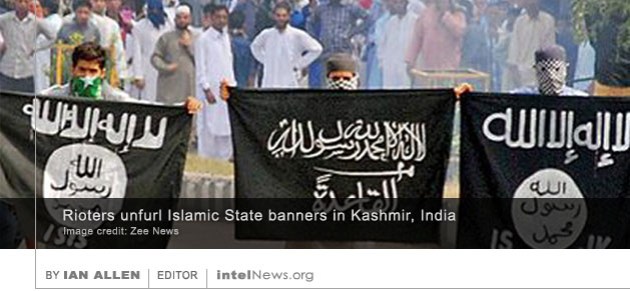 Indian counterterrorism officials have alleged in court that four members of the Islamic State in Indian-administered Kashmir were guided by a handler from Pakistan. The court case involves four young men from Jammu and Kashmir who were arrested last November on terrorism charges. Court documents filed recently identify the four as members of the Islamic State. This development is significant because Indian officials have until recently dismissed as overstated claims that the Islamic State is present in Kashmir. The unfurling of Islamic State banners by anti-government rioters is a regular phenomenon in Indian Kashmir. But government officials dismiss those who wave such banners as impressionable youth who have no access to weaponry or logistical support from the Islamic State. Last November’s arrests, however, highlighted the fact that the Islamic State does in fact have an armed presence on the ground in India.
The four young men have been named as Haris Mushtaq Khan, Tahir Ahmad Khan, Asif Suhail Nadaf and Asif Majid. They were apprehended in Srinagar, Jammu and Kashmir’s largest city, following the arrest in September of 2018 of two other men who were allegedly affiliated with a group calling itself the Islamic State in Jammu and Kashmir (ISJK). The group has since renamed itself to Islamic State – Khorasan Province, while recently it proclaimed an overseas province in the region, which it calls “wilayah al-Hind” (province of Hind). Three of the four men have been charged with attacking a tourist visitor center in the area with hand grenades. In their official indictment against the four men, officers of India’s National Investigation Agency accuse them of being “confirmed terrorists of the Islamic State”, which amounts to the first confirmation in Indian government documents of the presence of Islamic State militants in India. The 28-page indictment states that the four men were among several locals who “acted as ground workers and […] provided logistics to the ISJK cadres”.
Additionally, two of the men, Haris and Tahir, are accused of having been in contact online with a man identified as Abu Huzefa, an Islamic State recruiter based in Afghanistan. According to the court documents Huzefa is a Pakistani national and “an active cadre of the Islamic State based in Afghanistan”. He was allegedly in regular contact with the two Indian men and provided them with Islamic State literature and other propaganda material. In their indictment the NIA officers also admit that the arrests of the four men point to “a larger conspiracy of these terrorist elements propagating pan-Islamic ideology of IS by recruiting and radicalizing Kashmiri youth towards jihad and targeting security forces”.
► Author: Ian Allen | Date: 20 June 2019 | Permalink
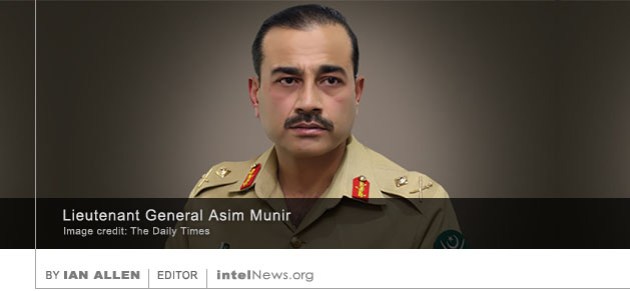 In a surprising move the Pakistani military has dismissed the head of the powerful Inter-Services Intelligence (ISI) spy agency just eight months after appointing him to that position. The decision was announced on Sunday in a brief statement by the Inter-Services Public Relations, the public-relations wing of the Pakistan Armed Forces. The statement said that Lieutenant General Asim Munir had stepped down from his post as director of ISI and would take over as commander of the Gujranwala Corps in Punjab, Pakistan’s second-largest province. The statement did not explain the reasons for the reshuffle; the latter came as a surprise, as ISI directors typically serve for at least three years in that post. General Munir’s tenure
 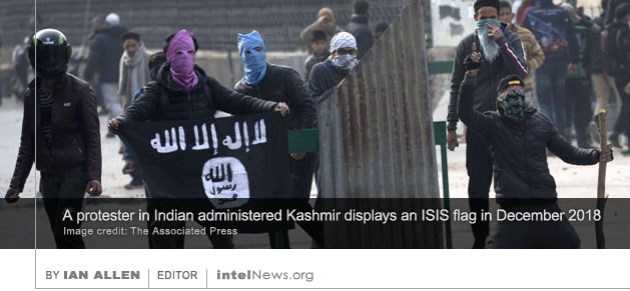 The group calling itself the Islamic State has announced the establishment of a new overseas province in India’s Jammu and Kashmir state. The announcement was made over the weekend by Amaq, which serves as the news agency of the Islamic State. According to the news release, the Islamic State (known also as the Islamic State of Iraq and Syria) has named the new province “wilayah al-Hind” (province of Hind), and said it is based in the Muslim-majority Kashmir Valley, which is located in one of the three administrative divisions of the Indian administered state of Jammu and Kashmir.









 intelNews.org
Germany convicts married couple of spying for Indian intelligence service
December 13, 2019 by Joseph Fitsanakis Leave a comment
According to the prosecution, Manmohan S. was recruited by India’s Research and Analysis Wing (RAW) in January of 2015. His wife joined his intelligence-collection activities in July 2017. Following their arrest, the couple told German authorities that they held regular meetings with a RAW case officer who was serving as a diplomat in the Indian consulate in Frankfurt. They also said they were paid nearly $8,000 for their services.
The two convicted spies said at their trial that they were tasked to spy on adherents of the Sikh religion and members of the Kashmiri expatriate community in Germany. The central European country is believed to host as many as 20,000 Indian Sikhs, many of whom openly proclaim secessionist aspirations. Many Sikhs in India and abroad campaign for the creation of a Sikh state in parts of northwestern India and Pakistan, which they call Khalistan. India is also concerned about the secessionist aspirations of Kashmiris, a predominantly Muslim population of 10 million that lives in the region of Jammu and Kashmir. Delhi has long claimed that expatriate groups living in Europe and the United States provide funding for secessionist groups that operate in the region.
On Thursday, Frankfurt’s Higher Regional Court found the couple guilty of conducting illegal espionage activities on German soil. It handed Manmohan S. a one-and-a-half-year suspended jail sentence, while Kanwal Jit K. was given a fine that equates to 180 days of income.
► Author: Joseph Fitsanakis | Date: 13 December 2019 | Permalink
Filed under Expert news and commentary on intelligence, espionage, spies and spying Tagged with espionage, Germany, India, Indian consulate in Frankfurt, Jammu (India), Kanwal Jit K., Kashmir (India), lawsuits, Manmohan S., News, non-official-cover, Sikhism