Israel reportedly behind discovery of Russian antivirus company’s spy links
October 11, 2017 1 Comment
 Israeli spy services were reportedly behind the United States government’s recent decision to purge Kaspersky Lab antivirus software from its computers, citing possible collusion with Russian intelligence. Last month, the US Department of Homeland Security issued a directive ordering that all government computers should be free of software products designed by Kaspersky Lab. Formed in the late 1990s by Russian cybersecurity expert Eugene Kaspersky, the multinational antivirus software provider operates out of Moscow but is technically based in the United Kingdom. Its antivirus and cybersecurity products are installed on tens of millions of computers around the world, including computers belonging to government agencies in the US and elsewhere. But last month’s memorandum by the US government’s domestic security arm alarmed the cybersecurity community by alleging direct operational links between the antivirus company and the Kremlin.
On Tuesday, The New York Times reported that the initial piece of intelligence that alerted the US government to the alleged links between Kaspersky Lab and Moscow was provided by Israel. The American paper said that Israeli cyber spies managed to hack into Kaspersky’s systems and confirm the heavy presence of Russian government operatives there. The Times’ report stated that the Israelis documented real-time cyber espionage operations by the Russians, which targeted the government computer systems of foreign governments, including the United States’. The Israeli spies then reportedly approached their American counterparts and told them that Kaspersky Lab software was being used by Russian intelligence services as a backdoor to millions of computers worldwide. The Israelis also concluded that Kaspersky’s antivirus software was used to illegally steal files from these computers, which were essentially infected by spy software operated by the Russian government.
It was following the tip by the Israelis that he Department of Homeland Security issued its memorandum saying that it was “concerned about the ties between certain Kaspersky [Lab] officials and Russian intelligence and other government agencies”. The memorandum resulted in a decision by the US government —overwhelmingly supported by Congress— to scrap all Kaspersky software from its computer systems. Kaspersky Lab has rejected allegations that it works with Russian intelligence. In a statement issued in May of this year, the company said it had “never helped, nor will help, any government in the world with its cyberespionage efforts”.
► Author: Joseph Fitsanakis | Date: 11 October 2017 | Pemalink
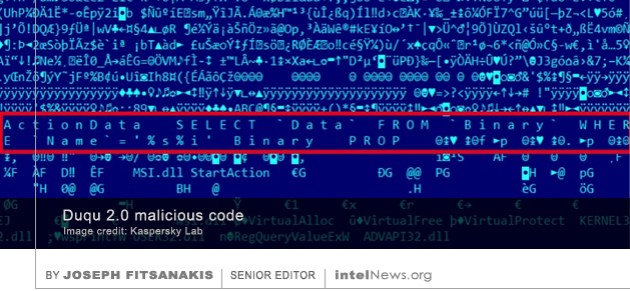 The Israeli government rejected reports yesterday that its spy agencies were behind a virus found on the computers of three European hotels, which hosted American and other diplomats during secret negotiations on Iran’s nuclear program. Cybersecurity firm Kaspersky Lab said on Wednesday that it first discovered the malware, which it dubbed “Duqu 2.0”, in its own systems. The Moscow-based firm said the sophisticated and highly aggressive virus had been designed to spy on its internal research-related processes. Once they detected the malicious software in their own systems, Kaspersky technicians set out to map Duqu’s other targets. They







 intelNews.org
Western spies used ‘crown jewel’ of espionage tools to hack into Russia’s Google
June 28, 2019 by Joseph Fitsanakis Leave a comment
On Thursday, Reuters cited “four people with knowledge on the matter […] in Russia and elsewhere”, who said that Yandex was targeted by a sophisticated hacking operation between October and November of 2018. The news agency said that three of its sources had direct knowledge of the details of the cyber-espionage operation against Yandex. According to the unnamed sources, the hackers appeared to be primarily interested in breaching the accounts of specific employees in Yandex’s research and development unit. Their purpose was to acquire technical information about how Yandex authenticates user accounts. That information could potentially enable them to impersonate Yandex users and access private information, including email messages, geolocation information, and other sensitive private data. Reuters said that the hackers attempted to breach Yandex for purposes of espionage, not sabotage or disruption, or stealing intellectual property for commercial purposes.
Moreover, the hackers used Regin, a highly sophisticated malware that a technical expert from the Symantec Corporation described as “the crown jewel of attack frameworks used for espionage”. Regin was identified as a malware employed by intelligence services of the so-called Five Eyes intelligence alliance between spy agencies of the United Kingdom, Canada, New Zealand, Australia and the United States. It was identified as a Western cyber-espionage tool in 2014, based on revelations made by Edward Snowden, the American former employee of the National Security Agency and the Central Intelligence Agency who defected to Russia. The same malware was used in 2013 to access about a dozen mainframe computers of Belgacom, Belgium’s largest telecommunications service provider, which is partly state-owned. The attack was widely attributed to a consortium of Western intelligence services led by the NSA.
According to Reuters, the hackers were able to penetrate Yandex’s networks for several weeks or longer, without being noticed by the company’s cyber-security monitors. When the penetration was detected, Yandex hired a cyber-security team from the Russian anti-virus firm Kaspersky. The Kaspersky team identified Regin and, according to Reuters, concluded that the hackers behind the cyber-espionage operation were tied to Western intelligence agencies. Kaspersky, the Russian government, and intelligence agencies from the Five Eyes alliance declined requests by Reuters to comment on the story. Yandex confirmed the cyber-espionage attack in a statement to Reuters, but said that its cyber-security experts had been able to detect and “fully neutralize [it] before any damage was done”. Consequently, said Yandex, “no user data was compromised in the attack”.
► Author: Joseph Fitsanakis | Date: 28 June 2019 | Permalink
Filed under Expert news and commentary on intelligence, espionage, spies and spying Tagged with cyber security, cyberespionage, Kaspersky Lab, News, Regin, Russia, Yandex