China and Taiwan swap jailed spies in historic first
December 1, 2015 Leave a comment
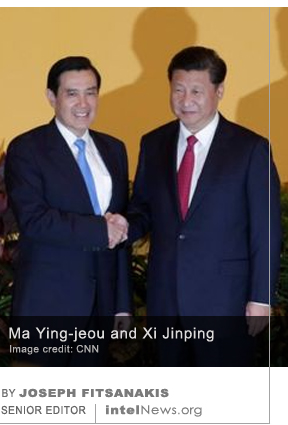 China and Taiwan reportedly swapped each other’s imprisoned spies, just days before a historic meeting between their heads of government. It was the first time in the two nations’ history that they have swapped jailed spies with each other. The exchange appears to have taken place in secret in late October, less than two weeks ahead of a historic November 7 meeting between Chinese President Xi Jinping and Taiwanese President Ma Ying-jeou. The meeting, which took place in Singapore, was hailed for its historic significance, as it was the first of its kind since 1949, when the two countries emerged following a bitter civil war between communist and nationalist forces.
News of the spy exchange emerged in the Taiwanese press on Monday, when it was reported that Taipei had released Li Zhihao. Li, a mysterious Chinese intelligence officer known in spy circles as “the man in black”, had been arrested in 1999 after being lured into Taiwan, and was serving a life sentence. He is believed to be 70 years old. In return, Beijing appears to have freed Chu Kung-hsun and Hsu Chang-kuo, two colonels in Taiwan’s Military Information Bureau, who were arrested by mainland China’s counterintelligence nearly a decade ago. At the time of their arrest, the Taiwanese government protested that the two officers had been kidnapped from the Vietnamese side of the Chinese-Vietnamese border. But Beijing had dismissed Taipei’s protestations and had convicted the two men of espionage.
It is worth pointing out that the two Taiwanese officials had initially been sentenced to death, but their sentences were later commuted to 20 years behind bars. It is believed that they were the last Taiwanese military officials held in China for espionage, and that they were the highest-ranked Taiwanese spies imprisoned in China. Their release, therefore, marks an unprecedented development in Chinese-Taiwanese relations, though it should be remembered that dozens of Taiwanese civilians are held in Chinese jails on espionage charges.
► Author: Joseph Fitsanakis | Date: 01 December 2015 | Permalink







 intelNews.org
Taiwan admits for the first time that Chinese general Liu Liankun was one of its spies
April 6, 2018 by Joseph Fitsanakis Leave a comment
According to his Chinese government accusers, Liu passed information to Taiwan during the so-called 1996 missile crisis —known in Taiwan as the 1996 Taiwan Strait crisis. The crisis was prompted by a series of missile tests conducted by Beijing in the waters around the island of Taiwan. The crisis lasted several months, from July of 1995 to March of 1996. Many in Taiwan were convinced that China’s missile tests were the precursors of a military advance by Beijing, aimed at conquering the island one and for all. However, Taiwan’s Ministry of Defense eventually issued a press statement saying it was aware that the Chinese missiles were not equipped with armed warheads. The information was correct, but it made China realize that Taiwan was receiving information from a highly placed source inside its military. After an extensive counterintelligence investigation, the Chinese arrested Liu and accused him of having spied for Taiwan in exchange for nearly $2 million in bribes. Liu was eventually executed by lethal injection in a Beijing prison. He was 58. At the time of his conviction, Liu was the most senior Chinese military officer to have ever been convicted of spying for Taiwan.
But Taiwan continued to deny any involvement in Liu’s case. That changed last week, however, when Taiwan’s Military Information Bureau unveiled its renovated memorial, which is housed at its headquarters in Taipei City. The memorial features plaques commemorating 75 individuals who have died while carrying out MIB intelligence operations. Those featured include both intelligence officers and their assets —foreign people recruited by intelligence officers to spy for Taiwan. Among the plaques, visitors to the memorial saw one dedicated to Liu for the first time. A note beneath the plaque acknowledges Liu’s contributions during the 1996 missile crisis. But it also states that the Chinese military official also provided assistance to Taiwan during earlier crises with China in the 1990s, as well as inside information about the death of Chinese Premier Deng Xiaoping in 1997.
► Author: Joseph Fitsanakis | Date: 6 April 2018 | Permalink
Filed under Expert news and commentary on intelligence, espionage, spies and spying Tagged with 1996 missile crisis, 1996 Taiwan Strait Crisis, China, espionage, Liu Liankun, Military Information Bureau (Taiwan), military intelligence, News, Taiwan