US reportedly considering airstrikes against pro-ISIS groups in the Philippines
August 9, 2017 1 Comment
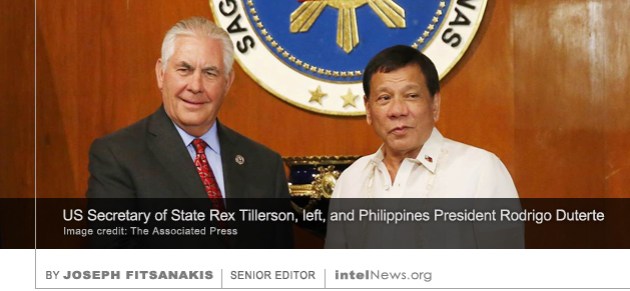 The United States is reportedly weighing plans to launch airstrikes in the Philippines, against militant groups that are affiliated with the Islamic State of Iraq and Syria. However, some American officials are skeptical about reports of possible airstrikes, while Philippine government officials claim no such action is necessary. For more than 40 years, the Philippine army has been fighting a counterinsurgency campaign against secessionist Moros in the country’s southwest. The region is home to most of the Philippines’ Muslim population, which constitutes around 6 percent of the country’s overall population. In recent years, some Muslim secessionist groups, including the most formidable, Abu Sayyaf, have pledged allegiance to the Islamic State of Iraq and Syria, known as ISIS.
For about 15 years, a small contingent of US troops has assisted the Philippine military in its war against Muslim militants. Known as Joint Special Operations Task Force Trident, the small group of US soldiers performs a low-key advisory role in the Philippine military’s counterinsurgency campaign. The American military presence in the Philippines is not a ‘named operation’, which means that its funding from the Pentagon is relatively small and its range of activities remains limited. But this week’s visit to Manila by the US Secretary of State Rex Tillerson prompted rumors that Washington may be considering naming the Task Force Trident operation, and possibly increasing the scope of its activities to include airstrikes against Abu Sayyaf. The American news network NBC said on Tuesday that the US is considering launching an offensive air campaign against ISIS, “as part of [a new] collective self-defense” treaty with Manila. Citing two unnamed US defense officials, NBC said that the air campaign could be officially announced as early as this week.
But the network also said that another US official cautioned that a new collective self-defense agreement between the US the Philippines would not necessarily have to include provisions for an offensive air campaign. Typically, self-defense agreements between Washington and allied countries that are not members of the North Atlantic Treaty Organization are “more about intelligence sharing than offensive US strikes”, said the official. Meanwhile, Philippine government officials denied on Tuesday that Manila had requested air support from Washington in its war against Abu Sayyaf. The island country’s Secretary of Defense, Delfin Lorenzana, told reporters that “there was no need” for US airstrikes in the Philippines. The US Pentagon did not comment on the NBC report.
► Author: Joseph Fitsanakis | Date: 09 August 2017 | Permalink











 intelNews.org
ISIS militant was first-ever Filipino suicide bomber, say police officials
July 3, 2019 by Joseph Fitsanakis Leave a comment
The Islamic State —known also as the Islamic State of Iraq and Syria (ISIS)— claimed responsibility for the attack, leading many to speculate that the suicide bombers were not Filipinos, but other Arab nationals. That would fit the pattern of the two previous suicide bombings that have taken place in the history of the Philippines. In July of 2018, a Moroccan ISIS follower drove a van laden with explosives at an army checkpoint on the island of Basilan, killing ten people. And in January of this year, two Indonesian suicide bombers attacked a Roman Catholic congregation on Jolo Island, killing 23 and injuring over 100 churchgoers. All three suicide bombers were members of Abu Sayyaf, a Filipino Salafi jihadist group that pledged allegiance to ISIS in 2014. Moreover, none of the three suicide bombers were native Filipinos; rather they had traveled to the island country in order to carry out terrorist attacks.
This pattern may have changed as of last Friday, however. According to local military officials, a Filipino woman identified the remains of one of the two suicide bombers as belonging to her son. The woman reportedly told authorities that her son was named Norman Lasuca and was 23 years old. She also said that he, like his father, belonged to the Tausūg, a million-strong predominantly Muslim ethnic group that includes many recent converts to Islam.
On Tuesday, several Philippine Army commanders gave a press conference in Sulu, where they discussed the latest information regarding last week’s suicide attacks. One of the speakers, Brigadier-General Edgard Arevalo, said that the purported mother of the suicide bomber had provided DNA samples to the authorities, in order to help positively identify the body. If the DNA tests are positive “then […] we can say conclusively that the person is Filipino”, which will be a first, said Arevalo. A positive result would suggest that the ideology of ISIS may be more appealing to local Filipino youth than has generally been assumed by counterterrorism officials, Arevalo concluded.
► Author: Joseph Fitsanakis | Date: 03 July 2019 | Permalink
Filed under Expert news and commentary on intelligence, espionage, spies and spying Tagged with Abu Sayyaf Group, Basilan (Philippines), Islamic State, Moro ethnic group, News, Philippines, suicide bombings, Sulu (Philippines), terrorism