German spy agency says it is monitoring anti-lockdown conspiracy movement

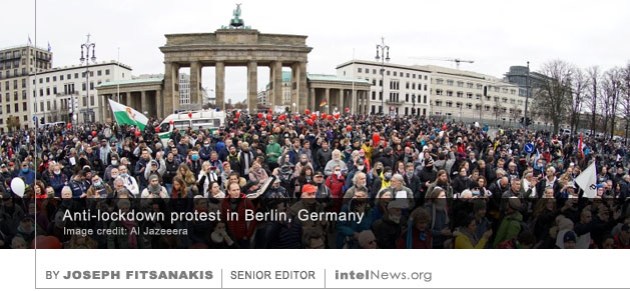
Querdenker GERMANY’S DOMESTIC INTELLIGENCE AGENCY said on Wednesday it has begun monitoring groups associated with conspiracy theories surrounding COVID-19, who are “challenging the legitimacy of the state”. Germany is home to one of the most vocal anti-lockdown movements in the Western world, with public rallies against lockdown measures taking place nearly every week across the country. These rallies attract a peculiar mix of participants who come from a variety of backgrounds, including anti-vaccination proponents, various conspiracy theorists, and supporters of both far-left and far-right parties.
In recent months, demonstrations against lockdown measures have been turning violent, as members of militant far-right groups have begun to participate in large numbers. They include members of Germany’s largest far-right party, Alternative für Deutschland (AfD), as well as the anti-Semitic Reichsbürger movement and followers of the Selbstverwalter —the Germany’s version of the American Sovereign Citizens movement. Some of these groups are coalescing around a new nucleus of anti-government activists, who describe themselves as members of the Querdenker movement.

The term Querdenker translates into “lateral thinkers”. It represents what Germany’s domestic spy agency, the Federal Office for the Protection of the Constitution (BfV) describes as “a new category” of anti-government militancy. Its adherents do not conform to either far-left, far-right, or religiously motivated militancy. Over 90 percent of Querdenker followers are over the age of 30, with their average age being nearly 50. Over two thirds describe themselves as middle class, and vote for far left and the far right parties in equal numbers. Others do not vote at all. But, according to sociological studies, xenophobia and negative views of Muslims are prominent among Querdenker followers.

This is the first time that Germany’s domestic spy agency has formally identified a group that is associated with anti-lockdown activities as the target of a national security investigation. Meanwhile, Querdenker leaders have vowed to continue their anti-lockdown activities across Germany in the coming weeks.

Author: Joseph Fitsanakis | Date: 29 April 2021 | Permalink

Flurry of diplomatic expulsions as European states respond to Russia spy allegations

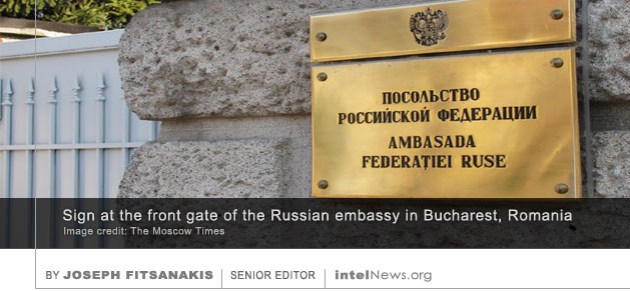
Russian embassy RomaniaSEVERAL EASTERN EUROPEAN STATES announced plans to expel Russian diplomats this week, as Moscow declared an Italian diplomat persona non grata in a tit-for-tat dispute with Rome over espionage allegations. Earlier this month, the Czech Republic expelled 18 Russian diplomats in protest against an explosion that totaled a remote munition depot in the east of the country, which Prague claims was part of a Russian intelligence operation.
The explosion, which occurred in October of 2014, killed two people and destroyed a munitions storage facility belonging to the Military Technical Institute of the Czech Ministry of Defense. Czech investigators recently concluded it was perpetrated by Unit 29155, a Russian elite spy outfit that operates under the Main Directorate of the General Staff of the Russian Armed Forces, commonly known as GRU. The Kremlin responded to the expulsions of its diplomats by ordering 20 Czech diplomats to leave Russia, and condemning Prague’s move as an “unprecedented” and “a hostile act” that was designed “to please the United States”.

The Czechs retorted by calling their allies in the North Atlantic Treaty Organization and the European Union to “expelled officers of Russian special services” in solidarity. In recent days, five countries have answered Prague’s call. Seven Russian diplomats have been given just days to leave Slovakia, Lithuania, Latvia, Lithuania and Estonia. Meanwhile, Romania announced on Monday that it would expel Alexei Grichayev, who serves as a deputy military attaché at the Russian embassy in Bucharest. The Romanian government said Grichayev’s “activities and actions [were] contrary to the Convention of Vienna on diplomatic relations” —a phrase used to denote espionage in diplomatic parlance.

Also on Monday, the Romanian Ministry of Foreign Affairs summoned the Russian ambassador in order to file an official complaint, while Hungary, Poland and Slovakia issued a joint statement decrying what they described as “deplorable act[s] of aggression and breach of international law committed by Russia on European soil”. In a separate development, Moscow said on Monday it would expel an Italian diplomat in response to the expulsions of two Russian diplomats from its embassy in Rome last month. The two Russians were accused of recruiting an Italian Navy captain, who has been charged with spying for the Kremlin.

Author: Joseph Fitsanakis | Date: 27 April 2021 | Permalink

Diplomat’s comments fuel speculation Japan may join US-led ‘Five Eyes’ spy alliance

Japan United StatesJAPAN’S AMBASSADOR TO AUSTRALIA has said he feels optimistic his country could join the Five Eyes intelligence alliance in “the near future”, adding to growing speculation on the topic. Japanese diplomat Shingo Yamagami, who has held the post of ambassador to Australia since late 2020, told The Sydney Morning Herald on Friday that he would like to see Japan join the intelligence alliance “in the near future”, adding that he was “very much optimistic” about such a prospect.

Ambassador Yamagami was referring to a longstanding United States-led intelligence-sharing agreement, which is also known as UKUSA. It brings together intelligence agencies of the United States, Britain, Canada, Australia and New Zealand. It came out of the five nations’ close military and intelligence cooperation during World War II. Under the agreement, the five nations share intelligence products of mutual interest, as well as raw signals intelligence, which they collect in their respective areas of operation. In some cases, Five Eyes nations collaborate with other allies, such as France, Germany, Norway, or Holland, on individual projects.

In the past, the United States, which leads the alliance in terms of resources and strategic direction, has resisted proposals to include more members. Prospective parties must share the Five Eyes nations’ strategic direction, democratic traditions, and societal values. Additionally, they must be able to demonstrate that their intelligence services are effective in preventing penetrations by adversaries. Critics suggest that the spy agencies of Five Eyes nations are themselves far from immune when it comes to counterintelligence threats. Additionally, some Five Eyes members, notably New Zealand, have at various times expressed disagreements about the strategic direction of the alliance.

Supporters of the idea of including Japan into the Five Eyes alliance point to the fact that, after Japan’s defeat in World War II, Japanese intelligence agencies developed under American tutelage. Moreover, Japan today is home to a substantial American military presence, while its intelligence agencies collaborate closely with America’s —especially in carrying out spy operations focusing on China, North Korea and Russia. Japan’s geographical proximity to these countries, coupled with its strong intelligence emphasis on China, arguably strengthen its candidacy for Five Eyes membership, according to supporters of this view.

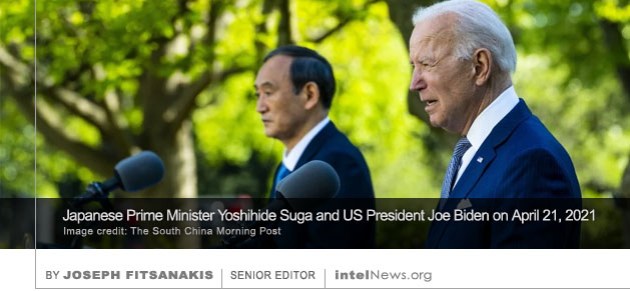
Last week, Japan’s Prime Minister, Yoshihide Suga, visited the White House, becoming the first foreign leader to be officially hosted by President Joseph Biden. Although talks between the two men focused largely on the topic of China, there was no public mention of Five Eyes. The governments of Japan and the United States have made no on-the-record comment about a potential inclusion of Japan into the intelligence agreement.

Author: Joseph Fitsanakis | Date: 26 April 2021 | Permalink

Investigation finds alleged loopholes in Malta ‘golden passport’ scheme

MaltaA JOINT INVESTIGATION BY Maltese and British reporters has found alleged loopholes that allow wealthy individuals from the Middle East, Asia and elsewhere to acquire European Union passports with minimum effort, in exchange for cash. The investigation concerns the so-called “cash for passports” scheme, which was launched by the government of Malta in 2014.
The scheme allows foreign nationals with no family connection to the island country to acquire a Maltese passport, if they invest €600,000 ($720,000) in Malta and purchase a residential property worth at least €700,000. Alternatively, they can sign a five-year lease on a residential property and donate €10,000 to charity. They then need to live in Malta for three years before they can claim citizenship in the European Union nation. However, the residential period can be reduced to one year if they invest €750,000 instead of €600,000 in the island country.

The scheme has proven lucrative in the past. In the 12 months leading to mid-2018 alone, Malta raised over €162 million, which was equivalent to 1.4% of its gross domestic product. Maltese officials have stated that, during the COVID-19 pandemic, income from the so-called “golden passports” scheme has helped keep the country’s economy afloat. But the European Union has called on Malta, Cyprus, Bulgaria, and other member states to stop their cash-for-passports schemes, because they pose serious security issues and can attract corrupt individuals with an interest in tax evasion and money-laundering.

Now a joint probe by British newspaper The Guardian and several Maltese investigative groups, including the Daphne Caruana Galizia Foundation, has uncovered alleged evidence of legal loopholes in Malta’s scheme. The alleged loopholes implicate Henley & Partners, a British-based firm that operates Matla’s a passport sales program. The firm describes itself as a “global citizenship and residence advisory firm”, and advises governments around the world on how to design and implement economic citizenship schemes.

The investigation was based on leaked documents and “thousands of emails” about the scheme. The emails and leaks reveal the existence of loopholes that allow wealthy investors to spend an average of 16 days in Malta, rather than a minimum of a year, before being awarded citizenship. The BBC reported on the case of an individual from the United Arab Emirates, who received Maltese citizenship after spending just nine hours on the island country. Other wealthy investors acquire Maltese citizenship by rending empty residential properties, or even yachts.

In a statement, the London-based Henley & Partners said it is “fully aware of the potential inherent risks in handling client applications for residence and citizenship” in Malta, and that its staff are “committed to due diligence”. It added, however, that “ultimately it is the responsibility of the countries involved [in passport-for-cash schemes] to investigate and vet applicants”.

Author: Joseph Fitsanakis | Date: 23 April 2021 | Permalink

Mexican drug cartel uses explosives-laden drones to attack police force

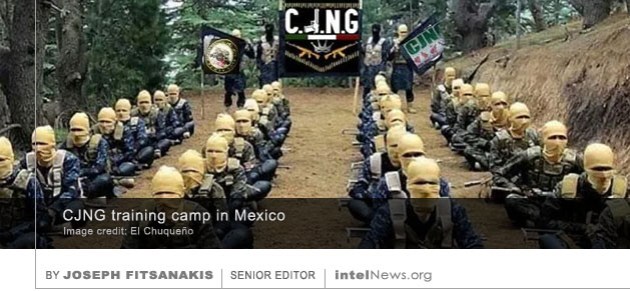
CJNGONE OF MEXICO’S MOST powerful drug cartels has reportedly used drones to attack police officers with explosives, according to local media reports. If confirmed, this incident will mark the first recorded use of drones by a Mexican drug cartel to attack law enforcement.

There is little public information about the attack. It reportedly occurred in El Aguaje, a small community in the state of Michoacán, located 350 miles west of Mexico City. The region is the birthplace of drug kingpin Nemesio Oseguera Cervantes. Otherwise known as “El Mencho”, Cervantes heads the Jalisco New Generation Cartel (CJNG), one of Mexico’s most powerful. For the past month, the CJNG has engaged in a fierce and bloody war against a rival cartel, Cárteles Unidos (United Cartels) for control of the Michoacán region. The war has forced hundreds of residents to evacuate the area, according to local reports.

On Tuesday, a police unit was deployed along the Apatzingán-Aguililla highway to clear up a number of blockades that the cartels had put in place in order to impede each other’s operations. As they were clearing and repairing the highway, members of the police unit were reportedly attacked with at least two explosives-laden drones. Two officers were injured and were sent to hospital, but recovered fully and were released later on the same day.

No cartel has claimed responsibility for the attack. However, police sources said that the design of the drones used in Tuesday’s attack was very similar to two drones that were found in August of 2020 in Tepalcatepec, another city in the state of Michoacán. The drones were found inside an armored vehicle that CJNG members had abandoned during a failed attempt to raid Tepalcatepec, according to local media reports. The drones had built-in remote detonators and were attached to plastic containers that had been filled with C4 explosive and ball bearings, according to reports.

Author: Joseph Fitsanakis | Date: 22 April 2021 | Permalink

Chinese technology firm denies it had access to Dutch government’s phone calls

Huawei PolandA LEADING CHINESE TELECOMMUNICATIONS firm has strongly denied a claim by a newspaper that its service personnel could listen in on calls made by Dutch telephone users, including senior government officials. The report dates from 2010 and was authored by consultancy firm Capgemini on behalf of KPN, one of Holland’s largest telecommunications service providers. The Rotterdam-based firm had hired Capgemini to conduct a risk analysis on whether more equipment should be purchased from Chinese telecommunications giant Huawei. By that time the Chinese company, one of the world’s largest in its field, was already supplying KPN with hardware and software equipment.
According to the newspaper De Volkskrant, which accessed the 2010 Capgemini report, the consultants cautioned KPN against purchasing more equipment from Huawei. They told KPN bosses that the Chinese firm had “unlimited access” to the content of phone conversations by subscribers through Huawei-built hardware and software that was already present in the Dutch company’s telephone system. These included Holland’s then-Prime Minister, Jan Peter Balkenende, and virtually every government minister. The report claimed that privacy standards existed in theory, but there was no mechanism in place to ensure that they were being followed.

On Tuesday, Huawei issued strong denials of the De Volkskrant report. The firm’s chief operating officer in the Netherlands, Gert-Jan van Eck, said that the Capgemini report allegations, as reported by the newspaper, were “just not [technically] possible”. Van Eck added that such claims were “patently untrue” and represented “an underestimation of the security of the interception environment” that Huawei was operating under in Europe. The Dutch government has made no comment on the De Volkskrant report.

Author: Joseph Fitsanakis | Date: 21 April 2021 | Permalink

Czechs ask EU and NATO to expel Russian diplomats in solidarity against Moscow

Jan HamacekCZECH GOVERNMENT OFFICIALS SAID they would welcome the expulsion of Russian diplomats from European Union and North Atlantic Treaty Organization countries, in support of Prague’s ongoing diplomatic spat with Moscow. The Czech Republic expelled 18 Russian diplomats last weekend, in order to protest against an explosion at a remote munition depot in the east of the country, which the government claims was part of a Russian intelligence operation.
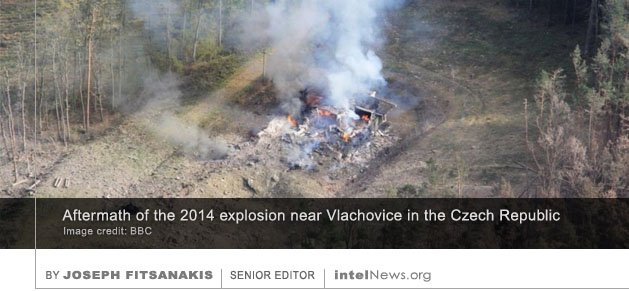

As intelNews reported on Monday, the explosion occurred in October of 2014. It killed two people and destroyed a munitions storage facility belonging to the Military Technical Institute of the Czech Ministry of Defense. Although the blast was initially classified as an accident, Czech investigators have recently come to the conclusion that it was in fact caused by Unit 29155, a Russian elite spy outfit. Little is known about Unit 29155, which is believed to operate under the Main Directorate of the General Staff of the Russian Armed Forces, commonly known as GRU.

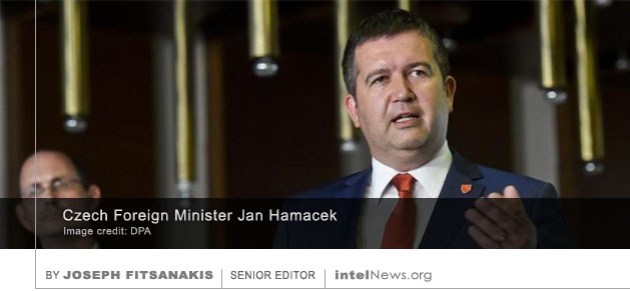
The Kremlin responded to the expulsions of its diplomats by ordering 20 Czech diplomats to leave Russia, and condemning Prague’s move as an “unprecedented” and “a hostile act” that was designed “to please the United States”. Meanwhile the Czech Republic’s acting Minister of Foreign Affairs, Jan Hamacek (pictured), stated on Tuesday that Prague “would welcome” if its allies in the EU and NATO “expelled officers of Russian special services” in the coming days, in an act of solidarity with the efforts of his office.

Following consultations with Hamacek, the office of the EU’s High Representative for Foreign Affairs and Security Policy said that it stood in “full support and solidarity” with the Czech Republic. No EU or NATO country has so far announced that it plans to expel Russian diplomats in response to Prague’s request. According to Czech media, discussions on the matter between Hamacek and several of his counterparts in the EU’s so-called Visegrad Group —consisting of Poland, the Czech Republic, Hungary, and Slovakia— are ongoing.

Author: Joseph Fitsanakis | Date: 20 April 2021 | Permalink

Russia expels Czech diplomats after Prague links Kremlin to munitions depot explosion

Vrbětice Czech Republic ammunition depot explosions

RUSSIA AND THE CZECH Republic ordered expulsions of each other’s diplomats over the weekend, after authorities in Prague said the Kremlin was behind a mystery explosion that leveled a munitions depot. The explosion took place on October 16, 2014, in a remote forest area near the village of Vlachovice, which is situated 171 miles southeast of the Czech capital, Prague.

The storage depot belonged to the Military Technical Institute of the Czech Ministry of Defense, and it was managed by a contractor, Imex Group. The blast killed two security guards and forced the evacuation of several communities located nearby. It was assumed to have been the result of an accident, though investigators were unable to determine the cause of the explosion.

On Saturday, Czech authorities announced that the blast was the work of Unit 29155, a Russian elite spy outfit, whose goal is to subvert European political and economic systems and processes. As intelNews has reported in the past, Unit 29155 operates under the Main Directorate of the General Staff of the Russian Armed Forces, commonly known as GRU. It has allegedly been in existence since at least 2009. According to Czech investigators, two members of Unit 29155 visited the munitions depot days prior to the explosion. They used forged passports from Tajikistan and Moldova, and claimed to be members of the National Guard of Tajikistan that were scheduled for an inspection. Based on their passport photographs, the two men, who used the cover names Ruslan Tabarov and Nicolaj Popa, appear to be the same men who tried to kill GRU defector Sergei Skripal in England in 2018.

The reasons why the Russians allegedly decided to blow up the munitions depot are unclear. It is speculated that some of the weapons in the depot were intended to be delivered to Ukraine on behalf of Bulgarian weapons dealer Emilian Gebrev. In 2015 Gebrev was hospitalized for several days for signs of poisoning, along with his son and one of his company’s executives. They eventually made a full recovery, but have since alleged that they were targeted by Moscow, because Gebrev’s firm sells weapons to adversaries of the Kremlin, including the government of Ukraine.

On Saturday, the Czech government gave 18 Russian diplomats, which its claims are intelligence officers, 48 hours to leave the country. It also said it would provide detailed information about its probe into the blast to European Union ministers and representatives of the North Atlantic Treaty Organization. But Moscow called the allegations “unfounded and absurd” and condemned the expulsions of its diplomats, describing them as “unprecedented” and “a hostile act” that was designed “to please the United States”. On Sunday, the Russian Ministry of Foreign Affairs announced that 20 diplomats of the Czech Republic would be expelled from Russian in retaliation to the expulsion of its diplomats by its former Cold War ally.

Author: Joseph Fitsanakis | Date: 19 April 2021 | Permalink

US Capitol Police ignored warnings prior to January 6, lacked adequate training

US Capitol

THE POLICE FORCE OF the United States Capitol did not take into account warnings ahead of the January 6, 2021, attack on Congress, and lacked adequate training to respond to it, according to its own inspector general. These findings are presented in a 104-page report that was given to Congress on Thursday, a day after it was leaked to NBC News.

The report’s lead author is Michael A. Bolton, who serves as the inspector general of the US Capitol Police. He presented his findings on Thursday before the Committee on House Administration, which deals with the general administration of the United States House of Representatives, including matters relating to employment, safety and appropriation.

According to Bolton’s report, Capitol Police did not act on intelligence reports that gave prior warning about the propensity for violence by supporters of the so-called “Stop the Steal” movement that formed around Donald Trump in late 2020. One intelligence warning, which is quoted in the inspector general’s report, stated that the Stop the Steal movement was attracting “white supremacists, militia members and others who actively promote violence [and] may lead to a significantly dangerous situation for law enforcement and the general public alike”.

Another intelligence report, issued on January 3, warned Capitol Police that Trump’s supporters had concrete plans to descend on the Capitol and were “actively promoting violence” with “Congress itself [as] the target”. Yet another intelligence report, issued by the Federal Bureau of Investigation, notified Capitol Police that maps of the Capitol Complex underground tunnel system were being circulated on online message boards frequented by Trump supporters.

The report concludes that, by the time the attack began to unfold on the afternoon of January 6, it was too late for Capitol Police force to stop it, because its personnel “lacked policies and procedures” that were needed to do so. The force was thus “severely unprepared” to deal with the mass insurrection that led to several deaths and many more injuries, the inspector general report concludes.

Author: Joseph Fitsanakis | Date: 16 April 2021 | Permalink

High-security trial of neo-Nazi group that wanted to spark civil war begins in Germany

AMIDST EXTREMELY TIGHT SECURITY, the trial of 12 members and supporters of a secretive neo-Nazi group that planned to destabilize society and spark a nationwide civil war has begun in the German city of Stuttgart. According to the indictment, the goal of the group, which calls itself “Gruppe S”, was to “shake and ultimately topple the state and social order” in Germany, in order to “spark a civil conflict”.

In accordance with German law, the accused have been identified in the media by their first names and last name initials only. All are German citizens, between the ages 32 and 61. It is worth noting that one of them is a police officer in the state of North Rhine-Westphalia. He is accused of supporting the group by offering €5,000 (nearly $6,000) for them to purchase weaponry in the illicit market. Another member of the group, who has not been arrested and remains at large, is being tried in absentia.

According to authorities, Gruppe S members had around 30 firearms in their possession, which they were using to train in preparation for war. All firearms were reportedly unlicensed. Shortly prior to their arrest in February of last year, Gruppe S members were reportedly preparing to purchase a Kalashnikov assault rifle and at least one Uzi submachine gun, as well as thousands of rounds of ammunition and several hand grenades.

It is believed that the investigation that led to the arrest of Gruppe S members begun after an informant came forward and alerted the authorities. This person is now believed to be the government’s chief witness, and is living under police protection. The trial is being conducted inside the Stammheim super-maximum security prison complex in Stuttgart, which is the same prison that housed the leading members of the Red Army Faction urban guerrilla group in the 1970s. The Gruppe S trial is scheduled to conclude in August.

Author: Joseph Fitsanakis | Date: 14 April 2021 | Permalink

US political operative convicted for illegal lobbying has CIA links, newspaper claims

Imaad Zuberi

A HIGH-FLYING AMERICAN political operative, who was convicted earlier this year for operating as an unregistered foreign agent, violating campaign-finance laws and large-scale tax-evasion, may have been an informant for the United States Central Intelligence Agency, according to a new report. In February of this year, a court in the US state of Virginia sentenced Imaad Zuberi, a 50-year-old Pakistani-born entrepreneur, to 12 years in prison, for —among other things— lobbying US politicians on behalf of foreign governments, giving illegal financial donations to both American political parties, hiding sources of income from the Internal Revenue Service, and obstructing justice. In addition to his long prison sentence, he is required to pay the US government nearly $18 million in back taxes and fines.

Prior to his conviction, Zuberi was mostly known as a high-level political fundraiser and donor, who had contributed millions to the election campaigns of both Democratic and Republican politicians, including those of Donald Trump, Barack Obama, Hillary Clinton and Joe Biden. After he was arrested and criminally charged in October of 2019, Zuberi quickly confessed to working as a foreign agent and hiding his lobbying activities from the US government. Among his clients were, according to the Associated Press, the governments of Sri Lanka and Turkey, as well as eastern European oligarchs with alleged ties to the Kremlin. According to government prosecutors, Zuberi would receive money from foreign government officials and tycoons in order to introduce them to influential American political figures.

In March of this year, Zuberi’s links to the CIA were discussed in a detailed account of his case by SpyTalk‘s veteran intelligence editor Jeff Stein. After reviewing “confidential case information” and speaking to intelligence insiders, Stein concluded there were “strong suggestions” that Zuberi “may indeed have carried out extremely sensitive operations against major U.S. adversaries for the CIA over the past 15 years”. Stein alleges that, among other things, “Zuberi paid off foreign politicians on the CIA’s behalf” in order to sabotage a foreign oil project by “a major US adversary”.

According to The Wall Street Journal, Zuberi’s legal team is now preparing to challenge his prison sentence in an appeal that will rest primarily on his alleged work for the CIA, detailed by Stein. The Journal claims to have seen Zuberi’s legal filing, which suggests that he has cooperated with the CIA for over a decade. Based on court documents, and sources that the paper described as being “familiar with the businessman’s defense”, it appears that Zuberi’s began cooperating with the CIA as an informant. Eventually, however, his role “grew to involve more formal tasks and missions”, according to the article. The paper did not elaborate on the nature of Zuberi’s alleged work for the spy agency.

The article claims, however, that Zuberi’s alleged links with the CIA were discussed at length during a closed-door hearing in court, under a law that is used in rare instances to protect government-sanctioned intelligence sources and methods. Since that time, Zuberi’s legal team has allegedly secured the assistance of two former CIA officials, who are willing to testify as witnesses in his appeal. The Wall Street Journal said it contacted the CIA for comment, but was told to reach out to the Department of Justice. When contacted by the paper, the Department of Justice said it had no comment to make on Zuberi’s case.

Author: Joseph Fitsanakis | Date: 12 April 2021 | Permalink

Taiwan files charges against couple identified by Chinese defector as alleged spies

Wang Liqiang

AUTHORITIES IN TAIWAN HAVE filed money-laundering charges against a Chinese couple, who were identified as spies by a man who defected to Australia in 2019, claiming to be a Chinese intelligence operative. Wang “William” Liqiang, 28, from China’s eastern Fujian province, defected to Australia in October of 2019, while visiting his wife and newborn son in Sydney. He and his family are currently believed to be living under the protection of the Australian Security Intelligence Organization (ASIO).

In a 17-page sworn statement filed shortly after his defection, Wang reportedly gave details of his work as an undercover intelligence officer for Chinese military intelligence. He is also said to have shared the identities of senior Chinese intelligence officers in Taiwan and Hong Kong, and to have explained how they carry out espionage operations on behalf of Beijing. Some media reports claimed that Mr. Wang had shared details about deep-cover Chinese intelligence networks in Australia. Wang also claimed that he worked for a Hong Kong-based company called China Innovation Investment Limited (CIIL), which was in reality a front company set up to provide proprietary cover for Chinese spies like himself.

The Chinese government responded to Wang’s allegations by publicly calling him a “fraud” and claiming that his Chinese passport and Hong Kong identity papers were forgeries. Meanwhile, CIIL filed legal action against Wang for libel and spreading malicious falsehoods. But that did not stop Taiwanese authorities from arresting CIIL’s directors, Xiang Xin and Gong Qing, on November 24, 2019. The directors, a married couple, were about to board an international flight at Taiwan’s Taoyuan Airport, when they were detained by members of the country’s Investigation Bureau. Following their detention, they were barred from leaving the country until further notice.

Under Taiwanese law, authorities in the island country had until April 14 of this year to file charges against the couple, or allow them to leave the country. On Thursday, the Office of the Taipei District Prosecutor announced that money laundering charges had been filed against the two CIIL directors. According to the indictment, the couple used nearly $26 million that they allegedly acquired illicitly from China, in order to purchase three luxury apartments in Taipei’s affluent Xinyi district. Additionally, the Prosecutor’s office said the two Chinese citizens continue to be under investigation for potentially violating Taiwan’s National Security Act.

Author: Joseph Fitsanakis | Date: 09 April 2021 | Permalink

Vienna’s wartime Gestapo chief worked for West German intelligence, records show

Franz Huber

THE HEAD OF THE secret police in Nazi-occupied Vienna, who oversaw the mass deportation of Austrian Jews to concentration camps, worked for West Germany’s postwar spy agency, according to newly released records. Starting his career as a police officer in Munich during the Weimar Republic, Franz Josef Huber joined the Nazi Party in 1937. Due to his prior law enforcement work, he was immediately appointed to the office of Heinrich Müller, who headed the Gestapo —Nazi Germany’s secret police.

Following the German annexation of Austria in 1938, the Nazi Party sent Huber to Vienna, where he oversaw all criminal and political investigations by the Gestapo. He remained head of the Nazi secret police in the Austrian capital until December of 1944. Under his leadership, the Vienna branch of the Gestapo became one of the agency’s largest field offices, second only to its headquarters in Berlin, with nearly 1000 staff members. Huber himself was in regular communication with Adolf Eichmann, who was the logistical architect of the Holocaust. Nearly 66,000 Austrian Jews, most of them residents of Vienna, perished in German-run concentration camps under Huber’s watch.

In May of 1945, following the capitulation of Germany, Huber surrendered to American forces and was kept in detention for nearly four years. During his trial in the German city of Nuremburg, Huber admitted to having visited German-run concentration camps throughout his tenure in the Gestapo. But he claimed that he had not noticed signs of mistreatment of prisoners. He was eventually cleared of all charges against him and released in 1949, allegedly because allied forces wanted to concentrate on more senior members of the Nazi Party, including Huber’s boss, Heinrich Müller.

Last week, German public-service broadcaster ARD said it found Huber’s name in records belonging to the Federal Intelligence Service —Germany’s external intelligence agency. It turns out that, following his release from detention in 1948, Huber joined the Gehlen Organization —named after the first director of the BND, Reinhard Gehlen. Gehlen was a former general and military intelligence officer in the Nazi Wehrmacht, who had considerable experience in anti-Soviet and anti-communist operations. In 1956, as the Cold War was intensifying, the United States Central Intelligence Agency, which acted as the BND’s patron, appointed Gehlen as head of the BND, a post which he held until 1968. During his tenure, Gehlen staffed the BND with numerous Nazi war criminals, who had considerable expertise on the Soviet Union and anti-communism.

According to the ARD, Huber worked for the BND under Gehlen until 1967, when he retired along with other former Nazi BND officers. His retirement occurred at a time when the BND, under popular pressure, tried to cut ties with some of the most notorious former Nazis in its ranks. However, Huber was given a state pension, which he kept until his death in 1975. Following his retirement from the BND, he allegedly worked for an office equipment supplier in his hometown of Munich, without ever facing any prosecution for his wartime role in the Gestapo. In an article published on Monday, The New York Times claimed that the United States government was fully aware of Huber’s Nazi past.

Author: Joseph Fitsanakis | Date: 07 April 2021 | Permalink

Cambridge spy ring member gave USSR British royals’ pro-Nazi letters

Anthony Blunt

ANTHONY BLUNT, A MEMBER of the so-called Cambridge ring of communist spies, gave Soviet intelligence private letters written by members of the British royal family, which revealed “the depth of their Nazi sympathies”, according to a new television documentary. This revelation is included in “Queen Elizabeth and the Spy in the Palace”, the second of a three-part documentary series entitled Royals Declassified. The program was aired last week by Britain’s Channel 4 television station. According to the documentary, Russia’s Foreign Intelligence Service (SVR), the post-Soviet inheritor of the KGB’s external functions, may still be in possession of these controversial letters.

The Cambridge Spies were a group of British diplomats and intelligence officers who worked secretly for the Soviet Union from their student days in the 1930s until the 1960s. They included Guy Burgess, Donald Maclean and H.A.R. “Kim” Philby, all of whom eventually defected to the Soviet Union. In 1964, Sir Anthony Blunt, an art historian and former British Security Service (MI5) agent, who in April of 1945 became Surveyor of the King’s Pictures and was knighted in 1954, admitted under interrogation by the British Security Service (MI5) that he had operated as the fourth member of the spy ring.

The Channel 4 documentary features an interview with Australian author and historian Roland Perry, who recounts his conversations with the late Soviet intelligence officer Yuri Ivanovich Modin. Modin handled the Cambridge Spies from 1948 to 1951 as an officer of the Ministry for State Security (MGB), the immediate forerunner of the KGB. According to what Modin told Perry, in 1945 Blunt was tasked with a secret mission by King George VI, father of Queen Elizabeth II, who is Britain’s current reigning monarch.

Blunt’s mission was to accompany the British royal family’s librarian, Sir Owen Morshead, on a trip to Germany’s Darmstadt region. By that time the Third Reich had collapsed and the Darmstadt region was under American military occupation. The purpose of the secret trip was to take ownership of nearly 4,000 personal letters sent by various British royals to their German relatives during the first four decades of the 20th century. According to Perry, among these letters were several items of correspondence written in the years immediately preceding World War II by two of George V’s sons, Princes Edward and George. Perry claims that the letters expressed strong support for German National Socialism and, according to media reports, “would have proved hugely embarrassing” for the British royal family, had they been made public. The potential fallout of these letters was deemed so critical that Blunt and Morshead’s secret mission was personally sanctioned, not only by George VI, but also by British Prime Minister Sir Winston Churchill.

The two men recovered the letters, the majority of which were held at Friedrichshof Castle, located 12 miles northwest of Frankfurt. But the Channel 4 documentary alleges that Blunt secretly took photographs of the letters and passed them on to the Soviets. Perry claims that Modin told him during one of their meetings that the letters were highly incriminating and that Soviet intelligence could have blackmailed the British royals, had it chosen to do so. But the Cambridge spy ring handler said that the KGB decided not to take action on the matter —most likely to protect Blunt.

Despite his allegedly full confession in 1964, Blunt was never seriously disciplined for his espionage activities against Britain. In return for revealing his spy activities and naming others who had assisted him, he was granted immunity from prosecution.

Author: Joseph Fitsanakis | Date: 06 April 2021 | Permalink

Jordanian news agency claims Mossad involvement in helping alleged coup plotter

A NEWS AGENCY IN Jordan has said that a man with alleged ties to Israeli intelligence offered protection to Hamzah bin Hussein, half-brother of Jordan’s King Abdullah II, who is reportedly under house arrest in Amman. Prince Hamzah is among at least 16 members of the Jordanian royal family and other senior officials, who were apparently arrested last week, with the government claiming soon afterwards that a coup to depose the country’s monarch had been averted.

Hours after his arrest, Prince Hamzah’s family leaked a video to the BBC, in which the King’s half-brother said he was under house arrest, and blamed the ruling family for corruption and for incompetence in dealing with the ongoing COVID-19 pandemic. Hamzah was Jordan’s crown prince until 2004, when he was stripped of his title by his half-brother. King Abdullah II has ruled the Hashemite Kingdom since the 1999 passing of his father, King Hussein, who ruled the country for nearly 50 years.

Hamzah claimed in the leaked video that he was being punished for participating in meetings in which Jordan’s “ruling system” had been criticized. This emerging dispute is rare in Jordan, as the royal family is extremely private and the media are strongly discouraged from reporting about internal splits and other disagreements among senior royals. This development also points to potential sources of instability in one of the Middle East’s few stable political entities. Critics claim that Jordan’s stability is an apparition that masks growing social angst amidst a state-run system of censorship.

On Sunday, Jordan’s largest news agency, Ammon, cited an “informed source” in claiming that an Israeli businessman made contact with Hamzah’s family and offered to fly them out of Jordan using a private airplane. The report also claimed that the businessman, Roy Shaposhnik, had previously been associated with Israel’s Mossad intelligence agency. Shaposhnik served as an adviser to Israel’s former Prime Minister, Ehud Olmert, but is today primarily known for his company, RS Logistical Solutions, which is contracted for services by governments around the world.

In a subsequent media interview, Shaposhnik reportedly confirmed that he had offered to help Hamzah, because he was his “close personal friend”. But he denied ever having worked for the Mossad, saying he is simply “an Israeli living in Europe. I never served in any role in the Israeli intelligence services”. On Sunday, Israel’s Minister of Defense, Benny Gantz, said that the alleged coup plot was “an internal Jordanian issue”, but added that Israel was “prepared to assist Jordan as necessary” and cited the close security ties between Israel and Jordan.

Author: Joseph Fitsanakis | Date: 05 April 2021 | Permalink