South Korea rejects US pressure to maintain intelligence agreement with Japan

South Korea JapanSouth Korea appears determined to reject calls from the United States to maintain an intelligence-sharing agreement with Japan, as relations between Seoul, Tokyo and Washington continue to experience tensions. The South Korean government has been issuing warnings since August that it will not renew the General Security of Military Information Agreement (GSOMIA), which is scheduled to lapse on Saturday. The agreement dates to 2016; it facilitates the sharing of intelligence between South Korea and Japan about North Korea’s missile and nuclear programs.

The agreement has fallen victim to an escalating tit-for-tat row between the two Asian countries, which is rooted in the use of forced Korean labor by Japan in World War II. South Korea is demanding financial compensation for the use of slave labor, including sex slaves, by Japanese occupation troops during Korea’s annexation by Japan from 1910 until 1945. In July, Tokyo responded to a mass boycott of Japanese goods by South Korean consumers by limiting the export of electronics to be used in South Korea’s ship-building industry. It also removed South Korea from the list of countries with the ability to fast-track their exports to Japan. South Korea responded last summer by threatening to effectively abandon GSOMIA.

Since that time, Washington has been pressuring Seoul to remain in the treaty. The United States is widely seen as the architect of GSOMIA, as it worked closely with Japan and South Korea for over 6 years to convince them to agree to exchange intelligence, despite their deep-rooted mutual animosity. The White House has traditionally viewed GSOMIA as a significant parameter in security cooperation between its allies in the Far East. Back in August, American officials warned that terminating GSOMIA would threaten its ability to monitor North Korean nuclear activity.

But Seoul is not willing to back down. On Thursday, the country’s Minister of Foreign Affairs, Kang Kyung-wha, said that unless there was “a change in Japan’s attitude, our position is we won’t reconsider”. Kang Gi-jung, Political Affairs Secretary to South Korean President Moon Jae-in, added that Seoul would “not wave a white flag”. Japan’s Minister of Defense, Taro Kono, urged South Korea to “make a sensible decision” and warned that Seoul, not Tokyo, would be the biggest victim of the termination of GSOMIA. Most observers expect that GSOMIA will simply expire come Saturday.

Author: Joseph Fitsanakis | Date: 22 November 2019 | Permalink

South Korea ends intelligence pact with Japan as bilateral relations enter crisis mode

Japan South KoreaSouth Korea has formally terminated an intelligence-sharing agreement with Japan, as relations between the two countries have reached their lowest point since they formally recognized each other in 1965. Seoul’s decision is the latest move in a tit-for-tad row sparked by the use of forced Korean labor by Japan in World War II. South Korea is demanding financial compensation for the use of slave labor, including sex slaves, by Japanese occupation troops during Korea’s annexation by Japan from 1910 until 1945. Last month, Tokyo responded to a mass boycott of Japanese goods by South Korean consumers by limiting the export of electronics to be used in South Korea’s ship-building industry. A few days ago, Tokyo also removed South Korea from the list of countries with the ability to fast-track their exports to Japan.

Earlier this week, the foreign ministers of South Korea and Japan met in China in an attempt to bridge the differences between the two countries. But the negotiations failed. This morning South Korea responded to Japan’s latest move by refusing to renew the General Security of Military Information Agreement (GSOMIA). This treaty between Japan and South Korea, which was due to be renewed today, facilitates the sharing of intelligence about North Korea’s missile and nuclear programs. But the South Korean government announced it would not renew the agreement, following a decision taken by the country’ National Security Council. The country’s President, Moon Jae-in, has agreed with the decision. A South Korean government spokesman said South Korea had determined that maintaining “an agreement we signed with the aim of exchanging military information which is sensitive to security […] would not serve our national interest”.

Japan called South Korea’s decision to scrap GSOMIA “extremely regrettable” and said that it “completely misreads the security situation” in the region. It added that it would continue to cooperate with South Korea “where cooperation is necessary”. Late last night, Tokyo summoned the South Korean ambassador to Japan to voice its disapproval of Seoul’s decision. Meanwhile there has been no response from the United States government, which was the architect of GSOMIA in 2016. Washington worked closely with the two countries for over 6 years to convince them to agree to exchange intelligence, despite their mutual animosity. American observers have warned that the termination of GSOMIA “threatens real-time information sharing between the United States, Japan and South Korea to monitor North Korean nuclear activity”.

Author: Joseph Fitsanakis | Date: 23 August 2019 | Permalink
South Korean spy agency says North Korean nuclear negotiators were not executed

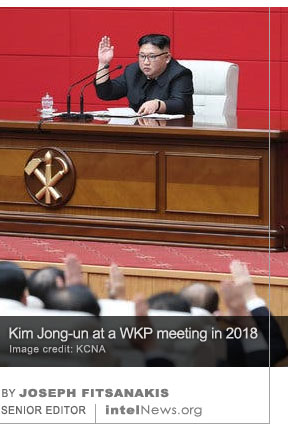
Kim Jong-unThe spy agency of South Korea has dismissed media reports that North Korea had several of its top nuclear negotiators executed or sent to labor camps, but has not rejected rumors of a major reshuffle in Pyongyang. In early June, media reports in Seoul claimed that North Korea had executed at least five of its senior nuclear negotiators and imprisoned several others. Prior to these reports, rumors of executions of North Korean nuclear negotiators had circulated in international diplomatic circles since February, but no specific allegations had surfaced in the news media. That changed when Chosun Ilbo, South Korea’s highest-circulation newspaper, alleged that at least five executions of nuclear negotiators had taken place in Pyongyang in March.
The paper claimed that the most senior North Korean official to be executed was Kim Hyok-chol, who led the nuclear negotiations with Washington prior to the Vietnam summit. The summit culminated with a —seemingly fruitless— face-to-face meeting between the North Korean Supreme Leader Kim Jong-un and US President Donald Trump. Citing an “anonymous source” Chosun Ilbo said that Kim had been executed by a firing squad at the Pyongyang East Airfield in Mirim, a suburb of the North Korean capital. Four other Ministry of Foreign Affairs officials were executed at the same time, allegedly for having been “swayed by American imperialists to betray the Supreme Leader”, said the newspaper. Two more senior North Korean nuclear negotiators, Kim Yong-chol and Kim Song-hye, were allegedly stripped of their government posts and sent to labor camps, according to the report.

On Tuesday, however, South Korea’s National Intelligence Service (NIS) directly contradicted Chosun Ilbo’s account. The spy agency told a closed-door meeting with members of parliament in Seoul that Kim Yong-chol had made recent appearances at senior-level events of the ruling Workers’ Party of Korea (WPK), and that Kim Hyok-chol was still alive. But the NIS did not rule out the possibility of a major reshuffle among the ranks of Pyongyang’s nuclear negotiators and the replacement of some of the top figures with new officials from the ranks of the WPK. Most international observers agree that Kim Jong-un is displeased with the impasse in the nuclear negotiations with Washington and has criticized —in some cases publicly— the performance of his team of negotiators.

Author: Joseph Fitsanakis | Date: 18 July 2019 | Permalink

Son of South Korean foreign minister defects to North Korea

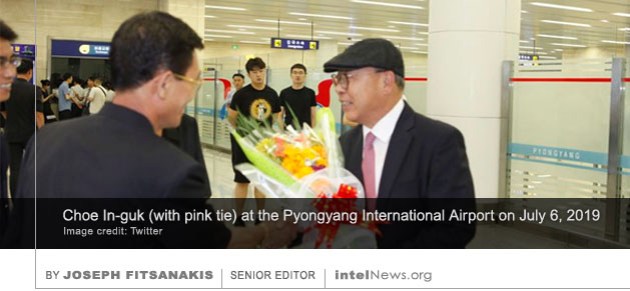
Choe In-gukThe son of a South Korean former cabinet minister has defected to North Korea, marking a rare instance of a citizen of South Korea switching his allegiance to the North. It is even rarer for such high-profile South Korean citizens to defect to North Korea. The defector is Choe In-guk, son of Choe Deok-sin, who served as South Korea’s minister of foreign affairs in the 1970s under the South Korean dictator Park Chung-hee. Choe was an American-trained army officer who served under United States command in the Korean War. He then served as a member of the cabinet and as South Korea’s ambassador to West Germany.
But by 1980, Choe had fallen out with the South Korean military government and was subsequently pushed out of the ruling Democratic Republican Party of Korea. He moved to the United States with his wife, Ryu Mi-yong, from where in 1986 the couple defected to North Korea. Soon after his defection, Choe was appointed director of North Korea’s Committee for the Peaceful Reunification of the Fatherland under the ruling Workers’ Party of Korea (WPK). Until her death in 2012, Ryu served as chairwoman of the Chondoist Chongu Party, a nationalist North Korean political party that supports the policies of the ruling WPK.

North Korean media reported that Choe and Ryu’s son, Choe In-guk, arrived at the Pyongyang Sunan International Airport on July 6. The North Korean state-run news website Uriminzokkiri published several photographs of the 73-year-old Choe being greeted by a welcoming committee of North Korean government officials holding flowers and gifts. Choe is reported to have given a brief speech upon his arrival in Pyongyang, praising North Korea’s leader and lamenting not having defected earlier in his life. The defector added that he intended to devote the remainder of his life to continue the work of his parents and to push for the reunification of the two Koreas.

On Sunday, South Korean Ministry of Unification confirmed that Choe had defected to North Korea from the United States. The Ministry also said that Choe had not obtained permission to travel to North Korea, which is required of all South Korean citizens who wish to cross the border between the two countries. It appears that Choe first traveled to the United States and for there to a third country —possibly China— before entering North Korea. South Korean officials announced that an investigation into his defection has been launched.

Author: Joseph Fitsanakis | Date: 08 July 2019 | Permalink

Sister of N. Korean leader promoted to #2 position, says S. Korean spy agency

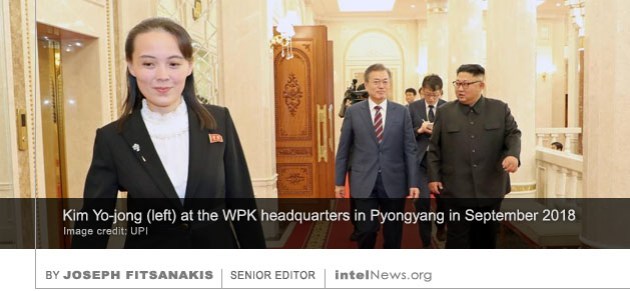
Kim Yo-jongThe younger sister of North Korea’s Supreme Leader Kim Jong-un appears to have been promoted to the number two position in the country’s ruling apparatus, according to a South Korean intelligence assessment. Until recently, Kim Yo-jong (pictured), 30, was Director of the Propaganda and Agitation Department of the ruling Workers’ Party of Korea (WPK). She also served as an alternate member of the Political Bureau, which is the highest decision-making body within the WPK.
Recently, however, she was spotted attending public festivities in Pyongyang, sitting in a prominent position next to General Kim Yong-chol, vice chairman of the WPK’s Central Committee. The festivities, which were televised nationwide, were held on the occasion of the Chinese President Xi Jinping’s visit to North Korea. The seating of North Korean officials in such high-profile events is carefully arranged to reflect their precise status within North Korea’s governing structure. Kim’s seating placement may signify a major government reshuffle, through which she has been elevated to one of the two or three most powerful posts in North Korea.

This assessment was delivered to South Korean lawmakers on Tuesday in a closed-door presentation by the National Intelligence Service (NIS), South Korea’s primary external spy agency. A summary of the presentation was shared with the media by Lee Hye-hoon, chairman of the Intelligence Committee at the South Korean National Assembly. According to Lee, the NIS’s assessment was that Kim’s authority appeared to be “enhanced due to an adjustment of roles” and that she seemed to have been promoted to the leader level”.

At the same time, the leadership status of North Korea’s other high-profile female official, Kim Song-hye, appears to have diminished. As intelNews reported earlier this month, there were rumors in Seoul that the North Korean nuclear negotiator had been stripped of her government post and sent to a labor camp. She was reportedly charged with having been “swayed by American imperialists to betray the Supreme Leader”. However, she reappeared on June 9, when she was seen attending a mass gymnastics ceremony in the North Korean capital. However, her public role appears notably muted in recent weeks.

Author: Joseph Fitsanakis | Date: 26 June 2019 | Permalink

Trump says US will not use spies on North Korea, then appears to retract statement

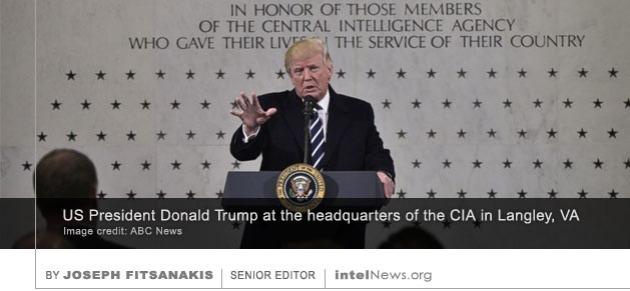
Trump CIA - JFUnited States President Donald Trump said on Tuesday that he would not allow American intelligence agencies to use spies against North Korea, raising eyebrows in Washington, before appearing to backtrack a day later. The American president was speaking to reporters at the White House on Tuesday, when he was asked about a report that appeared in The Wall Street Journal that day. According to the report, Kim Jong-nam, the half-brother of North Korean leader Kim Jong-un, held regular meetings with officers of the US Central Intelligence Agency before he was assassinated with VX nerve gas at a busy airport terminal in Malaysia in February 2017. The Wall Street Journal’s claim was echoed by a book written by Washington Post correspondent Anna Fifield, which also came out on Tuesday. In the book, entitled The Great Successor, Fifield claims that Kim had traveled to Malaysia to meet his CIA handler when he was killed.
On Tuesday, President Trump said he had seen “the information about the CIA, with respect to [North Korean Supreme Leader Kim Jong-un’s] half-brother. And I would tell [Kim] that would not happen under my auspices, that’s for sure”, said the US president, before repeating, “I wouldn’t let that happen under my auspices”. Reporters interpreted Trump’s comments to mean that he would not use human assets or any other kinds of informants to collect intelligence on the regime of the North Korean leader. As can be expected, the US president’s remarks raised eyebrows among lawmakers and national security experts in Washington. It was suggested that Trump appeared to voluntarily eliminate a potentially invaluable tool of intelligence collection from America’s arsenal. The president’s comments were even more peculiar given the hermetically sealed nature of the North Korean regime, which Western spy agencies would argue necessitates the use of human assets for intelligence collection. Moreover, President Trump’s comments appeared to once again place him at odds with his own Intelligence Community, as previously in the cases of Iran’s nuclear program, the current status of the Islamic State, or Russia’s meddling in American political life.

On Wednesday, however, the US president appeared to backtrack on his comments. When asked at a joint press conference with Polish President Andrzej Duda about his earlier remarks, Trump denied that he had implied the US would not use spies to collect information on North Korea. “No, it’s not what I meant”, the president responded to the reporter who asked him the question. “It’s what I said and I think it’s different, maybe, than your interpretation”, said President Trump, but refused to elaborate on what he actually meant with his statement on Tuesday. The Reuters news agency contacted the CIA seeking an official statement on the US president’s remarks, but the agency said it had no immediate comment on the issue.

Author: Joseph Fitsanakis | Date: 13 June 2019 | Permalink

North Korean leader’s half-brother worked with CIA before his death, paper claims

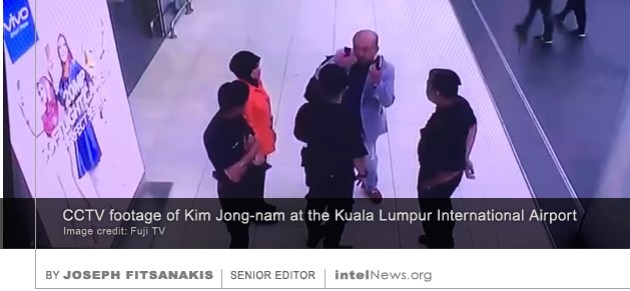
Kim Jong-nam murderKim Jong-nam, the half-brother of North Korean leader Kim Jong-un, held regular meetings with American intelligence officers before he was assassinated with VX nerve gas at a busy airport terminal in Malaysia. Two women approached Kim Jong-nam as he was waiting to board a plane at the Kuala Lumpur International Airport on February 13, 2017. The estranged half-brother of the North Korean leader was about to travel to the semi-autonomous Chinese territory of Macau, where he had been living in self-exile since 2007. Soon after his encounter with the two women, Kim collapsed and eventually died from symptoms associated with VX nerve agent inhalation.
But a new book published on Tuesday by a Washington Post reporter, and an article that came out in The Wall Street Journal on the same day, allege that Kim Jong-nam was working with the United States Central Intelligence Agency and was in fact in Malaysia to meet with his American spy hander when he was killed. The Wall Street Journal article said that many details of Kim Jong-nam’s precise relationship with the CIA remain “unclear”. It is doubtful that the late half-brother of the North Korean leader had much of a powerbase in the land of his birth, where few people even knew who he was. So his usefulness in providing the CIA with crucial details about the inner workings of the North Korean regime would have been limited. However, the paper quoted “a person knowledgeable about the matter” as saying that “there was a nexus” between the CIA and Kim. The article also alleges that Kim met with CIA case officers “on multiple occasions”, including during his fateful trip to Malaysia in February of 2017.

In her just-published book The Great Successor, Anna Fifield, a correspondent with The Washington Post, claims that Kim spent a number of days on the island of Langkawi, a well-known resort destination in Malaysia. Security footage at his hotel showed him meeting with “an Asian-looking man [Korean-American, according to The Wall Street Journal] who was reported to be an American intelligence [officer]”. It was one of regular trips Kim took to places like Singapore and Malaysia to meet his spy handlers, according to Fifield, who cites “someone with knowledge of the intelligence”. She adds that, although meeting with this CIA handler may not have necessarily been the sole purpose of Kim’s fateful trip to Malaysia, it was certainly a major reason. Fifield alleges that the backpack Kim was carrying when he was killed at the Kuala Lumpur International Airport was found to contain $120,000 in cash. The Wall Street Journal claims that, in addition to meeting with the CIA, Kim held regular meetings with spy agencies of other countries, including China.

Meanwhile, two South Korean government agencies, the National Intelligence Service and the Ministry of Reunification, said on Tuesday that they were unable to confirm that Kim was indeed an asset of the CIA or any other intelligence agency. They also said that they could not confirm whether Kim had traveled to Malaysia to meet with a CIA case officer at the time of his assassination.

Author: Joseph Fitsanakis | Date: 12 June 2019 | Permalink

North Korea said to have executed senior nuclear negotiators as ‘spies’

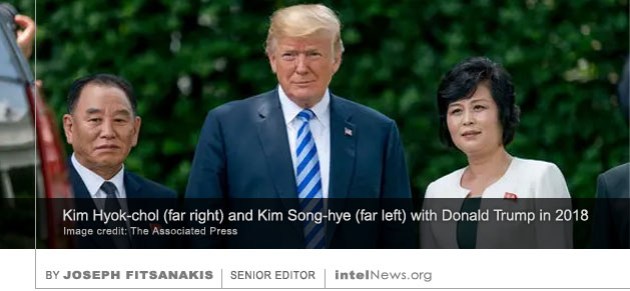
Kim Song-hye Kim Hyok-cholNorth Korea has executed at least five of its senior nuclear negotiators and imprisoned several others, according to a report in a leading South Korean newspaper. Rumors of executions of North Korean nuclear negotiators have circulated in international diplomatic circles since February, but specific allegations have not surfaced in the news media. That changed on Friday, when Chosun Ilbo, South Korea’s highest-circulation newspaper, said that at least five executions of nuclear negotiators took place in Pyongyang in March.

According to the paper, the most senior North Korean official to be executed was Kim Hyok-chol (pictured), who led the nuclear negotiations with Washington until February, when the North Korean Supreme Leader Kim Jong-un met US President Donald Trump in Vietnam. Citing an “anonymous source” Chosun Ilbo said on Friday that Kim was executed by a firing squad at the Pyongyang East Airfield in Mirim, a suburb of the North Korean capital. Four other Ministry of Foreign Affairs officials were executed at the same time, allegedly for having been “swayed by American imperialists to betray the Supreme Leader”, said the newspaper. Two more senior North Korean nuclear negotiators, Kim Yong-chol and Kim Song-hye (also pictured), have been stripped of their government posts and sent to labor camps, according to the report. Until recently, Kim Song-hye headed the Bureau of the Committee for the Peaceful Reunification of the Fatherland, Pyongyahg’s main agency for negotiations with South Korea. Kim Yong-chol was one of several vice-chairs of the ruling Workers’ Party of Korea. He visited Washington with Kim Song-hye for negotiations prior to last February’s high-level summit in Vietnam.

There have been no reports in North Korean media about purges of senior officials or executions of alleged spies. However, the three officials named in the Chosun Ilbo report have not been seen in public in nearly a month. Additionally, last week the official Workers’ Party of Korea newspaper, Rodong Sinmun, published an editorial that condemned “counter-party and counter-revolutionary actions” of government officials who “claim to labor for the Supreme Leader […] but clandestinely harbor other machinations behind the back of the Supreme Leader”. The New York Times reached out to the South Korean and American governments about the Chosun Ilbo report, but no-one would comment on record. If the Chosun Ilbo report is accurate, it would support the view that there is exasperation in Pyongyang about the breakdown of its nuclear negotiations with Washington. It would also signify that Kim has radically reshuffled his team of negotiators, but this does not necessarily denote a change in his negotiating stance.

Author: Joseph Fitsanakis | Date: 03 June 2019 | Permalink

Malaysia releases second female assassin of Kim Jong-un’s half-brother from prison

Siti AisyahThe second of two female assassins who killed the half-brother of North Korean leader Kim Jong-un in 2017 in Kuala Lumpur has been released from prison by the Malaysian state, after a mostly secret trial. The two women, Doan Thi Huong of Vietnam and Siti Aisyah of Indonesia (pictured), approached Kim Jong-nam as he was waiting to board a plane at the Kuala Lumpur International Airport on February 13. The estranged half-brother of the North Korean leader was about to travel to Macau, where he had been living in self-exile since 2007. Soon after his encounter with the two women, Kim collapsed and eventually died from symptoms associated with VX nerve agent inhalation. Huong was arrested on February 15, when she returned to the same airport to catch an outbound flight to Vietnam. Siti’s arrest was announced a day later.
Both women told Malaysian police that they worked as escorts and that they were under the impression that they had been hired by a Japanese YouTube show to carry out a televised prank on an unsuspecting traveler. They claimed that they did not realize that the men who had hired them several months prior to the assassination operation were agents of the North Korean government —which international authorities blamed for Kim’s murder. In March of this year, Malaysian authorities announced that all charges against the Indonesian woman, Siti, had been dropped, and that she would be released from detention. No reasoning behind the decision was provided to the media. On Thursday, it was revealed that Huong would be freed, after she agreed to plead guilty to a much lesser charge of “causing bodily injury”, as requested by government prosecutors.

What is behind the decision of the Malaysian court? British newspaper The Guardian said last month that the government of Indonesia engaged in intense “behind-the-scenes diplomacy” in order to have its citizen released. These efforts “significantly influenced how events […] unfolded in the courtroom”, said the paper. Additionally, the Malaysian government had been uncomfortable with the international attention of this incident from the very beginning, and had expressed the desire “to be done with the trial because it was diplomatically inconvenient”, according to The Guardian. The paper added that, as the international status of Kim Jong-un rose unexpectedly through his meetings with United States President Donald Trump, Malaysia sought to be “part of this conversation”. Kuala Lumpur thus decided that “the recovery of [its] relationship with Pyongyang [was] more important than justice for the assassination of Kim Jong-nam”, former South Korean intelligence officer Dr. Nam Sung-wook told The Guardian.

Author: Joseph Fitsanakis | Date: 03 May 2019 | Permalink

Spain returns stolen material to North Korean embassy in Madrid, say sources

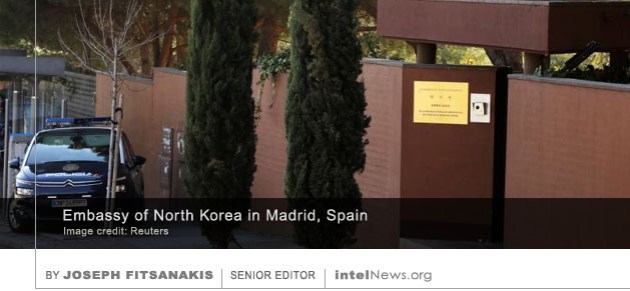
North Korea SpainAuthorities in Spain have returned material that was stolen from the embassy of North Korea in Madrid by a group of raiders in February, according to a source that spoke to the Reuters news agency. The unprecedented attack took place in the afternoon of February 22 in a quiet neighborhood of northern Madrid, where the North Korean embassy is located. Ten assailants, all Asian-looking men, entered the three-story building from the main gate, brandishing guns, which were later found to be fake. They tied up and gagged the embassy’s staff and some visitors to the embassy. After several hours spent inside the buildings, the assailants abandoned the building in two embassy vehicles that were later found abandoned.
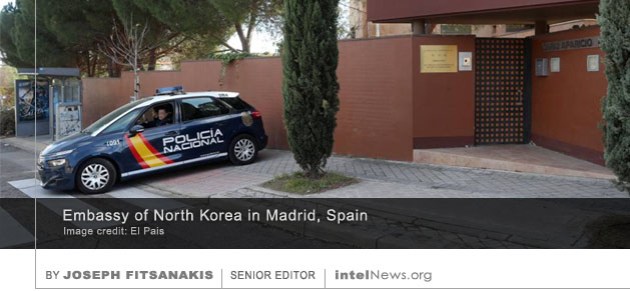
A few weeks following the raid, a North Korean dissident group calling itself Cheollima Civil Defense —also known as Free Joseon— claimed responsibility for the attack. Cheollima Civil Defense is North Korea’s first known active resistance group. Its members call for the overthrow of the Kim dynasty. Subsequent reports said that some of those who took part in the embassy raided fled to the United States and approached the Federal Bureau of Investigation (FBI) with an offer to hand over computer hardware and telephones captured in the attack. On Tuesday, the Reuters news agency reported that the FBI “returned the material [to Spanish authorities] two weeks ago”, and that Spanish police handed it over to the North Koreans. Citing “a Spanish judicial source”, Reuters said that American authorities returned the material directly to the Spanish court that is investigating the raid.

According to the news agency, Spanish authorities returned the material to the North Korean embassy without reviewing its contents, thus complying with the norms of diplomatic protocol. Data and items belonging to foreign embassies are usually off-limits to the authorities of host nations. The report did not clarify whether the FBI returned all the material that was stolen by the raiders in February, nor did it state whether the FBI reviewed its contents prior to handing it over to the Spanish court.

Author: Joseph Fitsanakis | Date: 17 April 2019 | Permalink

Dissident group ‘approached the FBI’ after raid on North Korean embassy in Madrid

North Korea embassy SpainMembers of a self-styled dissident group that raided North Korea’s embassy in Madrid last month reportedly approached the authorities in the United States, offering to share material taken from the embassy. The attack took place in the afternoon of February 22 in a quiet neighborhood in northern Madrid, where the North Korean embassy is located. Ten assailants, all Southeast Asian-looking men, entered the three-story building from the main gate, brandishing guns, which were later found to be fake. They tied up and gagged the embassy’s staff, as well as three North Korean architects who were visiting the facility at the time. The assailants later abandoned the building in two embassy vehicles that were later found abandoned.
Initial reports alleging that Washington was involved in the raid were later found to be inaccurate, as an obscure North Korean dissident group, calling itself Cheollima Civil Defense —also known as Free Joseon— claimed responsibility for the attack. Cheollima Civil Defense is North Korea’s first known active resistance group in living memory, and has called for the overthrow of the Kim dynasty. But little is known about its members.

On Tuesday, however, Judge José de la Mata, of the Spanish High Court, told reporters that three members of the group had been identified by Spanish authorities. He named them as: Adrian Hong Chang, a Mexican national who is a resident of the United States; Sam Ryu, an American citizen; and Woo Ran Lee, a South Korean. Judge de la Mata said that all ten members of the group had managed to leave Spain in the hours following the attack on the North Korean embassy. Interestingly, however, Chang, who left Europe through Portugal, appeared in New York on February 27 and approached the local field office of the FBI. He allegedly met with FBI agents and described the raid on the North Korean embassy. He then offered to give the FBI some of the material that Cheollima Civil Defense stole from the embassy, including a mobile phone, USBs, laptops, as well as several hard drives.

It is not known whether the FBI accepted Chang’s offer. But, according to Judge de la Mata, Chang “handed over audiovisual material” to the FBI. When asked about Judge de la Mata’s statement, the FBI said it does not comment on investigations that are in progress. The US Department of State said that the American government “had nothing to do” with the attack on the North Korean embassy in February.

Author: Joseph Fitsanakis | Date: 27 March 2019 | Permalink

Analysis: Who was behind the raid on the North Korean embassy in Madrid?

North Korea SpainAn obscure North Korean dissident group was most likely behind a violent raid on North Korea’s embassy in Madrid on February 22, which some reports have pinned on Western spy agencies, including the Central Intelligence Agency. The group, known as the Cheollima Civil Defense, is believed to be the first North Korean resistance organization to declare war on the government of Supreme Leader Kim Jong-un.

THE ATTACK

The attack took place at 3:00 in the afternoon local time in Aravaca, a leafy residential district of northern Madrid, where the embassy of North Korea is located. Ten assailants, all Southeast Asian-looking men, entered the three-story building from the main gate, brandishing guns, which were later found to be fake. They tied up and gagged the embassy’s staff, as well as three North Korean architects who were visiting the facility at the time. But one staff member hid at the embassy. She eventually managed to escape from a second-floor window and reach an adjacent building that houses a nursing home. Nursing home staff called the police, who arrived at the scene but had no jurisdiction to enter the embassy grounds, since the premises are technically North Korean soil. When police officers rang the embassy’s doorbell, an Asian-looking man appeared at the door and Q Quote 1said in English that all was fine inside the embassy. But a few minutes later, two luxury cars belonging to the North Korean embassy sped away from the building with the ten assailants inside, including the man who had earlier appeared at the front door.
Once they entered the embassy, Spanish police found eight men and women tied up, with bags over their heads. Several had been severely beaten and at least two had to be hospitalized. The victims told police that the assailants were all Korean, spoke Korean fluently, and had kept them hostage for nearly four hours. But they refused to file formal police complaints. The two diplomatic cars were later found abandoned at a nearby street. No money was taken by the assailants, nor did they seem interested in valuables of any kind. But they reportedly took with them an unknown number of computer hard drives and cell phones belonging to the embassy staff. They also stole an unknown quantity of diplomatic documents, according to reports.

POSSIBLE FOREIGN CULPRITS

Within a few hours, Spanish police had reportedly ruled out the possibility that the assailants were common thieves, arguing that the attack had been meticulously planned and executed. Also, common thieves would have looked for valuables and would not have stayed inside the embassy for four hours. Within a week, several Spanish newspapers, including the highly respected Madrid daily El País and the Barcelona-based El Periodico, pinned the raid on Western intelligence services. They cited unnamed police sources who claimed that at least two of the assailants had been identified and found to have links with the CIA. The reports also cited claims by embassy employees that the attackers interrogated them extensively about Soh Yun-sok, North Korea’s former ambassador to Madrid. Soh became Pyongyang’s chief nuclear negotiator after he was expelled by the Spanish government in 2017 in protest against North Korea’s nuclear missile tests. Read more of this post

North Korea-linked hackers growing in reach and sophistication, McAfee warns

Computer hackingA computer hacking group with links to the North Korean government has a wider reach and is more sophisticated than was initially believed, according to the computer security firm McAfee. The group, dubbed Lazarus by cybersecurity experts, is believed to be connected with Guardians of Peace, the hacker team that orchestrated the 2014 attacks on Sony Pictures Entertainment. The company drew the ire of the North Korean government for producing The Interview, a black comedy based on a fictional attempt by two Americans to assassinate North Korean leader Kim Jong-un. Known collectively as ‘the Sony Pictures hack’, the attacks included the compromise of internal documents and unreleased copies of films produced by Sony, as well as personal attacks on Sony executives and members of their families. There were also attempts to damage Sony’s digital infrastructure, which cost the company an undisclosed amount in damages, believed to be in the millions of dollars.
In February of last year, the computer security software company McAfee said that Lazarus was behind an ongoing campaign targeting global banks and bitcoin users. On Sunday, the California-based firm said that Lazarus was responsible for what its experts call Operation SHARPSHOOTER, a widespread effort to compromise key industries across several continents. Speaking at the RSA IT security conference in San Francisco, McAfee experts said that SHARPSHOOTER began as early as September of 2017, and that it was first detected in December of 2018. By that time, said McAfee, around 80 firms and organizations had been targeted by Lazarus. But in recent months, it has become clear that SHARPSHOOTER is “more extensive in complexity, scope and duration” than previously thought, according to McAfee experts. They added that they drew this conclusion based on “command-and-control serve code” data that was made available to them by an unnamed “government entity”. This is the type of forensic data that is customarily seized by government agencies and is rarely made available to cybersecurity researchers in the private sector, said the McAfee representatives. This “non-typical access” afforded McAfee technical experts “a rare opportunity” to examine “the inner workings [of Lazarus’] cyberattack infrastructure”, they added.

As a result, the company’s “confidence levels are now much higher” that Lazarus is targeting key agencies and industries, including government organizations involved with national defense, energy and critical infrastructure. Most of Lazarus’ targets are in the United States, Germany and Turkey. But smaller attacks have been detected in Asia and Africa, in countries such as the Philippines and Namibia. Many attacks begin with so-called ‘spearphishing’ attempts, which target particular employees of agencies or firms. These attacks center on emails that are “masked as extremely convincing job recruitments”. The emails contain links to Microsoft Word or Adobe PDF files on popular file-sharing platforms like DropBox, which are infected with malware, said McAfee.

Author: Joseph Fitsanakis | Date: 05 March 2019 | Permalink

CIA has maintained secret communication with North Korea for 10 years

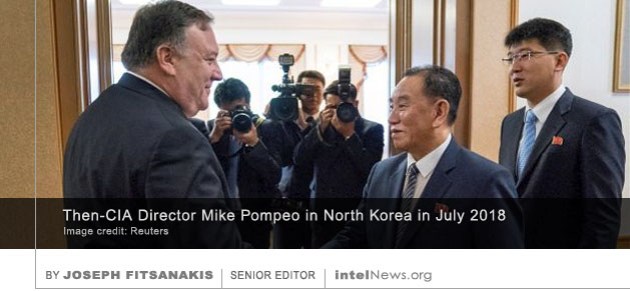
Mike Pompeo North KoreaWith presidential approval, the United States Central Intelligence Agency has maintained a secret channel of communication with North Korea since at least 2009, according to The Wall Street Journal. Many were surprised in 2018, when the then CIA director Mike Pompeo made a sudden visit to Pyongyang to speak with senior North Korean officials. But according to The Wall Street Journal, the CIA channel with the North Koreans had been there since at least 2009 and Pompeo simply “re-energized it” after being instructed to do so by the White House.
The United States and North Korea have never had official diplomatic relations, nor have they ever maintained embassies at each other’s capitals. In rare instances, the North Korean Permanent Mission to the United Nations in New York has been utilized to pass messages from the White House to the communist country’s Ministry of Foreign Affairs. No other systematic diplomatic activity between the two sides has ever been reported.

But an article published in The Wall Street Journal on Monday claims that an intelligence channel between the CIA and unspecified North Korean intelligence officials has been active —with some periods of dormancy— for at least a decade. The previously unreported channel has led to a number of public meetings, such as the 2014 visit to Pyongyang by James Clapper, the then US Director of National Intelligence, as well as an earlier visit to the North Korean capital by former US President Bill Clinton in 2009. But, says the paper citing “current and former US officials”, most of the contacts have been secret. They include several visits to North Korea by CIA official Joseph DeTrani before and after Clinton’s visit, as well as two trips to Pyongyang by CIA Deputy Director Michael Morell, in 2012 and 2013. His successor, Avril Haines, also visited North Korea, says The Journal, but notes that the channel went “dormant late in the Obama administration”.

Upon becoming CIA director following the election of Donald Trump to the presidency, Mike Pompeo was briefed about the secret channel’s existence and decided to resume it, with Trump’s agreement. That led to his eventual visit to North Korea along with Andrew Kim, who at the time headed the CIA’s Korea Mission Center. Eventually, this channel of communication facilitated the high-level summit between President Trump and Supreme leader Kim Jong-un in June 2018 in Singapore. The Wall Street Journal said it reached out to the CIA, the Department of State and the White House about this story, but received no responses. The North Korean mission in the United Nations in New York also declined to comment.

Author: Joseph Fitsanakis | Date: 22 January 2019 | Permalink

North Korean ambassador to Rome missing since November, says Seoul

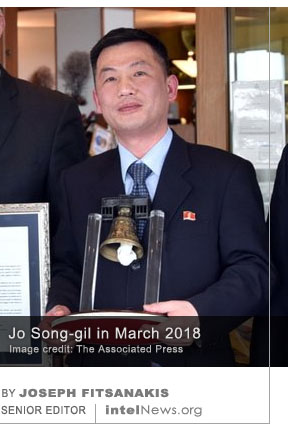
Jo Song-gilThe acting ambassador of North Korea to Italy has been missing for two months and there are reports that he may be under the protection of a Western country. Jo Song-gil (pictured), 48, a career diplomat who is fluent in Italian, French and English, presented his diplomatic credentials to the Italian government in May of 2015. In October 2017, he became his country’s acting ambassador after Italian authorities expelled Ambassador Mun Jong-nam from the country. The expulsion came in response to North Korea’s nuclear test in September of that year, when Pyongyang announced the detonation of a hydrogen bomb that could be loaded onto an intercontinental ballistic missile.


Jo is believed to be from a high-ranking family of officials and diplomats with a long history in the ruling Workers Party of Korea. His father is a retired diplomat and his wife’s father, Lee Do-seop, spent many years as Pyongyang’s envoy in Hong Kong and Thailand. It is believed that Jo had been permitted to take his wife and children with him to Rome, a privilege that is bestowed only to the most loyal of North Korean government official. Sources in the Italian government were quoted by British media on Thursday saying that Pyongyang had notified Italy’s Ministry of Foreign Affairs in October that Jo would be replaced in December. On Thursday, however, Kim Min-ki, a South Korean member of parliament, told reporters in Seoul that Jo had been missing since November. Kim added that he and a group of other parliamentarians had been briefed on the mater by officials from the National Intelligence Service, South Korean’s primary external intelligence agency. He went on to say that Jo’s wife and children were believed to have vanished with him and that South Korean authorities had not made contact with them since their disappearance.

Meanwhile, South Korean press reports stated on Thursday that Jo and his family “were in a safe place” under the protection of the Italian government, while they negotiated their defection. But Italian officials told the BBC that the Ministry of Foreign Affairs had “no record of an asylum request made by Jo” or other members of his family. Citing an anonymous “diplomatic source”, the Seoul-based JoongAng Ilbo said that the former ambassador and his wife were in the process of negotiating their defection to a Western country, along with an offer of political asylum. The paper did not name the country, but said that the missing family did not intend to remain in Italy. IntelNews regulars will recall the last defection of a senior North Korean diplomat in August 2016, when Thae Yong-ho, second-in-command at the North Korean embassy in London, defected to South Korea with his family.

Author: Joseph Fitsanakis | Date: 04 January 2019 | Permalink


