IRA is still ‘broadly in place’, says Northern Ireland police chief
August 28, 2015 1 Comment
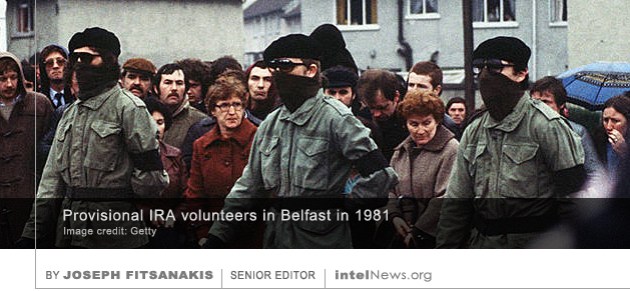 The Provisional Irish Republican Army, which fought British rule in Northern Ireland for decades, but officially disbanded in 2005, is still “broadly in place”, according to the head of the Police Service of Northern Ireland. On July 28, 2005, the Provisional IRA announced that was ceasing all paramilitary operations and disbanding as of 4:00 p.m. that day. The man who made the announcement on British television was Séanna Walsh, a former cellmate of Bobby Sands, the Provisional IRA volunteer who was the first prisoner to die in the 1981 Irish hunger strike. He read a statement authorized by the Provisional IRA leadership, which said that all PIRA units had been “ordered to dump arms” and that PIRA volunteers should “not engage in any other activities whatsoever”. Three years later, the Independent Monitoring Commission declared that the PIRA’s Army Council, which steered the activities of the militant organization, was “no longer operational or functional”.
In the ensuing years, which have seen the implementation of the Good Friday Agreement that restored peace in Northern Ireland, it has been generally assumed that the PIRA had ceased to exist. Last week, however, George Hamilton, the head of the Police Service of Northern Ireland, told reporters that “some of the PIRA structure from the 1990s remains broadly in place” in the area. Hamilton was speaking in reference to the murder earlier this month of Kevin McGuigan in east Belfast. McGuigan, a 53-year-old father of nine, was a former member of the Provisional IRA, who had fallen out with the organization. He was gunned down at his home, allegedly in retaliation for the murder last May of Gerard Jock Davison, a former commander of the Provisional IRA, who was also shot dead in the Markets area of Belfast.
Some allege that McGuigan had participated in Davison’s murder, and that the Provisional IRA’s Army Council authorized McGuigan’s killing in response. Chief Hamilton said last week that the PIRA had probably not authorized McGuigan’s killing, but added that the militant separatist organization was still in existence. In response to his statement, the Irish government said on Tuesday that it would reassess its intelligence on the activities of the PIRA during the last decade. Meanwhile, Gerry Adams, the leader of Sinn Fein, which is believed to be the political wing of the PIRA, has denied that the armed separatist group is still active and insisted that the PIRA “left the stage in 2005”.
► Author: Joseph Fitsanakis | Date: 28 August 2015 | Permalink








 intelNews.org
IRA source in high-profile counterfeit money case claims his life is in danger
July 4, 2016 by Joseph Fitsanakis Leave a comment
In 2000, in cooperation with the US Secret Service, British intelligence conducted a large-scale undercover operation codenamed MALI. According to the BBC’s investigative news program Panorama, the operation focused on Seán Garland, the former chief of staff of the Official IRA and former president of its political wing, the Workers’ Party of Ireland. The Official IRA and the Provisional IRA were the two main splinter groups of the “old” IRA, which parted ways in 1969 due to ideological and tactical differences. In 1972, the Official IRA declared a unilateral ceasefire and eventually morphed in to a leftwing political party calling itself the Workers’ Party of Ireland. Operation MALI allegedly found that the Workers’ Party former president, Seán Garland, traveled to Russia and visited the embassy of North Korea in Moscow. He is said to have picked up a package containing supernotes, which he then secretly smuggled into Ireland and from there to England, in exchange for money. Garland was arrested in 2005 in Belfast, UK, but managed to flee to Ireland when he was released on medical leave. He was arrested again in 2009 and released on bail. In 2011, his extradition request to the US was rejected by an Irish court on a technicality, but he remains wanted by Washington. Ireland is also considering whether there are legal grounds to prosecute Garland in Dublin. He and his supporters deny the charges against him and claim that they are politically motivated.
Last week, however, the man believed to be behind the tip-off that led to Garland’s arrest, said his life was in danger. The man, who uses the pseudonym “Michael O’Brien”, was a member of the Official IRA in the 1970s. But he says that after 1996 he worked as an undercover informant for Britain’s Security Service (MI5) and the Anti-Terrorist Branch of the British Police. He claims that it was he who first alerted British authorities about the involvement of members of the Workers’ Party of Ireland in the distribution of supernotes from Russia to Europe. He is also believed to have testified behind closed doors at a US court hearing involving Garland and other alleged conspirators in the counterfeit money case. However, O’Brien told The Sunday Times last week that his cover was blown in January of this year. Since then, he has allegedly been the subject of death threats and had to abandon his home in Belfast as a result. He also claims that the US Secret Service and British police have failed to provide him with protection. O’Brien told The Times that he chose to speak to the media in order to protect himself from possible assassination by Irish republicans.
► Author: Joseph Fitsanakis | Date: 04 July 2016 | Permalink
Filed under Expert news and commentary on intelligence, espionage, spies and spying Tagged with “Michael O’Brien”, counterfeiting, currency smuggling, forgery, informants, Ireland, News, Official IRA, Police Service of Northern Ireland, Seán Garland, superbill, superdollar, supernote, UK, US Secret Service, Workers’ Party of Ireland