Argentine ex-spy says government killed prosecutor Alberto Nisman
March 2, 2016 Leave a comment
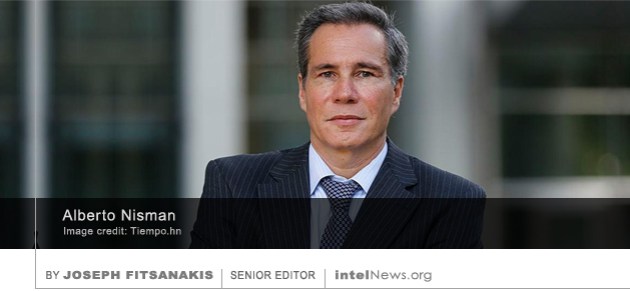 An Argentine former senior intelligence official has claimed in court testimony that the administration of President Cristina Fernández de Kirchner murdered a state prosecutor who had accused senior officials of having colluded with Iran to bomb Israeli targets in Buenos Aires. In January 2015, the prosecutor, Alberto Nisman, prompted international headlines by launching a criminal complaint against President Kirchner and several other notable personalities of Argentine political life. Nisman accused them of having colluded with the government of Iran to obstruct an investigation into the bombings of the Israeli embassy and a Jewish cultural center in Buenos Aires in the mid-1990s. A dozen people died in the bombing of the embassy, while another 85 were killed two years later, when the Asociación Mutual Israelita Argentina community center in the Argentine capital was bombed. Nisman was found dead on January 19, 2015, hours before he was due to give Congressional testimony on the subject. His body was found in the bathroom of his apartment, which had been locked from the inside.
Argentine authorities say they believe Nisman killed himself with a single shot to the head from a .22 caliber handgun. His family, however, as well as many notable personalities in Argentina, believe he was murdered on the orders of government officials who wanted to silence him. Such claims were reinforced this week following a dramatic 17-hour court testimony by Antonio Horacio Stiuso, better known as Jaime Stiuso, who served as chief operating officer for Argentina’s Secretaría de Inteligencia del Estado (SIDE) under President Kirchner. Stiuso was fired after Nisman’s death, when the government suddenly dissolved SIDE and replaced it with a new agency, the Agencia Federal de Inteligencia. In justifying the dramatic move, President Kirchner accused SIDE of feeding Nisman fabricated information implicating her and her government minsters in a fictional collusion with the Islamic Republic, and then killing him in order to destabilize her rule. She then charged SIDE’s leadership, including Stiuso, with involvement in Nisman’s killing. Stiuso promptly fled Buenos Aires for Brazil, from where he flew to Miami, Florida, on February 19, using an Italian passport.
But the former spy recently returned to Argentina and on Monday he testified in a closed-door hearing as part of an official investigation into Nisman’s death. Although Stiuso gave his testimony in secret, Argentine media published several extracts on Tuesday, which appear to have been leaked by witnesses. According to the excerpts, Stiuso accused members of an “inner circle” inside President Kirchner’s government of having killed Nisman and then tampered with incriminating evidence from the scene of the crime. The former spy appears to have told the judge in the case, Fabiana Palmaghina, that the state prosecutor’s death “was intimately linked to the work he was doing”. He is reported to have added that “the author of all this madness was that woman, Cristina Fernández de Kirchner.
Stiuso has refrained from talking to the media, and his comments to the court have not been confirmed. However, the judge in the case, who previously favored the view that Nisman committed suicide, has now referred Nisman’s case to a higher federal court in Argentina with instructions that it be examined as a possible homicide.
► Author: Joseph Fitsanakis | Date: 02 March 2016 | Permalink
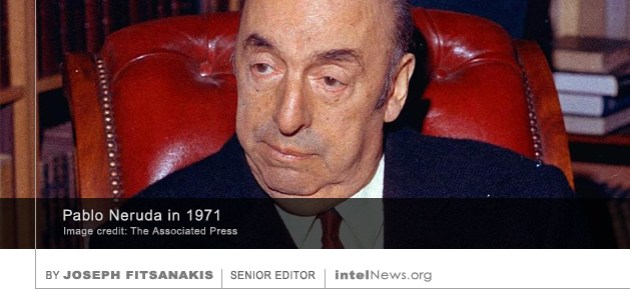 Two teams of international experts will examine the exhumed remains of Chilean Nobel Laureate poet Pablo Neruda, who some say was deliberately injected with poison by the Chilean intelligence services. The literary icon died on September 23, 1973, less than two weeks after a coup d’état, led by General Augusto Pinochet, toppled the democratically elected government of Salvador Allende, a Marxist who was a close friend of Neruda. The death of the internationally acclaimed poet, who was 69 at the time, was officially attributed to prostate cancer and the effects of acute mental stress caused by the military coup. In 2013, however, an
 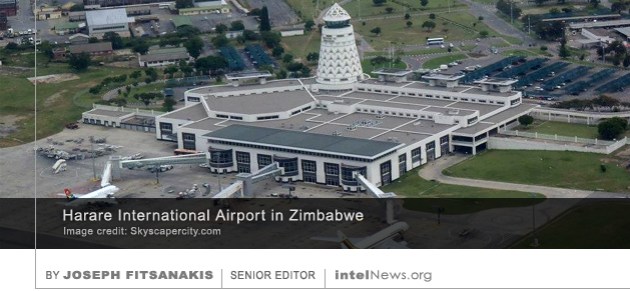 An American-registered airplane carrying large quantities of cash on behalf of a South African bank was impounded by authorities in Zimbabwe after a dead body was found on board. Zimbabwean media said police was notified after human blood was seen dripping from the plane’s cargo area during an emergency refueling stop. Authorities
  A Russian former intelligence officer, who is accused by the British government of having killed another Russian former spy in London, said the British intelligence services tried to recruit him in 2006. British government prosecutors have charged Andrei Lugovoi with the killing of Alexander Litvinenko, a former employee of the Soviet KGB and one of its successor agencies, the FSB. In 2006, Litvinenko died in London, where he had defected with his family in 2000, following exposure to the highly radioactive substance Polonium-210. In July of 2007, the British government charged Lugovoi and another Russian, Dmitri Kovtun, with the murder of Litvinenko, and expelled four Russian diplomats from London. Last week, following the conclusion of an official inquest into the former KGB spy’s death, the British government took the unusual step of summoning the Russian ambassador to London, to file an official complaint about Moscow’s refusal to extradite Lugovoi and Kovtun to the United Kingdom.
 The British government has taken the unusual step of summoning the Russian ambassador to London, following the conclusion of an official inquest into the death of a former KGB officer who is believed to have been killed on the orders of Moscow. Alexander Litvinenko, an employee of the Soviet KGB and one of its successor organizations, the FSB, defected with his family to the United Kingdom in 2000. But in 2006, he died of radioactive poisoning after meeting two former KGB/FSB colleagues, Dmitri Kovtun and Andrey Lugovoy, in London. A public inquiry into the death of Litvinenko, ordered by the British state,
 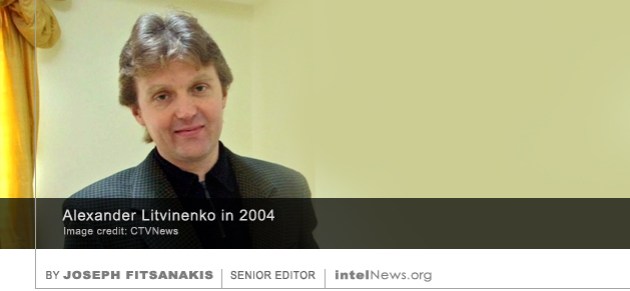 The long-awaited concluding report of a public inquiry into the death of a former Soviet spy in London in 2006, is expected to finger the Russian state as the perpetrator of the murder. Alexander Litvinenko was an employee of the Soviet KGB and one of its successor organizations, the FSB, until 2000, when he defected with his family to the United Kingdom. He soon became known as a vocal critic of the administration of Russian President Vladimir Putin. In 2006, Litvinenko came down with radioactive poisoning after meeting two former KGB/FSB colleagues, Dmitri Kovtun and Andrey Lugovoy, at a London restaurant. In July of 2007, after establishing the cause of Litvinenko’s death, which is attributed to the highly radioactive substance Polonium-210, the British government officially charged the two Russians with murder and issued international warrants for their arrest. Whitehall also announced the expulsion of four Russian diplomats from London. The episode, which was the first public expulsion of Russian envoys from Britain since end of the Cold War, is often cited as marking the beginning of the worsening of relations between the West and post-Soviet Russia.
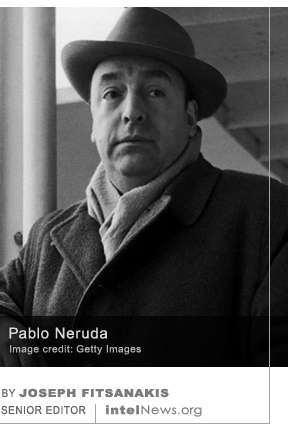 A report prepared by the Chilean government considers it “highly likely” that Chile’s Nobel laureate poet, Pablo Neruda, died as a result of deliberate poisoning. The literary icon, who was awarded the Nobel Prize in Literature in 1971, died on September 23, 1973. His death occurred less than two weeks after a coup d’état, led by General Augusto Pinochet, toppled the democratically elected government of Salvador Allende, a Marxist who was a close friend of Neruda.
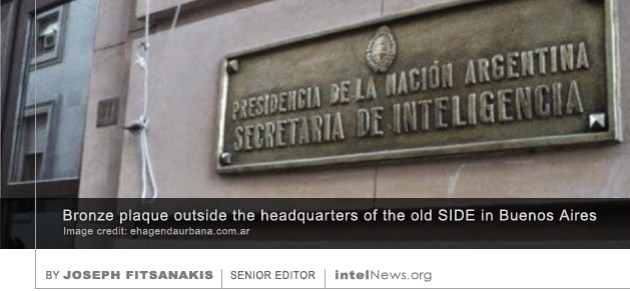 An Argentine former senior intelligence official, who is wanted in connection with the murder of a federal prosecutor in Buenos Aires, is hiding in the United States, according to the President of Argentina, who says Washington should extradite him. Antonio Horacio Stiuso, better known as Jaime Stiuso, rose through the ranks of Argentina’s Secretaría de Inteligencia del Estado (SIDE) to become its director of counterintelligence. In 2012, Argentine President Cristina Fernández de Kirchner appointed Stiuso to chief operating officer of SIDE, working directly under the agency’s director. However, Stiuso was fired in a massive agency shake-up in February of this year, when the government suddenly dissolved SIDE and replaced it with a new agency, called Agencia Federal de Inteligencia.
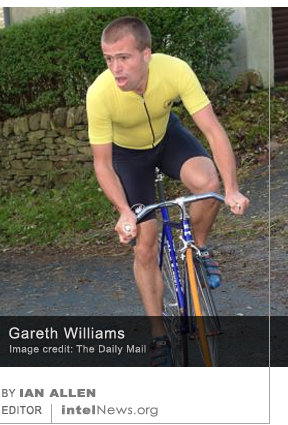 A British intelligence officer, who was found dead in his London apartment in 2010, was not a transvestite, as some media reports have speculated, but probably worked undercover dressed as a woman, according to a leading forensic investigator. Gareth Williams, a mathematician in the employment of Britain’s signals intelligence agency, GCHQ, had been seconded to MI6, Britain’s external intelligence agency, to help automate intelligence collection. He had also worked with several United States agencies, including the Federal Bureau of Investigation and the National Security Agency. But his career came to an abrupt end in August 2010, when he was
 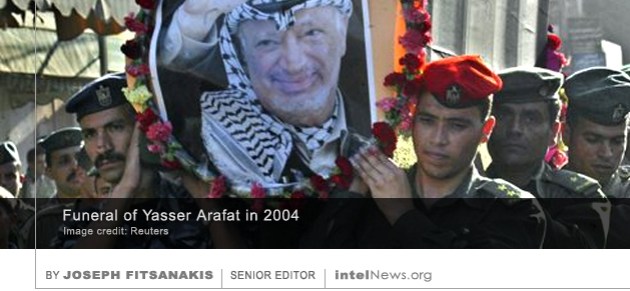 A government prosecutor in France has urged that a probe looking into whether the late Palestinian leader Yasser Arafat was poisoned with a radioactive substance should be dropped, because evidence shows he died of natural causes. Arafat was the founder of Palestinian nationalist group Fatah and led the Palestine Liberation Organization for over three decades before becoming the first president of the Palestinian Authority. He died in November 2004 at the Percy military hospital in Paris, France, weeks after being transferred there from his headquarters in Ramallah, West Bank. His official records indicate that he died from a stroke, which he suffered as a result of a blood disorder known as disseminated intravascular coagulation.
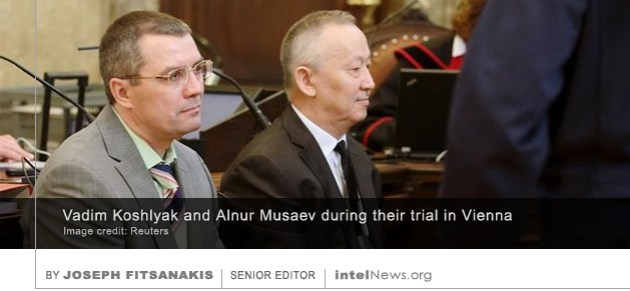 Kazakhstan’s former spy chief and a former presidential bodyguard have been acquitted by an Austrian jury, five months after a co-defendant in their double-murder trial, who was also the Kazakh president’s former son-in-law, was found dead in his Vienna cell. As intelNews has written
 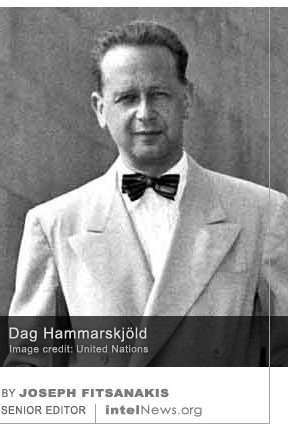 A panel of experts commissioned by the United Nations is about to unveil fresh evidence on the mysterious death in 1961 of UN secretary general Dag Hammarskjöld, who some claim was murdered for supporting African decolonization. The evidence could spark a new official probe into the incident, which has been called “one of the enduring mysteries of the 20th century”.
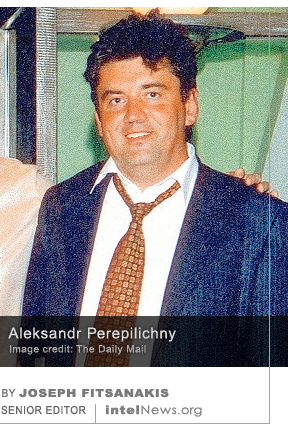 A Russian businessman, who died in London while assisting a Swiss probe into a massive money-laundering scheme, may have been poisoned with a substance derived from a highly toxic plant, an inquest has heard. Aleksandr Perepilichny was an influential Moscow investment banker until he fled Russia in 2009, saying that his life had been threatened after a disagreement with his business partners. A few months later, having moved to an exclusive district in Surrey, south of London, Perepilichny began cooperating with Swiss authorities who were investigating a multi-million dollar money-laundering scheme involving senior Russian government officials. The scheme, uncovered by a hedge fund firm called Hermitage Capital Management (CMP), and described by some as the biggest tax fraud in Russian history, defrauded the Russian Treasury of at least $240 million. The case made international






 intelNews.org
Mystery death of Putin’s ex-adviser in DC was accident, say US authorities
October 31, 2016 by Joseph Fitsanakis 1 Comment
Lesin became famous in Russia soon after the collapse of the communist system, when he founded Video International, an advertising and public-relations agency that was hired by Russian President Boris Yeltsin in 1995 to run his reelection campaign. Yeltsin’s electoral success was partly attributed to the well-tailored media message projected by Lesin’s company. The media magnate was rewarded by Yeltsin, who offered him influential government posts, including that of director of Russia’s state-owned news agency Novosti. Meanwhile, Lesin became a media personality and frequently gave interviews espousing a free-enterprise model for the Russian media industry. But soon after Vladimir Putin’s ascendance to the presidency, Lesin saw the writing on the wall and began advocating for increased government regulation of media and telecommunications conglomerates. In 1999, Putin made him Minister of Press, Broadcasting and Mass Communications, a post he held for nearly six years, until 2004. In 2006, Lesin was awarded the Order for Merit to the Fatherland, one of the most prestigious civilian decorations in Russia.
But in late 2009, Putin abruptly fired Lesin from his post in the Kremlin’s Media Advisory Commission, allegedly because the media mogul had developed close contacts with Russian organized crime. Lesin’s ties with Putin’s inner circle were further strained in 2014, when he resigned from his position as head of Gazprom Media, after he clashed with pro-Putin executives on the board. Last November, when Lesin’s body was found in his hotel room by a member of the staff, some suggested that he may have been killed by the Kremlin. But On Friday, the Metropolitan Police Department of Washington, DC, in cooperation with the US Attorney’s Office for the District of Columbia, said that Lesin’s death had been the result of injuries “induced by falls”, which came after “days of excessive consumption of alcohol”. The two agencies said that the Federal Bureau of Investigation, which had assisted in the investigation into Lesin’s death, concurred with the results. Consequently, the investigation is now closed, they said. The Kremlin, the Russian embassy in Washington, and the FBI, have not commented on the case.
► Author: Joseph Fitsanakis | Date: 31 October 2016 | Permalink
Filed under Expert news and commentary on intelligence, espionage, spies and spying Tagged with Mikhail Lesin, News, Russia, suspicious deaths, United States, Washington DC