In rare public comments, Taiwan spy chief points to 2027 as key in China’s plans
May 5, 2023 1 Comment
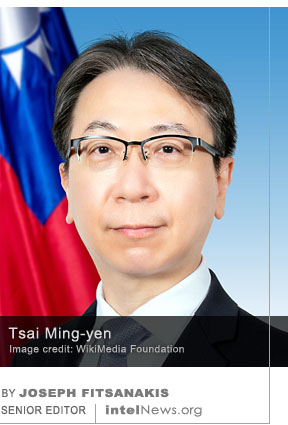 IN A SERIES OF rare public comments, the director of Taiwan’s primary intelligence agency has singled out 2027 as a year of paramount significance for China’s military plans for Taiwan. On Thursday, Tsai Ming-yen (pictured), director-general of Taiwan’s National Security Bureau (NSB) since February, spoke to an audience of graduating students at Taiwan’s National Chung Hsing University in Taichung City. According to reports, it was the first time in a quarter of a century that an NSB director-general had addressed a university audience.
In addition to his speech at the Chung Hsing University, Director-General Tsai, a former deputy foreign minister and diplomat, gave a rare interview to the United States-based Bloomberg news agency. He refused to weigh in on the ongoing discussion about a timeframe for a possible Chinese invasion of Taiwan. But he singled out the year 2027 as a significant one for Chinese Premier Xi Jinping’s plans to modernize the People’s Liberation Army (PLA).
The Chinese leader first introduced his “PLA Modernization 2035” plan in 2017, describing it as a whole-of-government effort to significantly improve the PLA’s combat capabilities as a step toward achieving China’s long-term goal of becoming a major global military power. Tsai pointed out that the year 2027 will be the 10-year mark into President Xi’s 18-year program of military reforms. Additionally, Xi will most likely be campaigning for a fourth presidential term that year, Tsai said.
In his interview with Bloomberg, Tsai said that President Xi “doesn’t allow any kind of different voice in the Chinese political system”. In essence, therefore, the Chinese leader has been surrounding himself with “a coterie of like-minded officials”. This resulting ‘groupthink’ means that “the risk of making a wrong decision” on pressing issues like Taiwan “will become much higher” in the coming years, he warned. To counter that threat, and to monitor China’s military intentions, Tsai said Taiwan is systematically deepening its real-time cooperation with its “international friends”, especially with the so-called “Five Eyes” alliance, an intelligence-sharing coalition comprising of the United States, United Kingdom, Canada, Australia, and New Zealand.
In a separate development, the United States Director of National Intelligence Avril Haines said on Thursday that the Taiwan Semiconductor Manufacturing Company Ltd (TSMC) would be a major cause for concern in a possible Chinese invasion of Taiwan. The United States and other countries rely overwhelmingly on the TSMC’s production output for the use of semiconductors in civilian and military hardware. Should a Chinese military invasion of Taiwan prevent the TSMC from producing those semiconductors, the resulting impact on the global economy would be “enormous”, possibly in the neighborhood of “between $600 billion to $1 trillion on an annual basis for the first few years”, Haines said.
► Author: Joseph Fitsanakis | Date: 05 May 2023 | Permalink
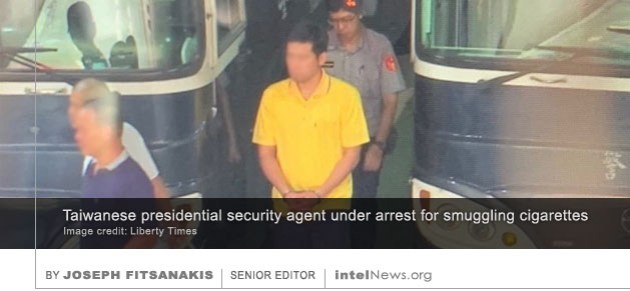 At least 70 members of Taiwan’s presidential security detail used the president’s official trips abroad to smuggle thousands of cigarettes into the country, it has been announced by Taiwan’s’s spy chief. According to








 intelNews.org
Taiwan jails soldiers guarding president’s office for spying for China
March 31, 2025 by Joseph Fitsanakis 2 Comments
According to the prosecution, the soldiers made use of their personal mobile phones to photograph “internal military information” they had access to. They then shared the photographs with their Chinese intelligence handlers. In return for their services, their handlers compensated the soldiers by paying them between $7,000 and $20,000 each. The espionage arrangement between the soldiers and their handlers lasted between 2002 to 2024, the court heard.
No information was shared during the open-door portion of the court case about the type of information that the four soldiers were accused of having shared with their Chinese handlers. But the prosecution alleged that the digital photographs given to the Chinese contained information that the four alleged spies had acquired while working in “extremely sensitive and important units” of the Taiwanese military. At the conclusion of the court case, the court sentenced the soldiers to between 70 and 84 months in prison for violating Taiwan’s national security law. In sentencing the accused, the judge said they had engaged in acts that “betrayed the country and endangered national security”.
Meanwhile, the Taiwanese National Security Bureau announced late last week that the number of people who were prosecuted for involvement in Chinese espionage in 2024 broke all recent records for the second year in a row. Specifically, there were 10 prosecutions for Chinese espionage in 2022, 48 in 2023, and 64 in 2024. Many of those caught spying for China were either active or former members of the Taiwanese military. These individuals were deliberately targeted by Chinese intelligence officers because they had knowledge of Taiwanese military secrets, the National Security Bureau said.
► Author: Joseph Fitsanakis | Date: 31 March 2025 | Permalink
Filed under Expert news and commentary on intelligence, espionage, spies and spying Tagged with China, espionage, military intelligence, News, Taiwan, Taiwanese National Security Bureau