Australian premier in ministerial spying scandal

Nathan Rees

Nathan Rees

By IAN ALLEN | intelNews.org |
The premier of Australia’s state of New South Wales has been accused of trying to spy on local government officials by planning to install telephone surveillance equipment in their work offices. Nathan Rees, a Labour Party politician, who is one of six Australian state chief executives, is reportedly planning to employ phone-tracking software in an attempt to “put the screws on suspected dissidents” within his cabinet. The technology in question appears to be a real-time phone call data monitoring system, which records basic information of telephone exchanges (i.e. who calls whom, at what time, etc), but not their content. According to The Sydney Morning Herald, Rees’ envoys have already contacted at least one telephone surveillance equipment provider, KNet Technology, whose representatives say they briefed the Premier’s people. Read more of this post

News you may have missed #0056

  • South Korean spy agency seeks increased access to financial intelligence. The National Intelligence Service is pushing for legal revisions that will allow it to access information on financial transactions of over 20 million won (US$16,000) without a warrant. The agency claims the new powers will help track down “terrorism-related funds”.
  • Nepal to create new spy agency. The Maoist Nepali government is preparing to set up a powerful intelligence body that will be directly accountable to the Prime Minister. IntelNews hears that Indian government advisors are actively involved in setting up the new agency, which will “gather information on foreign intervention in Nepal”.
  • Peru’s Defense minister denies alleged espionage against Chile. Rafael Rey has denied any participation by Peru’s government in the case of Business Track, a company accused of telephonic and electronic interception to Chilean Army officers.

Bookmark and Share

News you may have missed #0025

  • BREAKING NEWS: Several news outlets are reporting this morning that it was former US vice-President Dick Cheney who ordered the CIA to conceal from Congress key information about a covert action intelligence program of an undisclosed nature. See here for more.
  • New book claims Ernest Hemingway was KGB agent. The new book Spies: The Rise and Fall of the KGB in America (Yale University Press), co-written by John Earl Haynes, Harvey Klehr and Alexander Vassiliev, alleges that the Nobel prize-winning novelist was on the KGB’s list of agents in America from 1941, when he was given the codename “Argo” by the Soviets.
  • Thousands of former Stasi spies still working in German civil service. A report in the German edition of The Financial Times claims that over 17,000 former members of East Germany’s Stasi remain employed as civil servants in reunified Germany. Stasi is the name commonly used for the Ministry for State Security, communist East Germany’s secret police.
  • NSA director’s secret visit to New Zealand revealed. A reporter accidentally spotted Lieutenant-General Keith Alexander, director of the US National Security Agency, entering a Wellington building accompanied by security personnel. The revelation prompted a spokesperson at the US embassy in Wellington to admit that Alexander was indeed in New Zealand “for consultations with government officials”. The close signals intelligence relationship between the US and New Zealand have been known since 1996.
  • Chinese national caught trying to purchase crypto hardware. Chi Tong Kuok was arrested by the FBI at the Atlanta International Airport en route from Paris to Panama, where he allegedly planned to purchase US military radios. The US government claims Kuok has admitted he was “acting at the direction of officials for the People’s Republic of China”.
  • Taliban say cell phone SIM cards guide US drone strikes. A Taliban circular says SIM cards planted by informants in cell phones used by militants are used to signal American drones in Afghanistan and Pakistan. As IntelNews recently explained, there are suspicions that this and similar discoveries are gradually prompting the Taliban and al-Qaeda to stop using cell phones altogether.

Bookmark and Share

Phone hacking ring helped groups evade eavesdroppers

By JOSEPH FITSANAKIS | intelNews.org |
Even though computer hacking tends to monopolize information security headlines, phone hacking, or phreaking, as it is technically known, remains a major source of headache for communications security professionals. Last Friday, law enforcement agencies in several countries announced the arrest of more than half a dozen individuals in the US, Italy and the Philippines, who were operating a major international phreaking network. The group had apparently broken into thousands of corporate telephone networks in Australia, Canada, the US, and Europe, and was channeling near-free telecommunications services to several criminal and militant organizations around the world. According to law enforcement insiders, “the hacked networks might have been used by terrorist organizations to thwart eavesdropping and tracking by intelligence agencies”. Read more of this post

Analysis: The changing landscape of communications intelligence

By JOSEPH FITSANAKIS and IAN ALLEN | intelNews.org |
Joseph Fitsanakis and Ian Allen have authored a new scholarly paper on communications intelligence, focusing specifically on the use of telephony intelligence in the 2008-2009 Israel-Gaza conflict. The paper, entitled Cell Wars: The Changing Landscape of Communications Intelligence, is available (.pdf) on the website of the Research Institute on European and American Studies. We argue that the 2008-2009 Israel-Gaza conflict featured a series of innovative approaches to communications intelligence, which included utilizing civilian telephone networks to achieve tactical and psychological objectives. The “cell war” between the IDF and Hamas is indicative of an ongoing global struggle between asymmetrical insurgents and state actors to control large-scale telecommunications structures. “Cell wars” have been taking place for quite some time in Iraq, Somalia, Afghanistan, Lebanon, Syria, and several other nations, including the United States. Read more of this post

Hamas-IDF cell phone war continues

By IAN ALLEN | intelNews.org |
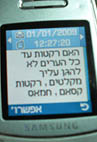
Since the beginning of the ongoing war in Gaza, IntelNews has frequently reported on the peculiar cell phone war that has been taking place between Palestinian group Hamas and the IDF, the Israel Defense Forces. Specifically, the IDF and Israeli intelligence appear to be randomly calling cell phones belonging to Gaza residents with messages prompting them to evacuate Hamas-affiliated targets. The tactic appears to have resulted in a backlash for the IDF, as Gazans receiving these calls often rush to roofs of potential target buildings in efforts to prevent the attacks. Moreover, Hamas seems to be employing a similar tactic to warn Israeli cell phone subscribers that Qassam rockets will fall “on all cities” and that “shelters [will] not protect” them. It now looks like Hamas is employing the cell phone trick to cause confusion in the ranks of IDF reservists. Israeli newspaper Ha’aretzi is reporting that Israeli reservists waiting to be called into action are receiving “numerous fictitious […] ’emergency call for duty’ messages” on their mobile phones. Read more of this post

Hamas copies Israel’s random phone call tactic

Hamas message

Hamas message

IntelNews has been reporting in recent days that Israeli intelligence are placing random calls to cell phones of Gaza residents prompting them to evacuate Hamas-affiliated targets. We also reported that this technique, which Israel also employed in Lebanon and Syria during the last couple of years, seems to have resulted in a backlash for the Israeli Defense Forces, as Gaza residents receiving these random calls often rush to the roofs of potential target buildings in efforts to prevent the attacks. It now appears that Hamas, the Palestinian group in charge of the Gaza strip, is employing a similar tactic to warn Israeli cell phone subscribers that Qassam rockets will fall “on all cities” and that “shelters [will] not protect” them. Read more of this post

Gaza civilians ignoring IDF cell phone warnings

Nizar Rayan

Nizar Rayan

IntelNews has reported in recent days that Israeli intelligence are employing cell phones to warn Gazan civilians that they may killed if located nearby Hamas-affiliated targets. Specifically, an undisclosed number of Gaza residents have been receiving “unusual phone calls” with an automated request in Arabic “that they and their families leave their homes as soon as possible for their own safety”. It now appears this technique has resulted in a backlash for the Israeli Defense Forces (IDF), as Gaza residents receiving such calls often rush to the roofs of potential target buildings in efforts to prevent the attacks. An article in The Australian reports that “in some cases, [Gaza] residents have gone up to the roof to show themselves to circling aircraft and succeeded in preventing the attack”. Read more of this post

UK Home Office to propose outsourcing interception database

A few months ago, UK Home Office Minister, Jacqui Smith, postponed the proposal of a controversial legislation placing in the hands of private companies a database containing all of the country’s intercepted telephone call and Internet traffic use data. The huge database collects the identity and location of all telephone callers and website visitors in the UK. Smith was eventually forced to abandon the plan, but now says she intends to publish a consultation paper re-introducing it to the public. She enjoys the backing of British law enforcement and intelligence services, who say “it is no longer good enough for communications companies to be left to retrieve such data when requested” to do so. Read more of this post

Israel using cell phones to caution Gazans

Palestine cell phone

IDF calling

On December 4 we reported that the Israeli intelligence services appeared to be calling thousands of seemingly random telephone subscribers in Syria with automated messages in Arabic, inquiring about missing Israeli soldiers and offering a multimillion dollar reward. It now appears that Israeli agents are again employing cell phones, this time to warn Palestinian civilians in the Gaza strip that they may become targets if they live nearby Hamas-affiliated facilities. An article in The Australian reports that an undisclosed number of Gaza residents have been receiving “unusual phone calls” during the past three days, with an automated request in Arabic “that they and their families leave their homes as soon as possible for their own safety”. The male voice is said to identify itself as representing the Israeli Defense Forces (IDF). Read more of this post

Strange phone calls in Syria point to Israeli intelligence services

In late October, 2008, thousands of seemingly random telephone subscribers in Syria received strange calls in which an automated message in Arabic asked them for information about missing Israeli soldiers. The recorded message guaranteed the safety of potential tipsters and offered a $10 million reward for information leading to the soldiers’ whereabouts. It then prompted them to call a telephone number starting with a British country code. Read more of this post