Relations between UK spy agencies “broke down” during war on terrorism
June 2, 2016 1 Comment
 Relations between two of Britain’s most powerful intelligence agencies, MI5 and MI6, suffered a “serious and prolonged breakdown” during the American-led war on terrorism. Citing sources in the British government, the London-based Guardian newspaper said on Tuesday that the two agencies entered an extensive row over Britain’s support for extraordinary rendition. The policy refers to the government-sponsored abduction of individuals and their extrajudicial transfer across national borders. It was widely practiced by the administration of US President George W. Bush, despite its connection to documented cases of torture of terrorism detainees, in countries like Egypt, Libya, and Jordan.
In Britain, the administration of Prime Minister Tony Blair secretly supported Washington’s extraordinary rendition operations. It instructed the Secret Intelligence Service, known as MI6, to assist its American counterpart, the Central Intelligence Agency, in efforts to abduct and rendition terrorism suspects. However, not everyone in Britain’s intelligence establishment was in agreement with government policy. One strong critic was Eliza Manningham-Buller, the then-director of Britain’s Security Service, commonly known as MI5, which she led from 2002 to 2007. According to The Guardian’s sources, Manningham-Buller was “evidently furious” when she discovered that MI6 had secretly colluded with governments like those of Libya and Egypt to rendition terrorism detainees. Believing extraordinary rendition and torture to be “wrong and never justified”, the MI5 director effectively stopped her agency from cooperating with MI6. She even “threw out” of MI5’s Thames House headquarters several MI6 liaison staff who were working there at the time, said The Guardian.
Soon afterwards, Manningham-Buller complained in writing to Prime Minister Blair about the conduct of some MI6 officers, whose actions allegedly “threatened Britain’s intelligence gathering” and “compromised the security and safety of MI5 officers and their informants”. The Guardian does not provide further elaboration of the contents of Manningham-Buller’s letter to the prime minister, but alleges that it contributed to a “serious and prolonged breakdown” in relations between MI5 and MI6. The paper says it contacted the two intelligence agencies, as well as Manningham-Buller, who has since retired, but no one wished to comment on the story. Sources did tell the paper, however, that the relationship between the two agencies “has now been repaired after a difficult period”.
► Author: Joseph Fitsanakis | Date: 02 Jun 2016 | Permalink
 An appeals court in Portugal has ruled that a former officer of the Central Intelligence Agency is to be extradited to Italy, where she faces charges of helping kidnap a man as part of a secret operation sponsored by the United States government. Sabrina De Sousa, 59, was an accredited diplomat stationed at the US consulate in Milan, Italy, in 2003, when a CIA team kidnapped Hassan Mustafa Osama Nasr from a Milan street in broad daylight. Nasr, who goes by the nickname Abu Omar, is a former member of Egyptian militant group al-Gama’a al-Islamiyya, and was believed by the CIA to have links to al-Qaeda. Soon after his abduction, Nasr was renditioned to Egypt, where he says he was brutally tortured, raped, and held illegally for years before being released without charge.
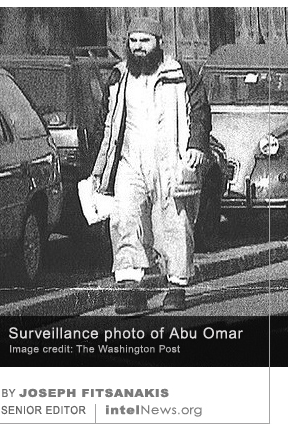 Europe’s highest human rights court has ruled against Italy in the case of an Egyptian man who was abducted from Milan in 2003 by the United States Central Intelligence Agency. Hassan Mustafa Osama Nasr, known as Abu Omar, is a former member of al-Gama’a al-Islamiyya, an Islamist group founded in the 1970s, which aimed to overthrow the Egyptian government and replace it with an Islamic regime. Members of the group have been implicated in the assassination of Egyptian President Anwar Sadat in 1981, as well as in numerous attacks on tourist facilities in Egypt in the 1990s. Once al-Gama’a al-Islamiyya was declared illegal in Egypt, Italian authorities offered Nasr political asylum, after he successfully argued that he would be subject to torture if arrested in Egypt.










 intelNews.org
UK may stop intelligence sharing with the US if Trump brings back torture
January 26, 2017 by Joseph Fitsanakis 3 Comments
But on Thursday, the British Prime Minister Theresa May warned that her government might be forced to reexamine its intelligence-sharing relationship with Washington, if the US reinstituted torture as a method of interrogation. Speaking to journalists during a flight to the US to meet President Trump, the British prime minister stressed that the United Kingdom “absolutely condemn[ed] the use of torture” and that she would deliver that message to her American counterpart. According to British law, government officials and intelligence personnel are forbidden from sharing intelligence with countries that are known to employ torture against detainees. They are also not allowed to use intelligence gathered by other countries through the use of torture.
Thursday’s comments by Theresa May point to a potentially serious rift between American and British, as well as European intelligence agencies, whose attitudes toward so-called ‘enhanced interrogation’ differ widely from those of President Trump. British newspaper The Daily Mail quoted Matt Tait, a former information security specialist for Government Communications Headquarters, Britain’s signals intelligence agency, who warned of a potential split between British and American spy agencies. If Trump reinstituted torture as a form of interrogation, it would mean that the United States Intelligence Community would “intentionally engage in war crimes”, said Tait. That would “make it impossible” for the UK to cooperate with the US “across a range of intelligence programs”, he added.
► Author: Joseph Fitsanakis | Date: 27 January 2017 | Permalink
Filed under Expert news and commentary on intelligence, espionage, spies and spying Tagged with Donald Trump, intelligence cooperation, News, Theresa May, torture, UK, United States, waterboarding