Pentagon study warned about global crisis caused by ‘novel respiratory disease’
April 6, 2020 1 Comment
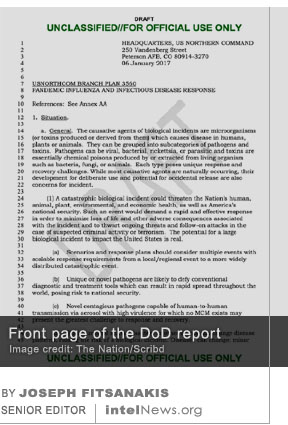 A United States Department of Defense report warned about the danger of a global crisis caused by a “novel respiratory disease”. The existence of the 2017 study adds to the mounting skepticism about President Donald Trump’s repeated assertions that the coronavirus pandemic “blind- sided the world” and “came out of nowhere”.
The 103-page report is titled USNORTHCOM Branch Plan 3560: Pandemic Influenza and Infectious Disease Response, and was presented to the leadership of the US Northern Command headquarters in January 2017. It discusses the possible causes of a “clinically severe pandemic” and outlines the complications that it is likely to cause around the world. It also proposes an array of possible responses to such a crisis by the US military. A draft of the report was published online by The Nation earlier this month. The American newsmagazine said that it obtained the report from “a Pentagon official who requested anonymity to avoid professional reprisal”.
The Department of Defense study bases its analysis on data acquired from recent pandemics, such as the 2012 Middle Eastern Respiratory Syndrome Coronavirus (MERS coronavirus) and others. It discusses “coronavirus infections” and warns that “[t]he most likely and significant [pandemic] threat is a novel respiratory disease, particularly a novel influenza disease”. The report then goes on to describe the medical supply shortages that would be caused by a coronavirus pandemic. It does so with a stunning degree of accuracy that mirrors the situation that the US is currently experiencing due to COVID-19. For instance it states that global “[c]ompetition for, and scarcity of, resources will include […] non-pharmaceutical Medical Countermeasures”, namely medical masks, gloves and other personal protective equipment needed by healthcare workers.
It also warns that dire shortages in medical equipment will be hampered by inadequate logistical support and will have “a significant impact on the global workforce”. Furthermore, the Pentagon study appears to anticipate a “worldwide competition” for ventilators and other hi-tech medical devices associated with intensive care units, as well as a scarcity of hospital beds. It ominously states that “even the most industrialized countries will have insufficient hospital beds” to accommodate the numbers of those who will need to be hospitalized due to having been infected by the virus.
Two weeks ago, The Washington Post reported that, starting in January of this year, the US Intelligence Community repeatedly warned the White House about “a virus that showed the characteristics of a globe-encircling pandemic” requiring “swift action to contain it”. The paper cited “a US official who had access to intelligence reporting” about the coronavirus, who said that “the system was blinking red” in January.
► Author: Joseph Fitsanakis | Date: 06 April 2020 | Permalink
 The United States Intelligence Community issued “ominous classified warnings” in January and February about the global danger posed by the coronavirus, but the White House failed to take timely action, according to an investigative






 intelNews.org
Opinion: Fumbling Russian spies fail to stop ISIS-K attack, despite warnings from U.S.
March 25, 2024 by Joseph Fitsanakis 7 Comments
By 2017, ISIS-K had begun to draw to its ranks hundreds of fighters from central and south Asia, who were inspired by the group’s goal of establishing an Islamic caliphate in the lands of the greater Khorasan. The term refers to a historical region that extends from eastern Iran and Turkmenistan, to the mountains of Kyrgyzstan, containing all of present-day Afghanistan, most of Uzbekistan, and even some parts of the Russian Caucasus. Like the Islamic State of Iraq and Syria (ISIS) during its heyday, ISIS-K aspires to establish control over a territorially unified entity and then use perpetual war to expand its influence in central Asia and beyond.
Until 2021, the biggest obstacle to ISIS-K’s plan for regional domination was the U.S. By some accounts, American forces and Western-trained Afghan commando units had managed to eliminate more than half of ISIS-K’s 4,000-strong base in northeastern Afghanistan. Since the hurried U.S. withdrawal from the country in 2021 (which was marred by an ISIS-K suicide bombing that killed nearly 200 people, including 13 U.S. troops), ISIS-K has expanded its reach beyond all prior measure. The group has since claimed responsibility for attacks in Afghanistan, Pakistan, Iran, and now Russia, that have killed over 600 people and injured thousands.
A primary reason for the proliferation of ISIS-K’s terrorist activity is that the U.S., which has more intelligence than anyone on the group, issues warnings that are not being taken into consideration by the group’s primary targets, namely Afghanistan, Iran, and Russia. Indeed, despite the Washington’s best efforts, its warnings about pending ISIS-K attacks have been ignored by the group’s primary targets. A few days after an ISIS-K attack killed nearly 100 people in Kerman, Iran, The Wall Street Journal claimed the U.S. government had provided Tehran with “a private warning” of an imminent terrorist threat from ISIS-K. If that is true, then the Iranians clearly did not heed Washington’s warning.
It now appears that, once again, Washington had considerable intelligence insight into ISIS-K’s plans to strike inside Russia. On March 7, the U.S. embassy in Russia warned on its website that “extremists have imminent plans to target large gatherings in Moscow, to include concerts”. The warning provided no specifics. However, seeing how U.S. authorities issued private warnings to Iran, a country with which the U.S. has no diplomatic relations, then it is highly likely they provided similar information to Russia, which at least hosts American diplomats and intelligence officers on its soil. Yet, not only did the Russians ignore these warnings, but they openly dismissed them. Read more of this post
Filed under Expert news and commentary on intelligence, espionage, spies and spying Tagged with 2024 Crocus City Hall attack, Islamic State - Khorasan Province, Joseph Fitsanakis, Newstex, Opinion, Russia, United States, warning intelligence