Boko Haram spy network is better than Nigerian state’s, says ex-Army chief

Boko Haram NigeriaA former Chief of Staff for the Nigerian Army has said that the intelligence capabilities of Islamist group Boko Haram are “100 percent better” than those of the Nigerian military and security agencies. The comments were made on Tuesday by Theophilus Danjuma, a retired lieutenant general in the Nigerian Army, who served as the Army’s chief of staff from 1975 to 1979. Danjuma was also minister of defense from 1999 to 2003, under President Olusegun Obasanjo. Speaking in the city of Sokoto, located in Nigeria’s predominantly Muslim northwest region, Danjuma claimed that Boko Haram insurgents relied on surveillance and intelligence-collection capabilities that were “far superior” to those of Nigeria’s state agencies.

Boko Haram is a Sunni Islamist group that is currently active in northern Nigeria, Niger, Chad and northern Cameroon. The separatist group was founded in 2002 and has since launched an armed campaign aimed at establishing an Islamic state in northern Nigeria. In 2015, the group formally declared its allegiance to the Islamic State of Iraq and Syria, a Sunni militant outfit that today controls much of Syria and northern Iraq. In response to the ascendancy of Boko Haram, the Nigerian government declared a state of emergency in several regions of northern Nigeria, which has since been extended to cover the entirety of the country’s predominantly Muslim regions. Nearly 20,000 people have been killed in the conflict between Boko Haram and the Nigerian state, while over 2 million are estimated to have been internally displaced.

In the summer of 2014, Boko Haram gained control of Borno, Nigeria’s northernmost state, which borders Niger, Chad and Cameroon. The government of Nigeria responded with a full-scale military assault, with which which managed to regain control of most of Borno. In September of this year, the Nigerian military announced that it had captured or destroyed most of Boko Haram’s military bases in Borno. But Danjuma said on Tuesday that the war against Boko Haram is only now “entering its most critical stage”, as government forces are moving into territory previously controlled by the militant group. Instead of fighting government troops face-to-face, Boko Haram militants are “disappearing into the wider civilian population and “setting up sleeper cells” with the aim of “wreaking havoc on soft targets”, said the former defense minister.

In May of last year, intelNews cited reports claiming that the United States government was “not […] sharing raw intelligence data” on Boko Haram with the Nigerian state. It was believed at the time that the lack of intelligence-sharing between the US and Nigeria was due to concerns in Washington that the Nigerian military had been infiltrated by Boko Haram members and sympathizers. In 2013, the then-president of Nigeria, Goodluck Jonathan, admitted that the country’s security services had been compromised by Boko Haram agents.

Author: Ian Allen | Date: 04 November 2015 | Permalink

Why is the US federal tax agency using phone interception devices?

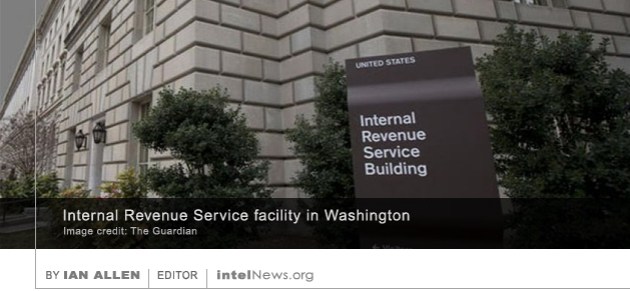
Internal Revenue ServiceDocuments acquired by a newspaper show that the Internal Revenue Service, which is the United States government’s agency responsible for collecting taxes, has purchased devices used to intercept cell phone messages. Founded in 1862, the IRS is the revenue service of the US state, and operates as a bureau of the Department of the Treasury. But it also maintains a number investigative components, including the Criminal Investigation Division. The latter consists of between 3,000 and 4,000 personnel and is tasked with investigating and helping build cases for the prosecution relating to tax evasion, money laundering and other financial crimes.

Historically, the Criminal Investigation Division’s scope and tactics have been limited and rarely relied on telecommunications interceptions. But according to British newspaper The Guardian, the IRS purchased a number of Stingray devices in 2009 and 2012. Known also as IMSI catchers, Stingrays are portable communications-interception devices, which mimic the operation of cell phone towers. They gather data, including the phone numbers dialed, duration of phone calls and location of users, from cell phones that communicate with them. Some Stingray models are said to be able to intercept the content of telephone calls made by unsuspecting cell phone users.

According to The Guardian, the IRS made an initial order to purchase Stingray equipment in 2009 and repeated the request in 2012. At least 12 US federal agencies and hundreds of local law enforcement agencies use Stingrays for communications-interception purposes. But the London-based paper says this is the first time that the IRS has been found to be using the devices. It is unclear, however, what the IRS uses the Stingrays for. The Guardian said it contacted an IRS spokesman who refused to respond to questions on the matter.

Author: Ian Allen | Date: 27 October 2015 | Permalink

Russian subs looking for undersea Internet cables, say US officials

Undersea cableAn increased presence of Russian submarines near American territorial waters appears to correspond to the location of undersea Internet cables used for commercial and military communications, according to officials. Citing “more than half a dozen” American and European officials, including naval commanders and intelligence professionals, The New York Times said on Sunday that the United States Department of Defense was paying close attention to what it described as “significantly increased Russian activity” along known routes of the cables. The paper was referring to Russian underwater vessels, which Washington believes are equipped with technology designed to tap into the cables, or even to sabotage them, by severing them.
According to The Times, officials at the Pentagon believe that Moscow is less interested in tapping into the cables and more interested in mapping their location so that it can attack them during a hypothetical clash with the US. Superficially, the paper said that, according to US officials, the Russian Navy appeared to be seeking to locate the precise coordinates of the fiber-optic cables. The ultimate goal was to sever them “at some of their hardest-to-access locations” if Russia ever needed to disrupt the flow of communication to and from the US. The Russian submarines seem to be seeking some of the deeper locations of the undersea cable networks, which would make it harder for repair crews to locate and repair severed fiber-optic cables.

The New York Times said that, alongside commercial Internet cable networks, Russian submarines were looking for military networks, whose location is usually classified. The paper quoted a European diplomat, who said anonymously that Russian submarine patrols in American territorial waters had increased by nearly 50% since 2014. The level of activity of Russian submarines was now “comparable to what we saw in the Cold War”, said the diplomat.

Author: Ian Allen | Date: 26 October 2015 | Permalink

Australian spy agency reviews gun policy after ‘drunken episode’ in Afghanistan

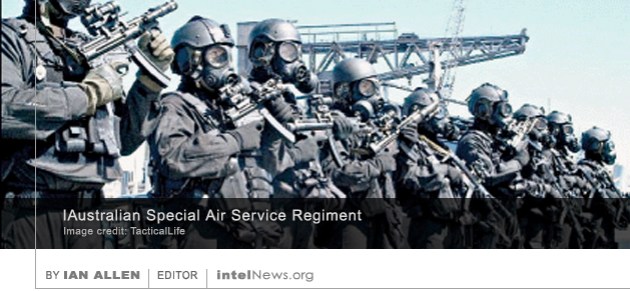
Australian Special Air Service RegimentThe use of firearms by Australian intelligence and security personnel stationed abroad is being reviewed following an incident in which an intoxicated special forces soldier pulled a gun on a spy in Afghanistan. According to reports in the Australian media, the review was conducted by the Inspector General of Intelligence and Security, a government-appointed office that monitors the conduct of Australian intelligence and security agencies.
It is believed that the Inspector General’s office began the investigation in 2014, shortly after it was made aware of the alleged incident in Afghanistan. According to unconfirmed reports, the incident involved two members of a “defence support team” who were stationed in Kabul. Defence support teams are highly secretive outfits that operate abroad and bring together members of Australia’s Special Air Service Regiment (SASR) with officers of the Australian Secret Intelligence Service (ASIS) —the country’s primary external intelligence agency. Some reports suggest that a group of SAS soldiers had been drinking heavily at the embassy of Australia in the Afghan capital, and that one of them, who was heavily intoxicated, pointed a loaded handgun at a female ASIS officer, while verbally threatening her.

Cooler heads prevailed and the incident ended quickly. But it allegedly shook everybody who witnessed it, and it was quickly reported to the Inspector General. The watchdog promptly carried out an audit “to make sure guns were only being issued to foreign posts that really needed them”. Its written recommendations were circulated within ASIS earlier this week. However, the agency says it will not reveal the precise content of the Inspector General’s recommendations, because it could “prejudice [Australia’s] security relations with other counties” and place spies at risk.

Author: Ian Allen | Date: 21 October 2015 | Permalink

Pinochet considered killing own spy chief to hide role in US bombing

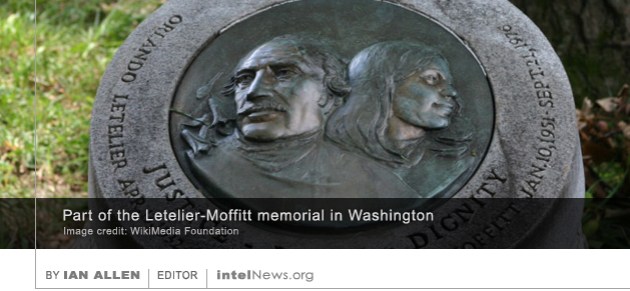
Orlando LetelierThe president of Chile in the 1970s considered killing his own spy chief in order to conceal his government’s involvement in a terrorist attack in Washington DC, which killed two people, according to declassified memos from the United States Central Intelligence Agency. The target of the attack was Orlando Letelier, a Chilean economist who in the early 1970s served as a senior cabinet minister in the leftwing government of Salvador Allende. But he sought refuge in the US after Allende’s government was deposed in a bloody coup on September 11, 1973, in which Allende was murdered. He taught in several American universities and became a researcher at the Institute for Policy Studies (IPS) in Washington. At the same time, he publicly pressured the US to break off diplomatic and military ties with the Chilean dictatorship.

On September 21, 1976, Letelier died along with American IPS campaigner Ronni Moffitt, when the car they were in suddenly exploded in front of the embassy of Ireland in downtown Washington DC. It is believed that DINA, the Chilean secret police, carried out the bombing. In a private memorandum in 1987, the then-US Secretary of State George Schultz described the bombing as “the only clear case of state-supported terrorism that has occurred in Washington DC”. But the Chilean government, which at the time had friendly relations with the White House, refused to cooperate with the US investigation into the incident.

But declassified US government documents now show that the CIA had concluded that the Chilean government was indeed behind Letelier’s murder. Additionally, the bombing had been directly authorized by the country’s dictator, General Augusto Pinochet, who had led the coup against Allende in 1973. Copies of the documents were personally delivered to Chilean President Michelle Bachelet last week by US Secretary of State John Kerry, as Santiago is seeking to reopen the investigation into the murders. They reveal that Manuel Contreras, head of DINA at the time of the bombing, told an American source that he had supervised the operation to murder Letelier’s under direct orders by General Pinochet. Additionally, according to the CIA documents, the Chilean dictator tried to sabotage the US investigation in to the bombing, and even contemplated killing Contreras in order to hide his personal involvement.

As intelNews has reported before, the US investigation led to the arrest of Michael Townley, an American professional assassin who had previously worked for the CIA. Townley was hired by DINA to help assassinate Letelier’s. He was extradited to the US by the Chilean government in 1978 after strong US pressure. He served just 62 months in prison, in return for agreeing to collaborate with US government investigators. Townley is currently said to be living under the US Witness Protection Program.

Author: Ian Allen | Date: 12 October 2015 | Permalink

Third person charged in probe into alleged US Pentagon ‘rogue operation’

PentagonA third person has been charged in a complex criminal investigation into the procurement of weapon silencers by the United States Department of Defense, which one American newspaper has described as a possible “rogue operation”. The case concerns the Directorate for Plans, Policy, Oversight and Integration, an obscure civilian-led Pentagon office, whose stated mission is to provide logistical support and procurement for intelligence operations conducted by the US Navy and Marine Corps.
According to media reports, more than three years ago the Directorate ordered 349 weapon suppressors, known commonly as silencers. By general admission, silencers are not the type of military hardware used in conventional combat. More importantly, the procurement cost of the silencers should have been no more than around $10,000. However, purchase records show that the Directorate paid the supplier of the silencers over $1.6 million. The supplier then turned out to be the brother of the Directorate’s officer in charge of intelligence, David W. Landersman. Last week it was revealed that Landersman became the third person to face charges of theft and conspiracy as part of the investigation.

Initially, Pentagon officials suggested that the silencers had been purchased for a top-secret operation codenamed UPSTAIRS. The operation was allegedly a “special-access program” aimed at arming foreign paramilitary forces while avoiding the risk of the weapons being traced back to the US. Though limited details were provided, one government witness told the court that military hardware acquired through UPSTAIRS was intended for the US Navy’s Sea, Air, Land Team 6, commonly known as US Navy SEAL Team 6. The special-forces team became famous in 2010, when it carried out the Central Intelligence Agency’s operation NEPTUNE SPEAR, which killed al-Qaeda founder Osama bin Laden in Pakistan. Later during the course of the investigation, however, SEAL Team 6 representatives told court officials that their unit “had not ordered the silencers” and knew nothing about them. Following that development, government prosecutors objected to further discussion of the case in open court due to the alleged “sensitive nature” of the case. Since then, much of the court documentation on the case has been filed under seal on grounds of national security.

But the discrepancies in the case led The Washington Post to speculate last year that the procurement of the weapons silencers may have been part of a “rogue operation”, that is, a military activity not authorized by the Pentagon leadership. The Post spoke to an unnamed “former senior Navy official familiar with the investigation”, who said the Pentagon’s Directorate for Plans, Policy, Oversight and Integration was “building its own mini law enforcement and intelligence agency” without oversight from higher-ups. Another unnamed source, a former Pentagon official familiar with the Directorate, told the paper that “deeper issues might be in play” in the case.

Last week, a Pentagon spokesman said Landersman was “no longer performing duties in any way associated with intelligence” for the US government, though he appeared to still be employed by the US Navy in a clerical capacity, pending the outcome of the investigation.

Author: Ian Allen | Date: 06 October 2015 | Permalink

Hackers stole 5.6 million US government employee fingerprints

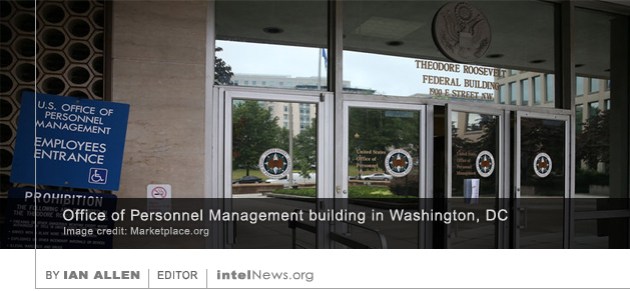
Office of Personnel Management 2A massive cyber hacking incident that compromised a United States federal database containing millions of personnel records also resulted in the theft of 5.6 million fingerprint records, American officials have said. Up to 21 million individual files were stolen in June of this year, when hackers broke into the computer system of the US Office of Personnel Management (OPM), which handles applications for security clearances for all agencies of the federal government. The breach gave the unidentified hackers access to the names and sensitive personal records of millions of Americans who have filed applications for security clearances —including intelligence officers.

Back in July, OPM officials told reporters that just over 1 million fingerprint records had been compromised by the cyber hack. However, a new statement issued by the White House last week said that the actual number of stolen fingerprints from the OPM database was closer to 5.6 million. In a subsequent statement, the OPM said there was little that the hackers could do with the fingerprint records, and that the potential for exploitation was “currently limited”. But it added that, as technology continued to be developed, the risk of abuse of the stolen fingerprint records could increase. Therefore, an interagency working group would be put together to “review the potential ways adversaries could misuse fingerprint data now and in the future”, the OPM statement said. It added that the group would be staffed with fingerprint specialists for the Federal Bureau of Investigation, the Department of Defense and the Department of Homeland Security.

External American intelligence agencies, which typically send their officers abroad posing as diplomats, and sometimes under cover identities, are reportedly concerned that certain foreign counterintelligence agencies will be able to use the stolen fingerprints to identify the true identities or professional background of US government employees stationed abroad.

Author: Ian Allen | Date: 29 September 2015 | Permalink

Russia jails ex-military intelligence employee for contacting Swedish company

Tselina satelliteA court in Moscow has sentenced a former employee of Russia’s military intelligence agency to a lengthy prison term for seeking to work for a Swedish engineering firm. Gennady Krantsov worked for the GRU, Russia’s military intelligence agency, from 1990 to 2005. As a radio engineer, he is believed to have worked on a number of projects relating to satellite technology. The terms of his government contract reportedly forbade him from travelling outside Russia. He was also forbidden from participating in intelligence-related engineering projects for foreign governments or the private sector for a minimum of five years after leaving the GRU.

But he was arrested last year by Russia’s Federal Counterintelligence Service, known as FSK, allegedly for sending a letter to a Swedish engineering company seeking work. In 2013, when the FSK first questioned Kravtsov, it was told by the former GRU engineer that his letter to the Swedish firm contained no state secrets. Additionally, Kravtsov was not found to have received any funds from the Swedes. But the counterintelligence agency returned to arrest Kravtsov in 2014, claiming that a polygraph test he had taken showed that he had shared classified material with foreign agents. According to Russian government prosecutors, Kravtsov gave the Swedes information about Tselina-2, a military radio surveillance system designed to detect the location and activity of radio-emitting objects from space.

Kravtsov was convicted of state treason and stripped of his GRU rank of lieutenant colonel. He was sentenced on Monday to 14 years in a maximum-security penal colony. The judge said that he had violated his promise not to reveal information about his GRU-related work to foreign government officials. His lawyers, however, complained that the case had been held completely behind closed doors and that they had not been permitted to call witnesses or examine material that was central to the case.

Author: Ian Allen | Date: 22 September 2015 | Permalink

MI6 spy found dead in 2010 may have used female disguise, says expert

Gareth WilliamsA British intelligence officer, who was found dead in his London apartment in 2010, was not a transvestite, as some media reports have speculated, but probably worked undercover dressed as a woman, according to a leading forensic investigator. Gareth Williams, a mathematician in the employment of Britain’s signals intelligence agency, GCHQ, had been seconded to MI6, Britain’s external intelligence agency, to help automate intelligence collection. He had also worked with several United States agencies, including the Federal Bureau of Investigation and the National Security Agency. But his career came to an abrupt end in August 2010, when he was found dead in a padlocked sports bag at his home in Pimlico, London.
The discovery of £15,000 ($20,000) worth of women’s clothing in Williams’ apartment caused some in the British media to speculate that sexual jealousy may have behind the spy’s death. British tabloid The Sun suggested at the time that Williams was “a secret transvestite who may have been killed by a gay lover”. There were also reports that police investigators themselves suspected that Williams’ death may have been the result of “a sex game gone wrong”. This appeared to be substantiated by the discovery that Williams had visited gay bars and drag nightclubs in London in the weeks before his death. Subsequent reports, however, suggested that law enforcement investigators described Williams’ death as “a neat job”, a term used to refer to professional killings. There have also been official denials by police that Williams’ murder was sex-related.

Now a leading forensic investigator has said that Williams was not a transvestite and that he probably dressed in women’s clothing for his job with MI6. Peter Faulding, who specializes in deaths within confined spaces, and has advised British and American law enforcement agencies, has previously spoken publicly against the theory that Williams locked himself in the bag. He said he tried without success to lock himself in the same type of bag 300 times before discounting the self-lock theory. Faulding spoke again to The Sun last week, this time to suggest that there is no evidence that the late MI6 spy was a transvestite. “The key question never asked was: were these clothes used for his job?” he said, referring to the feminine attire found in Williams’ apartment. He told The Sun that the clothes were “used for work, rather than pleasure”. “I am certain he made a very convincing female”, said Faulding. “He was slim, with feminine features, and as a cyclist he shaved his legs”.

Author: Ian Allen | Date: 21 September 2015 | Permalink

Pakistani spies fear up to 100 million citizen records may have been stolen

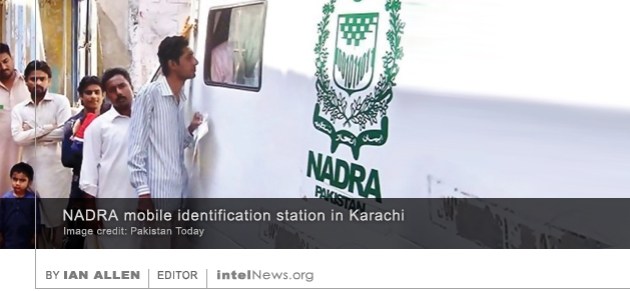
NADRAA report by Pakistan’s main intelligence agency warns that the personal records of up to 100 million Pakistanis may have been stolen by foreign intelligence agencies due to the alleged links of a software vendor with Israel. The Inter-Services Intelligence directorate (ISI), Pakistan’s premier spy agency, said that the software used by the National Data base and Registration Authority (NADRA), which issues national identity cards on behalf of the government of Pakistan, is not secure and should be replaced by an “indigenous” software product.

Established in 1998 as the National Database Organization, NADRA operates under Pakistan’s Ministry of the Interior. Its main mission is to register and fingerprint every Pakistani citizen and supply every adult in the country with a secure Computerized National Identity Card. This has proven to be a Herculean task in a country of 182 million, of whom just over half are over the age of 18. Consequently, the NADRA electronic database contains files on over 96 million Pakistanis, making it one of the world’s largest centralized databases.

But the ISI warned in a recently authored report that the NADRA database may have been compromised through the software that the agency uses to digitize and store fingerprints. According to the Pakistani newspaper Express Tribune, which published a summary of the ISI report on Monday, “the thumb-digitiser system [used by NADRA] was purchased from a French company of Israeli origin”. The report refers to the Automatic Finger Print Identification System, known as AFIS, which NADRA has been using since 2004. The software was purchased for close to $10 million from Segem (now called Morpho), a leading global vendor of identity software. The company is based in France, but the ISI report states that has connections with Israel, a country that Pakistan does not officially recognize and has no diplomatic relations with. Because of that, says the ISI report, the entire content of NADRA’s database may have been accessed by the Israeli Mossad, the United States Central Intelligence Agency, India’s Research and Analysis Wing, and other spy agencies seen as “hostile” by Islamabad.

Officials from NADRA refused to respond to the Express Tribune’s allegations, or to acknowledge that the ISI had indeed contacted the agency with concerns about the AFIS database. But a NADRA senior technical expert, who spoke anonymously to the paper, claimed that the ISI’s concerns were unfounded, since NADRA’s servers were not connected to the World Wide Web and were therefore impossible to access from the outside. Another NADRA official told the Express Tribune that Segem was the only international vendor of fingerprint recognition systems in 2004, when NADRA purchased the software product. Additionally, the Ministry of the Interior successfully sought ISI’s approval prior to purchasing the software. Last but not least, NADRA officials pointed out that the Pakistani Armed Forces are also using Segem software products.

Author: Ian Allen | Date: 15 September 2015 | Permalink

Obama authorizes Special Forces, CIA, to conduct assassinations in Syria

Islamic State convoy in SyriaThe United States Central Intelligence Agency is collaborating with the country’s Special Forces in a targeted killing program aimed against senior members of the Islamic State and other militant groups in Syria. The program, which has been directly authorized by US President Barack Obama, is limited in scope and has so far involved fewer than a dozen strikes against suspected militants. But it is believed to reflect increasing frustration in Washington about the lack of progress shown by the military campaign against the Islamic State. Recent reports by American intelligence agencies confirm that the militant group is “fundamentally no weaker” today than it was a year ago, despite an intense US-led bombing campaign involving thousands of airstrikes in Iraq and Syria.
The Washington Post, which revealed the existence of the program on Tuesday, said it brought together the CIA’s Counterterrorism Center (CTC) and the Joint Special Operations Command (JSOC). The CTC is believed to be primarily responsible for identifying and locating senior Islamic State figures in Syria, while the JSOC is in charge of killing them, mostly through the use of unmanned drones, according the paper. The two agencies continue to operate separate drone centers, said The Post, in Virginia and North Carolina respectively; but they have exchanged several of advisors who have constant access to each other’s drone video feeds.

The goal of the targeted killing program is to assassinate what the CIA refers to as “high-value targets”, which includes Islamic State leaders and those members of the organization whose job is to build a membership base outside the territorial boundaries or the Islamic State’s self-described caliphate. The Post said that the list of Islamic State members killed by the CIA-JSOC program includes Junaid Hussain, a British citizen who was instrumental in building and maintaining the Islamic State’s outreach campaign on social media. The paper noted that the CIA-JSOC targeted killing campaign is not part of the wider American military offensive against the Islamic State.

Author: Ian Allen | Date: 01 September 2015 | Permalink

Maltese far-right party had links to CIA, British documents suggest

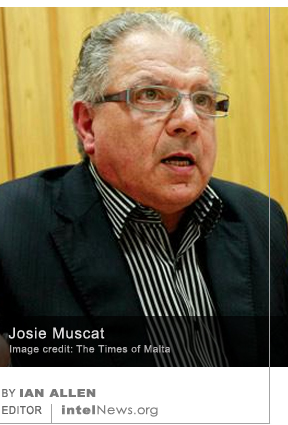
Josie MuscatA Maltese ultra-nationalist group believed to be behind a string of bombings in the 1980s was believed by British intelligence to have links to the United States Central Intelligence Agency (CIA), according to recently declassified documents. The Front Freedom Fighters (FFF) was a staunchly anticommunist group whose members violently objected to what they saw as Malta’s overly close contacts with the Communist Bloc. During the 16-year rule of the Maltese Labour Party, which began in 1971, the Mediterranean island maintained close relations with countries during such as Libya and North Korea. The Maltese Nationalist Party, which formed the main opposition to Labour, was highly critical of these contacts, but failed to win three consecutive electoral contests and was thus unable to influence the country’s foreign policy in any significant way.

The FFF emerged in the early 1980s from within the ranks of the Nationalist Party. It consisted of younger activists who favored a violent response to the rule of the Labour Party. The group was led by Josie Muscat, a dynamic anticommunist campaigner and longtime Nationalist Party Member of Parliament, who gathered around him some of the more extreme rightwing elements in the Nationalist Party. A string of bombings and threats directed at Labour Party facilities on the island was attributed to the FFF by the popular press, though Muscat himself consistently denied such accusations. Many believed that the FFF was actively preparing to launch an armed coup d’etat.

Eventually, the leadership of the Nationalist Party, which saw itself as falling within the mainstream of the European conservative tradition, began distancing itself from the FFF’s rhetoric and actions. In July of 1983, the party expelled FFF leaders from its ranks and forbade its members from associating with FFF-linked groups. Few Nationalist Party members followed Muscat, and his movement eventually suffered what some observers described “a natural death”.

However, new documents released this month by the National Archives in Britain show that the British Foreign Office believed that the FFF was being funded by the CIA. A Foreign Office Report from the early 1980s states that the group was probably behind several bomb explosions targeting Labour Party activists, as well as moderate Nationalist Party members. The report describes the FFF as “neo-Fascist in character” that prioritized crude violence as its main tactic. It goes on to say that the group consisted of about 500 determined members, but that its violent core was much smaller. The Foreign Office report also suggests that Muscat may have traveled abroad to meet CIA officers, as well as to network with other anticommunist organizations throughout Europe.

Asked to give his reaction to the British government documents, Muscat told The Times of Malta that he “hadn’t had such a good laugh in years”. The now retired politician denied having any links to the CIA and said that the FFF’s activities had been “mostly limited to political debating and had never even come close to any form of violence”.

Author: Ian Allen | Date: 25 August 2015 | Permalink

Former KGB officer facing deportation voluntarily leaves Canada

Mikhail LennikovA Russian former officer in the Soviet KGB, who defied deportation orders issued against him by the Canadian government by taking refuge in a Vancouver church for six consecutive years, has voluntarily left the country. Mikhail Lennikov, who spent five years working for the KGB in the 1980s, had been living in Canada with his wife and son since 1992. But in 2009, Canada’s Public Safety Ministry rejected Lennikov’s refugee claim and notified him that he could “be ordered deported from the country in as early as a few weeks”.
Canadian authorities have refused to reveal the precise reason for the decision to issue deportation orders against the former KGB agent. But it is believed that his Soviet intelligence background is perceived by Canadian authorities as a national security threat. Lennikov has consistently rejected accusations that he is a threat to Canada’s national security and has previously stated that he voluntarily revealed his KGB background to Canadian authorities. He has also said that if sent back to Russia he could face imprisonment for having revealed his KGB background to a foreign government. In 2009, the former KGB officer sought refuge at the First Lutheran Church in Vancouver, where he lived until recently. Meanwhile, his wife and children, who have no connections to Soviet or Russian intelligence, were awarded asylum and eventually Canadian citizenship.

Last week, however, it emerged that Lennikov had left the Vancouver church that had been his home for six years. His lawyer, Hadayt Nazami, told reporters that the former KGB officer had left Canada. His departure appears to have taken place after an agreement was struck between him and the Canada Border Services Agency. Nazami said on Sunday that Lennikov had “left at the end of this week and left on his own accord, voluntarily, according to his own wishes and decisions he reached himself”. Canadian media reported that it “no longer seemed to be the case” that Lennikov would face treason charges if he went back to Russia. When asked about Lennikov’s whereabouts, Nazami told journalists that it was “something that I cannot comment on”, but added that his client “feels safe and we are going by that assumption”. Lennikov’s wife and children, who are Canadian citizens, plan to remain in Canada, said Nazami.

Author: Ian Allen | Date: 19 August 2015 | Permalink

Sweden conducts spy flights over Russia amidst heightened tensions

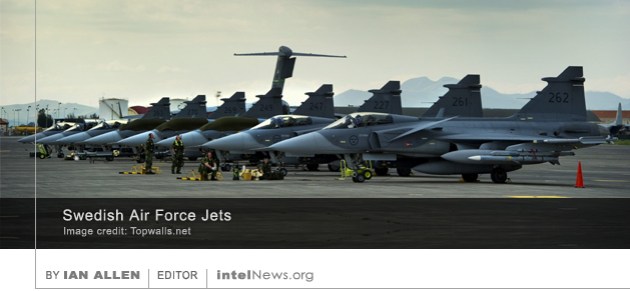
Swedish Air ForceSwedish Air Force spy planes conducted reconnaissance flights over Russia on Wednesday —and there was nothing the Kremlin could do about it. The flights were part of the 1992 Treaty on Open Skies, an international agreement designed to build trust among former Cold War rivals. The treaty was first proposed by the United States in 1990, with the intention of covering all member-states of the Warsaw Pact and the North Atlantic Treaty Organization. When it was eventually signed, on March 24, 1992, it was ratified by 23 countries, including the US and Russia. An additional 11 states have joined the treaty at various times since, with Sweden joining in 2002. On Wednesday, Swedish reconnaissance airplanes conducted flights over a number of Russian military installations as part of the treaty, as they do every year during predetermined times.

This year, however, the stakes are different, since relations between Stockholm and Moscow have deteriorated dramatically. The Scandinavian country has issued numerous formal complaints against what it says were illegal infiltrations of its airspace by Russian military jets since 2014. Carl Bildt, Sweden’s Minister of Foreign Affairs, said earlier this year that some of these alleged airspace infiltrations represented “the most serious aerial incursions by the Russians in almost 10 years”. In October of last year, Swedish authorities shut down airspace over Stockholm while searching for a misery foreign vessel seen off the coast of the Swedish capital, said to be a Russian spy submarine. The mystery vessel was never detected, but some Swedish media sites claimed that its mission had been to either “pick up or drop off a Russian spy” without alerting Swedish authorities. In March of this year, the Swedish Security Service, known as SAPO, said that Russia was Sweden’s greatest short-term threat, adding that nearly a third of all Russian diplomats stationed in Sweden were in fact intelligence officers.

Swedish media quoted Swedish Armed Forces Colonel Carol Paraniak, who said that Russia was and would always remain an intelligence target for Sweden. This is especially true today, as the “security and political situation […] has changed a lot compared to last year. Tensions have increased dramatically”, said Paraniak.

Author: Ian Allen | Date: 13 August 2015 | Permalink

Israel charges Swedish citizen with spying for Hezbollah

HezbollahIsraeli authorities have charged a Swedish citizen with working as an intelligence officer for the Lebanese militant group Hezbollah. It is believed that Hassan Khalil Hizran, 55, was born to Palestinian refugees in Lebanon, from where he emigrated to Sweden many years ago. But he was arrested in Tel Aviv on July 21 while disembarking a flight at Israel’s Ben Gurion International Airport and was taken into custody by the Shin Bet, Israel’s counterterrorism and counterintelligence agency. A spokesman for the agency said Hizran had confessed during interrogation to being an intelligence operative for Hezbollah, a primarily Shiite organization that controls much of Lebanon’s territory. He is said to have told his interrogators that he was recruited by the group in the summer of 2009 while visiting Lebanon from Sweden with his wife and children.

Shin Bet said that Hizran had been asked by his Hezbollah handlers to gather intelligence relating to Israeli military installations and that he visited Israel several times in order to fulfil his missions. He would then return to Lebanon after visiting a third country in order to provide his Hezbollah handlers with the information he had collected while in Israel. Sources in Tel Aviv said Hizran visited Lebanon at least twice since his 2009 recruitment, specifically in 2011 and 2013. He returned to Sweden with monetary sums given to him by Hezbollah as payment for his services, which amounted to several thousand dollars, according to Shin Bet. The Israeli security agency said the Swede was helping Hezbollah identify military targets for a future war, which it interpreted as “proof that Hezbollah is preparing for the net war with Israel by compiling a target bank”.

According to the Israelis, Hizran had also been tasked by Hezbollah with recruiting Arabs with ties to Israeli Jews, but that he was either unable or unwilling to do so. However, on Sunday he was charged with three criminal counts including contacting an agent of a foreign government and communicating sensitive information. The Swedish man’s Israeli lawyer, Leah Tsemel, denied that her client was guilty of espionage and claimed that he had “refused repeated requests to inflict harm on the national security of Israel”. The Swedish and Lebanese governments have not commented on Hizran’s arrest.

Author: Ian Allen | Date: 10 August 2015 | Permalink