Hamas ‘found tracking devices’ inside weapons bound for Gaza

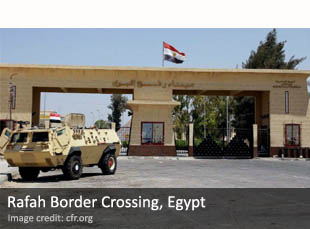
Rafah Border CrossingBy JOSEPH FITSANAKIS | intelNews.org |
The Palestinian militant group Hamas said on Sunday it refused to take possession of a shipment of missiles after its weapons experts discovered they contained a number of carefully hidden tracking devices. The Egyptian newspaper Al-Youm Al-Sabea, which reported the story, said it spoke to a source “closely affiliated with weapons smugglers” in Egypt’s Sinai Peninsula, who confirmed Hamas’ claim. According to Al-Youm, the weapons shipment consisted of 28 long-range missiles stolen from the arsenal of the Libyan armed forces during the uprising that led to the overthrow of Libya’s late leader, Colonel Muammar al-Gaddafi. The shipment made its way across the border with Egypt and from there to the Sinai desert, before ending up at the Rafah Border Crossing, located between Egypt and the Gaza Strip. It was there that the missiles were inspected by a team from the Izz al-Din al-Qassam Brigades, the military wing of Hamas. The paper reported that one of the Hamas inspectors, a senior member of the al-Qassam Brigades, discovered a number of miniature tracking devices carefully concealed inside the missiles, which appeared to be active. Following the discovery, the Hamas team backed out of the purchase deal and abandoned the inspection site. Al-Youm also said that the Palestinian group has decided to terminate its contacts with a significant number of weapons smugglers operating in the Sinai, because of concerns that they may have been penetrated by Israeli and Egyptian intelligence. Read more of this post

Analysis: The Current State of the China-Taiwan Spy War

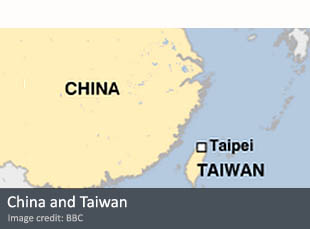
China and TaiwanBy JOSEPH FITSANAKIS | intelNews.org |
Last week I spoke about the current state of the espionage war between China and Taiwan with Tim Daiss, a Southeast Asia-based American journalist who has been covering the Asia-Pacific region for over a decade. Our discussion formed the basis of a comprehensive piece on the subject, published in British newspaper The Independent, in two parts (part one and part two). I told Daiss that the Ministry of State Security —China’s primary national intelligence agency— is not known for its technological prowess. However, the sheer size of Beijing’s intelligence apparatus is proving a good match for the more advanced automated systems used by its less populous regional rivals, including Taiwan. When it comes to traditional human intelligence, the Chinese have been known to employ time-tested methods such as sexual entrapment or blackmail, as was confirmed most recently in the case of Taiwanese Major-General Lo Hsien-che. Lo, who headed the Taiwanese military’s Office of Communications and Information, was convicted of sharing classified top-secret information with a female Chinese operative in her early 30s, who held an Australian passport. During his trial, which marked the culmination of Taiwan’s biggest spy scandal in over half a century, Lo admitted that the Chinese female spy “cajoled him with sex and money”. In addition to honey-trap techniques, Chinese spies collect intelligence by way of bribery, as do many of their foreign colleagues. In the case of China, however, a notable change in recent years has been the accumulation of unprecedented amounts of foreign currency, which make it easier for Chinese intelligence operatives to entice foreign assets, such as disgruntled or near-bankrupt state employees, to sell classified data. Read more of this post

British government tries to block probe into ex-KGB officer’s murder

Alexander LitvinenkoBy JOSEPH FITSANAKIS | intelNews.org |
The family of a Russian spy, who died of poisoning after defecting to Britain, has accused the British government of trying to cover up the affair in order to avoid embarrassing Russia. Alexander Litvinenko was an employee of the Soviet KGB and one of its successor organizations, the FSB, until 2000, when he defected with his family to the United Kingdom. He soon became widely known as a vocal critic of the administration of Russian President Vladimir Putin. In 2006, Litvinenko came down with radioactive poisoning soon after meeting a former KGB/FSB colleague, Andrey Lugovoy, at a London restaurant. He died in hospital three days later. A public inquest into Litvinenko’s murder had been scheduled for May, 2013. On Tuesday, however, it was revealed that the British government had filed a written petition to limit the information disclosed in the inquest. According to The London Times, British Foreign Secretary William Hague filed a Public Interest Immunity Certificate (PIIC), which, if allowed to stand, would limit the scope of the inquest on national security grounds. It is believed that the government wishes to block information linking Litvinenko to the Secret Intelligence Service —also known as MI6— Britain’s primary external spy agency. Last December, Ben Emmerson, the lawyer representing Litvinenko’s widow, claimed that the late Russian spy was a “registered and paid” agent of MI6 and Spanish intelligence at the time of his death. Read more of this post

Former Mossad officer describes Zygier affair as ‘scandalous’

Ben ZygierBy JOSEPH FITSANAKIS | intelNews.org |
A former member of Israeli spy agency Mossad, who claims to have worked in the same covert-operations unit as Ben Zygier, has described the latter’s incarceration and subsequent death as “scandalous”. The Australian-born Zygier was a Mossad officer several years before he was placed in solitary confinement following his arrest in Israel, in February 2010. Known to the outside world only as ‘Prisoner X’, he allegedly killed himself in his cell a few months later. Earlier this month, when an Australian television program identified ‘Prisoner X’ as Zygier, the Australian government admitted it had been aware of its citizen’s incarceration and death, but chose not to extend to him diplomatic support. So far, the Mossad, Israel’s foremost covert-action agency, has remained silent on the matter. But a former Mossad operative, who uses the name Michael Ross, has weighed in with his opinion. Ross was born in Canada and converted to Judaism before joining the Mossad for 13 years, seven of which he claims to have spent in the same covert-operations unit as Zygier. Although he never met his Australian-born colleague, Ross wrote in The Daily Beast in the weekend that he and Zygier “were in the field at the same time, albeit in different units”. In his article, the former Mossad spy dismisses allegations that Zygier may have betrayed his employer, saying that he has seen no evidence that the Australian-born Jew was not dedicated to the mission of the Mossad. He argues that the circumstances surrounding Zygier’s incarceration in solitary confinement were “scandalous”, because the jailed spy presented “no danger to the public”. Instead, says the former spy, Zygier could have been dismissed from the spy service and placed under house arrest for as long as it would have been necessary for the accusations against him to be “dealt with internally”. Read more of this post

Al-Qaeda manual on how to deceive unmanned drones found in Mali

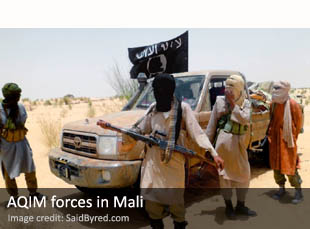
AQIM forces in MaliBy JOSEPH FITSANAKIS | intelNews.org |
A detailed manual with instructions on how to defeat the surveillance capabilities of unmanned drones has been found in a former al-Qaeda hideout in northern Mali. International news agency The Associated Press said the photocopied document, which is written in Arabic, had been left behind in a building previously occupied by members of Al-Qaeda in the Islamic Maghreb (AQIM). The militants abandoned the document while fleeing into the Sahara desert, ahead of a French military advance on the town of Timbuktu. The document is believed to have been authored by Abdallah bin Muhammad, the operational name of a Yemeni militant serving as a senior commander in the Al-Qaeda in the Arabian Peninsula (AQAP). Its earliest known date of publication is June 2, 2011, on an online Islamist forum. Since that time, it has reappeared at least three times, all in Arabic, according to The Associated Press. The version of the manual found in Mali contains nearly two dozen detailed tips on how to deceive unmanned drones. One tip advises covering the tops of vehicles with floor mats made of hay or other natural-looking material, in an effort to confuse aerial surveillance systems. Another tip proposes camouflaging the roofs of buildings with the use of reflective glass, so as to render them invisible to aerial surveillance. A third suggestion is to mix sugar with water and dirt and apply the sticky mixture onto the body of vehicles, in order to confuse the imagery sensors of unmanned drones. Read more of this post

US held secret meetings with North Korea after Kim Jong Il’s death

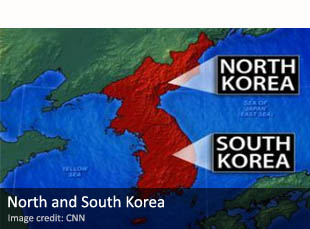
North and South KoreaBy JOSEPH FITSANAKIS | intelNews.org |
Senior United States officials traveled secretly to North Korea for talks on at least two occasions following the death of North Korean leader Kim Jong Il, according to a leading Japanese newspaper. Quoting unnamed sources from Japan, South Korea and the United States, the Tokyo-based Asahi Shimbun newspaper said last week that the American officials traveled on US military airplanes from an Air Force base on the Pacific island of Guam to North Korean capital Pyongyang. According to the paper, the visits, which took place on April 7 and August 18-20, 2012, were kept secret from both the South Korea and Japanese governments. It appears, however, that Tokyo found out about the secret flights after it was approached by amateur air traffic hobbyists, who noticed the Pyongyang-bound flights out of Guam. After analyzing air traffic patterns, officials at the Japanese Ministry of Foreign affairs contacted the US Department of State inquiring about the mystery flights. Incredibly, however, Washington refused to discuss the flights with its Japanese ally, citing national security concerns. Eventually, says Asahi, the State Department acknowledged one of the visits, but responded to persistent Japanese pressure by warning Tokyo that further inquiries on the subject “would harm bilateral relations” between Japan and the US. The Japanese daily claims that the secret flights carried a host of senior US officials, including Joseph DeTrani, then chief of the North Koran desk at the Office of the Director of National Intelligence, and Sydney Seiler, Korea policy chief at the White House National Security Council. Read more of this post

New information emerges on Hezbollah commander’s assassination

Imad MughniyahBy JOSEPH FITSANAKIS | intelNews.org |
A Lebanese newspaper has published the most detailed account to date of the 2008 assassination of Hezbollah commander Imad Mughniyah. The car explosion that killed Mughniyah in Syrian capital Damascus on February 12, 2008, is widely believed to have been the work of the Mossad, Israel’s foremost covert-action agency. Mughniyah was among the founders of Hezbollah, the Shiite militant group that controls large parts of southern Lebanon. At the time of his assassination, Mughniyah headed the Hezbollah’s security apparatus and was among the organization’s most senior intelligence officials. On Tuesday, Arabic-language newspaper al-Akhbar , which is based in Lebanese capital Beirut and is informally affiliated with Hezbollah, published a detailed article that reads like an unclassified version of the militant group’s internal investigation into Mughniyah’s killing. The article claims that “Hezbollah is absolutely positive that Israel was behind […] the operation from A to Z”. It says that Mughniyah’s assassins “were not Syrian citizens”, but rather entered Syria from abroad and stayed there six weeks while planning and executing the assassination operation. The article also claims that the Mossad recruited a Syrian expatriate, who visited Damascus on a regular basis in order to provide logistical support for the operation. This included renting a villa in the outskirts of Damascus and purchasing at least three vehicles to be used in the operation. Read more of this post

Israel’s ‘Prisoner X’ identified as Australian Mossad agent

Ben ZygierBy JOSEPH FITSANAKIS | intelNews.org |
In late 2010, an unnamed man known in Israel as ‘Prisoner X’ allegedly hanged himself while being held at a maximum-security prison near Tel Aviv. He committed suicide despite being under constant surveillance inside a facility originally built for the man who assassinated Israeli Prime Minister Yitzhak Rabin in 1995. So secret was the identity of the mysterious prisoner that, it was claimed, not even his guards knew his identity. Some in Israel speculated at the time that it might have been an abducted Iranian general. On Tuesday, however, an investigative Australian television program identified the dead man as an Australian citizen who had allegedly been recruited by the Mossad, Israel’s covert-action agency. ABC’s Foreign Correspondent program identified ‘Prisoner X’ as Ben Zygier, an Australian father of two, who moved to Israel in 2000 at the age of 24. The program said Zygier, who in Israel went by the name Ben Alon, was arrested by Israeli authorities in 2010 for unknown reasons. There is intense speculation, however, that Zygier’s secretive incarceration might be connected with an extremely serious security case, possibly involving high treason against the state of Israel. Despite the allegation by ABC of Zygier’s Mossad connection, Israeli news outlets are subjected to an active court order authorizing Israel’s Shin Bet internal security service to prohibit any media discussion on the subject. Israeli newspaper Ha’aretz reported on Tuesday that, hours after ABC’s revelation of Zygier’s identity, Israeli news outlets received telephone calls from the Office of the Israeli Prime Minister. Read more of this post

Did the CIA exclude Israel from its extraordinary rendition program?

Open Society Foundations report coverBy JOSEPH FITSANAKIS | intelNews.org |
The most comprehensive non-classified account of the United States Central Intelligence Agency’s extraordinary rendition program has been published by a human-rights advocacy group. It details for the first time the fate of nearly 140 known targets of the controversial program, who were abducted by the CIA mostly during the administration of US President George W. Bush. Under the controversial program, individuals were systematically detained and transferred without due process to countries where the use of torture on prisoners was –in the words of the report– standard practice. The report, entitled Globalizing Torture: CIA Secret Detention and Extraordinary Rendition, was authored by Amrit Singh, formerly of the American Civil Liberties Union and currently senior legal officer at the National Security and Counterterrorism program at the Open Society Justice Initiative. It concludes that the CIA was able to build and maintain the program with significant assistance from 54 countries, including 13 in Africa, 14 in Asia and 25 in Europe. The long list of countries that willingly cooperated with the CIA’s extraordinary rendition practices includes Canada, Denmark, Australia, Finland, Mauritania, Romania and South Africa. It even includes countries that are known to have had tense relations with Washington in the past decade, such as Zimbabwe, Syria, Pakistan, Libya, and even Iran. Certainly, the Open Society Justice Initiative report points to the fact that it is both shortsighted and inaccurate to refer to the Bush administration’s post-9/11 extraordinary rendition program as “an American operation”. It was informed and supported at all levels by America’s North Atlantic Treaty Organization allies, as well as by many countries which, for one reason or another, wished to be on the good side of the US. But the list of complicit states is also interesting for what it doesn’t include. Most importantly, it doesn’t include Israel. Read more of this post

Canadian passports still highly coveted by spies and terrorists

Canadian passportBy JOSEPH FITSANAKIS | intelNews.org |
An extensive investigation into a bus bombing that targeted Israeli tourists in Bulgaria points to the continued attraction of forged Canadian passports for terrorist groups and intelligence agencies. Bulgaria’s Minister of the Interior, Tsvetan Tsvetanov, said on Tuesday that the July 18, 2012, terrorist attack, was perpetrated by Al-Muqawama al-Islamiyya, the military wing of Hezbollah. The militant Shiite group, which controls large parts of southern Lebanon, has denied involvement in the bombing, which killed seven people, including five Israeli tourists. Tsvetanov said that, during a lengthy police investigation, which was assisted by American and Israeli investigators, the printer used to produce forged driver licenses found on two of the plotters was traced to Lebanon. He also told a press conference in Bulgarian capital Sofia that the suicide bomber, who died in the attack, entered Bulgaria using a forged Canadian passport. Commentator Paul Koring, of Canadian newspaper The Globe and Mail, correctly suggests that the revelation by the Bulgarian authorities points to the continued status of Canadian passports as the international travel documents of choice for both spies and terrorists. In the 1970s, Hezbollah’s biggest enemy, the Israeli intelligence service Mossad, used Canadian passports in Operation WRATH OF GOD (also known as Operation BAYONET). The operation exterminated almost every original member of Black September, the Palestinian group that perpetrated the massacre of the Israeli athletes in the 1972 summer Olympic Games in Munich. In 1997, the Israeli spy agency employed Canadian passports once again, during the famously disastrous attempt to kill Khaled Mashal, Chairman of the Political Bureau of Palestinian militant group Hamas, in Jordan. Read more of this post

German authorities had monitored Turkish bomber of US embassy

Ecevit ŞanlıBy JOSEPH FITSANAKIS | intelNews.org |
Some observers were surprised by news last week that the suicide attack at the US embassy in Turkish capital Ankara was perpetrated by secular Marxists, instead of religious extremists. But students of terrorism know that modern suicide bombings have historically been employed by secular separatist groups. These include the Liberation Tigers of Tamil Eelam (LTTE) in Sri Lanka, as well as the Kurdistan Workers Party (PKK) in Turkey. The Revolutionary People’s Liberation Party/Front (DHKP/C), which assumed responsibility for last Friday’s attack in Ankara, is a Marxist-Leninist splinter group, which has carried out suicide operations against its ideological enemies since at least 2001. Last week’s attack, which killed two and injured over a dozen people, was perpetrated by Ecevit Şanlı, a 40-year-old Turk from the city of Gölköy in northeastern Turkey. A member of DHKP/C for at least 20 years, in 2000 Şanlı became a cause célèbre among far-leftists in Turkey. During that year, he played a leading role in a hunger strike organized by self-described political prisoners in Turkey, in protest over prison conditions. The protest was brutally suppressed by Turkish security forces, and Şanlı barely survived it. He was eventually released on probation after serving a lengthy prison sentence. According to German sources, upon his release from prison, Şanlı moved to Germany, home to the world’s largest Turkish expatriate community. While there, he joined local leftist causes and appears to have been active in DHKP/C’s network of supporters among the Turkish community there. In 2009, German authorities briefly detained Şanlı after he was found in possession of propaganda literature belonging to DHKP/C, which is a designated foreign terrorist organization by the German government. Read more of this post

[Updated] World braces as Israel attacks Syria for first time in 5 years

Cyprus, Israel, Syria, LebanonBy JOSEPH FITSANAKIS | intelNews.org |
Alarm bells were sounding all over the Middle East Wednesday as Syria confirmed it had been attacked by Israeli military jets for the first time since 2007. It remains unclear at this point whether the Israeli airstrikes were meant to disrupt the flow of weapons to neighboring Lebanon, or whether Israel has officially entered the Syrian Civil War. Unnamed United States officials told The New York Times late on Wednesday that the Israel Air Force had entered Syrian airspace and destroyed a single truck transporting a “game-changing” cache of weapons to Lebanon. The cargo, allegedly consisting of Russian SA-17 anti-aircraft missiles, is said to have been destined for Hezbollah, the Shiite militant group that controls large parts of southern Lebanon. The alleged attack occurred near Zabadani, a small town on the road that connects Syrian capital Damascus to the Lebanese border. Hours later, however, Syrian state television confirmed the Israeli attack, but said the target was a “military research center aimed at raising the level of resistance and self defense” of the Syrian nation, located near Damascus. Some Israeli media suggest that, if the Syrian government’s claims are accurate, the target of the Israeli attack would seem to have been the so-called Syrian Scientific Studies and Research Center, also known as CERS. Both The New York Times and Israel’s Ha’aretz newspaper report that Israel informed the United States prior to launching the attack, but neither Washington nor Tel Aviv have so far commented on the airstrikes. In the absence of credible corroboration, confusion persists on whether the Israeli action was directed against Hezbollah, or meant to assist the aims of the Syrian opposition –or both. Read more of this post

Would UK, USA, share intel with independent Scottish spy agencies?

United Kingdom and IrelandBy JOSEPH FITSANAKIS | intelNews.org |
Scotland plans to set up its own security and intelligence agencies if its people vote in favor of independence from the United Kingdom in 2014, according to policy planners. But critics contend that it might be some time before Scotland’s spy organizations are trusted by their sister intelligence agencies in Britain and the United States. The Scottish National Party (SNP) which won an absolute majority in the Scottish Parliament in the 2011 election, has put forward a plan for a referendum proposing Scotland’s full independence from the UK, to be held in late 2014. On Monday, the Scottish Parliament’s Committee on Foreign Affairs met in Edinburgh to conduct an official inquiry into the possible foreign policy implications of an independent Scotland. Nicola Sturgeon, the SNP’s Deputy Leader and Deputy First Minister of Scotland, told the Committee that an independent Scotland would have to build a domestic intelligence agency to combat security threats such as terrorism, organized crime and cyber attacks. She said the agency would serve the interests of the Scottish people and the Scottish government, but would maintain “very close intelligence sharing with the rest of the UK”. According to Sturgeon, given that Scotland shares “an island with the rest of the UK”, a Scottish domestic security service would inevitably find itself “sharing intelligence and sharing our response to some of these threats”. She also suggested that an independent nation of Scotland would have the option to establish an “external security service” modeled on Britain’s MI6, also known as the Secret Intelligence Service. But Committee members opposed to independence directed heavy criticism against the minister’s plans, arguing that the financial cost of replicating existing UK intelligence and security structures would be colossal. They also warned Sturgeon that Scottish intelligence agencies would have to prove that they were reliable and safe before they struck intelligence-sharing arrangements with British and American organizations. Read more of this post

Israel intelligence confirms ‘major blast’ at Iran nuclear plant

Fordo nuclear facility, IranBy JOSEPH FITSANAKIS | intelNews.org |
Intelligence officials in Israel have confirmed reports of a “major explosion” that is believed to have severely damaged an Iranian nuclear enrichment facility, but refused comment on rumors that Israeli jets were seen flying nearby around the time of the blast. The blast was initially reported late on Sunday by Reza Kahlili, an Iranian former agent of the United States Central Intelligence Agency inside Iran’s Revolutionary Guard Corps. Citing Hamidreza Zakeri, a former officer in Iran’s Ministry of Intelligence and National Security, Kahlili said that the explosion severely damaged the nuclear enrichment plant in Fordo, centrally located in Iran’s Qom Province. According to Zakeri, the blast was strongly felt across a three-mile radius around Fordo and “destroyed much of the installation” itself. The former government official added that around 240 plant workers had been trapped underground by the powerful explosion. Following the blast, according to Zakeri, Iranian troops quickly cordoned off the plant and prevented anyone from getting closer than 15 miles from Fordo. A few hours after Kahlili’s report, Seyyed Shamseddin Barbroudi, Deputy Head of the Iranian Atomic Energy Agency told Iranian media that there had been “no explosion in Fordo Nuclear Facility”. His denial was echoed by Alaeddin Boroujerdi, member of the Iranian Parliament’s Committee on Foreign Policy and National Security. He told the Islamic Republic News Agency that rumors of an explosion at Fordo were “Western-made propaganda” aimed at destabilizing Iran.  On Monday morning, however, the London-based Times newspaper said its “sources in Tel Aviv” had confirmed the blast took place in Fordo. Read more of this post

Russia evacuating its citizens from Syria: A political turning point?

Busses carrying Russians arrive in LebanonBy JOSEPH FITSANAKIS | intelNews.org |
In a move that surprised observers, the government of Russia began on Tuesday to evacuate its citizens from Syria. Late on Tuesday afternoon, four chartered busses carrying nearly a hundred Russians, mostly women and children, arrived at the Jdaidet Yabous border crossing, which links Syria with Lebanon. As soon as they stepped on Lebanese soil in Masnaa, which is located five miles west of Jdaidet Yabous, the evacuees were met by an official from the Russian embassy in Beirut, who had been waiting for them for several hours. Russian officials dismissed rumors that this is the beginning of a mass evacuation of Russian citizens from Syria. But international observers described this development as “the strongest indication yet” that Moscow is acknowledging the eventual collapse of the regime in Damascus. Russia has persisted in its role as the strongest international backer of the regime of Syrian President Bashar al-Assad since 2011, when the Syrian uprising against his government began. But many view the Kremlin’s move to evacuate some of its citizens as “a turning point in its view of the civil war” in the Middle Eastern country. According to reports by the Associated Press, the Russians onboard the buses, which had been chartered by the Russian government, appeared to have been briefed to avoid contact with the press at the border crossing. Many covered the bus windows closest to them with curtains so as not to be photographed by journalists, and most refused to speak with press crews. The few who spoke publicly said without exception that they were simply traveling to Russia “to visit relatives”. The evacuees were taken to Beirut, where they have been scheduled to board two airplanes chartered by the Russian government, headed for Moscow. Read more of this post