Sons of exposed Russian deep-cover spies want their Canadian citizenship back

FoleyThe sons of a Russian couple, who fraudulently acquired Canadian citizenship before being arrested for espionage in the United States, are seeking to reinstate their Canadian citizenship, which was annulled when their parents were found to be Russian spies. Tim and Alex Vavilov are the sons of Donald Heathfield and Tracey Foley, a married couple arrested in 2010 under Operation GHOST STORIES —a counterintelligence program run by the US Federal Bureau of Investigation (FBI). Following their arrest, their sons, who allegedly grew up thinking their parents were Canadian, were told that their parents were in fact Russian citizens and that their real names were Andrei Bezrukov and Elena Vavilova. Their English-sounding names and Canadian passports had been forged in the late 1980s by the KGB, the Soviet Union’s primary external intelligence agency.

The two boys were at the family’s home in suburban Cambridge, MA, on Sunday, June 27, 2010, when FBI agents conducted coordinated raids across New England, arresting their parents and eight more Russian ‘illegals’. The term is used to signify Russian non-official-cover operatives, namely intelligence officers who operate abroad without diplomatic cover and typically without connection to the country they spy for. It is now believed that Bezrukov and Vavilova were recruited as a couple in the 1980s by the KGB’s Department S, which operated the agency’s ‘illegals’ program.

But the two brothers, who were born in Canada, are currently involved in a prolonged legal battle to have their Canadian citizenship reinstated. The latter was rescinded when it became clear that their parents’ Canadian passports were fraudulent. According to the Canadian Citizenship Act, children born in Canada to “employees of a foreign government” are not entitled to Canadian nationality. But the brothers argue that they were 20 and 16 when their parents were arrested and were unaware of their double identities. It follows, they told Canada’s newsmagazine Maclean’s in August, that they cannot be punished for their parents’ crimes.

This past June, Canada’s Federal Court of Appeal overturned the decision of a lower court and ordered the government to reinstate Alex Vavilov’s Canadian citizenship. Now the government has until September 20 to decide whether to appeal the Federal Court of Appeal’s decision to the Supreme Court. If it does not, or if it upholds the decision of the Federal Court of Appeal, it is thought that Alex’s brother, Tim, will also have his Canadian citizenship reinstated.

But the case may be further-complicated by allegations made by the Canadian Security Intelligence Service (CSIS) that Tim was aware of his parents’ espionage activities when they were arrested by the FBI. The CSIS claims that the two Russian spies had groomed Tim to enter the intelligence profession, and that the then-20-year-old had given an oath of allegiance to the SVR —the KGB’s post-Cold-War successor agency. But Tim Vavilov denies he was groomed or “sworn-in” by the Russians, and argues that he has never been presented with evidence of this allegation, even though his parents’ home in Massachusetts was bugged by the FBI for nearly a decade.

Author: Joseph Fitsanakis | Date: 15 September 2017 | Permalink

Ex-spy chief jailed as elite power struggle widens in oil-rich Kazakhstan

The Tengiz oil refinery in KazakhstanA former director of Kazakhstan’s feared intelligence agency has been given a lengthy prison sentence, as a ruthless power struggle between rival factions surrounding the country’s president widens. From 2001 to 2006, Nartai Dutbayev directed the Kazakh National Security Committee (KNB), a direct institutional descendant of the Soviet-era KGB. Founded in 1992, the KNB is today directly controlled by Kazakhstan’s authoritarian President, Nursultan Nazarbayev. Many officials serving in senior KNB positions are members of the president’s family, or close friends.

For many years, Dutbayev enjoyed unchallenged power, which was afforded to him by way of his close links to the presidential palace. But in 2006, he resigned from his top KNB post in the aftermath of the murder of popular Kazakh opposition politician Altynbek Sarsenbaev. Ten members of a specialist commando unit within the KNB were found guilty of Sarsenbaev’s murder. He was killed soon after he announced his decision to compete electorally against President Nazarbayev. But Dutbayev was never personally censured by the government. Then, in December of last year, Dutbayev was arrested on charges of “divulging government secrets”. The former spy chief’s trial began in July of this year, but was conducted in its entirety behind closed doors.

This past Monday it was reported that Dutbayev was sentenced to 7 ½ years in prison for espionage on August 24. It is not known why Dutbayev’s sentence was announced to the country’s media more than two weeks after it was formally imposed by the court. Additionally, Kazakh authorities have said nothing about who Dutbayev is believed to have divulged government secrets to, or why. Three alleged accomplices of Dutbayev, including former senior KNB officials Erlan Nurtaev and Nurlan Khasen, were also sentenced to between three and five years in prison for espionage.

Many observers believe that the jailing of the KNB officials is part of a broader power struggle that is currently taking place between rival factions competing to succeed President Nazarbayev. Kazakhstan’s leader has ruled the former Soviet Republic with an iron fist since before its independence from the USSR in 1991. The KNB appears to be a central player in the unfolding power struggle between the country’s governing elites. Almost exactly nine years ago, a Kazakh intelligence officer tried unsuccessfully to abduct another KNB former director, Alnur Musaev, who was living in self-imposed exile in Austria at the time. Many believe that he was acting under Nazarbayev’s direct orders. In 2014, two Kazakh men, believed to be KNB officers, tried unsuccessfully to abduct Viktor Khrapunov, Kazakhstan’s former Minister for Energy and Coal, who also served as mayor of Almati, before leaving Kazakhstan for Switzerland.

Dutbayev is reportedly already in prison. He is believed to be sharing a cell with Serik Akhmetov, Kazakhstan’s former prime minister, who is serving 11 years for alleged corruption.

Author: Joseph Fitsanakis | Date: 12 September 2017 | Permalink
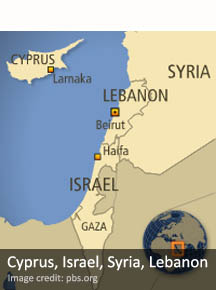
Alleged Israeli spying device concealed inside fake rock found in Lebanon

Cyprus, Israel, Syria, LebanonA sophisticated spying device disguised as a rock, which was allegedly planted by Israeli intelligence, was found by Lebanese Army troops on a hill located a few miles from the Lebanese-Israeli border. The discovery was reported early on Saturday by several Lebanese news websites, including Al-Mayadeen and Al-Manar, which are closely affiliated with Hezbollah. Al-Manar said that the spy device had been found in the outskirts of Kfarchouba, a predominantly Shiite Lebanese village, located in Arkoub, 100 miles southeast of Lebanon’s capital, Beirut. Kfarchouba’s location is extremely strategic, as the village overlooks northern Israel on the south and the Golan Heights on the east. It has been bombed by Israel several dimes between the 1970s and today, and is remains heavily militarized.

Reports from Lebanon said that a Lebanese Army patrol found the device hidden inside a fake rock, which had been placed on a hill outside Kfarchouba. The device had been placed in direct view of a major Lebanese military outpost, known as Rawisat. As soon as the device was detected, the patrol reportedly called in the Lebanese Army’s intelligence corps for support. Technical experts soon examined the discovery and determined that it contained a sophisticated thermographic camera. Also known as infrared or thermal imaging cameras, thermographic cameras capture images using infrared radiation, instead of using visible light, as is the case with commonly used cameras. This allows them to capture relatively clear images in the darkness, and are thus used for military operations that require night vision. Some Lebanese websites published photographs showing parts of the alleged spy device, which appear to bear writing in Hebrew.

This is not the first time that alleged Israeli spy devices have been found in southern Lebanon. In September of 2014, one person was killed when a mysterious device found near the Lebanese village of Adloun suddenly exploded as Hezbollah troops were examining it. It was later suggested that the device had been attached by Israeli troops to the Hezbollah-owned telecommunications network that spans southern Lebanon. Hezbollah said that the device had been remotely detonated by an Israeli drone in order to prevent it from being reverse-engineered. Two other devices found by a Lebanese Army patrol in the same region in October of 2009 suddenly exploded, as Lebanese security personnel were approaching. A Lebanese Army official said on Sunday that the device found in Kfarchouba will be dismantled by Lebanese Army engineers.

Author: Joseph Fitsanakis | Date: 11 September 2017 | Permalink

Iraqi Kurds claim they have captured senior Turkish intelligence officers

Cemîl BayikThe Turkish government has refused to comment on reports from Iraq, which suggest that Kurdish forces have captured at least two senior Turkish intelligence officers. News of the arrests first emerged in mid-August, when pro-Kurdish media in Turkey’s Anatolia region claimed that an armed Kurdish group in Iraq had captured two members of the National Intelligence Organization (MİT), Turkey’s principal intelligence agency.
According to the reports, the Turkish intelligence officers had used forged identity papers to travel from eastern Turkey to the northern Iraqi city of Erbil. From there, they went to Sulaimaniyah, a metropolitan center in Iraq’s Kurdish north. Allegedly, the Turkish officers traveled to Iraq in order to assassinate Cemîl Bayik, a co-founder and senior leader of the Kurdistan Worker’s Party (PKK). Founded in 1978, the PKK is a leftwing secessionist paramilitary organization that seeks an independent homeland for Turkey’s Kurdish minority. Iraq’s Sulaimaniyah region is controlled by another Kurdish armed group, the Patriotic Union of Kurdistan (PUK), which has close relations with Iran. But a rival Kurdish group, the Kurdistan Democrat Party (KDP), which is supported by Turkey and opposes the PKK’s secessionist aims, also has a strong presence in the area. It is not known whether KDP forces were aware of —or even assisted— the Turkish intelligence officers in Sulaimaniyah.

Kurdish sources claim that the two Turkish intelligence officers were arrested by PUK forces. Notably, media reports suggest that one of arrestees serves as the MİT’s deputy undersecretary for foreign operations, while the other heads the MİT’s PKK desk. The PUK is now threatening to publish photographs of the two men, which would blow their cover. But there has been no comment on this story from Ankara, where Turkish government officials refuse to confirm or deny that the arrests happened or that the two men are indeed MİT employees. Some observers, however, note that the Turkish government shut down the PUK’s office in the Turkish capital on August 23, and expelled the organization’s representatives. The group has maintained an office in Ankara since 1991, so the Turkish government’s surprising move may signify that the media reports about the arrests of the two MİT officers are indeed accurate.

Author: Joseph Fitsanakis | Date: 08 September 2017 | Permalink

French police officer charged in complex spy case involving Morocco, Algeria

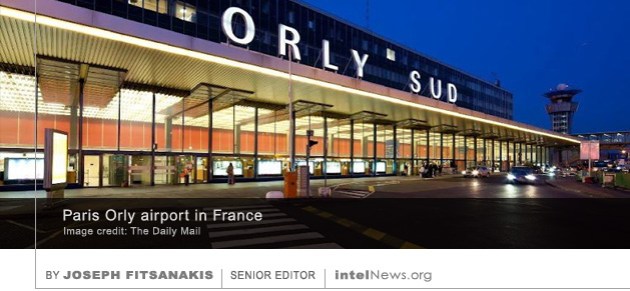
Paris Orly AirportA French police officer has been charged with illegally sharing secret government documents in an espionage case involving France’s border police and diplomats from Morocco and Algeria. According to information published by the French daily Libération, the police officer supplied Moroccan intelligence with classified information about France’s border-control policies and procedures. He also gave the Moroccans information about the movements in France of Moroccan nationals and senior Algerian government officials.
According to the report by Libération, the police officer, identified only as “Charles D.”, was charged on May 31 of this year with corruption and violating secrecy rules. Court documents state that Charles D. gave away classified documents belonging to the Direction centrale de la police aux frontières (DCPAF), a directorate of the French National Police that is in charge of immigration control and border protection across France. He reportedly gave the documents to another man, identified in court documents as “Driss A.”, who worked at Paris’ Orly Airport. It is believed that Driss A. worked as director of the Orly branch of ICTS International, a Dutch-based company that provides security services in several European airports. It is also believed that Driss A. —a Moroccan-born French citizen— was secretly employed by the Deuxième Bureau, Morocco’s military intelligence service. It appears that the Moroccans compensated Charles D with free holidays in Morocco in exchange for his services.

Interestingly, when French counterintelligence officers raided Driss A.’s home in Paris, they found documents detailing the activities of senior Algerian government ministers during their official trips to France. The officials are identified in the documents as Algeria’s former Deputy Prime Minister Noureddine Yazid Zerhouni, Higher Education Minister Tahar Hadjar, and Telecommunications Minister Hamid Grine. The documents appear to have been produced by Algerian intelligence and given initially to the embassy of Algeria in France. No explanation has been given about how these documents fell in Driss A.’s possession. Some observers assume that Driss A., acting as a Moroccan intelligence operative, must have acquired them from a source inside the Algerian embassy in Paris.

Author: Joseph Fitsanakis | Date: 07 September 2017 | Permalink

Probe uncovers massive $3 billion secret bribe fund in Azerbaijan

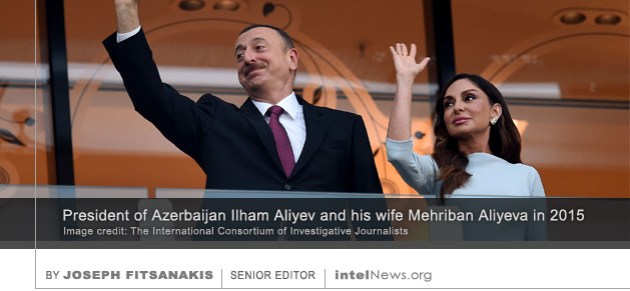
Ilham AliyevAn investigation by a consortium of European newspapers has uncovered details of a massive slush fund worth nearly $3 billion, which was allegedly used by Azerbaijan’s governing elite to bribe officials, business leaders and journalists at home and abroad. The fund was operated out of Baku, the capital of the former Soviet state, which is routinely accused of human-rights abuses. Western countries, including the United States, censure the government of the oil-rich state for its role in systematic abuses. These involve high levels of public- and private-sector corruption, vote-rigging, politically motivated disappearances, and wide curtailment of basic civil liberties. This new information is bound to add to Azerbaijan’s image as a secretive oil-rich state ruled by corrupt elite connected to the country’s President, Ilham Aliyev, and his family.

The existence of the slush fund was revealed by the Organized Crime and Corruption Reporting Project (OCCRP), an international investigative consortium. The OCCRP’s report was published in Tuesday, following a lengthy investigation by members of 17 European news media, including publications in the United States, Britain, Germany, France, Denmark and Belgium. The report states that the fund, which it nicknames “the Azerbaijani Laundromat”, was operational for over two years, from 2012 to 2014. During that time, it participated in “over 13,000 transactions”, many of which were carried out through companies based in the United Kingdom but registered in the British Virgin Islands, Belize and the Seychelles. Payments were processed by the Estonian branch of Danske Bank, a major European banking institution.

According to the OCCRP report, most of the fund’s recipients were politicians, business executives, reporters and other influential people in Western Europe, as well as Turkey and Central Asia. Other recipients included wealthy families in Azerbaijan, who used the funds to finance a luxurious lifestyle, according to the report. Some foreign recipients of the funds were politicians, journalists or lobbyists who have been vocal in supporting Azerbaijan’s government and its policies. Most of the funds are believed to have originated from Azerbaijani-based companies, primarily Baktelecom MMC. But Russian-based companies, including Rosoboronexport, Russia’s state-operated exporter and importer of defense-related technologies, also contributed over $30 million to the slush fund.

Perhaps most controversially, the OCCRP report alleges that some of the secret slash funds originated from senior cabinet members in Azerbaijan, as well as some intelligence officials. It also states that investigators uncovered “ample evidence of [the fund’s] connection to the family of [Azerbaijan’s longtime] President Ilham Aliyev”. Late on Tuesday, a statement issued by President Aliyev’s office rejected the report as “baseless, malicious and […] provocative in nature”. More reactions to the OCCRP report are expected in the coming days.

Author: Joseph Fitsanakis | Date: 06 September 2017 | Permalink

More facts revealed about mystery sonic attacks on US embassy in Cuba

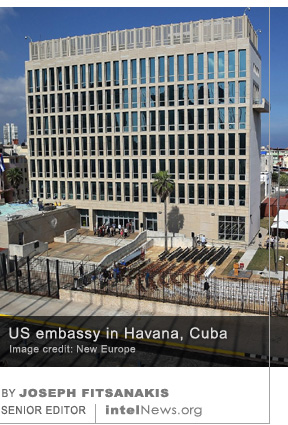
US embassy in CubaAmerican officials have revealed more information about a mysterious sonic device that is believed to have caused numerous diplomats to suffer hearing loss and other serious ailments. Last month, the Associated Press reported that the first hearing-loss symptoms were reported by personnel at the US embassy in Havana in the fall of 2016. The news agency said that at least five embassy personnel reported suffering from sudden and unexplained loss of hearing. The symptoms were so serious that caused some American diplomats “to cancel their tours early and return to the United States”, according to the Associated Press.
Now new information has been disclosed by the United States Department of State. It suggests that, although diplomats began reporting hearing-loss symptoms in as early as fall 2016, the incidents continued until mid-August of this year. In a report published on Saturday, the BBC said that the bizarre incidents had not ended “several months ago” as was initially believed. Instead, they continued even after the last week of May, when the US deported two Cuban diplomats from Washington, DC. The move was in response to what Washington believes was a deliberate attempt to sabotage its diplomatic mission in Havana. The American embassy in the Cuban capital reopened in 2015, 54 years after it was closed down following a series of diplomatic rifts between Cuba and the US during the height of the Cold War.

Additionally, the Department of State said on Friday that the number of American diplomats and other US embassy personnel who have reported sonic-related symptoms has increased to 19. State Department spokeswoman Heather Nauert told reporters in Washington that doctors were still evaluating the health of those serving at the US embassy in Havana. She added that new cases of people suffering from sonic-related medical symptoms could not be ruled out. A report from the American Foreign Service Association, which represents members of the United States Foreign Service, said on Friday that its representatives had spoken to 10 people who had received various treatments for ailments related to the alleged sonic attacks in Cuba. It said that many had suffered “permanent hearing loss”, while others were diagnosed with mild brain injuries.

According to media reports, Washington has concluded that the American diplomats were exposed to “an advanced device that was deployed either inside or outside their residences”. But the Cuban government denied that it had anything to do with the American diplomats’ symptoms, and some believe that the alleged “covert sonic device” may have been deployed by an intelligence service of a third country —possibly Russia— without the knowledge of Cuban authorities.

Author: Joseph Fitsanakis | Date: 04 September 2017 | Permalink

US troops in Syria battle anti-Assad rebels once funded by the CIA

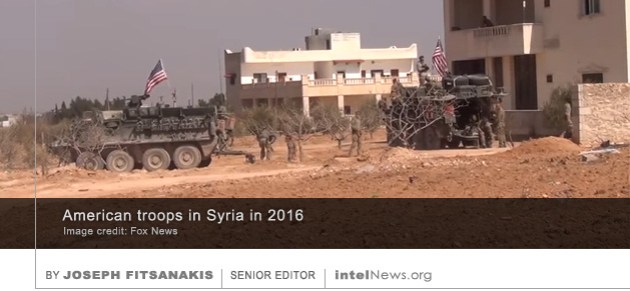
US troops in SyriaAmerican troops deployed in Syria have exchanged fire with rebels that were until recently supported by the United States Central Intelligence Agency. In 2013, soon after the outbreak of the Syrian Civil War, the then-US President Barack Obama instructed the Central Intelligence Agency to provide covert support to fighters in Syria. Acting on the president’s directive, the CIA promptly joined forces with spy agencies from Britain, France, Saudi Arabia and the United Arab Emirates, to assist fighters affiliated with the Free Syrian Army. At that time, Washington saw the Free Syrian Army and forces affiliated with it as ideologically moderate. It also agreed with the group’s main aim, which was to topple the regime of Syrian President Bashar al-Assad.
Under the project, which was codenamed TIMBER SYCAMORE, CIA personnel trained Free Syrian Army fighters in irregular warfare, while also providing them with light weaponry including machine guns, sniper rifles and off-road vehicles. But on July 19 of this year, US President Donald Trump abruptly ended the CIA program, which he called “dangerous and wasteful”. It soon became apparent that many Free Syrian Army soldiers approached Turkey, seeking financial income and protection. By early August, there were reports from Syria that large groups of former Free Syrian Army troops were conducting raids in northern Syria in coordination with the Turkish military.

Early on Wednesday, a spokesman for the Combined Task Force Operation Inherent Resolve told reporters that US troops in Syria had come under fire by Turkish-commanded former Free Syrian Army units. The spokesman told reporters in Kuwait City that the rebels shot at US troops in the outskirts of Manbij, a northern Syrian city of about 70,000, located a few miles from the Turkish border. The American soldiers reportedly returned fire before seeking shelter from the assault. According to the US Pentagon, the Turkish government was promptly contacted by Inherent Resolve commanders, who described the incident as “not acceptable”. Washington alleges that its troops have come under fire “multiple times” in the past month. Some of the culprits are believed to be Turkish-controlled Syrian insurgents, including former members of the Free Syrian Army.

Turkey and the US are member states of the North Atlantic Treaty Organization. But the two countries do not follow a common policy on Syria. The US Pentagon supports Kurdish insurgents in Syria, which Turkey claims are connected with Kurdish separatists inside Turkey. Washington’s official position on Kurdish separatists is that they engage in terrorism against the Turkish state.

Author: Joseph Fitsanakis | Date: 30 August 2017 | Permalink

Ukraine releases rare footage showing arrests of North Korean nuclear spies

North Korean SpiesUkrainian authorities have released rare surveillance footage filmed during a sting operation that ended with the capture of three North Korean spies. The North Koreans, two of whom are now serving prison sentences in Ukraine, had traveled there in 2011 believing they would be given missile technology secrets. Last July, North Korea surprised missile technology experts by successfully testing two intercontinental ballistic missiles (ICBMs). Government-controlled media in Pyongyang claimed that North Korean ICBMs were capable of reaching the United States’ mainland.
On August 14, a report by the London-based International Institute of Strategic Studies (IISS) suggested that North Korea’s technological leap had been achieved with assistance from abroad. The report claimed that one possible source of North Korea’s technical advancement was the Yuzhnoye Design Office, a corporation that specializes in the design of rockets and satellites. Based in the central Ukrainian city of Dnipro, Yuzhnoye has its roots in the Soviet space and weapons program of the early 1950s. Following the publication of the IISS report, some experts claimed that North Korean spies may have illicitly purchased or stolen missile designs from Yuzhnoye. Ukrainian authorities strongly denied these allegations, and argued that Russia was a far more likely source of North Korea’s technical knowledge —something that Moscow refutes. In an effort to strengthen their claims, Ukrainian officials were authorized to release details of counterespionage operations against North Korean spies in recent years. They told the US-based news network CNN that several North Korean spies had been caught spying in Ukraine in recent years, and that Ukraine responded in 2016 by barring all North Koreans from entering the country.

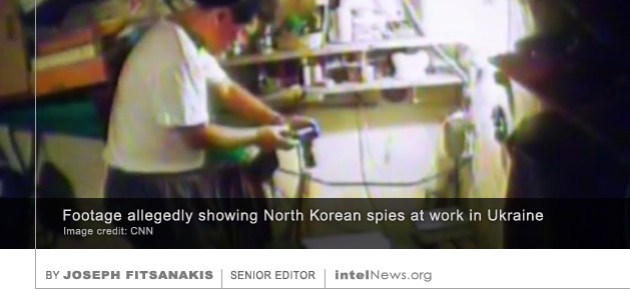
The Ukrainians also released to CNN surveillance footage filed during a sting operation in 2011, in which three North Korean diplomats were caught photographing classified documents in Ukraine. The documents, which contained technical blueprints of missiles, were fake, and the operation had been planned by the Ukrainians several years prior. The three North Koreans had traveled to Ukraine from the Democratic People’s Republic of Korea’s embassy in Moscow. One of the men, who had been tasked with transporting stolen hardware missile parts out of Ukraine, was deported following his arrest. His two accomplices are currently serving eight-year prison sentences in a Ukrainian prison located nearly 90 miles west of Kiev. Reporters from CNN were also granted access to the two North Korean prisoners, known only as “X5” and “X32”. The younger prisoner, who goes by X32, declined to be interviewed. But X5, who is in his mid-50s, told CNN that he was born in Pyongyang and that at the time of his arrest he was serving as a trade representative in the DPRK’s embassy in Belarus.

Ukrainian officials told CNN that the two men were visited in jail once by officials in the DPRK’s embassy in Moscow, but that was their only contact —face-to-face or otherwise— with North Korean citizens since their arrest. The officials argued that this information about Ukraine’s counterespionage operations against North Korean spies should help dispel all allegations that Pyongyang may have acquired its missile knowhow from Ukrainian sources.

Author: Joseph Fitsanakis | Date: 28 August 2017 | Permalink

Russia jailed senior intelligence officers for helping CIA nab notorious hackers

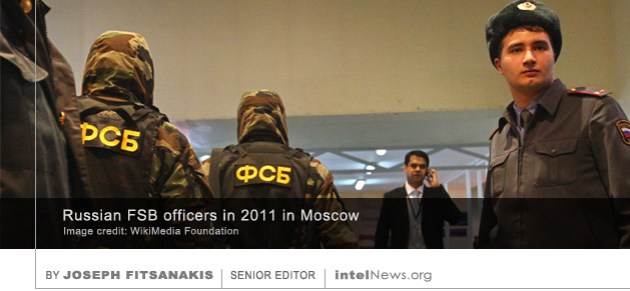
FSB - JFTwo senior officers in the Russian intelligence services were charged with treason after they were found to have helped the United States catch two notorious Russian hackers, according to reports in the Russian media. Sergey Mikhailov was a career officer in the Federal Security Service —a descendant of the domestic section of the Soviet-era KGB— which is often referred to as Russia’s equivalent of the United States Federal Bureau of Investigation. Mikhailov had risen through the ranks of the FSB to eventually head the agency’s Center for Information Security. Known in Russia as CIB, the Center is tasked with investigating electronic crime in the Russian Federation.

But in December 2016, Mikhailov and one of his trusted deputies in the CIB, Dmitry Dokuchaev, were suddenly removed from their posts and arrested. The arrests marked some of the highest-profile detentions of intelligence officers in Russia since the demise of the Soviet Union. Russian authorities refused to reveal the reasons for the arrests, but confirmed that the two men had been charged with treason. Reports soon surfaced in the Russian media, claiming that Mikhailov and Dokuchaev were arrested for their involvement in a Russian criminal hacker gang. Some Western media, including The New York Times, speculated that the two men may have been arrested for helping US intelligence investigate Russian interference in the 2016 US presidential election.

But now a new report alleges that Mikhailov and Dokuchaev were charged with treason after helping the US Central Intelligence Agency catch two prolific Russian hackers. The report was aired on Russian television station TV Dozhd, also known as TV Rain, a privately owned channel based in Moscow, which broadcasts in Russia and several other former Soviet Republics. One of the hackers, Roman Seleznev, known in hacker circles as Track2, reached worldwide notoriety for defrauding major credit card companies of tens of millions of dollars. He was arrested in 2014 in the South Asian island country of Maldives and eventually extradited to the US to stand trial. He was sentenced to 27 years in prison, which he is currently serving. The other hacker, Yevgeniy Nikulin, was arrested in the Czech Republic in 2016, pursuant to a US-issued international arrest warrant. He is now awaiting extradition to the US, where he is expected to be tried for hacking several high-profile companies, including DropBox and LinkedIn.

TV Dozhd said that Russian authorities are also suspecting the men of being members of hacker gangs, but that their main charges relate to their close cooperation with American intelligence agencies, reportedly in exchange for cash.

Author: Joseph Fitsanakis | Date: 25 August 2017 | Permalink

CIA warned Barcelona police two months ago about possible Islamist attack

BarcelonaThe United States Central Intelligence Agency recently warned Spanish authorities that the Islamic State planned to attack Barcelona, according to Spanish media. The disclosure follows Thursday’s dramatic events in the Catalan capital, where a white van deliberately drove into a crowd in the pedestrian mall of La Rambla, killing at least 16 people and injuring more than 100. The attack was followed by reports early on Friday that Catalan police had shot dead four suspects who were planning a second strike.
In the hours following the attack, several observers noted that Barcelona was always an obvious target for the Islamic State, given that the group had already perpetrated terrorist attacks in Berlin, London, Paris and Brussels. They also raised questions about the low level of police presence and the absence of anti-vehicle barrier systems in Barcelona —one of Europe’s busiest tourist destinations. Late on Thursday, the Catalan newspaper El Periódico reported that, two months ago, the CIA alerted the Mossos d’Esquadra, the autonomous police and security service of Catalonia, of a possible terrorist attack by the Islamic State. According to the Barcelona-based daily, the CIA even mentioned La Rambla as the main target of Islamist militants.

Even before the CIA issued its warning, the Islamic State had directed several threats against Spain since 2014, when the group first appeared in Syria. As El Periódico said, the group’s followers “consider themselves obligated to re-establish Islam” in areas that were ruled by Muslim leaders in the past. For much of the medieval period, Spain and Portugal were known as Al-Andalus, and were ruled by a succession of Muslim caliphs. The Spanish daily also reported that a Twitter account associated with the Islamic State issued several warnings against Spain two weeks ago. Specifically, on July 30, the account twitted a series of messages that read: “We will implement the caliphate in Spain and will recover our land. Impending attack on Al-Andalus, God willing”. Similar threats had been issued a year ago on social media, but were later disregarded after they failed to materialize, said El Periódico.

Author: Joseph Fitsanakis | Date: 18 August 2017 | Permalink

Saudi government secretly abducting its critics from abroad, say dissidents

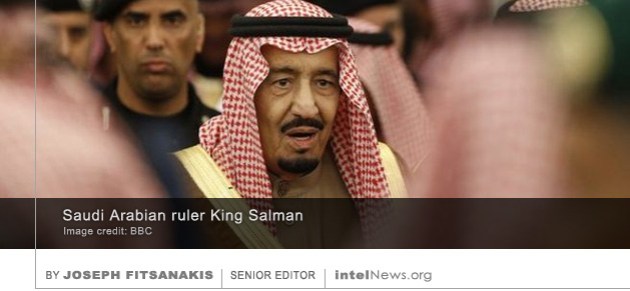
Salman of Saudi ArabiaAt least three prominent Saudi dissidents living in Europe, who openly criticized Saudi Arabia’s system of government, have been illegally abducted by the country’s monarchy in the past two years, according to a report by the BBC. All three, who are members of the Saudi royal family, are missing, believed to be dead or held against their will in Saudi Arabia. But the country’s government will not comment on their fate.

According to the BBC World Service, one of the missing dissidents is Prince Turki bin Bandar, a former major in the Saudi police force. In 2010, the prince began falling out with the Saudi royal family over a disputed inheritance. He was reportedly arrested and imprisoned. Once released from prison, in 2012, he moved to France, from where he began criticizing the Saudi government by posting videos and messages on social media. But his messages calling for political reform and an end to corruption in Saudi Arabia stopped in the summer of 2015 when, according to his friends, he disappeared. One of them, the blogger Wael al-Khalaf, told the BBC that Prince Bandar was visiting Morocco where he was detained following a request by the Saudi government. It is believed that he was then deported to Saudi Arabia, where he remains today, almost certainly against his will.

Another Europe-based Saudi royal, Prince Saud bin Saif al-Nasr, has been missing since 2015. His disappearance came after a year-long social-media campaign in which he called for the prosecution of senior Saudi officials for backing the overthrow of the now deposed Egyptian President Mohammed Morsi. In September 2015, shortly before his disappearance, Prince Nasr had publicly endorsed two anonymous open letters —allegedly written by a Saudi prince— calling for the violent overthrow of the Saudi monarchy. According to the BBC, Prince Nasr was the only Saudi royal to publicly and openly endorse the letters. He then disappeared and is presumed to be in Saudi Arabia.

The third case, that of Prince Khaled bin Farhan, is more complicated. The prince was living in Switzerland and was a prominent figure among Saudi exiles calling for political reforms in their homeland. In 2003, he took a flight from Milan to Rome on a private jet, which, according to the BBC, had been provided to him by a Russian-Italian company seeking to strike a business deal with him. But Prince Farhan alleges that the trip was a ruse, and that the jet took him instead to Saudi Arabia, where he was imprisoned. Seven years later, the Saudi government allowed him to seek medical treatment in the United States. But when he arrived in Boston, Massachusetts, the prince immediately filed a criminal complaint against his abductors in the Swiss courts. Amazingly, in 2016 he was convinced by the Saudi government in Paris, where he was living at the time, to use a Saudi government plane to visit his ailing father in Cairo, Egypt. But, predictably, the airplane took him and his 18-member entourage —which included non-Saudi citizens— to Riyadh. When the jet landed, Prince Farhan was “dragged […] from the plane” by heavily armed guards while “screaming at his team to call the US embassy”, according to two members of his entourage who spoke anonymously to the BBC.

The two anonymous sources told the British broadcaster that they had their passports taken away and were kept in a hotel for three days without being allowed to use a telephone to contact their family abroad or their country’s embassy in Saudi Arabia. They were then allowed to “fly to a destination of their choice” with their expenses paid by the Saudi government. The BBC said it contacted the Saudi government seeking information about the three missing royals, but Saudi officials declined to respond to questions.

Author: Joseph Fitsanakis | Date: 17 August 2017 | Permalink

Germany investigates Swiss intelligence officers over espionage claims

Germany SwitzerlandGermany has launched an unprecedented investigation into three officers of Switzerland’s intelligence agency on suspicion that they spied on German tax investigators who were probing the activities of Swiss banks. News of the investigation comes three months after authorities in Germany arrested another Swiss intelligence officer, identified only as “Daniel M.”, for engaging in espionage on German soil. German media report that the three unnamed men are officers of Switzerland’s Federal Intelligence Service (NDB). They are suspected of engaging in the same type of activity as “Daniel M.”, namely monitoring German tax-fraud investigators.
The German government believes that billions of euros are deposited by its citizens in banking institutions in European tax-havens like Liechtenstein, Switzerland or Monaco. For the past decade, German authorities have resorted to bribing whistleblowers in offshore banks in order to acquire internal documents that reveal the identities of German citizens who are hiding their money in foreign bank accounts. It is estimated that over a hundred million dollars have been paid to whistleblowers by German authorities since 2006. The latter argue that the proceeds collected from unpaid taxes and fines more than justify the payments made out to whistleblowers. But the Swiss government has strongly criticized Berlin for encouraging Swiss banking sector employees to steal internal corporate information that often breaks Switzerland’s stringent privacy laws. It is believed that the NDB has been instructed by the Swiss government to monitor efforts by German tax-fraud investigators to approach potential whistleblowers working in the Swiss banking sector.

According to German media, the investigation against the three NDB officers was launched earlier this month. The news is likely to further complicate relations between Berlin and Bern. The two governments have been at loggerheads since the arrest of “Daniel M.”. Switzerland responded to the arrest by issuing arrest warrants for a number of German tax investigators. But Germany dismissed the move, saying it would refuse to comply with the warrants. On Monday, several European news media quoted German foreign minister Sigmar Gabriel, who described the alleged activities of the NDB as “incredible” and warned that the ongoing dispute between Germany and Switzerland could “wreck” their bilateral relationship.

Author: Joseph Fitsanakis | Date: 16 August 2017 | Permalink

Mystery sonic device blamed for foreign diplomats’ hearing loss in Cuba

US embassy in CubaAuthorities in Cuba, the United States and Canada are investigating reports that several foreign diplomats stationed in Havana have been experiencing severe hearing loss in recent months. Some are blaming the deployment of a mystery “covert sonic device” for the diplomats’ symptoms. The allegations originate from diplomatic personnel stationed at the US embassy in Havana. The embassy reopened in 2015, 54 years after it was closed down following a series of diplomatic rifts between Cuba and the US during the height of the Cold War.
Last week, citing anonymous “officials with knowledge of the investigation into the case”, the Associated Press said that the first hearing loss symptoms were reported by personnel at the US embassy in Havana in the fall of 2016. Several of them —five, according to the Associated Press, though the Department of State will not give a precise number— reported suffering from sudden and unexplained loss of hearing. The news agency reported that, in a few cases, the symptoms were so serious that caused some American diplomats “to cancel their tours early and return to the United States”. Following those bizarre incidents, authorities in Washington proceeded to conduct an investigation. They concluded that the American diplomats had suffered loss of hearing after being repeatedly “exposed to an advanced device that had been deployed either inside or outside their residences”.

In response to the outcome of the investigation, the White House secretly ordered on May 23 of this year the expulsion of two Cuban diplomats from the embassy of Cuba in DC. But the Cuban government denied that it had anything to do with the American diplomats’ symptoms, and some believe that the alleged “covert sonic device” may have been deployed by an intelligence service of a third country —possibly Russia— without the knowledge of Cuban authorities. Meanwhile, the plot thickened on Friday of last week, after the Canadian government claimed that at least one of its diplomats stationed in Havana had also suffered from sudden loss of hearing. Canada has now joined the Federal Bureau of Investigation and the Diplomatic Security Service in the US in investigating the incidents. The Cubans have also launched their own investigation.

Author: Joseph Fitsanakis | Date: 15 August 2017 | Permalink

Cold War files show CIA support for guerrilla warfare inside USSR (Part II)

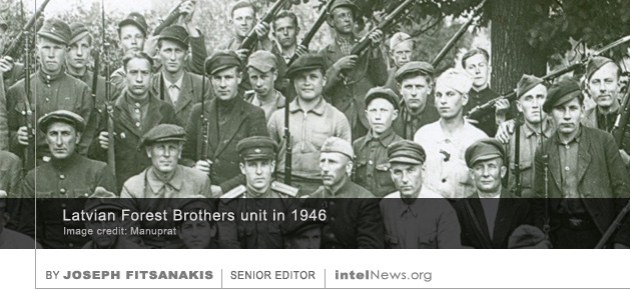
Latvia Forest BrothersThe role of the CIA in funding and helping to organize anti-Soviet groups inside the USSR has been known for decades. But, as intelNews explained in part I of this article, a batch of recently released documents, unearthed by Russian-language service of Latvian state television, sheds light into the CIA’s early understanding of the identity, strength and operations of these groups. They also contain new information about the background and structure of underground anti-Soviet groups like the Forest Brothers in Latvia.

Judging that Latvia’s anti-Soviet underground movement could be “of considerable operational value”, the CIA initiated project ZRLYNCH in the summer of 1950. Operated out of the CIA’s Munich station in Germany, ZRLYNCH was intended as a long-term project supervised by the Office of Policy Coordination, an early Cold War covert operations outfit that in 1952 was absorbed into the CIA’s Directorate of Operations. The Latvia operation was part of a wider effort by the CIA, which was aimed at subverting Soviet power in Eastern Europe.

For the first year of ZRLYNCH, the CIA’s Office of Policy Coordination asked for —and received— a budget of $30,000. The top-secret document unearthed recently by Latvian state television states that the budget was to be used primarily for intelligence collection inside Soviet territory, as well as for covert operations by the Forest Brothers (for information about the group, see part I of this post). The latter were to conduct sabotage activities as part of organized guerrilla warfare. These activities are not specified in the CIA documents. By the end of the first year, it appears that the CIA had recruited three Latvian agents in Europe (one in Sweden and two in Germany), who were acting as mediators between the CIA and the Forest Brothers inside the USSR. Less than three years later, the ZRLYNCH budget had risen to $134,000, with $52,000 going toward covert —mostly psychological— operations and the rest being used to fund intelligence collection efforts. The CIA was also funding the travel expenses of leading Latvian émigré figures in the US, and was diverting tens of thousands of dollars toward Latvian émigré conferences in America, which aimed to unite the various political factions of the fragmented Latvian community in the States.

But the CIA officers behind ZRLYNCH were extremely concerned about operational security. They did not want the Kremlin finding out that the Agency was behind efforts to stir up armed resistance against Soviet power in the Baltic region. One CIA document states that there would be no tolerance for “any breaches of security” that compromised ZRLYNCH. Consequently, any action that uncovered the link between the US government and the Forest Bothers would lead “to an immediate cessation of financial support” for ZRLYNCH, states the memo.

Ultimately, ZRLYNCH failed to seriously challenge Soviet power in Latvia. Most of the members of the Forest Brothers were killed during Red Army counterinsurgency operations, and much of the organization’s structure was penetrated by agents of Soviet intelligence. Eventually, the Forest Brothers became extinct in 1957, when their last members emerged from the forest and surrendered to Latvian and Soviet authorities.

Author: Joseph Fitsanakis | Date: 11 August 2017 | Permalink