US Justice Department and CIA may intervene in Saudi lawsuit to protect secrets
May 24, 2021 1 Comment
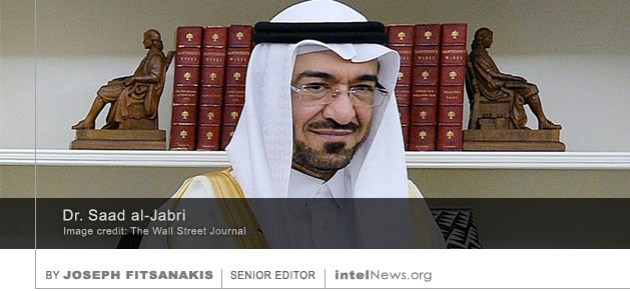
THE UNITED STATES DEPARTMENT of Justice and the Central Intelligence Agency may intervene in a civil lawsuit filed by an exiled Saudi spy against the oil kingdom’s de facto ruler, in order to protect state secrets. In a 106-page lawsuit, filed last year with the US District Court in Washington, DC, Dr. Saad al-Jabri claims that Saudi Arabia’s de facto ruler, Crown Prince Mohammed bin Salman, dispatched members of his “personal mercenary group”, known as the Tiger Squad, to North America, in order to assassinate him.
Al-Jabri was a courtier of Crown Prince Muhammad bin Nayef, grandson of Saudi Arabia’s founding monarch, King Abdulaziz. Bin Nayef, who was widely expected to be Saudi Arabia’s next king, eventually appointed al-Jabri Minister of State and made him his senior adviser on matters of security and intelligence —in essence his spy chief. But al-Jabri’s standing changed suddenly in 2015, when King Abdullah died and was succeeded by King Salman. Salman then named his son, Mohammed bin Salman, as his successor, effectively usurping al-Jabri’s mentor and protector, Prince bin Nayef. Within weeks, al-Jabri had been fired, while his patron, bin Nayef had gone under house arrest. Fearing for his life, al-Jabri took his eldest son, Khalid, and escaped to Canada in the middle of the night. They remain there to this day.
Bin Salman’s lawyers have dismissed al-Jabri’s lawsuit as baseless, and accuse the former spy chief of embezzling $3.4 billion from Saudi state coffers under the pretense of funding security programs. Al-Jabri’s lawyers have told the court that an “examination of the counterterrorism and national security activities of the United States government” may be necessary in order to demonstrate that their client has not embezzled state funds.
This development has US government officials worried, according to The Washington Post’s well-sourced David Ignatius. He reports that, in April of this year, the US Department of Justice filed a document in a federal court in Massachusetts, in which it outlines its plans to intervene in al-Jabri’s lawsuit against bin Salman. According to the Department of Justice, al-Jabri’s legal team may intend “to describe information concerning alleged national security activities”, which is something the US government would like to prevent.
According to Ignatius, the Department of Justice could invoke the rarely used “state secrets privilege”, which allows the US government to refuse to disclose information when ordered to do so by a court of law, if there is a “reasonable danger” that doing so could threaten US national security. Ignatius added that the Central Intelligence Agency is also looking into whether it could resist a judge’s orders to disclose information pertaining to the case of al-Jabri.
► Author: Joseph Fitsanakis | Date: 24 May 2021 | Permalink
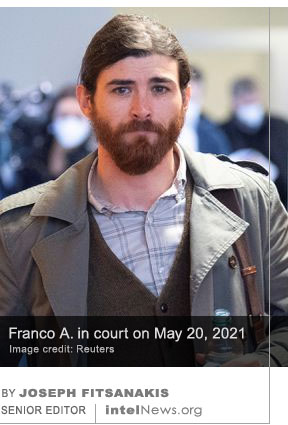 A GERMAN ARMY LIEUTENANT, who led a double life as a fake Syrian refugee, has gone on trial in Frankfurt, accused of planning to kill German politicians so as to provoke anti-Arab sentiment among Germans. The man has been identified by the German media as “Franco A.”, 32, due to strict German privacy laws. He lived in France, where he served in the Franco-German Brigade, an elite military force that combines units from the French and German armies, and is meant to symbolize Franco-German rapprochement in the postwar era.




 surprised observers with its range of weapons, such as long-range missiles with a reach that is in excess of 150 miles. This constitutes a strategic surprise for Israel. So far (May 13, 2021), Hamas has fired about 1,500 missiles at Israel, most of which have been intercepted by Israel’s air defense system called the Iron Dome.




 UNITED STATES JOE BIDEN reportedly told the director of Israel’s external intelligence agency, the Mossad, that Washington has “a long way to go” before rejoining a 2015 agreement aimed at halting Iran’s nuclear ambitions. The meeting between Biden and Mossad director Yossi Cohen reportedly took place last Friday, during Cohen’s visit to Washington last week, to discuss bilateral security issues with a series of American officials. On Thursday Cohen met with a number of Biden administration officials, including Secretary of State Anthony Blinken and Brett McGurk, who is the National Security Council’s Coordinator for the Middle East and North Africa.








Belarussian spies were onboard commercial airliner diverted by force to Minsk
May 25, 2021 by Joseph Fitsanakis 1 Comment
BELARUSSIAN INTELLIGENCE OFFICERS were allegedly onboard a commercial airliner that was en route to Lithuania, but was forcibly diverted to Minsk on Sunday, where a vocal Belarussian dissident was arrested. The dissident is 26-year-old Roman Protasevich, who is known as one of the most outspoken opponents of Belarus’ authoritarian President, Alexander Lukashenko.
Protasevich has been voicing his criticism of Lukashenko’s government on popular social-media outlets, such as Telegram. He has evaded charges of terrorism and incitement to violence in his home country by living in Poland, where he applied for political asylum in 2019. On Sunday, May 23, Protasevich was among the 171 passengers onboard Ryanair flight FR4978 from Athens, Greece, to Vilnius, Lithuania. However, while flying over Belarussian airspace en route to Vilnius, the commercial airliner was confronted by a Belarussian Air Force MiG-29 fighter jet, while the pilots were told by Belarussian ground control that a bomb threat had been issued against the plane.
The airplane was forcibly redirected to Minsk, despite the fact that there were several international airports that were physically closer. As soon as the aircraft landed, officers of the Belarussian State Security Committee, known as the KGB, boarded the plane and apprehended Protasevich. He is now under arrest in Minsk. It later surfaced that President Lukashenko had personally given instructions to the MiG-29 to prevent the Ryanair airplane from exiting Belarussian airspace.
Speaking on the breakfast show of Newstalk, an independent radio station in the Republic of Ireland, Ryanair Chief Executive Officer Michael O’Leary described Sunday’s incident as “a case of state-sponsored hijacking”. He added that according to Ryanair personnel onboard the aircraft, who witnessed the incident, Belarussian KGB officers were “onboard the plane when it took off from Athens” and participated in forcibly arresting Protasevich once the airplane had landed in Minsk.
Protasevich appeared on a video issued by the Belarussian authorities late on Sunday. He is reportedly facing 12 years in prison if convicted of inciting riots. However, he faces the death penalty if convicted of acts of terrorism.
► Author: Joseph Fitsanakis | Date: 25 May 2021 | Permalink
Filed under Expert news and commentary on intelligence, espionage, spies and spying Tagged with aircraft hijackings, Belarus, KGB (Belarus), Roman Protasevich, Ryanair