NSA gives Israel raw intercepts containing US citizens’ data

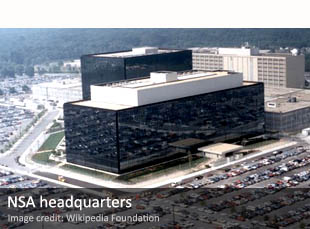
NSA headquartersBy JOSEPH FITSANAKIS | intelNews.org |
The United States National Security Agency (NSA) shares raw intercepted data with Israeli intelligence without first deleting information pertaining to American citizens, according to a leaked document. British newspaper The Guardian published on Wednesday an informal memorandum of understanding between the NSA and the Israel SIGINT National Unit (ISNU). The five-page document was supplied to the newspaper by Edward Snowden, a technical contractor for the NSA who defected to Russia this past summer. It outlines an agreement reached in 2009 between the NSA and the ISNU, under which the American side provides the Israelis with raw intercepts, which often contain telephone and email data belonging to American citizens. The memorandum describes this type intelligence sharing as a “routine” aspect of a broader “SIGINT relationship between the two organizations”. SIGINT refers to signals intelligence, a term used in the intelligence community to describe the interception of communications data or content. Additionally, the document specifically mentions that the data shared with the Israelis is “raw” or “unminimized”, meaning it has not been subjected to the process of extracting and deleting information that identifies US citizens or residents —known as “US persons”. By law, the NSA is not permitted to spy on US persons and is required to ‘minimize’ intercepted data so that the communications of US persons remain private, unless they are absolutely indispensible in understanding a piece of foreign intelligence. The memorandum describes a number of restrictions on the use of this information by Israeli intelligence, stating that the ISNU is forbidden from using it in order to target US persons. It also states that the ISNU must shield the identities of US persons when sharing the information with other Israeli government agencies. Read more of this post

Australian civil servant accused of spying denied access to evidence

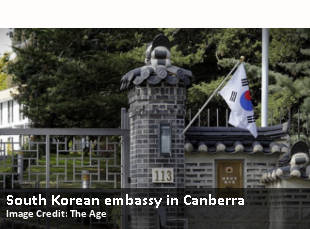
Embassy of South Korea in AustraliaBy IAN ALLEN | intelNews.org |
Australia’s Federal Court has rejected a bid by a senior civil servant to view the evidence the government is using to accuse him of espionage. Until September of 2011, Dr. Yeon Kim was a career civil servant with the Australian Bureau of Agricultural and Resource Economics and Sciences (ABARES). His specialization in international trade policy required a security clearance, which Kim had possessed since 2001. But in 2011, he was sacked and had his security clearance revoked for allegedly holding clandestine meetings with officers of South Korea’s National Intelligence Service (NIS). The Australian government accuses Kim of meeting repeatedly with Hoo-Young Park, an employee of the South Korean embassy in Canberra, who had been declared to the Australian government as an NIS liaison officer. According to court documents, three other NIS officers serving under diplomatic cover in Australia, Bum-Yeon Lee, Sa-Yong Hong, and a third man named Kim, were involved in collecting intelligence on Australian trade secrets. The Australian Security Intelligence Organisation (ASIO), which detained Kim, said that he willingly participated in the “foreign interference” operation by the NIS. For several months now, Kim has been contesting the Australian government’s legal case against him in the Federal Court. His legal team recently requested that the Court annul two certificates issued by the Australian attorney general, designed to bar the defense from accessing evidence against Kim. The certificates were originally submitted by government prosecutors during an earlier Administrative Appeals Tribunal hearing. But the Court declined the request, saying the defense waited too long to challenge the certificates. In issuing the ruling, Justice Lindsay Foster said Kim’s legal team should have requested that the certificates be declined during the original hearing. The judge censured Kim’s defense lawyers for “stand[ing] by and watch[ing] while the certificates were [originally] deployed”, adding that it would undermine the integrity of the legal process to allow the certificates to be challenged at this late stage. Read more of this post
Commission urges probe of plane crash that killed UN secretary general

Dag HammarskjöldBy JOSEPH FITSANAKIS | intelNews.org |
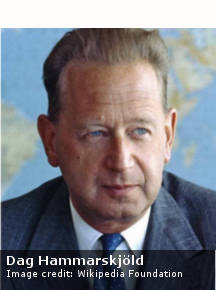
A commission of experts formed to examine the 1961 death of former United Nations Secretary General Dag Hammarskjöld has urged the reopening of an investigation into the airplane crash that killed him. Hammarskjöld died when the Douglas DC-6 transport aircraft that was carrying him crashed in the British-administered territory of Northern Rhodesia (now Zambia). He was on his way to Congo’s mineral-rich Katanga region to meet European-supported chieftains who in 1960 had seceded from the nationalist government of Congolese Prime Minister Patrice Lumumba. Two subsequent investigations into the crash, conducted by the Rhodesian Board of Investigation and the Rhodesian Commission of Inquiry, failed to determine the precise cause of the crash. But an official United Nations Commission of Investigation, conducted in 1962, concluded that deliberate sabotage could not be ruled out as a likely cause of the tragedy. In 2011, a Swedish investigator argued in a report that Hammarskjöld’s plane had been “shot down by an unidentified second plane”. The investigator told The Guardian newspaper that British colonial authorities had deliberately left the sole surviving airplane passenger, American sergeant Harold Julian, to die of his injuries at a makeshift hospital in Northern Rhodesia. In 2012, the Hammarskjöld Inquiry Trust appointed an international team of lawyers to study all available evidence and report to the United Nations. The team, called the Hammarskjöld Commission, is composed of a diplomat and three judges from the Netherlands, the United Kingdom, South Africa, and Sweden. On Monday, they held a press conference to present the findings of their investigation. Its conclusion is that the UN should reopen the 1962 probe into the plane crash, because “significant new evidence” has recently emerged. The Commission report suggests that American intelligence agencies, in particular the National Security Agency (NSA), may hold “crucial evidence” that could help clarify the causes of the crash. Read more of this post

Dissident playwright assassinated with poison pellet 35 years ago

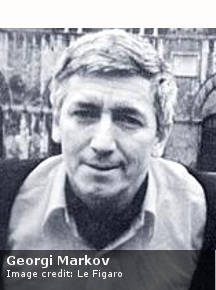
Georgi MarkovBy JOSEPH FITSANAKIS | intelNews.org |
This past Sunday marked 35 years since the assassination with a poisoned umbrella pellet of Bulgarian literary icon and political dissident Georgi Markov. By 1969, when he defected from Bulgaria, Markov had achieved considerable fame in his homeland and was considered one of the Eastern Bloc’s most talented and promising young novelists. Increasingly, however, Markov fraternized with dissident artists and intellectuals, and several of his short stories and plays were disapproved by Bulgarian government censors. In 1969, while visiting his brother in Bologna, Italy, Markov decided to remain in the West. Two years later, he moved to the United Kingdom where he was offered a job at the Bulgarian unit of the BBC World Service. He also did contract work for Germany’s Deutsche Welle and Radio Free Europe, which was funded by the United States government. This prompted the Bulgarian authorities to view Markov’s actions as a defection, and he was sentenced in absentia to nearly seven years in prison by a court in Sofia. But Markov continued his work unabated, earning critical acclaim for his plays in the UK and elsewhere in the West. But on September 7, 1978, the Bulgarian dissident developed a powerful fever and was admitted to a London hospital, where he died 72 hours later, on September 11. Following an autopsy, Britain’s Metropolitan Police concluded that Markov had been poisoned by a micro-engineered pellet made of platinum, which had been filled with ricin. While on his deathbed, Markov had told police investigators that he had felt a sharp pinch on the back of his right thigh while walking across London’s Waterloo Bridge over the River Thames. When he turned around, prompted by the pinching feeling, he said he saw a well-dressed man picking up an umbrella from the ground. The man then quickly crossed the street and hailed a taxi. Since then, Soviet intelligence defectors, including Oleg Gordievsky and Oleg Kalugin, have suggested that Markov’s murder had been planned by the Soviet KGB and carried out by Bulgarian intelligence. Read more of this post

NSA ‘broke, circumvented Internet encryption standards’

NSA headquartersBy IAN ALLEN | intelNews.org |

The United States National Security Agency (NSA) has been able to crack or get around basic encryption standards used daily by hundreds of millions of Internet users, according to newly leaked documents. The New York Times said on Friday that it was in possession of documents that prove that the NSA is not restrained by universal encryption standards used in the US and abroad. The NSA, which is America’s largest intelligence agency, and is tasked by the US government with intercepting electronic communications worldwide, is now able to routinely circumvent Secure Sockets Layer or virtual private networks, as well as encryption protection standards used on fourth-generation cell phones. It therefore has instant access to the content of billions of encrypted messages exchanged by users of some of the Internet’s most popular email companies, including Gmail, Hotmail, Yahoo and Facebook. The paper said it obtained the documents from Edward Snowden, a technical contractor for the NSA who defected to Russia this past summer. They include internal NSA memoranda that suggest the NSA deployed specially built supercomputers to break Internet encryption standards. In other cases, the Agency worked with selected companies and convinced them to “build entry points into their products”. The multi-billion effort was apparently launched by the NSA in the early 2000s, soon after the US government lost a lengthy battle with the communications industry centering on the so-called ‘clipper chip’. Read more of this post

News you may have missed #850 (Syria edition)

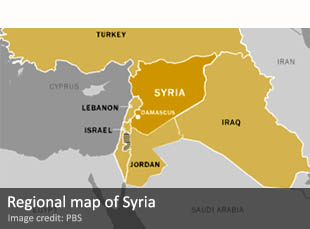
Regional map of SyriaBy IAN ALLEN | intelNews.org |

►►FBI sharpens scrutiny of Syrians in US. The FBI has increased its surveillance of Syrians inside the United States in response to concerns that a military strike against the government of President Bashar al-Assad could lead to terrorist attacks inside the US or against American allies and interests abroad. The US government has also taken the unusual step of warning federal agencies and private companies that American military action in Syria could spur cyberattacks, the officials said. There were no such alerts before previous military operations, like the one against Libya in 2011.
►►French spies provide details Syrian chemical weapons program. As Congress debates whether to authorize a military strike on Syria, the French government has released its declassified intelligence report on the August 21 chemical weapons attack in the eastern Damascus suburbs. While the American report focuses solely on the most recent attack, the French provide a comprehensive look at the nature of the Syrian chemical weapons program. Also, while US officials have conceded that they don’t know if Assad himself ordered the use of chemical weapons, the French assessment rebuts claims that the August 21 attack could have been the work of a rogue officer.
►►Ex-CIA WMD Counterterrorism Unit chief on Syria: “We cannot afford […] miscalculations in regard to Syria. We will launch our missiles and drop our bombs. Then we will announce the end of active operations. That will not signal the end of the war. It will signal its beginning […]. Assad and his Iranian and Hezbollah friends will begin to respond. They will do so on their timetable and only where they perceive the odds to be in their favor. Embassies will be struck. Hostages will be taken. American and Western tourists will be slaughtered. If the opportunity presents itself, we may even feel the impact here in the United States with attacks on prominent landmarks and public places”.

US spy agencies probed job seekers with links to al-Qaeda

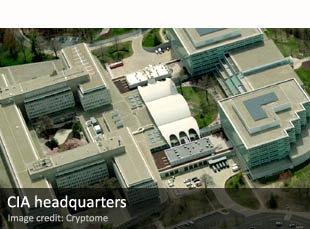
CIA headquartersBy JOSEPH FITSANAKIS | intelNews.org |
One in five applicants for jobs in American intelligence agencies, who were rejected due to questionable backgrounds, were found to have connections with foreign intelligence or militant groups, including al-Qaeda.  This is revealed in an internal document provided to The Washington Post by American defector Edward Snowden. Snowden, a former technical expert for the Central Intelligence Agency (CIA) and the National Security Agency (NSA), is currently living in Russia, where he has been granted political asylum. Last week, he gave The Post a top-secret document containing the 2012 budget summary for the US National Intelligence Program. Among other things, the document reveals that individuals with links to what the United States Intelligence Community terms “hostile intelligence”, or foreign terrorist organizations, have sought to obtain intelligence-related jobs in the US. According to the paper, roughly one out of every five job seekers at the CIA,  whose applications were rejected by the Agency due to suspicious backgrounds, had “significant terrorist and/or hostile intelligence connections”. Such connections allegedly included links with Lebanese Hezbollah, Islamic Hamas, as well as various al-Qaeda affiliates, all of which are on the US State Department’s list of foreign terrorist organizations. The Post subsequently spoke to a CIA source who argued that the number of applicants found to have ties with militant groups was relatively small. The leaked document also mentions that the NSA has launched a major counterintelligence scheme aimed at uncovering “potentially suspicious or abnormal […] activity” among its employees. Read more of this post

Announcement: Calling All Undergraduate Students of Intelligence

Security and Intelligence Studies JournalBy JOSEPH FITSANAKIS | intelNews.org |
The academic study of security and intelligence used to be seen as a strictly graduate-level preoccupation. Today, however, it is routinely encountered in undergraduate curricula and constitutes one of the fastest growing programs in political science. In response to the rising undergraduate interest in this field of study, the Security and Intelligence Studies program at King University in Bristol, Tennessee, launched The Security and Intelligence Studies Journal last spring. It is the world’s first undergraduate scholarly journal focusing exclusively on themes of intelligence, security, counterterrorism, geopolitics and international relations. The first issue of the SIS Journal was published in May of 2013 and is available on Amazon. It contains some of the finest undergraduate research on the theme: “security challenges in the 21st century”. For its second issue, the SIS Journal calls on interested authors to submit papers of up to 3,000 words in length on the theme: “Al-Qaeda – past, present, future”.

The theme’s elaboration, which can be found on the journal’s website, is as follows: “In less than a quarter of a century, al-Qaeda has grown from a small administrative unit in the Hindu Kush Mountains to a leading global agent of Sunni militancy. The history of this enigmatic organization is replete with unpredictable twists and turns that continue to mystify scholars and counterterrorism experts alike. During the last decade, the demise of central al-Qaeda figures, including its founder and Emir, Osama bin Laden, have prompted some to proclaim the organization extinct. Others point to the rise of al-Qaeda-inspired franchise groups in the Arabian Peninsula and parts of Africa, as well as lone-wolf terrorist acts around the world, in arguing that al-Qaeda’s ideology is far from obsolete. The Security and Intelligence Studies Journal calls on interested authors to explore various aspects of al-Qaeda’s past, present, or future, in an effort to shed scholarly light on one of the world’s most mysterious and elusive militant groups”.

The deadline for submissions of relevant scholarly papers of up to 3,000 words in length has been set for October 20, 2013. The SIS Journal editors encourage undergraduate students from around the world with a serious scholarly interest in security and intelligence to contact the journal by visiting its website or emailing the editors at kcsis@king.edu, to express their interest in submitting a paper. Collaborative works are welcome. We also kindly ask academics to forward this call for papers to their undergraduate students.

Snowden exposes ‘unprecedented’ US intelligence budget details

Report coverBy JOSEPH FITSANAKIS | intelNews.org |
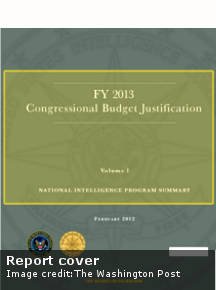
In what experts call an unprecedented move, The Washington Post has published excerpts from the classified United States intelligence budget, obtained from American defector Edward Snowden. Snowden, a former technical expert for the Central Intelligence Agency (CIA) and the National Security Agency (NSA), is currently in Russia, where he has been granted political asylum. He gave The Washington Post a top-secret document containing the 2012 budget summary for the US National Intelligence Program. A new version of this document is produced each year by the United States Intelligence Community (IC). It provides Congressional intelligence committees with a detailed justification for the funds requested by the IC, while highlighting the objectives, priorities, successes and failures of American intelligence agencies. The Post published several charts and tables from the document, which show that the US intelligence complex is currently sustained at a financial level that exceeds that reached at any point during the Cold War. Moreover, funding for the IC appears to have doubled since 2001 and is up by a quarter since 2006. Perhaps the most unexpected feature in the leaked document centers on the revelation that funding for the CIA is 50 percent higher than that of the NSA, which had long been seen by outsiders as the best-funded American intelligence agency. It appears, however, that the NSA, which specializes in communications interception, and is by far the largest American intelligence agency, received just over $10 billion last year, way below the $15 billion given to the CIA. The latter’s budget also exceeded that of the National Reconnaissance Office, a highly technical and very expensive government agency that maintains America’s spy satellites. In the words of The Post, the CIA’s requested budget “vastly exceeds outside estimates” and represents in excess of a quarter of the entire US intelligence budget. Another interesting revelation is that the US IC places Israel alongside Cuba, China, Russia and Iran, as a “priority target” when it comes to counterintelligence —meaning efforts to prevent these countries from spying on the US. Read more of this post

Western spy agencies tapped major undersea fiber optic cable

SEA-ME-WE 3 networkBy IAN ALLEN | intelNews.org |

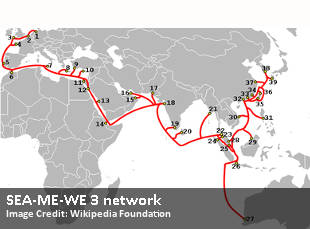
Information obtained by a major German newspaper appears to show that an alliance of Western and Asian intelligence agencies has managed to tap into one of the world’s major undersea telecommunications cables, which facilitates worldwide communication between Europe, Asia and the Middle East. Munich-based Süddeutsche Zeitung, Germany’s largest broadsheet newspaper, claimed on Wednesday that Britain’s General Communications Headquarters (GCHQ) has been leading the ambitious interception effort. The GCHQ is Britain’s signals intelligence agency, tasked by the British government with intercepting communications from around the world. According to the Süddeutsche Zeitung, the effort is supported by the National Security Agency (NSA), which is GCHQ’s American equivalent. The paper cited American defector Edward Snowden as the source of the information. Snowden was a technical contractor for the NSA before he defected to Russia this past summer, where he has now been offered political asylum. The cable, codenamed SEA-ME-WE-3, is considered one of the world’s primary undersea fiber optic conduit. Completed in 2000, it is the longest fiber optic cable installation in the world. It runs from the northern German coast to the Straits of Gibraltar, and from there to Suez, Djibouti and Singapore, before reaching Japan and Australia. It serves as one of the world’s main communications networks that link Asia with the Middle East and Europe. It is owned by an international consortium of telecommunications companies led by France Telecom, China Telecom, British Telecom, Australia’s Telstra Corporation, Singapore’s SingTel, and other corporations from Europe, Asia and the Middle East. Read more of this post

Israeli intelligence ‘critical’ in US case for strikes on Syria

Regional map of SyriaBy JOSEPH FITSANAKIS | intelNews.org |
As the United States prepares to make its case in support of military action against the Syrian government, there are reports that Israeli intelligence will be playing “a central role in cementing” Washington’s argument. The White House indicated this week that it is prepared to launch military strikes against Syrian government targets, following reports that chemical weapons were fired at a Damascus suburb. Western intelligence sources suggest that last week’s chemical weapon strikes killed “hundreds of people” and wounded “at least a thousand”, including many civilians. Interestingly, while the US administration of President Barack Obama is collating the evidence of the Syrian government’s complicity in the attacks, reports from Israel have identified even the Syrian Army unit that allegedly fired the chemical rounds. Late last week, Israel’s Channel 2 claimed that the attack was launched by the 155th Brigade of the Syrian Army’s 4th Armored Division, which is known to be commanded by Maher al-Assad, brother of Syrian President Bashar al-Assad. German media reports suggest that the source of the claim was Unit 8200, the electronic interception division of the Israel Defense Forces (IDF). It is believed that the IDF has in its possession intercepted conversations between senior Syrian military commanders allegedly discussing last week’s chemical attack. Most analysts appear confident that Israel would play no visible part in a possible US-led military strike on Syria. But many senior Israeli cabinet ministers are voicing strong support for direct Western military involvement in the Syrian civil war. On Tuesday, Naftali Bennett, Israel’s Economy and Commerce Minister, said the time for intervention had come: “it cannot be that less than 100 kilometers from Israel, children are being gassed to death and we let the world remain silent and ignore it”, he told reporters. Read more of this post

CIA shuts down office that declassifies historical materials

CIA headquartersBy JOSEPH FITSANAKIS | intelNews.org |
The division of the United States Central Intelligence Agency that is responsible for weeding through and declassifying historical materials from the Agency’s archives is to close due to the sequester budget cuts. The CIA’s Historical Collections Division has been at the source of some of the most sensational declassification of American intelligence material in recent years, spanning several decades of postwar history. But it has now been disbanded due to budget cuts associated with so-called sequester. The widespread cuts were automatically imposed after the two political parties in Congress failed to compromise last year on the Federal budget. The sequester is an across-the-board budget reduction that affects every single agency or office operating under the US government. It is believed that the CIA dealt with the cuts by terminating an unknown number of agreements with outside contractors, some of whom were responsible for the declassification of historical documents. The Los Angeles Times, which reported on the story, quoted CIA spokesman Edward Price, who told journalists last week that the Historical Collections Division had been “moved into a larger unit” within the Agency in order to “create efficiencies”. He identified that unit as the CIA’s Office of the Chief Information Officer, whose Information Management Services handle all Freedom of Information Act requests from the public. Price assured reporters that the CIA remained faithful to declassifying historical material, which it described as part of its “public interest mission”. But The Times quoted several scholars who said that the disbandment of the CIA’s Historical Collections Division will almost certainly result in a reduced number of public disclosures. Read more of this post

NSA operates ‘secret collection program’ out of US embassies

NSA headquartersBy JOSEPH FITSANAKIS | intelNews.org |
Documents leaked by American intelligence defector Edward Snowden point to the existence of a sizable signals intelligence collection program operating out of dozens of United States embassies and consulates located around the world. The documents, given by Snowden to German newsmagazine Der Spiegel, contain details of a monitoring program known as the Special Collection Service (SCS), which appears to operate under the auspices of the National Security Agency (NSA). The NSA is America’s largest intelligence agency —it is bigger than the CIA and the FBI combined— and is tasked by the US government with intercepting electronic communications worldwide. Snowden was a technical contractor for the NSA before he defected to Russia this past summer, where he was offered political asylum. Der Spiegel says that Snowden’s documents point to the existence of the SCS, which allegedly operates covert listening posts in over 80 American embassies and consulates worldwide. These listening posts operate clandestinely, without the knowledge or permission of the host countries. The German newsmagazine identifies the United Nations (UN) headquarters in New York as being among the SCS’s principal listening targets. In the summer of 2012, says Spiegel, an SCS operation managed to compromise the UN headquarters’ internal video conferencing system, by breaking the encryption used to secure the communications of resident diplomats. One NSA document seen by Spiegel hails the “dramatic improvement of data [collected] from video teleconferencing and the ability to decrypt the traffic”. It goes on to state that intercepted communication exchanges rose from 12 to nearly 500 within three weeks following the SCS penetration. Read more of this post

US goes after schools that teach how to beat polygraph tests

Polygraph examinationBy IAN ALLEN | intelNews.org |
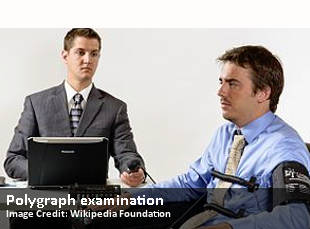
The United States government has launched an extensive criminal investigation of companies and individuals who coach job applicants on how to deceive polygraph examiners. It is believed that the government administers about 70,000 polygraph tests a year to candidates seeking security-related jobs, or to employees who wish to maintain their security clearances. The significance of the tests, which can sometimes make or break a security or intelligence employee’s career, have given rise to the phenomenon of polygraph coaches. There are several dozen companies and individual instructors in the US, who claim to be able to teach people how to pass polygraph examinations. They train test-takers in methods such as controlling their breathing, tensing and relaxing their muscles, focusing their thoughts, or biting their tongue, in order to skew the results of the test in their favor. In the past, government agencies have largely ignored these instruction techniques, claiming that there is no proof they actually work (critics question whether polygraph tests themselves work, pointing to the fact that they are rarely permissible in court). But the US government’s attitude to these techniques appears to be changing, judging by a criminal investigation that was recently launched against polygraph coaches. The government has refused to acknowledge the existence of the investigation, but McClatchy newspapers said last week that its existence had been confirmed by “several people familiar” with the probe. Read more of this post

Analyst who spied on US for Israel speaks out for first time

Jonathan PollardBy JOSEPH FITSANAKIS | intelNews.org |
A convicted American spy, who is serving a life sentence for betraying American secrets to Israel in the 1980s, has broken his 28-year-long silence by penning an article in an Israeli newspaper. Jonathan Jay Pollard was a United States Navy intelligence analyst who spied for Israel in exchange for money from 1984 until his arrest in 1986. Many in US counterintelligence consider him one of the most damaging double spies in American history. But he is widely viewed as a hero in Israel, where many conservative Israelis, as well as pro-Israel Americans, are actively pressuring the US administration of President Barack Obama to release him. In 1998, after many years of official denials, Israel publicly admitted that Pollard had operated as an Israeli agent in the United States. Pollard, who acquired Israeli citizenship in 1995, has so far served 28 years of a life sentence in a US prison. Throughout his incarceration, Pollard has remained silent. But he broke his silence on August 16, by writing an editorial for conservative Israeli newspaper The Jerusalem Post. In it, he derides Israel for freeing 26 Palestinian prisoners, who were convicted of violent actions against Israel, ahead of peace talks with the Palestinian Authority. Pollard claims that most Israelis are against the move to free the prisoners, and describes Israel as a “strange kind of democracy that pays no heed whatsoever to the will of the people”. The jailed spy adds that “Israel is the only country in the world ever to voluntarily expel its own citizens from chunks of its homeland in order to hand over the land to its enemies”. He also reveals his displeasure with his own fate by claiming that Israel “holds unenviable world records for betraying those who serve the state”. Read more of this post