Iran’s coronavirus crisis exacerbates internal struggle between government and IRGC
May 15, 2020 Leave a comment
 A tense struggle is unfolding in Iran between the country’s civilian leaders and the parallel state of the Islamic Revolutionary Guard Corps. The two entities are fighting about who will control the national response to COVID-19, according to sources. The outbreak of the pandemic in Iran followed closely that of China. Today the Iranian government claims the disease has infected no more than 115,000 people and killed fewer than 7,000. But these numbers seem low for a country of 82 million, and many observers dispute them.
The secrecy with which the government is treating the coronavirus epidemic may be masking an increasingly tense turf war between Iran’s civilian leaders, led by President Hassan Rouhani, and the IRGC. The latter is controlled by Iran’s Supreme Leader, Ali Khamenei. Iran watchers describe the IRGC as a ‘praetorian guard’ whose members possess immense power and often wealth. Today the IRGC is a military force with a command structure that is distinct from that of Iran’s regular Armed Forces. It maintains its own army, navy and air force, has its own paramilitary and political protection units, and is in charge of Iran’s nuclear program.
The IRGC has seen its income fall drastically in the past two years, partly due to the continuing economic pressure that Iran is facing from strict sanctions imposed on it by the United States. The effects of the dramatic reduction in the value of Iran’s currency —down nearly 2/3 since 2018— have only been exacerbated by the monumental drop in global oil prices, which has practically decimated Tehran’s main source of foreign income.
According to sources, Khamenei and the IRGC forced the country’s civilian leadership to re-open the economy last month, fearing an absolute economic collapse. But this only resulted in a dramatic uptick in COVID-19 cases in nearly every region of the country. The IRGC is now reportedly trying to take control of Iran’s civilian healthcare system, in an effort to prevent the government from disclosing the extent of the re-emergence of the virus throughout the country.
Meanwhile, the IRGC’s prestige has suffered greatly this year, following the accidental shoot-down of a Ukrainian civilian airliner over Tehran in January, which killed nearly 180 people, most of them Iranians. Last week, the IRGC was believed to behind a missile test that went terribly wrong, resulting in the destruction of an Iranian navy ship that killed as many as 31 sailors. These fatal errors are for the time being giving President Rouhani the right to question the IRGC’s competence and resist giving away his administration’s control of the national response to COVID-19. The turf war continues to intensify, however, and it is difficult to forecast which side will prevail.
► Author: Joseph Fitsanakis | Date: 15 May 2020 | Permalink
 •
•  News media in the Czech Republic have named a Russian diplomat who allegedly transported poison to Prague last month, in what officials claim was a foiled plot to kill as many as three high-profile Czech politicians. Late last April, the Czech weekly investigative magazine Respekt
  A so-called ‘red notice’ has been issued by INTERPOL for Anne Sacoolas, an alleged former employee of the United States Central Intelligence Agency, who is accused of causing an accident that killed a man in the United Kingdom last year. The accident victim is Harry Dunn, 19, who died on August 27, 2019, after a collision with a automobile that was being driven by Sacoolas. British police have said that Sacoolas’ car was being driven on the wrong side of the street at the time of the accident.
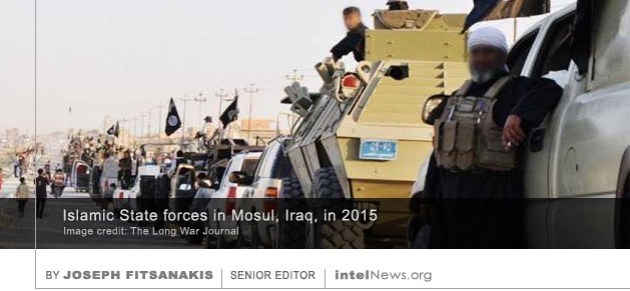 Iraq is currently witnessing the largest resurgence of the Islamic State since December of 2017, when the Iraqi government declared it had defeated the group, according to local and international observers. The Sunni militant group, which became known as the Islamic State of Iraq and Syria (ISIS), is exploiting a moment of opportunity, as Iraqi security forces, Shia militias and American troops are essentially sheltering in place to avoid the effects of COVID-19.
 France’s primary external intelligence agency has expressed frustration with the overall poor quality of job applicants, as it tries to expand its staff by 20 percent in the coming years. The Direction Générale de la Sécurité Extérieure, known as DGSE, is France’s equivalent to the United States’ Central Intelligence Agency and the United Kingdom’s Secret Intelligence Service, or MI6. It is tasked with procuring secret political, military and economic information from foreign targets.
 Venezuelan state television aired on Wednesday an interview with one of two Americans facing charges of having participated in a failed armed plot to overthrow the government of President Nicolás Maduro. Venezuelan media have been referring to the failed plot as “enfrentamiento en El Junquito” (“El Junquito raid”), or “Operación GEDEÓN”.
 The United States could end all sensitive intelligence operations and withdraw its intelligence assets from the United Kingdom if a leading Chinese company is hired to upgrade the country’s telecommunications network. The British government has come under
  Spy agencies from every country are participating in a worldwide competition to develop a vaccine for the COVID-19 pandemic, by protecting their own biomedical secrets while trying to steal other nations’ research. Much like frantic efforts to secure personal protective equipment like masks and gloves, ongoing research to develop a vaccine against COVID-19 appears to be taking the form of a competition between nations. The country that first develops a successful vaccine to combat the epidemic is likely to emerge as a major power-player in a post-coronavirus world.
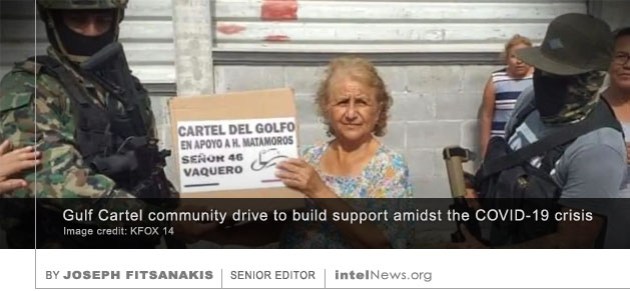 Drug cartels are organizing sophisticated ‘care package’ drives throughout Mexico in an attempt to build political capital and solidify their community support. Nearly every drug cartel in Mexico is organizing its own handout distribution
 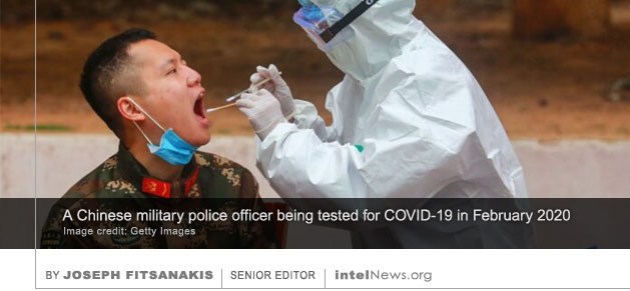 In a rare public statement, the Intelligence Community of the United States has said that the novel coronavirus “was not manmade or genetically modified”. The statement was issued on Thursday by the Office of the Director of National Intelligence, which manages the US National Intelligence Program and whose director serves as the country’s most senior intelligence officer.
 Terrorism experts have issued warnings that the Islamic State may be exploiting the global instability caused by the novel coronavirus pandemic to stage a worldwide resurgence. Indeed, there are signs that Islamic State activity has been intensifying in Asia, Africa, the Middle East and even Europe, in recent days.
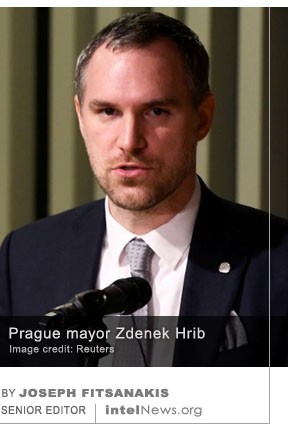 The Russian government has strongly denied accusations in the Czech media that it dispatched an assassin to Prague to kill two leading Czech politicians. The denial was issued by the Kremlin a day after Prague mayor Zdeněk Hřib said he had been placed under 24/7 police protection because of fears his life could be in danger.
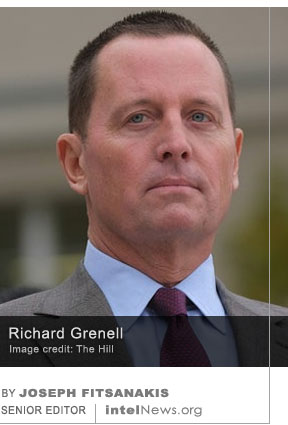 The administration of United States President Donald Trump is considering the possibility of limiting or terminating the sharing of intelligence with countries around the world that criminalize homosexuality. The move is being led by Richard Grenell, an American diplomat, civil servant and media consultant, who was appointed by the White House as acting Director of National Intelligence in February. This makes Grenell the most senior intelligence official in the US.






 intelNews.org
News you may have missed #897
May 16, 2020 by Ian Allen Leave a comment
• US security clearances become more lucrative amid pandemic. Security clearances will almost certainly become an even more valuable credential as the US economy transforms amid the COVID-19 pandemic. While well over 30 million Americans have filed initial unemployment claims since mid-March, those employed in jobs that require a security clearance remain largely insulated from the economic volatility caused by the pandemic. The ever-increasing desirability of a security clearance has raised the stakes for those looking to gain or maintain a clearance in these economically uncertain times.
• Michigan cancels legislative session to avoid armed protests. Michigan closed down its capitol in Lansing on Thursday and canceled its legislative session rather than face the possibility of an armed protest and death threats against Democratic Governor Gretchen Whitmer. The gathering, meant to advocate opening the state for business despite the coronavirus pandemic, followed one April 30 that resulted in pictures of protesters clad in military-style gear and carrying long guns crowding the statehouse. They confronted police and taunted lawmakers. The debate grew more tense in recent days as some lawmakers read about threats to the governor’s life on social media, which were published in the Detroit Metro Times.
Author: Ian Allen | Date: 16 May 2020 | Permalink
Filed under Expert news and commentary on intelligence, espionage, spies and spying Tagged with Chinese space program, Coronavirus, COVID-19, David Thompson, intelligence recruitment, News, news you may have missed, Russian space program, security clearance, US Space Force