Israeli armed raid in Syria reportedly led to US banning laptops on some flights
November 27, 2017 2 Comments
 A temporary ban issued by United States authorities on laptop computers onboard some commercial flights earlier this year came from a tip by Israeli intelligence, according to a new report. The report was published last week in the American magazine Vanity Fair. It claimed that Israeli commandos carried out a dangerous night-time operation deep inside Syria, in order to acquire physical proof that the Islamic State had built bombs that were not detectable by X-ray screening systems at airports. But some Israeli intelligence officials became infuriated with Donald Trump after the US President allegedly gave Russia background information about the commando operation, according to the article.
The order to temporarily ban electronic devices larger than cellphones was issued by the US government on March 20, 2017. It applied to direct flights to the US departing from a dozen international airports in the Middle East. In June, the New York Times alleged that the ban was aimed at stopping Islamic State operatives from bringing onboard airplanes bombs disguised as laptop batteries. The paper also said that the information about these bombs had been acquired by Israeli government hackers who had penetrated Islamic State computer systems. But now a new report by Vanity Fair claims that Tel Aviv tipped off the Americans following a commando raid deep inside Syrian territory, which acquired physical evidence of the bombs. The magazine alleges that the raid was carried out by the Sayeret Matkal, an elite unit of the Israel Defense Forces, under the supervision of the Mossad, Israel’s external spy agency. Its target was a highly secretive cell of explosives experts, who were led Ibrahim al-Asiri, a Saudi militant who built bombs for the Yemen-based Al-Qaeda in the Arabian Peninsula. The Mossad shared some of the intelligence from that raid with the Central Intelligence Agency, which in turn told President Trump. That led to the decision to ban laptops from selected flights, until X-ray machines at airports were modified to detect the new type of bomb.
The Vanity Fair article repeats earlier claims that President Trump shared intelligence given to him by the Israelis with Russian Foreign Minister Sergei Lavrov and Russian Ambassador to the United States Sergei Kislyak, when he met them in May of this year. According to Israeli sources, Mr. Trump did not tell the Russian officials that Israel was behind the operation. But he allegedly identified the city in Syria where the raid took place, and in doing so placed the life of an Israeli human asset at risk, according to some. The Israeli government will not comment on these allegations. Additionally, Vanity Fair said that one “former Mossad officer with knowledge of the operation and its aftermath” would not say whether the asset in question had been safely exfiltrated from Syria or even whether he or she was still alive.
► Author: Joseph Fitsanakis | Date: 27 November 2017 | Permalink
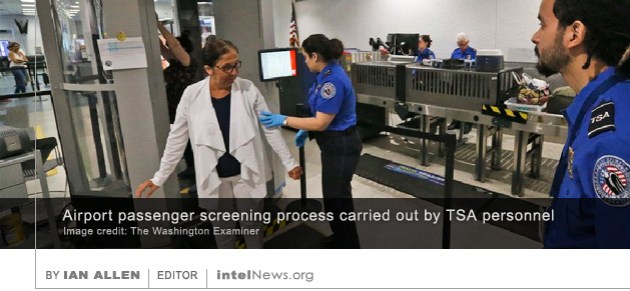 Attempts by undercover investigators to smuggle weapons, explosives and contraband aboard American passenger flights were successful between 70 and 80 percent of the time in the past year, according to reports. The results of the investigations were revealed in Congress behind closed doors on Wednesday of last week, prompting lawmakers to severely criticize the United States Transportation Security Administration (TSA). The TSA was founded in November 2001 in direct response to the tragic events of September 11 of that year. It is primarily concerned with air travel and is responsible for ensuring the safety of the traveling public across the US.







 intelNews.org
Citing security concerns, Lithuania bans Chinese airport baggage scanners
February 18, 2021 by Joseph Fitsanakis 1 Comment
Since its founding in 1997, Nuctech has become a major supplier of security-screening products and equipment in airports in Asia, Europe and Africa. Early in 2020, the company was awarded a competitive bid to install baggage-scanning equipment at several major Lithuanian airports, including those in Vilnius, Kaunas and Palanga. But in January of this year, it was reported that the United States government had approach several European governments with the aim of convincing them to drop Nuctech on security grounds. The Americans were claiming that passenger data collected by Nuctech could potentially be shared with the Chinese intelligence services, under a 2017 law that obligates state-owned companies to contribute to national intelligence gathering.
On Wednesday, following a closed-door meeting of the Lithuanian cabinet, a spokesman for the prime minister’s office announced that the government had “decided that the contract [with Nuctech] does not meet the interests of national security”. Earlier on Wednesday, a local news agency had quoted the United States ambassador to Lithuania, Robert Gilchrist, as saying that Washington welcomed the fact that Lithuania was reconsidering Nuctech’s role in airport security. Late on Wednesday, a Nuctech representative said the company failed to understand the Lithuanian government’s reasoning for canceling the agreement, since the scanning equipment used in Lithuanian airports would be manufactured in Poland, rather than in China.
► Author: Joseph Fitsanakis | Date: 18 February 2021 | Permalink
Filed under Expert news and commentary on intelligence, espionage, spies and spying Tagged with airport security, China, Lithuania, News, Nuctech