Year in review: The 10 biggest spy-related stories of 2016, part I

End of Year ReviewSince 2008, when we launched intelNews, it has been our end-of-the-year tradition to take a look back and highlight what we think were the most important intelligence-related stories of the past 12 months. In anticipation of what 2017 may bring in this highly volatile field, we present you with our selection of the top spy stories of 2016. They are listed below in reverse order of significance. This is part one in a two-part series; part two is here.
10. Kim Philby videotaped lecture surfaces in Germany. While working as a senior member of British intelligence, Harold Adrian Russell Philby, known as ‘Kim’ to his friends, spied on behalf of the Soviet NKVD and KGB from the early 1930s until 1963, when he secretly defected to the USSR from his home in Lebanon. Philby’s defection shocked Western intelligence and is seen as one of the most dramatic moments of the Cold War. In April of this year, the BBC found a videotaped lecture by Philby in the archives of the BStU, the Federal Commissioner for Stasi Records in Germany. During the one-hour lecture, filmed in 1981, Philby addresses a select audience of operations officers from the Stasi, the Ministry of State Security of the former East Germany. Excerpts were aired publicly for the first time.

9. Britain’s MI6 to increase in size by 40% by 2020. It was revealed in July that, according to satellite images, the headquarters of the Russian Foreign Intelligence Service, known as SVR, has doubled, and possibly tripled, in size in the past nine years. So it probably shouldn’t come as a surprise that the British government plans to implement a 40 percent increase in personnel numbers for MI6 over the next four years. The agency, which is formally known as the Secret Intelligence Service, currently employs about 2,500 people. But that number will rise to approximately 3,500 by 2020. Experts agree that we are witnessing the most significant growth in the size of state intelligence agencies since the end of the Cold War.

8. Israel’s Mossad has a successful year, allegedly. It has been quite a year for Israel’s primary external intelligence agency, the Mossad. In 2015, the secretive organization got a new director, Yossi Cohen. Since that time, it has emerged that Bassam Mahmoud Baraka, a senior member of the military wing of Hamas, the Palestinian militant group that governs the Gaza Strip, has defected to Israel. Mossad is also believed to be behind the killing of Mohamed Zaouari, a senior aviation engineer who headed Hamas’ unmanned aerial vehicle program. Zaouari was shot dead outside his home in Tunisia earlier this month, by a group of assailants using gun silencers.

7. Information points to previously unknown ISIS spy agency. According to The New York Times, the Islamic State has set up a secretive intelligence agency whose task is to set up sleeper cells abroad and has already sent “hundreds of operatives” to Europe and Asia. The ISIS intelligence agency goes by the name Emni and appears to be a multilevel organization that includes domestic and external operational components. Emni’s external unit is tasked with conducting terrorist operations abroad. These are the responsibility of several lieutenants, who are permitted to recruit the most capable members of ISIS from around the world.

6. South Korea announces most high-profile defection from North since Korean War. An announcement issued by the South Korean government in April said it had given political asylum to a colonel in the Korean People’s Army, who worked for the Reconnaissance General Bureau, a military-intelligence agency that resembles the US Central Intelligence Agency’s Special Activities Division. The unnamed man is the most high profile defector to the South since the end of the Korean War in 1953, according to authorities in Seoul. Meanwhile, Thae Yong-Ho, the second-in-command at the North Korean embassy in the United Kingdom, also defected with his wife and children in August, and was given political asylum in South Korea.

This is part one in a two-part series; part two is here.

Author: Joseph Fitsanakis and Ian Allen | Date: 29 December 2016 | Permalink

Analysis: Boko Haram insurgency far from over, despite Nigerian claims

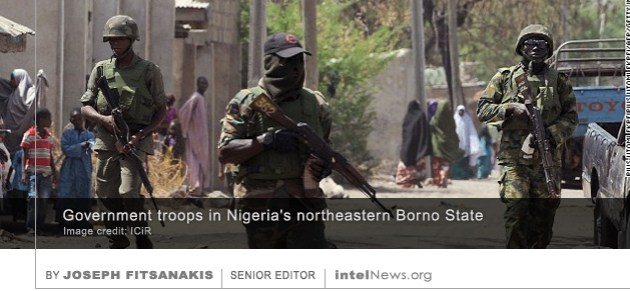
NigeriaOn Saturday, Nigerian President Muhammadu Buhari made a statement announcing that the country’s military had delivered a “final crushing” on Boko Haram’s “last enclave” deep in the Sambisa Forest. He then congratulated the Nigerian troops for “finally entering [the forest] and crushing the remnants of the Boko Haram insurgents”. This is not the first time that a Nigerian head of state announces the “final crushing” of the Boko Haram insurgency. Even though Boko Haram has suffered significant territorial losses since 2014, the armed conflict that has destabilized the entire Lake Chad region for nearly a decade is far from over, and Boko Haram may even bounce back, just as it has done in the past.

Boko Haram emerged as a public-pressure group in predominantly Muslim northeastern Nigeria in 2003, stating multiple grievances against the corruption and nepotism of Nigeria’s ruling elite. In 2009, the group launched an armed insurgency against the government, with the stated aim of establishing an Islamic state ruled by sharia (Quranic law) in Nigeria’s northeast. In 2015, Boko Haram’s leader, Abubakar Shekau, pledged the group’s allegiance to the Islamic State of Iraq and Syria and announced the establishment of “Islamic State West Africa Province”. Since then, the group has continued to fight the Nigerian military in a seven-year war that has killed more than 15,000 people and displaced two million more. The United Nations estimates that at least 14 million people in the Lake Chad region have been affected by the war and in immediate need of significant humanitarian assistance.

By early 2014, Boko Haram had managed to drive out all Nigerian government presence from the country’s northeastern Borno state and control an area of approximately 12,000 sq. mi. At that time, however, the Nigerian military, in association with Chadian and Nigerien forces, launched Operation LAFIYA DOLE, with the aim of recapturing Boko Haram’s territory. The operation involves thousands of Nigerian, Chadian and Nigerien ground forces, as well as airplanes and even construction crews, who built dirt roads leading deep into the Sambisa Forest in search of Boko Haram’s camps. As government forces have been advancing on all sides, Boko Haram fighters have retreated deeper into the 500-sq. mi. forest. On Saturday, the Nigerian president announced that government troops sacked Boko Haram’s “Camp Zero” and that the insurgents were desperately fleeing into the surrounding areas. There was no word about the fate of Shekau, the group’s leader. Read more of this post

Analysis: Russia did meddle in US election, but its goal was not to elect Trump

Trump 2016No person familiar with the theory and practice of intelligence will be shocked by allegations that Russia interfered in the recent American presidential election. On the contrary, the claim will strike experienced observers as a textbook case of covert operation —an intelligence activity designed to influence foreign political, military or economic developments. Far from being physically violent, most covert operations involve actions like secretly funding political parties, planting misinformation or propaganda in foreign media outlets and —in more extreme cases— bribing or extorting key political actors. During the Cold War, hardly a national election took place without attracting the covert attention of the Central Intelligence Agency (CIA) and its Soviet equivalent, the KGB. This practice continues today, as nearly every intelligence agency engages in covert operations of some form or other.
It would thus be extremely unusual and highly uncharacteristic of Russian spy agencies if they did not launch at least a rudimentary covert campaign to target the 2016 US presidential election. To not have done so would mean that the Russian intelligence apparatus failed to abide by its mission statement. Such an eventuality would be unthinkable, especially given the size and importance of the target. It should therefore be presumed that Russian spy agencies, in particular the Foreign Intelligence Service and the Main Intelligence Directorate, engaged in systematic efforts to meddleq-quote in last month’s US election. Indeed, the opposite would be strange.
The view that Russian spy agencies interfered in the US presidential election does not, for the moment, rely on publicly available evidence. The latter remains absent, though it is worth noting that, according to The Washington Post, US intelligence agencies concluded “with high confidence” that Russia meddled in the campaign over many months. It is always wise to treat claims in the media by unnamed “US officials” with some skepticism. But if The Post’s allegation is factual, then the words “with high confidence” are significant. The business of intelligence analysis is one of accuracy and precision. The term “high confidence” is rarely employed, and when it is, it typically denotes an almost indisputable degree of confidence in an analytical conclusion.

That the president-elect chose to automatically dismiss The Post’s allegations by describing them as “ridiculous” and denouncing the CIA in its entirety as “the same people that said Saddam Hussein had weapons of mass destruction” is worrying. It indicates a fundamental misunderstanding of the intelligence profession and its role in executive decision-making. Ideally, the president-elect should have remained silent until he had an opportunity to confer with the CIA and examine the evidence behind the report. Instead, during a Sunday morning interview on Fox News, Trump said simply: “I don’t believe it”. But this has nothing to do with belief. It has to do with facts and data, which he ought to examine before summarily dismissing an entire agency.

What is more, the evidence behind these allegations must be presented to the American people, who were the ultimate targets of the alleged operation. This was not about the two presidential q-quotecandidates. This was about the reputation of the American electoral process. In fact, the primary goal of Russia’s involvement in the US election —which, again, must be presumed— was not to empower a particular candidate, but to weaken the reputation of American political institutions as a whole. Those who claim that the Kremlin tried to promote Trump because the Republican candidate appears to be more favorably disposed toward Russia are wrong. They misunderstand the complex nature of Russian-American relations and underestimate Russian strategy. Moscow understands that its bilateral relationship with Washington rests on a set of longstanding geopolitical variables and does not depend on ephemeral personal relations between individual leaders. Furthermore, the Kremlin views Trump as an inherently unpredictable actor that is not to be trusted. The Russian plan, therefore, was not to help elect Trump. Rather, it was to sow mistrust between American –and by extension Western– civil society and its political institutions. Given the challenges currently being faced by European and American democracy, that is not a far-fetched goal.
The current state of American politics, which is characterized by ugly sectarianism the likes of which have not been witnessed since the Vietnam War, favors Russia’s strategic goals. Many Americans are currently convinced that the president-elect and some of his most senior aides are influenced by Moscow. Instead of actively trying to alleviate these concerns, Trump has now gone on an all-out offensive against the US Intelligence Community while essentially defending Russia. Americans who care about the current state and future of the Republic must be seriously concerned with this picture, regardless of their political affiliation. It may be that the history textbooks of the future will record the Russian meddling in the 2016 US presidential election as one of the most successful covert operations of modern times.

Author: Joseph Fitsanakis | Date: 12 December 2016 | Permalink

Analysis: Turkey’s entry in Syrian war further-complicates a chaotic conflict

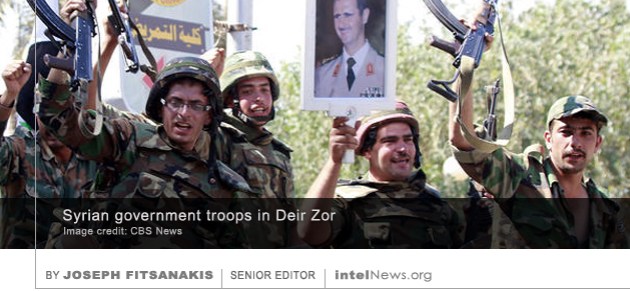
Syrian troopsEver since 2011, when the Syrian Civil War erupted, Turkey has refrained from directly intervening in the conflict, other than to provide material support to opponents of Syrian President Bashar al-Assad. The hope in Ankara was that Islamist and pro-Assad forces would exhaust each other. There is no evidence that Turkey was at any point seriously alarmed about the rise of Sunni militancy in Syria. Instead, the Turkish government of President Recep Tayyip Erdoğan made no secret of its primary concern, which was the rise of Kurdish nationalism in northern Syria.
However, a possible demise of the Islamic State may strengthen Kurdish forces in Syria and Iraq and could leave the al-Assad regime in place in Damascus. That would be the worst possible outcome for Turkey, which has always viewed the Syrian president a direct threat to its national security, surpassed only by Kurdish separatism. In a desperate effort to avoid such an outcome, Turkey is now increasingly intervening in the war. Its current goal is to have a strong say in how the region will look like once the Islamic State has been defeated.

With the exception of some pro-Turkish rebels, such as the Syrian Turkmen Brigades, who openly welcome Ankara’s intervention, no rebel factions in Syria are especially elated by Turkey’s entry in the war. Most recognize that the sole reason for Turkey’s intervention is the protection of its own national interest, which centers on preventing a rise of an independent Kurdish state —either official or de facto— in northern Syria.

Turkey’s involvement in the Syrian war will further complicate the conflict and is likely to prolong it. The more international actors are involved in the war, the more convoluted it gets and the longer it will take for it to end. Currently we have the Syrian government, various Sunni rebel forces, the Islamic State, Russia, the United States, Iran, Saudi Arabia, the Kurds, and several European powers involved in the war. The last thing this conflict needs is yet another foreign intervention, no matter where it comes from.

Moreover, Ankara’s overall role in the Syrian conflict has been inconsistent, as the country has at times sharply distanced itself from both Russian-led and American-led efforts in the region. President Erdogan’s policy on Syria —as on most other matters— has been spasmodic and haphazard, and has been primarily shaped by domestic concerns, as Turkey’s political strongman tries to solidify its rule inside the country. Consequently neither Moscow nor Washington have much faith in the reliance of the Turkish military contribution to the conflict.

The election of Donald Trump in the United States could further-complicate the regional balance of power in the Middle East and Turkey’s role in it. If a rapid rapprochement takes place between Washington and Moscow in 2017, Turkey will feel increasingly uneasy about its regional role. The Kurds, who have been working closely with Russia in Syria and with America in Iraq, will expect to be rewarded and compensated once the dust settles in the region. There have been voices in Moscow and Washington calling for the establishment of a de facto independent Kurdish state in northern Syria. If that happens, it will signal a massive setback for Turkey’s foreign policy and negatively affect its relations with Russia and possibly the United States.

Over a million people have now died in the Syrian civil war. Millions more have been displaced internally and abroad. Things could get immeasurably worse if Russian-led and American-led forces launch all-out attacks in Aleppo and Mosul respectively. There is no reason to believe at this point that the Islamic State and other rebel groups will abandon these cities, where over a million people remain trapped between the warring sides. We could be seeing the largest slaughter of civilians since World War II. At that point, there will be little that Ankara or anyone else can do to restore stability in that desperately troubled region.

Author: Joseph Fitsanakis | Date: 30 November 2016 | Permalink

Comment: Far-right militancy just as dangerous as Islamist extremism

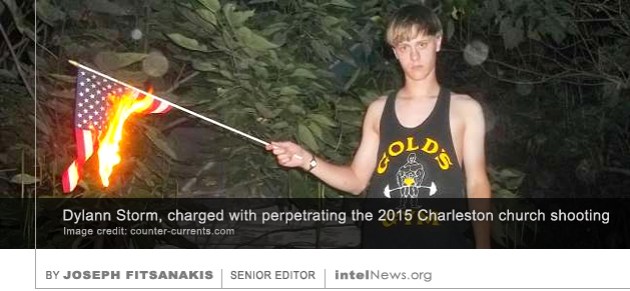
Dylann RoofMany in the United States associate terrorism with contemporary versions of militant Islam. The data, however, tells a different story: since 2002, domestic extremists who hold far-right ideologies have struck more often and have killed more people than Islamic-inspired radicals. This blog has argued in the past that American counterterrorism policy creates a security vacuum by over-concentrating on Islamic-inspired radicals and largely ignoring domestic terrorist groups. In an insightful article published earlier this year in Newsweek magazine, Kurt Eichenwald, a 20-year veteran of investigative reporting and author of The Informant, argues that far-right radicalism is a bigger threat to American security than Islamic militancy, including the Islamic State.
Eichenwald cites a report by Duke University’s Triangle Center on Terrorism and Homeland Security, which was based on surveys from 382 law enforcement groups across the US. The report, published in June of last year, argues that American “law enforcement agencies […] consider anti-government violent extremists, not radicalized Muslims, to be the most severe threat of political violence” they face. He also points to increasing incidents of surveillance of Muslim schools, religious and community centers in nearly a dozen states by members of far-right militia groups for what informants describe as “operational purposes”.

American counterterrorism specialists understand that the term “far-right militancy” encompasses thousands of groups of various sizes and capabilities, which are both wildly diverse and constantly evolving, says Eichenwald. Most experts separate the members of these groups into three distinct categories, namely violent racists, anti-federalist (or anti-government) radicals, and religious fundamentalists. These factions, which include dozens of sub-factions, do not usually work together and even have adversarial relations with each other. Violent racists operate as members of groups such as the Ku Klux Klan in mostly rural and semi-urban settings. In urban environments, neo-Nazi and skinhead groups are more prevalent than the KKK. Anti-government radicals join armed militias that espouse various ideologies representing the so-called “sovereign citizens” worldview —namely the belief that federal, state or local laws are tyrannical and do not apply to them. The final category, religious fundamentalists, are members of various Christian identity groups that prioritize the Bible over the US Constitution and support the violent imposition of Christian religious codes on social life.

The list of these groups is growing, says Eichenwald, largely in reaction to economic pressures caused by the deep recession of 2007. The ascendency of Barack Obama to the US presidency has also radicalized the racist-oriented far right, he says, which overlaps to some extent with the militia movement. In 2008 there were 42 organized militia groups operating in the US. Today there are 276, he says, referring to information provided by the Alabama-based Southern Poverty Law Center. There is no doubt that Islamic fundamentalism poses clear dangers to US security. But, as Eichenwald argues, this country has been extremely lucky to have avoided a repeat of the 1995 attack on the Oklahoma Federal Building, which was carried out by a white supremacist guided by militant anti-government ideas. A repeat of such a massacre in recent years has not been due to lack of trying, says Eichenwald, and ignoring the problem will not make it go away.

Author: Joseph Fitsanakis | Date: 06 October 2016 | Permalink

Analysis: Is Putin planning to restore the Soviet-era KGB?

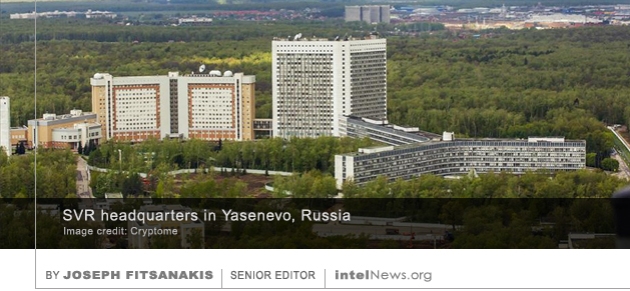
SVR hqLast week, following the results of Russia’s parliamentary election, Russian media run a story suggesting that the Kremlin is planning to implement far-reaching changes to the country’s intelligence apparatus. According to the Moscow-based daily Kommersant, the administration of President Vladimir Putin is considering merging Russia’s two major intelligence and counterterrorism agencies into one. Specifically, the Russian Foreign Intelligence Service, or SVR, will merge with the FSB, the Federal Security Service, according to Kommersant. The merger will create a new amalgamated intelligence agency that will be named “Ministry of State Security”, or MGB, in Russian. The last time this title was used was from 1946 to 1953, during the last years of the reign of Soviet Premier Joseph Stalin. It was one of several agencies that were eventually combined to form the Soviet KGB in 1954.

If the Kommersant article is accurate, Russia’s two main intelligence agencies will merge after an institutional separation that has lasted a quarter of a century. They were separated shortly after the official end of the Soviet Union, in 1991, when it was recognized that the KGB was not under the complete control of the state. That became plainly obvious in August of that year, when the spy agency’s Director, Vladimir Kryuchkov, helped lead a military coup aimed at deposing Soviet Premier Mikhail Gorbachev. The two new agencies were given separate mandates: the SVR inherited the mission of the KGB’s foreign intelligence directorates and focused on collecting intelligence abroad; the FSB, on the other hand, assumed the KGB’s counterintelligence and counterterrorist missions. A host of smaller agencies, including the Federal Agency of Government Communications and Information (FAPSI), the Federal Protective Service (FSO) and others, took on tasks such as communications interception, border control, political protection, etc.

Could these agencies merge again after 25 years of separation? Possibly, but it will take time. An entire generation of Russian intelligence officers has matured under separate institutional roofs in the post-Soviet era. Distinct bureaucratic systems and structures have developed and much duplication has ensued during that time. If a merger was to occur, entire directorates and units would have to be restructured or even eliminated. Leadership roles would have to be purged or redefined with considerable delicacy, so as to avoid inflaming bureaucratic turf battles. Russian bureaucracies are not known for their organizational skills, and it would be interesting to see how they deal with the inevitable confusion of a possible merger. It could be argued that, if Putin’s goal is to augment the power of the intelligence services —which is doubtful, given their long history of challenging the power of the Kremlin— he would be better off leaving them as they are today.

Author: Joseph Fitsanakis | Date: 04 October 2016 | Permalink

Analysis of the Islamic State’s ‘wedding attack’ in Gaziantep, Turkey

Gaziantep, TurkeySaturday’s suicide bombing, which killed over 50 and injured dozens at a wedding in Gaziantep, Turkey, was without doubt the work of the Islamic State. It was yet another attempt by the militant Sunni group to discourage the Kurds from confronting it in battle, by pointing to the deadly consequences. It was also fueled by the desire for vengeance against a population that has consistently resisted the Islamic State’s ideology. Additionally, if confirmed, the use of a child as a suicide bomber by the Islamic State may form a pattern of operational activity that can lead to broader conclusions about the current state of the organization.
It has become increasingly clear in the past two years that the armed Kurdish groups in northern Syria and Iraq, as well as Kurdish peshmerga units based in Turkey, are some of the most formidable opponents of militant Jihadists on the ground. By bombing soft targets inside Turkey, the Islamic State is sending a message to the Kurds that armed opposition on the ground will carry a heavy cost at home. Contrary to initial impressions, there was nothing special about the particular wedding ceremony that was targeted on Saturday. Any wedding would have been suitable for the Islamic State’s purpose. In fact, the randomness of the attack increases its shock value by demonstrating to the local population that any activity can be attacked, even if it does not involve notables. Additionally, the specific choice of a wedding magnifies the brutality of the attack, by targeting a young couple on what is typically the happiest day of their lives. The high concentration of children among the casualties may indicate that the bomber was given specific operational instructions to attack younger participants. The clear warning here is that the disruption will leave nothing untouched –including something as ‘off-limits’ as a couple on their wedding day, or groups of children– if the Kurds continue to fight the Islamic State.

Moreover, the Islamic State is trying to widen the already deep division between the Turkish state and the Kurds, by exposing the inability of the government in Ankara to protect its Kurdish population from attacks. The Kurds already resent Turkey’s ‘soft policy’ on the Islamic State. They and the rest of the world can see that Ankara has typically viewed the government of Bashar al-Assad in Damascus as far more threatening than the continuing rise of Islamist fundamentalism. Since the failed July 15 coup, the Turkish state has begun to revise its soft stance on the Islamic State, but this comes too late to pacify the country’s infuriated Kurdish population. This latest attack will only intensify the deep anger felt by the Kurds against the Turkish state.

Initial reports indicate the possible use of a child or a teenager to carry out the Gaziantep bombing. These may or may not be accurate. They could easily be an attempt by the Kurds to further-incense international public opinion against the Islamic State. If the reports are accurate, they do not necessarily represent some sort of break from the traditional tactics of the Islamic State. According to the group’s war-fighting doctrine, there is no differentiation between men and children when it comes to what it sees as the defense of Sunni religious doctrine. Every Muslim, regardless of race, gender, or age, is required to engage in holy war. Indeed, the Islamic State has deployed children before, in warfare, executions and suicide bombings against both hard and soft targets. However, even though the use of a child to carry out the Gaziantep bombing is not in itself unique, or particularly important, it matters if it forms part of a broader pattern. If it is verified that ISIS is increasingly using children in suicide bombings, or in warfare, it may signify two things: first, that the organization is finding it difficult to recruit able-bodied men for missions. Second, that adult ISIS recruits are becoming scarcer, so the organization is trying to preserve them for decisive battles.

It may be, of course, that a child or younger teenager was selected in order to avoid security profiling by the Kurds. Still, the use of children in warfare or suicide missions can result in a large degree of unpredictability. Children may be relatively easy targets for recruiters, for the obvious reason that they are young and impressionable. Their reality can therefore be effectively altered by fantastical tales of the supernatural, which the Islamic State is very skilled at. However, children are not necessarily very dependable in war, or terrorism. They can be easily frightened, can change their mind at the last minute, and they do not stay calm under pressure. There are several recent examples of children or teenagers who were recruited for suicide operations but surrendered after changing their mind.

Ultimately, shocking massacres such as Saturday’s attack in Gaziantep cannot be prevented. They can only be limited through careful police and intelligence work. In the case of Turkey, however, this will be difficult. The country’s police, intelligence and military structures have been significantly weakened following the failed July 15 coup. Thousands of government officials, police officers, intelligence and military personnel have been fired, demoted or imprisoned. The state, which is becoming increasingly synonymous with the President Recep Tayyip Erdoğan’s AKP party, is too preoccupied with preserving its own stability to concentrate on combating the terrorist spillover from Syria.

Author: Joseph Fitsanakis | Date: 23 August 2016 | Permalink

Analysis: It seems everyone predicted the coup in Turkey except its spy agency

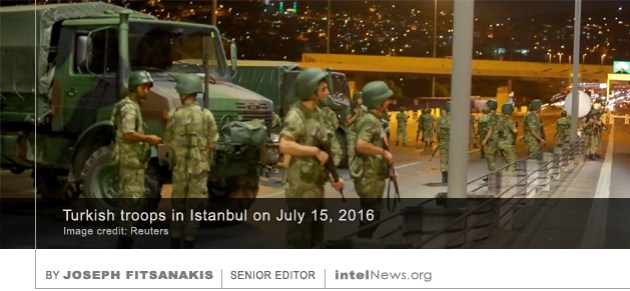
Turkey coupAfter the failure of the recent military coup d’état in Turkey, much attention has been given to the country’s armed forces, the police, even the judiciary. In contrast, little to no information has surfaced about Turkey’s intelligence establishment, which is led by MİT, the National Intelligence Organization. Did it anticipate the plot, and how did it fare as the crisis unfolded in the early hours of July 16?
Two days after the failed coup, American Congressman Peter King (R-NY), a senior member of the United States House of Representatives’ Committee on Homeland Security, claimed that “no one […] saw this coup coming”. Speaking on WNYM, a conservative talk-radio station in his home state of New York, Rep. King said that, as far as he was aware, “there was no diplomatic talk; there was no intelligence talk of this coup”. Speaking a day earlier, US Secretary of State John Kerry had stated that the White House had “no idea” that a coup was imminent in Turkey, and that developments in the country had “surprised everybody”.

As is often the case, King and Kerry were both wrong. Even as early as October of 2015, Norman Bailey, of the University of Haifa in Israel and the Institute of World Politics in Washington, was stating with certainty that Turkey’s “army will step in and take over” if it senses that the country is descending into chaos. On March 12 of this year, Russian observers warned that Turkey’s military was “gradually building up its political influence, thus laying grounds for a military coup”. Later in the same month, Michael Rubin, of the American Enterprise Institute, asked: “could there be a coup in Turkey?”, and answered that “no one should be surprised […] if the Turkish military moves to oust Erdogan and place his inner circle behind bars”. And on March 30, the esteemed journal Foreign Affairs hosted an article by Gönül Tol, founding director of The Middle East Institute’s Center for Turkish Studies, in which she explained that Turkey was about to face its “next military coup”. During an interview on July 2 of this year, the present author spoke about the “very volatile situation within [Turkey]” and added: “I can’t think of any countries in the region that are more unsettled and unpredictable right now than Turkey”.

If analysts relying on open sources were able to issue concrete warnings about Turkey’s political instability at least a year in advance of the coup, it should be taken for granted that intelligence observers were equally alarmed over the same period. We know, for instance, that American intelligence analysts were “concerned for months” prior to the coup “about simmering tensions between President […] Tayyip Erdoğan and Turkish military brass”. Read more of this post

Analysis: Will ISIS claim responsibility for Istanbul airport attack? (updated)

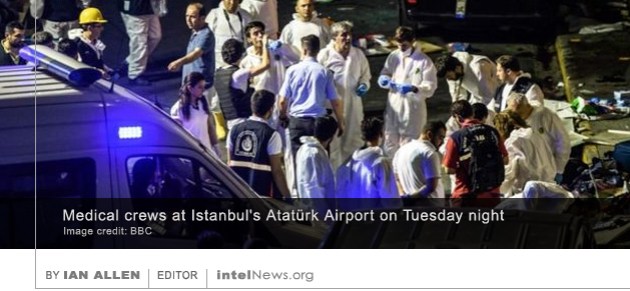
Istanbul Airport TurkeyTurkish security and counterterrorism officials are blaming the Islamic State of Iraq and Syria for Tuesday’s bloody attack at Istanbul’s Atatürk airport, which left at least 41 people dead and nearly 300 injured. But will ISIS claim responsibility for the attack? And if not, why not? ISIS is indeed the most likely culprit of Tuesday night’s terrorist attack. The modus operandi of the three attackers, which some unconfirmed reports suggest Turkey has now confirmed were foreign nationals, matches that of previous ISIS attacks on high-profile international targets. More importantly, the style of the attack does not fit the profile of the secessionist Kurdistan Workers’ Party, known as PKK, which almost always targets uniformed personnel in Turkey.
There is no shortage of motives for ISIS to target Turkey. The militant group wants to destabilize Turkey, which it sees as a prime market for spreading its ideas, especially among the country’s disenfranchised religious working class. The attack at Istanbul’s airport happened in the holy month of Ramadan, the most revered time on the Muslim religious calendar, during which ISIS said would launch a wave of violence around the world. Last but not least, foreign and domestic intelligence agencies had warned the Turkish government in recent weeks of an impending large-scale attack by ISIS, saying that the group was anxious to re-galvanize its supporters after suffering heavy military defeats in Iraq and Syria. Since the start of 2015, experts have connected ISIS to at least seven different attacks on Turkish soil, most of them in large urban centers like Ankara and Istanbul. However, the only attacks the militant group has claimed responsibility for were against Syrian anti-ISIS activists based in southern Turkey. In contrast, ISIS has shied away from officially linking itself with deadly attacks against high-profile targets in Turkey. This latest attack may fall in line with that pattern.

But why would ISIS not claim responsibility for such a media-savvy strike? There is no question that the Sunni Islamist group wants to destabilize Turkey’s economy, a goal that it sees as key to its success. That explains Tuesday night’s attack on one of the country’s busiest transport hubs during the peak of the tourist season. At the same time, however, ISIS is aware that Turkey’s main concern in the Middle East is not Sunni Islamism, but the rise of the PKK and other secessionist Kurdish groups. The latter are some of ISIS’ most formidable military adversaries, and the Islamist group would rather not distract Turkey from its escalating war against the Kurds. What’s more, because Ankara has been paying most of its attention to Kurdish separatists, ISIS has been able to build an extensive network of operatives inside Turkey, and it does not want to see it demolished by Turkish security forces. ISIS is therefore engaged in a delicate balancing act: on the one hand it wants to destabilize Turkey so as to export its sectarian war to one of the world’s most populous Sunni Muslim nations. On the other hand, however, it does not want to alter Turkey’s security priorities, which are mostly focused on Kurdish militias.

What will it mean if ISIS breaks with the typical pattern and does claim responsibility for Tuesday’s attack in Istanbul? That would be equivalent to an official declaration of war by the Islamic State against the Turkish Republic, a call for arms issued to all pro-ISIS networks in Turkey for the opening of a northern front in this widening regional conflict. It could also spell trouble for Turkey’s beleaguered security forces, which will be forced to divide their attention between two foes, the PKK in the east and in urban centers, and ISIS in the south and in popular tourist resorts throughout the country.

Author: Ian Allen | Date: 30 June 2016 | Permalink

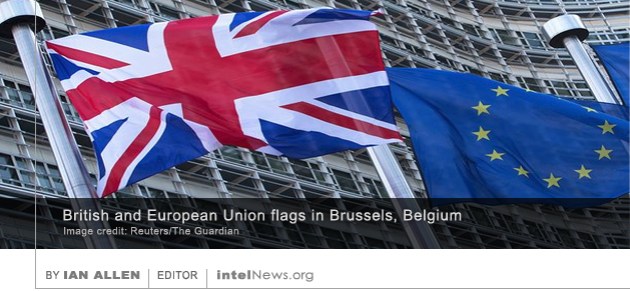
Experts warn about Brexit’s effects on European, NATO cooperation

BrexitAfter Thursday’s Brexit vote, European and American security officials have tried to pacify concerns about major disruption of longstanding Western security cooperation arrangements. But experts stress that the international security landscape will be significantly impacted by Britain’s decision to leave the European Union (EU). As early as Thursday night, British defense, military and intelligence officials launched a marathon of phone calls in order to reassure their European and American counterparts that the United Kingdom was not going to retreat from its role in security pacts with Europe and the North Atlantic Treaty Organization (NATO).

On Friday, the office of NATO Director General Jens Stoltenberg issued a statement assuring the public that Britain’s decision to leave the EU would not impact on NATO’s security arrangements. On Sunday, however, a new statement by Stoltenberg appeared to revise his earlier comments. It argued that Britain was “the biggest provider of security in Europe” and that its eventual exit from the EU “matters”, adding that the West’s security situation post-Brexit was “more unpredictable […] than before”. Citing security officials from both sides of the Atlantic, including Stoltenberg, The Wall Street Journal opined on Sunday that Brexit “could have a profound effect on global security”, but stressed that its precise impact remains uncertain. Some officials warned that, in the long run, Britain’s exit from the EU would weaken its military, which is Europe’s most powerful. This could happen through a possible breakup of the country, with Scotland and Northern Ireland splitting from the United Kingdom in reaction to Brexit. Alternatively, Britain’s worsening economic situation could prove detrimental to its overall defense spending.

On Saturday, United States Navy Admiral (ret.) and former NATO commander James Stavridis, argued that NATO will benefit from Brexit, because it will allow the United Kingdom to devote “more resources and manpower to support” NATO’s mission. There will also be a “reduction in the […] battlefield competition between NATO and the EU”, said Adm. Stavridis, which “will likely produce a stronger NATO”. Others, however, disagreed. Citing several current and former officials, The Wall Street Journal warned that Britain’s exit from the EU would result in the loss of a quarter of the EU’s combat power. That could prompt Germany, France, and other EU nations to increase their military spending, in order to advance a more unified defense policy among EU nations. That could bring about a unified EU military headquarters, or even a joint European Army, which NATO has traditionally resisted, as it believes it would duplicate resources and undermine transatlantic cooperation. But with Britain leaving the EU, a staunch pro-NATO voice that strongly objected to the creation of a European Army ceases to exist. That could open the door to the creation of a European Army, say experts.

Last but not least, the UK was a strong player lobbying in favor of instituting EU-wide sanctions against Russia in the wake of the war in eastern Ukraine and Russia’s annexation of Crimea. With London now removed from the decision-making center in Brussels, the voices from EU member states like Spain, Italy and Greece, which argue for abandoning the sanctions against Moscow, are likely to grow louder, said The Wall Street Journal.

Author: Ian Allen | Date: 27 June 2016 | Permalink

Recent gains against ISIS are not enough, may actually backfire, say experts

First Post HWestern experts and intelligence officials are warning that the recent military gains made against the Islamic State of Iraq and Syria (ISIS) are not enough to damage it, and may in fact make the group stronger in the long run. Undoubtedly, the impressive momentum of ISIS, which calls itself the Islamic State, has been curtailed, and the image of invincibility that it once projected is no longer there. Observers estimate that the Sunni militant group has lost nearly a fifth of its territory in Syria, while it is no longer in control of about half of the land it used to occupy in Iraq. As a result of these territorial defeats, ISIS has lost a third of its oil production, which is believed to account for half of its overall revenue. Earlier this month, US President Barack Obama said that, as ISIS continues to concede territory, it is “losing the money that is its livelihood”.

But US intelligence officials do not seem to agree. Speaking on June 16 before the US Senate’s Select Committee on Intelligence, John Brennan, Director of the Central Intelligence Agency, cautioned against triumphalism. He told senators that the efforts of the international military coalition against ISIS “have not reduced the group’s terrorism capability and global reach”, adding that ISIS would “have to suffer even heavier losses of territory, manpower, and money for its terrorist capacity to decline significantly”. According to Reuters, a number of US intelligence officials and counterterrorism experts support Brennan’s views. The news agency said on Wednesday that many experts are warning that the military campaign on the ground was “far from eradicating [ISIS] and could even backfire”.

The fact that local troops fighting ISIS are almost completely composed of Shiite Arabs from Iraq and Iran, or are Kurdish Peshmerga, could add legitimacy to ISIS as the protector of the Sunni Arab minority in the region. There are also reports of human rights violations against Sunnis by the advancing Shiite forces, including an unconfirmed allegation that 49 Sunni men of fighting age were executed after surrendering to the anti-ISIS coalition in Falluja. Additionally, if ISIS loses much more territory, it will be tempted to simply abandon conventional fighting tactics and turn into a guerrilla group. Reuters quotes RAND Corporation analyst Seth Jones, who argues: “It looks like the areas that the Islamic State has lost, they are generally abandoning, and that would mean preparing to fight another way”. That could mean that ISIS fighters intend to blend in with the urban population and launch a campaign of sabotage, assassination and disruption of government services.

As ISIS has lost ground in Iraq and Syria, the flow of foreign fighters intending to join the organization has dropped significantly. But that is not necessarily a good thing, says Reuters. These fighters, who in the past were instructed to join ISIS in the Middle East, may now be told to launch lone-wolf terrorist attacks abroad. The Reuters report cites one terrorism expert, Hassan Hassan, of the Royal Institute of International Affairs in London, who argues that the international appeal of the Islamic State is not connected to the group’s military performance in the Middle East. In other words, its popularity among its Western followers will persist even if all of the group’s territorial strongholds are lost to its adversaries.

Author: Ian Allen | Date: 23 June 2016 | Permalink

Opinion: Islamic State’s strategy will affect America’s gun control debate

Orlando shootingOut of the myriad of questions emerging from Sunday morning’s massacre in Orlando, two are perhaps most pressing. One concerns internal security in the United States; the other relates to the broad strategy of the Islamic State, the militant Sunni Muslim group that claimed responsibility for the bloody attack. The two topics are closely related.

Like most issues in modern-day America, the topic of internal security is heavily politicized, with public debate dominated by Democratic and Republican partisans. Predictably, each side is using Sunday’s massacre to advance its political agenda. It cannot be denied that, rightly or wrongly, gun ownership is a deeply entrenched feature in the American understanding of citizenship for a variety of social and historical reasons. It is equally undeniable that America’s liberal gun laws make it extremely easy for aspiring terrorists to acquire weapons. Recent mass shootings show that even those with documented mental illnesses or individuals who have been questioned by the Federal Bureau of Investigation for possible links to terrorism, like Omar Mateen, are legally able to purchase high-powered weapons. This reduces the number of people that are needed to inflict mass casualties and directly assists the work of terrorist groups. Furthermore, the ability of aspiring terrorists to legally acquire high-powered weaponry exceeds America’s law enforcement and intelligence capabilities, and thus directly threatens the security of daily life in the country.

Judging by other recent mass shootings, and the speed with which the relentless news cycle moves on to other stories, this latest massacre is unlikely to have a major impact on US gun laws. However, if the attack in Orlando proves to be part of a broader strategy by the Islamic State, then the center of the debate on gun control in America may shift in unprecedented directions.

Most commentators agree that the Islamic State is currently retreating not only in its Syrian and Iraqi strongholds, but also in Libya, where it appears to be losing its control of the strategic port of Sirte. The possibility of losing its territorial base may radically alter the group’s modus operandi and strategic goals. Historically, the Islamic State has focused on what can be described as its core terrain, which includes Iraq, Syria, the Sinai Peninsula, and to a lesser extent Jordan and Lebanon. Back in 2014, Islamic State leaders could have urged the group’s tens of thousands of followers in the West to carry out the jihad there. But they didn’t, because the grand strategy of the Islamic State is to secure a territorial base in the Middle East before taking on bigger tasks. Islamic State supporters were therefore urged to join the fight to establish a territorially secure caliphate in the Middle East instead of attacking Western targets. The latter have of course been attacked, but this has been done primarily for two reasons: first, to discourage Western countries from getting directly involved in the war against the Islamic State; second, to encourage Islamophobia in the West and further-marginalize already disaffected Western Muslim youth, driving them to join the Islamic State.

But should the militant Sunni group be territorially defeated, it might decide to change its tactic and begin unleashing its followers in the West. Or if it is sensing that it is losing control of its self-proclaimed caliphate, it may already be already changing its strategy. There is currently no evidence that Omar Mateen was in touch with the Islamic State prior to committing Sunday’s massacre. But if he did, the Orlando massacre may have been an early indication of the Islamic State’s change of direction. Perhaps, then, the US is in for a lot more of these carefully targeted and lethally executed strikes.

It may be that the blood of over 50 people spilled in Orlando will not seriously affect the gun control debate. But if these killings increase in frequency and lethality, American society will face a number of unprecedented dilemmas that combine the issues of gun rights, domestic security and citizenship.

Author: Ian Allen | Date: 13 June 2016 | Permalink

Analysis: Mullah Mansour’s killing will shape future of Afghan War

Mullah MansourThe American operation that killed the leader of the Afghan Taliban, Mullah Akhtar Mohammad Mansoor, on May 21, was unprecedented in more ways than one. It marked the first known effort by the United States to neutralize the leadership of the Afghan Taliban. It was also the first US drone strike in Pakistani Baluchistan, a region that is far removed from the Federally Administered Tribal Areas, where American operations have traditionally focused. Mullah Mansour’s killing also marked the most high-profile American incursion into Pakistani territory since the May 1, 2011 attack that killed al-Qaeda co-founder Osama bin Laden. Q QuoteIronically, just hours before killing Mansour, Washington was calling the Taliban to join the negotiation table for peace talks with the Afghan government. So what exactly was America’s intention in killing the leader of the Afghan Taliban?

PROSPECTS FOR A MODERATE SUCCESSOR

There is no question that Mansour represented the most intransigent and militant segment of Afghanistan’s militant Pashtuns. He consistently dismissed efforts by Washington and Kabul to strike a deal with his forces as a ploy designed to weaken the Taliban’s role in Afghan politics. So the primary outcome that the US is seeking from his death is the possibility that a more moderate figure will emerge from within the ranks of the Taliban. That, however, is far from guaranteed. Even if it does happen, it will probably come after a period of leadership struggle between different factions and tribes within the Taliban, much like the heated infighting that broke out after the announcement of the death of the Taliban’s founding leader, Mullah Mohammad Omar. There are even some who believe that the death of two successive Taliban leaders in such a short period may split the group into three or more factions.

To avoid such a prospect, the Afghan Taliban have already begun internal consultations in order to quickly enthrone a new emir. Major candidates include the late Mullah Omar’s son, Mullah Yakoub, and his brother, Mullah Abdul Manan Akhund. The list of contenders also features the late Mullah Mansour’s deputies, including Sirajuddin Haqqani, head of the Haqqani Network, which recently consolidated its forces with those of the Afghan Taliban. Many observers believe that Haqqani is Mansour’s most likely successor, as well as the most militant of all contenders for the group’s leadership.

THE END OF PEACE NEGOTIATIONS?

If the Afghan Taliban are led by Haqqani, a man described by the White House as a terrorist mastermind, the chances of seeing Afghanistan’s militant Pashtuns join peace negotiations with Kabul are slim to none. The country’s President, Ashraf Ghani, said last week that he hoped that the death of Mansour would weaken the Taliban hardliners and open the path to negotiations with his government. It is difficult to see, however, how the Taliban could sit at the table with the Afghan government and its American allies, namely the same people who just Q Quotekilled the group’s leader.

They only way that could possibly happen is if Pakistan, which is the Afghan Taliban’s state patron, compels them to do so. But such a prospect is unlikely. In the hours after Mansour’s assassination, the US Secretary of State John Kerry described it as an “action that sends a clear message to the world that we will continue to work with our Afghan partners”. Indeed, Mansour’s killing was a source of jubilation in Kabul. But there were no celebrations in Islamabad, which was notified about the US drone strike on its soil after its completion. The Pakistani position has always been that military action against the Afghan Taliban will only push them further underground. Instead, Pakistan argues that the Taliban should be brought to the table to sign a comprehensive peace treaty that will ensure ethnic rights for Afghanistan’s Pashtun population. But the prospect of that happening after Mansour’s assassination are slim, even if a more moderate figure succeeds him at the helm.

THE FUTURE OF THE AFGHAN WAR

What are, then, the prospects for peace in Afghanistan? A notable rise in violence should be expected, as various Taliban factions lash out against the government in Kabul with the aim of augmenting their standing against internal competitors. The Taliban now control more territory in Afghanistan than at any other point following the 2001 US invasion. If their alliance with the Haqqani Network survives, they will continue to be a formidable force in the country and the surrounding region, and will become increasingly difficult to defeat militarily. The group will continue to operate with considerable force even if Mansour’s position is not filled soon, as local Taliban forces have shown that they are capable of taking unilateral initiative in times like this. In the meantime, observers in Kabul and Islamabad, as well as the Afghan Taliban’s leadership in Quetta, will be wondering whether the assassination of Mansour marks the beginning of a more aggressive approach by Washington in the ongoing Afghan war. The answer to that question remains elusive, but will likely shape the future of the 40-year-old Afghan war.

Author: Joseph Fitsanakis | Date: 24 May 2016 | Permalink

EgyptAir Flight MS804: Was it a terrorist attack?

EgyptAir MS804In the early hours of Thursday, May 19, EgyptAir, Egypt’s national airline carrier, announced via Twitter that flight MS804 had vanished from the radar. The regularly scheduled flight had departed Paris, France, on time at 11:09 p.m. and had been scheduled to arrive in Egyptian capital Cairo at 3:05 local time. The airplane, an Airbus A320-232, was carrying 59 passengers and 10 crew. According to reports, the airplane disappeared over the eastern Mediterranean, southeast of the island of Crete.

Was this a terrorist attack? It will be several hours before this question can be conclusively answered. However, there are some early indicators that can help shed some light on the incident.

1. What has happened to the plane? The plane has almost certainly crashed into the sea. It has now been five hours since it disappeared from the radar. The eastern Mediterranean is not like the vast Indian Ocean, where Malaysia Airlines Flight 370 literally disappeared in March 2014, never to be found. In the case of EgyptAir MS804, if the plane had landed at a regional airport, the sighting would have been reported immediately —even if it was in rebel-held Syrian regions, or Islamic State-controlled territory in Iraq.

2. If the plane has indeed crashed, what brought it down? The possibility of a mechanical failure cannot be excluded. However, the plane is relatively new; it was built in France in 2003 and is less than 13 years old, which may mean that a serious mechanical failure is relatively unlikely. Additionally, weather conditions over the eastern Mediterranean were reportedly “clear and calm” at the time when the plane vanished from the radar. Last but not least, it must be stressed that there was reportedly no distress call made by the pilots or crew before the flight disappeared from radar screens. Which brings us to the next question, namely:

3. Was this a terrorist attack? American and European intelligence agencies, including France’s own DGSE, have warned repeatedly in previous weeks that the Islamic State was “planning new attacks […] and that France [was] clearly targeted”. The Islamic State is currently one of very few terrorist organizations that have the technical expertise and momentum to compromise security measures at a European airport. Moreover, the Islamic State has declared war on France, has attacked the country numerous times, and has stated repeatedly that it intends to continue and even intensify itsQ Quote efforts. The group has remained silent since early this morning, when EgyptAir announced the disappearance of flight MS804. However, it typically waits for several hours, and sometimes days, before assuming responsibility for high-profile attacks.

4. If it was a terrorist attack, how was the plane brought down? It is important to note that the plane is believed to have been flying at 37,000 feet when it vanished from radar screens. This means that, assuming that a non-state actor caused the aircraft’s disappearance, the attack must have been perpetrated from inside the plane. At least three of the 10-member crew are believed to be armed security guards. If that is the case, a team of hijackers would have to have been sizeable enough and sufficiently armed to overpower three armed security guards. What is more likely is that a bomb may have been planted on the plane, either in Paris or Cairo (the plane was returning to Cairo, having left from there for Paris earlier on Wednesday). The last time that the Islamic State assumed responsibility for downing an airliner, it did so by planting a bomb aboard the plane with the help of a ground worker in Egypt who had secretly joined the militant group.

5. If it was a terrorist attack, what does it mean? Should the Islamic State assume responsibility for this attack, it will make it increasingly difficult for France —and possibly other Western European nations— to resist putting boots on the ground in Iraq and Syria. Moreover, if a bomb was planted on the plane at Paris’ Charles De Gaulle airport, it will mean that the Islamic State, or possibly another militant group, has found a way to beat what are perhaps the most stringent airline travel security measures in all of Europe. It could be that the group behind this possible terrorist attack has found a unique and thus far unforeseen way to defeat the latest technological measures used to secure airline travel. Such a possibility could spell even more massive changes for the world’s airline industry, which is already reeling from all sorts of financial and administrative pressures in the post 9/11 era.

Analysis: Taliban-Haqqani alliance marks new phase in Afghan war

Haqqani NetworkAn expanding alliance between two of the most powerful armed groups in Afghanistan, the Taliban and the Haqqani Network, is reshaping regional power dynamics and possibly altering the course of the ongoing Afghan war. It was last summer when it was announced that Sirajuddin Haqqani, the leader of the notorious Haqqani Network based in southeastern Afghanistan, had been appointed deputy leader of the Taliban. The move, which brought together two groups that traditionally acted autonomously, was seen as largely symbolic at the time. But observers are now suggesting that the two groups are actively integrating more than ever before, and that their increasing cooperation is drastically changing the dynamics of the bloody Afghan war.

THE HAQQANI NETWORK

The Haqqani Network dates from the mid-1970s, when a group of pro-royalist Pashtuns took up arms against the government of Mohammad Daud Khan, a former cabinet minister who in 1973 led a coup that overthrew the country’s king, Mohammad Zahir Shah. The group, founded by Jalaluddin Haqqani, was actively supported by Pakistan, which perceived Khan’s government as pro-Soviet. As it became increasingly clear that the Soviet Union would invade the country, Pakistan’s assistance to the Haqqani Network was augmented by support from Saudi Arabia and the United States. During the Afghan-Soviet War of the 1980s, the Haqqani Network formed a major backbone of the anti-Soviet resistance. The group, and the Pashtun tribes that form its base in Afghanistan and Pakistan, have remained in a state of war against various invaders ever since. Today the Haqqani Network is led by Jalaluddin’s son, Sirajuddin Haqqani, who has closely followed in his father’s footsteps. He has continued to pledge allegiance to the Taliban by recognizing its commander-in-chief, Mullah Akhtar Mansour, as the Leader of the Faithful —essentially the Emir of the Islamic caliphate. At the same time, however, like his father, Siraj has maintained the Haqqani Network as an autonomous entity that operates based on its own command structure andQ Quote tactical priorities.

THE HAQQANI-TALIBAN ALLIANCE

The deepening cooperation between the Haqqani Network and the Taliban must be examined within the context of the failed efforts to broker a peace treaty between the Afghan government and the Taliban. In early 2016, the Quadrilateral Coordination Council, set up by the United States, China, Pakistan and the Afghan government, sought to bring the Taliban to the negotiation table, so that an official peace treaty could be put in place between them and Kabul. Throughout that time, however, the Afghan government has become increasingly weaker, faltering under the weight of its own ineptitude, corruption and sectarian divisions. The growing discontent against it among the people, as signified by the rise in mass immigration by young Afghans, has weakened Kabul’s trustworthiness as a national actor and strengthened the Taliban. At the same time, the Taliban, although strong, are not unilaterally capable of solidifying their power across the country unless they have the support of the many autonomous tribes and clans. For that reason, Taliban leader Mullah Mansour has spearheaded a policy of consolidation between his forces and regional groups, including the Haqqani Network.

The latter are also extremely capable militarily, having maintained a powerful armed force since the late 1970s, with its own heritage, traditions and command structure. During the 1980s, they were trained and supplied with ample war materiel by Saudi, Pakistani and American intelligence agencies, while also developing their own funding channels abroad. Today, Siraj Haqqani’s mother, who is an Arab, and many of his brothers, are located in the Persian Gulf, and are able to pursue alliances between the Network and oil-rich Arab donors. The group also maintains a large network of shell companies that operate internationally and bring in a substantial revenue to the group. Consequently, due to their strong financial backing, Haqqani forces are well-trained, well-supplied and have near-unparalleled military capabilities in the region. They are currently one of a handful of groups that have shown to be capable of striking at the heart of the Afghan government inside Kabul. Alongside their military prowess, Haqqani forces maintain an efficient, parallel administrative infrastructure in southeastern Afghanistan, which includes a justice Q Quotesystem, job centers, taxation offices and community militias. The administrative and military efficiency of the Haqqani Network only adds to the strength of the Taliban and places them in a renewed position of power vis-à-vis Kabul.

THE PAKISTANI FACTOR

Along with the Haqqanis and the Taliban, the Pakistanis have also gained strength in the past year as a regional actor. There is little doubt that the Haqqani Network, which operates a series of bases inside Pakistan’s North Waziristan region, maintains close connections with Inter-Services Intelligence directorate (ISI), Pakistan’s powerful spy agency. These links, which were forged in the 1980s during the Afghan-Soviet War, continue unabated and often —though not always— allow the Pakistanis to use the Haqqani Network as a proxy group to advance their interests in Afghanistan. Islamabad does not want India to dominate the region and has done more than any other regional actor to maintain the Taliban, Haqqanis, and other Pashtun groups as strong rivals to the central government in Kabul. By strengthening the role of the Haqqanis, which, unlike the Taliban, the US officially classifies as a terrorist group, Islamabad is making it more difficult for Washington to reach out to the Taliban in search of a comprehensive peace treaty. This development spells more violence and war in Afghanistan for the foreseeable future, as local and regional actors appear to be positioning themselves for a showdown between the Afghan government and its tribal rivals.

Author: Joseph Fitsanakis | Date: 10 May 2016 | Permalink