Senior Russian intelligence defector to the US is allegedly dead

Aleksandr PoteyevA Russian former senior intelligence officer, who reportedly defected to the United States after helping the Federal Bureau of Investigation arrest 10 Russian spies in 2010, is believed to have died. The arrests, which revealed the so-called “Russian illegals program” in the US, were part of a counterintelligence operation codenamed GHOST STORIES by the FBI. The operation culminated in June 2010 with the dramatic arrests of 10 Russian ‘illegals’ in several US states. The Russian illegals, deep-cover intelligence operatives with no official connection to the country that employs them, had been operating in the US for over a decade prior to their arrest, using passports from third countries, including Britain, Canada and Uruguay. They were eventually exchanged with spies for the West that had been imprisoned in Russia.

Moscow blamed the arrests of the illegals on Colonel Aleksandr Poteyev, a veteran of the Soviet war in Afghanistan, who rose through the ranks of the KGB and its successor agency, the SVR, to become second-in-command in the so-called Department S. The senior leaders of Department S are believed to be appointed directly by the president of Russia, and are tasked with directing the activities of all Russian illegals operating abroad. According to the Russian government, which tried Poteyev in absentia in 2011, he began working for the US Central Intelligence Agency in 1999, shortly before entering the senior echelons of Department S.

A panel of judges was told during Poteyev’s Moscow trial that he left Russia without permission on June 24, 2010, just days before the FBI arrested the 10 Russian illegals in the US. He initially went to Belarus, from where he notified his unsuspecting wife via a text sent from a mobile phone that he was leaving Russia for good. He then traveled to Ukraine and from there to Germany, where he was allegedly picked up by his American CIA handler. It is believed that was provided with a new identity and passport, which he used to enter the US. By the time the Russians sentenced him to 25 years in prison for treason, Poteyev was adjusting to his new life in America.

But on July 7, the Moscow-based Interfax news agency reported that Poteyev, had died in the US, aged 64. The brief report did not specify the cause of Poteyev’s alleged death, nor did it state how Interfax acquired the information. Since the report was issued, no confirmation of Poteyev’s purported death has appeared from any other news source, or from government agencies. Russia’s Sputnik News contacted the SVR last week, but the agency declined to comment. It is believed that Poteyev’s two children were working in the US at the time of his defection, and that they are still living in the country.

Author: Joseph Fitsanakis | Date: 11 July 2016 | Permalink

Video footage shows alleged CIA spy tackled outside US Moscow embassy

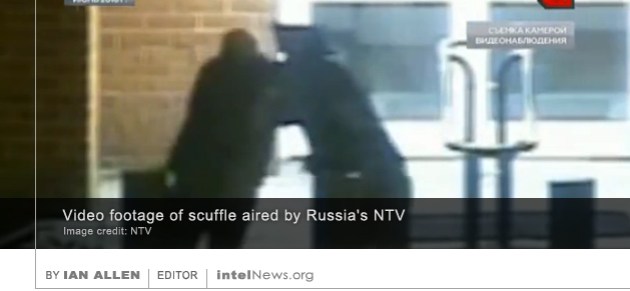
US embassy scuffleA Russian television station has aired footage allegedly showing a Russian guard stationed outside the United States embassy in Moscow trying to stop an American diplomat from entering the embassy. The Kremlin claims that the alleged US diplomat was in fact a Central Intelligence Agency officer who was returning to the embassy in disguise following a spy operation. As intelNews reported on July 1, the incident took place in the early hours of Monday, June 6. The American diplomat was making his way to the front entrance of the US embassy complex, which is located in the Presnensky District in downtown Moscow.

According to American sources, the diplomat was approached by an employee of the Russian Federal Security Service, the FSB, which regularly stations security personnel around the sizeable US embassy complex. The FSB claims that the guards are there to protect US diplomats, though it is common knowledge that the Russian agency, which is responsible for counterespionage, is primarily there to monitor activities in and around the US embassy. American sources claim that the diplomat presented the Russian guard with proof of identification when asked to do so. But he was then physically attacked and struck repeatedly by the FSB officer, which left him with several injuries, including a broken shoulder. The diplomat managed to enter the embassy grounds and had to be flown out of the country for urgent medical treatment. He has not returned to Russia.

On Thursday, Russian television channel NTV aired video footage purporting to show the altercation between the US diplomat and the FSB guard. The video aired on NTV shows a man exiting a taxi in a hurry and heading to what appears to be the US embassy’s front-perimeter entrance. However, as the man makes heads for the entrance, a uniformed individual jumps out of a guard station located nearby and tackles the man, throwing him on the ground. A scuffle ensues, during which the alleged diplomat is seen desperately trying to reach the entrance of the US embassy, which is American soil. He eventually manages to enter the embassy grounds, despite the effort of the uniformed guard to prevent him from entering. The same NTV report identified the American diplomat as Daniel Van Dyken and showed the photograph of a man said to be him. The report states that Van Dyken serves as third secretary of the US embassy’s Political Department.

Last week, Russian Foreign Ministry spokeswoman Maria Zakharova alleged that the diplomat in question was an intelligence officer. “It is well known”, said Zakharova, “that this very diplomat was in fact an agent of the CIA and was returning [to the US embassy], in disguise, after conducting an intelligence operation the previous night”. She also said that the Russian government employee involved in the altercation was a “police officer” who was attacked by the alleged spy when he asked to be shown proof of identification. Instead of supplying identification documents, the American diplomat “struck the guard in the face with his elbow before disappearing into the embassy”, said Zakharova. The US State Department and the CIA have refused to comment on Zakharova’s allegations.

Author: Ian Allen | Date: 08 July 2016 | Permalink
Muslim man held in New York prison claims he was CIA spy

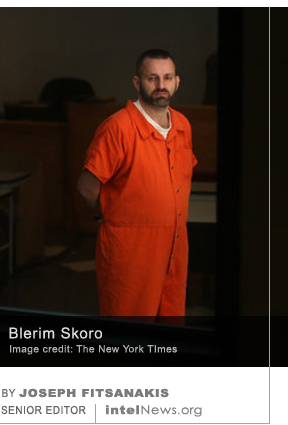
Blerim SkoroAn ethnic Albanian man facing deportation from the United States says he was trained by the Central Intelligence Agency to spy on “the most ruthless, dangerous terrorists in the Balkans and the Middle East”. Blerim Skoro, 45, from the former Yugoslav Republic of Kosovo, was arrested last February in Brooklyn, New York, for illegally using a discounted student MetroCard. He was then found to have entered the US illegally and is currently in prison in New Jersey, facing possible deportation back to Kosovo. But Skoro told The New York Times in an interview published on Wednesday that he cannot be sent back to Kosovo because he operated there as a spy for the CIA.
According to The Times, Skoro came to the US in 1994. Six years later, he was convicted in a New York court of transporting drugs and laundering nearly $700,000 in criminal proceeds. But while in prison, Skoro was recruited as an informant for the Federal Bureau of Investigation, and was tasked with monitoring inmates with militant Islamist leanings. In 2007, when Skoro was released from prison and deported back to Kosovo, he allegedly continued working for US intelligence. He told The Times that he was trained by US operatives in a CIA safe house in the former Yugoslav Republic of Macedonia before taking on assignments in the Balkans, the Middle East and even Pakistan. Throughout that time, Skoro says he posed as a militant Islamist who had become radicalized while serving his prison sentence in America. He claims to have supplied the CIA with intelligence relating to al-Qaeda and other Sunni Islamist groups.

However, in 2010, while traveling to a CIA safe house in Macedonia for a meeting, he was shot by assailants who probably knew he was working for a foreign spy agency. That incident prompted the CIA to sever its relationship with him, dismissing him from his agent status and offering him approximately $40,000 in compensation. Soon afterwards, Skoro made his way to Canada, from where he entered the US illegally, in November 2014. Before getting arrested in Brooklyn in February, he says he made contact with US intelligence officials, offering to spy for the US against the Islamic State. But his offer was not accepted. The Times article speculates that US intelligence may have no use for Skoro because his identity has been compromised, or because his reliability has come into question.

Currently Skoro is being held without bond at the Bergin County Jail in northern New Jersey, because federal prosecutors believe he might flee if released. The Times contacted the CIA, the FBI and police sources, but all declined to comment.

Author: Joseph Fitsanakis | Date: 07 July 2016 | Permalink

Diplomat involved in fight with US embassy guard is CIA spy, says Russia

FSB - IAThe Russian government says that an American diplomat, who was allegedly beaten up by a Russian security guard outside the United States embassy compound in Moscow, is an undercover spy. The man, who has not been named, was stationed in the Russian capital by the State Department as an accredited diplomat with immunity from prosecution in Russia. However, The Washington Post reported earlier this week that the American diplomat was severely beaten by a Russian government employee while attempting to enter the US embassy compound.
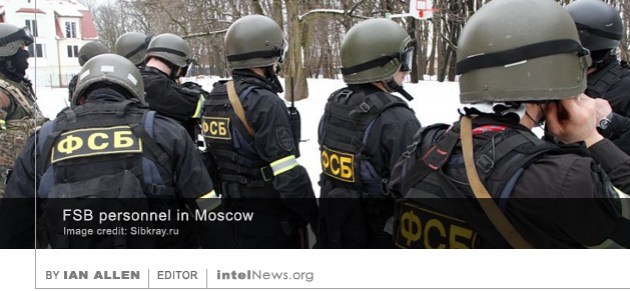
The alleged incident is reported to have taken place in the early hours of Monday, June 6. The American diplomat was making his way to the front entrance of the US embassy complex, which is located in the Presnensky District in downtown Moscow. According to American sources, the diplomat was approached by an employee of the Russian Federal Security Service, the FSB, which regularly stations security personnel around the sizeable US embassy complex. The FSB claims that the guards are there to protect US diplomats, though it is common knowledge that the Russian agency, which is responsible for counterespionage, is primarily there to monitor activities in and around the US embassy. American sources claim that the diplomat presented the Russian guard with proof of identification when asked to do so. But he was then physically attacked and struck repeatedly by the FSB officer, which left him with several injuries, including a broken shoulder. According to The Washington Post, the diplomat managed to enter the embassy grounds and had to be flown out of the country for urgent medical treatment. He has not returned to Russia.

The US government believes the attack was intentional. But what caused it? One theory entertained by The Washington Post is that the diplomat was in fact an officer of the Central Intelligence Agency working in Moscow under official cover, pretending to be a State Department employee. According to this theory, the FSB was chasing the American diplomat through the streets of Moscow after a spy operation that went awry. The Russians then tried unsuccessfully to prevent him from entering the US embassy, which constitutes American soil.

On Thursday, Russian Foreign Ministry spokeswoman Maria Zakharova alleged that the diplomat in question was an intelligence officer. “It is well known”, said Zakharova, “that this very diplomat was in fact an agent of the CIA and was returning [to the US embassy], in disguise, after conducting an intelligence operation the previous night”. She also said that the Russian government employee involved in the altercation was a “police officer” who was attacked by the alleged spy when he asked to be shown proof of identification. Instead of supplying identification documents, the American diplomat “struck the guard in the face with his elbow before disappearing into the embassy”, said Zakharova. The US State Department and the CIA refused to comment on Zakharova’s allegations.

Author: Ian Allen | Date: 01 July 2016 | Permalink

CIA tip led to Mandela’s fateful 1962 arrest, claims US ex-diplomat

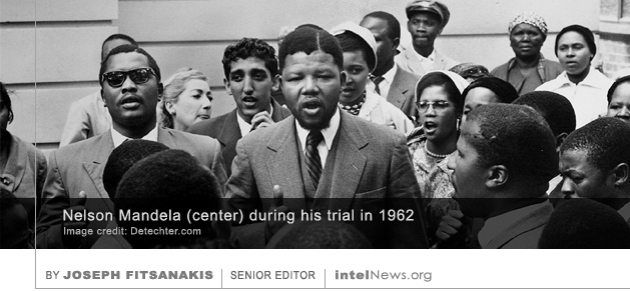
MandelaThe arrest of Nelson Mandela in 1962, which led to his 28-year incarceration, came after a tip from the United States Central Intelligence Agency, according to an American diplomat who was in South Africa at the time. At the time of his arrest, Mandela was the head of uMkhonto we Sizwe (MK), an organization he founded in 1961 to operate as the armed wing of the anti-apartheid African National Congress (ANC). But the white minority government of South Africa accused Mandela of being a terrorist and an agent of the Soviet Union. The US-Soviet rivalry of that era meant that the ANC and its leader had few supporters in America during the early stages of the Cold War.
Mandela was arrested on August 5, 1962 in the KwaZulu-Natal town of Howick by members of the South African Police. He was pretending to be the chauffeur of Cecil Williams, a white member of the ANC who was riding in the back seat of the car that Mandela was driving that night. The details of what led to Mandela’s arrest have always been mysterious, and the ANC has long suspected that the MK leader was betrayed by informants placed within the organization by the apartheid government. But an article in the London-based Sunday Times has said that it was the CIA that tipped off the South Africans about Mandela’s whereabouts that night. The claim is based on an interview with Donald Rickard, an American diplomat —now dead— who was serving as Washington’s vice-consul in Durban at the time of Mandela’s arrest. Some believe that Rickard was actually a CIA officer posing as a diplomat until his retirement from the service in 1978, and he himself never denied it.

Two weeks before he died, Rickard gave an interview to British filmmaker John Irvin, who was filming for his latest documentary, entitled Mandela’s Gun, about Mandela’s role in the MK. According to The Times, the former US diplomat told Irvin that in the early 1960s Mandela was “the most dangerous communist anywhere outside the USSR”. This is despite Mandela’s repeated denials that he had ever been a member or sympathizer of the South African Communist Party, which at the time was actively supporting the ANC. Rickard allegedly told Irvin: “I found out when [Mandela] was coming down and how he was coming […]. That’s where I was involved and that’s’ where Mandela was caught”. In his interview, Rickard insisted that Mandela was “completely under the control of the Soviet Union [and effectively] a toy for the communists”. Moreover, he said the CIA believed that he was planning to organize the large Indian population of Natal Province and incite them into an uprising led by communists, which, according to Rickard, could have prompted an armed Soviet invasion of South Africa. The former diplomat is quoted as telling Irvin: “We were teetering on the brink here and it had to be stopped, which meant Mandela had to be stopped. And I put a stop to it”.

Following his arrest, Mandela served nearly 30 years in prison on terrorism charges, until his eventual release in 1990. In 1994, he was elected as South Africa’s first black president, a post he held until his retirement in 1999. The US, which officially designated Mandela a terrorist in the 1980s under the administration of US President Ronald Reagan, kept the ANC leader on its terrorism watch list until 2008.

The US government has refused comment on Rickard’s claims.

Author: Joseph Fitsanakis | Date: 16 May 2016 | Permalink

Did Pakistan poison the CIA station chief in Islamabad?

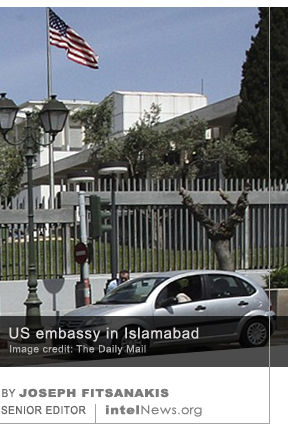
US embassy Islamabad PakistanA leading article in The Washington Post suggests that the United States Central Intelligence Agency suspected that its most senior officer in Pakistan was poisoned by the host country’s intelligence services, in an attempt to kill him. The CIA pulled its station chief from Islamabad in the summer of 2011, two months after Operation NEPTUNE SPEAR, which saw the killing in Abbottabad of al-Qaeda founder Osama bin Laden. The CIA official, who has since been identified as Mark Kelton, acted as the senior US intelligence representative in the Asian country. He had assumed the post, which was supposed to last at least two years, only seven months earlier. His abrupt removal raised questions, which were informally answered by Langley. There were rumors that Kelton’s return to the US was health-related, but that the decision to replace him was also affected by his extremely poor relations with the Inter-Services Intelligence (ISI) directorate, Pakistan’s powerful spy service.

On Thursday, however, The Washington Post’s Greg Miller said in a leading article that Kelton’s illness, which led to his replacement, had been so violent that it led him and others in the CIA to suspect that he had been poisoned. Prior to replacing him, the Agency had repeatedly flown the official back to the US for medical treatment, which proved fruitless. Eventually, some at Langley began to examine the possibility that the Pakistanis had poisoned Kelton, at a time when relations between the CIA and the ISI had sunk to unprecedented lows. Miller cites unnamed US intelligence officials who confirmed that the CIA had strong suspicions that Kelton had been deliberately poisoned. Even if the suspicions were groundless, said Miller, “the idea that the CIA and its station chief considered the ISI capable of such an act suggests that the breakdown in trust [between the two agencies] was even worse than widely assumed”.

Kelton has since recovered and assumed the post of deputy director for counterintelligence at the CIA before retiring from the Agency. The 59-year-old has since revealed his CIA background and even spoke with Miller on the phone as the Post correspondent was preparing his story. Although he declined Miller’s request for a detailed interview, the former CIA Islamabad station chief said that the initial suspicions about his poisoning “did not originate with” him. He added, however, that he would “rather let that whole episode lie”. The CIA told Miller that it had not uncovered any concrete evidence that the elements in the Pakistani government had poisoned Kelton. The embassy of Pakistan in Washington told The Washington Post that Miller’s story was “fictional and not worthy of comment”.

Author: Joseph Fitsanakis | Date: 06 May 2016 | Permalink

Portuguese appeals court orders extradition of ex-CIA officer to Italy

Sabrina De SousaAn appeals court in Portugal has ruled that a former officer of the Central Intelligence Agency is to be extradited to Italy, where she faces charges of helping kidnap a man as part of a secret operation sponsored by the United States government. Sabrina De Sousa, 59, was an accredited diplomat stationed at the US consulate in Milan, Italy, in 2003, when a CIA team kidnapped Hassan Mustafa Osama Nasr from a Milan street in broad daylight. Nasr, who goes by the nickname Abu Omar, is a former member of Egyptian militant group al-Gama’a al-Islamiyya, and was believed by the CIA to have links to al-Qaeda. Soon after his abduction, Nasr was renditioned to Egypt, where he says he was brutally tortured, raped, and held illegally for years before being released without charge.

Upon Nasr’s release from prison, Italian authorities prosecuted the CIA team that abducted him. They were able to trace the American operatives through the substantial trail of evidence that they left behind, including telephone records and bill invoices in luxury hotels in Milan and elsewhere. In 2009, De Sousa was among 22 CIA officers convicted in absentia in an Italian court for their alleged involvement in Nasr’s abduction. Since the convictions were announced, the US government has not signaled a desire to extradite those convicted to Italy to serve prison sentences. However, those convicted are now classified as international fugitives and risk arrest by Interpol and other law enforcement agencies, upon exiting US territory.

De Sousa was arrested at the Portela Airport in Lisbon, Portugal, in October of last year. She spent two nights in jail before being released. However, her passport was seized by Portuguese authorities until they decided whether to extradite her to Italy to face her conviction. After a decision was made to extradite De Sousa, her lawyers filed an appeal. Last week, however, her appeal was denied, which means that she is to be extradited after May 4. It appears that De Sousa will now have to travel to Italy in order to be given official notice of her conviction, as well as the sentence, according to European legal conventions. Following that, she will probably have to return to Portugal to serve her sentence. Her lawyer said, however, that De Sousa plans to challenge her conviction at the Supreme Court of Cassation, Italy’s highest court of appeal.

Author: Joseph Fitsanakis | Date: 26 April 2016 | Permalink


Names of intelligence officials, agents, appear in Panama Papers

Panama PapersThe massive data leak of documents belonging to Panamanian law firm Mossack Fonseca has revealed the names of intelligence officials and agents form several countries, who employed front companies to conceal their financial activities. According to German newspaper Süddeutsche Zeitung, which was the initial recipient of the largest data leak in history last summer, the list of names includes intelligence officials from the Middle East, Latin America and Africa, as well as “close intermediaries of the [United States] Central Intelligence Agency”.

Referred to as ‘the Panama Papers’, the massive leak amounts to over 11.5 million internal files from Mossack Fonseca, one of the world’s most prolific registrars and administrators of shell companies in offshore locations. Throughout its history, the company has created more than 300,000 shell companies, most of them in offshore tax havens like the British Virgin Islands, Cyprus, or Guernsey. Its clients are offered the ability to incorporate a generic-sounding company and headquarter it in an offshore tax haven. In exchange for an annual fee, Mossack Fonseca provides the company with a sham director and shareholders, thus concealing the true owner and actual beneficiary of the business.

The Süddeutsche Zeitung said on Monday that senior intelligence officials from Rwanda and Colombia are listed as Mossack Fonseca customers, but did not report the names of the individuals. It did, however, single out the late Sheikh Kamal Adham, who was director of Saudi Arabia’s General Intelligence Directorate in the 1960s and 1970s. During his 14-year directorship of the GID, the agency became a leading intermediary between the CIA and Arab intelligence agencies, notably those of Egypt and Iraq. Sheikh Adham was also a personal friend of CIA Director George Bush, who was later elected US president.

According to the Süddeutsche Zeitung, Sheikh Adham is one of many individuals with close CIA links whose names appear in the Panama Papers. Another is Farhad Azima, an Iranian-born American businessman, who is rumored to have leased aircraft to the CIA in the 1980s. The American intelligence agency is said to have used the aircraft, which belonged to Azima’s Kansas City, Missouri-headquartered Global International Airways, to transport weapons to Iran. The secret transfers were part of what later became known as the Iran-Contra scandal, in which US officials secretly sold weapons to Iran in return for the release of American hostages held by Iran-linked groups in the Middle East. The funds acquired from these weapons sales were then secretly funneled to the Contras, a medley of anti-communist paramilitary groups fighting the Sandinista-led government of Nicaragua.

Author: Joseph Fitsanakis | Date: 13 April 2016 | Permalink

Russia claims arrest of alleged CIA-trained spy

Lubyanka SquareThe Russian government says it has arrested a senior Ukrainian intelligence officer, who was allegedly trained by the United States Central Intelligence Agency and tasked with infiltrating the Russian secret services. In a statement published on Thursday, Russia’s Federal Security Service, known as FSB, said the alleged infiltrator is a “senior level employee” of the SBU, the Security Service of Ukraine. The SBU is Ukraine’s primary counterterrorism and counterintelligence agency, with much of its output focused on the Russian Federation.

The FSB statement identified the Ukrainian man as Lieutenant Colonel Yuriy Ivanchenko, but did not release further information about his background and identity, nor did it specify the details of his activities in Russia. According to the Russians, Ivanchenko allegedly entered the country in recent weeks, ostensibly in order to visit family members who live in Russia. But his real goal, according to the FSB, was to make contact with Russian intelligence and infiltrate the country’s security structure. Moscow says that Ivanchenko had planned to pose as a willing spy, namely an employee of Ukrainian intelligence who was offering to provide information to Russia. He was not a genuine spy, however, but rather a ‘dangle’ —namely someone posing as a genuine spy, but who is in fact attempting to deceive a rival intelligence agency by knowingly giving it misleading or inaccurate information.

Moreover, the Russians claim that Ivanchenko was being jointly run by the SBU and the CIA, and that the American intelligence agency had trained him to pose as a ‘dangle’ in order to collect information about FSB activities in Ukraine. The goal of the CIA, said Moscow, was to “lure an FSB employee and capture him with incriminating information”. However, the FSB statement said that Ivanchenko’s SBU connection and CIA affiliation were known to Russia prior to his arrival in the country, as he had previously tried to offer his services to Moscow. He was therefore arrested and will be deported in the coming days with a persona non grata (unwelcome person) designation. The CIA and SBU have not commented on Russia’s allegations.

Author: Joseph Fitsanakis | Date: 01 April 2016 | Permalink

German court sentences intelligence officer who spied for CIA

Markus ReichelA court in Germany has sentenced a former officer of the country’s intelligence agency, who spied for the United States and Russia from 2008 to 2014. Regular readers of this website will recall the case of ‘Markus R.’, a clerk at the Bundesnachrichtendienst, or BND, Germany’s external intelligence agency. The 32-year-old was arrested in July 2014 on suspicion of having spied for the United States’ Central Intelligence Agency. Germany’s Office of the Federal Prosecutor said at the time that Markus R. voluntarily made contact with the CIA in 2008 and offered his services to the American spy agency. He began working for the United States as a double agent soon afterwards. Soon after Markus R.’s arrest was made public, the German government ordered the immediate removal from Germany of the CIA chief of station –who was essentially the top American intelligence official in the country. Berlin also instructed its intelligence agencies to limit their cooperation with their American counterparts “to the bare essentials” until further notice.
On Thursday, Markus R., identified in some German media as Markus Reichel, was sentenced for selling over 200 classified German government documents to the CIA between 2008 and 2012, for which he said he received €80,000 ($90,000). During his trial, Reichel also admitted giving German government documents to personnel at the consulate of the Russian Federation in Munich in the summer of 2014. Among the documents that the former BND clerks is said to have given the CIA was a list of thousands of German intelligence operatives —including agents— stationed abroad, which contained their operational cover names and real identities. But Reichel was caught when German counterintelligence officers intercepted correspondence between him and his handlers and then used the information to set up a successful sting operation.

During his trial, Reichel issued a formal apology for engaging in espionage against the German state. He told the court that he had been motivated by boredom and by “lust for adventure”, which he said he did not get working for the BND. He also said he was frustrated by the lack of confidence that his superiors and colleagues had in him. “At the BND, I had the impression that no one trusted me with anything”, said Reichel. “But the CIA was different. You had the opportunity to prove yourself”, he added. Reichel was found guilty of treason against the German state and sentenced to eight years in prison.

Author: Joseph Fitsanakis | Date: 17 March 2016 | Permalink

Frank Terpil, CIA operative who defected to Cuba, dies

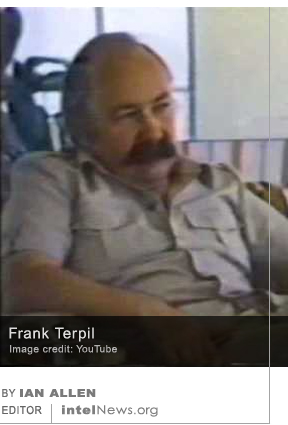
Frank TerpilFrank Terpil, a former operative of the United States Central Intelligence Agency, who defected to Cuba in 1981 to avoid charges of criminal conspiracy, has died. He was 76. Terpil resigned from the CIA in 1970, allegedly after he was caught running a pyramid scheme in India, where he had been posted by the CIA. Soon after his forced resignation from the Agency, US federal prosecutors leveled criminal charges on Terpil and his business partner. The former CIA operative was also charged with conspiracy to commit murder, after it was found that he had helped facilitate the illegal transfer of over 20 tons of plastic explosives to the government of Libya.
Terpil managed to leave the US and reappeared in Lebanon in 1980, shortly before a court in New York sentenced him in absentia to five decades in prison for conspiring to smuggle 10,000 submachine guns to African warlords, including Uganda’s dictator Idi Amin. As agents of various countries started to zero in on Terpil’s Lebanon hideout, he disappeared again and resurfaced in 1981 in Havana, Cuba. Shortly afterwards, Cuba’s General Intelligence Directorate hired him as an operative under the operational alias CURIEL. Since that time, Terpil has been repeatedly mentioned as having played a part in Cuban intelligence operations around the world, but rarely gave interviews. He appeared again in 2014, however, in a documentary entitled “Mad Dog: Inside the Secret World of Muammar Gaddafi”. The film was made by British company Fresh One Productions on behalf of Showtime, an American premium cable and satellite television network. In the documentary, Terpil admitted that he helped the Libyan dictator “eliminate” his opponents —most of them Libyan exiles living abroad.

British newspaper The Observer, which published news or Terpil’s death, said the former CIA operative’s legal status in Cuba “was never quite clear”. He had allegedly expressed concerns in recent months that the rapprochement between Washington and Havana could threaten his sanctuary in the Caribbean island. His Cuban wife told The Observer that complications from diabetes had caused his legs to be amputated in recent months. She told the paper that Terpil “died peacefully” on March 1, of heart failure.

Author: Ian Allen | Date: 07 March 2016 | Permalink

US, Russian spies often cooperate despite differences, says CIA director

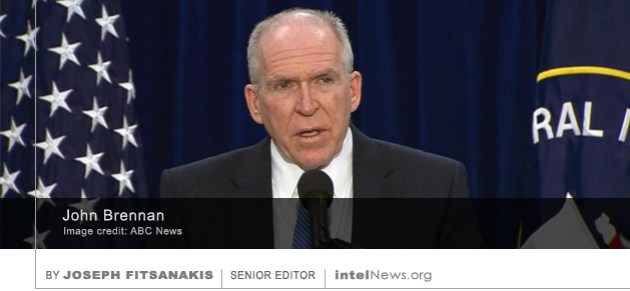
John BrennanRussia is being “very aggressive” toward the United States, but cooperation on counter-terrorism between Moscow and Washington is “highly active” despite the differences between them, according to the director of the United States Central Intelligence Agency. John Brennan, a longtime CIA career officer, who has led the Agency for nearly three years, spoke on National Public Radio on Wednesday about US-Russian relations, Syria and the Islamic State. He told the Washington-based radio station that Russian President Vladimir Putin sees Russia as a superpower that has to assert its influence beyond its immediate region. Thus, said Brennan, Moscow’s actions in Ukraine could be understood in the context of Russia’s regional-power doctrine; but its “very assertive, very aggressive” support for Syrian President Bashar al-Assad is part of a wider strategy of geopolitical domination that includes the Middle East.
Brennan said that Russia is losing ground in Ukraine because its “hybrid war” is “not going as planned” and Putin “has found that he’s in a bit of a quandary” in the former Soviet republic. Not only is Putin “not realizing his objectives” in Ukraine, added the CIA director, but the widening geopolitical confrontation between Russian and the West is “causing a chill […] even in intelligence channels”. He added, however that the CIA continues to work closely with the Russian intelligence community in counter-terrorism operations directed against Islamist militants. Brennan described the CIA’s relationship with Russian intelligence operatives as a “very factual, informative exchange. If we get information about threats to Russian citizens or diplomats, we will share it with the Russians”, said the CIA director, adding: “they do the same with us”.

Brennan, a fluent Arabic speaker who spent many years in Saudi Arabia, used the 2014 Winter Olympics in Sochi, Russia, as an example of a collaborative project between the CIA and its Russian counterparts. “We worked very closely with them” during the Sochi games, said Brennan, in order to “try to prevent terrorist attacks”. “And we did so very successfully”, concluded the CIA director.

Author: Joseph Fitsanakis | Date: 26 February 2016 | Permalink

European court of human rights censures Italy over CIA abduction case

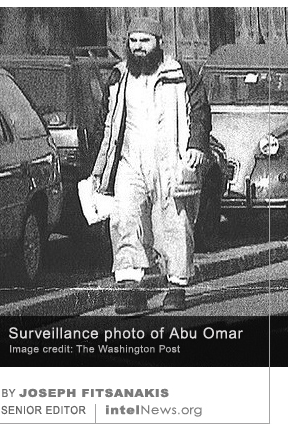
Abu Omar NasrEurope’s highest human rights court has ruled against Italy in the case of an Egyptian man who was abducted from Milan in 2003 by the United States Central Intelligence Agency. Hassan Mustafa Osama Nasr, known as Abu Omar, is a former member of al-Gama’a al-Islamiyya, an Islamist group founded in the 1970s, which aimed to overthrow the Egyptian government and replace it with an Islamic regime. Members of the group have been implicated in the assassination of Egyptian President Anwar Sadat in 1981, as well as in numerous attacks on tourist facilities in Egypt in the 1990s. Once al-Gama’a al-Islamiyya was declared illegal in Egypt, Italian authorities offered Nasr political asylum, after he successfully argued that he would be subject to torture if arrested in Egypt.
But in 2003, the CIA, which believed that Nasr was involved with al-Qaeda-linked groups in Europe, abducted him from Milan in broad daylight. After his abduction, Nasr was delivered by the CIA to Egyptian authorities under Washington’s “extraordinary rendition” program. He was then imprisoned in Egypt for four years without trial. Following his release in 2008, Nasr said he was brutally tortured and raped by his Egyptian captors and was never given access to a lawyer. Regular readers of intelNews will recall that the Nasr abduction prompted international headlines after an Italian court convicted 23 Americans and two Italians for Nasr’s kidnapping. The American defendants, most of whom are believed to be CIA officers, were tried in absentia. Washington has since refused to extradite them to Italy.

On Tuesday, Italy was found guilty of human rights violations in the Nasr case by the European Court of Human Rights, the highest court of justice sanctioned by the Council of Europe. The court said that the Italian state imposed “the principle of state secrecy […] in order to ensure that those responsible [for Nasr’s abduction] did not have to answer for their actions”. Consequently, those responsible for the abduction were “ultimately […] granted immunity”, said the court, implying that the Italian executive sabotaged the Italian trial in order to allow for the alleged CIA officers to escape justice. The court also ordered Italy to pay Nasr €115,000 ($127,000) in restitution.

Author: Joseph Fitsanakis | Date: 24 February 2016 | Permalink

CIA airplane sent to capture Edward Snowden in 2013, documents show

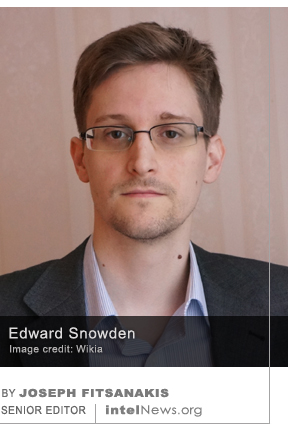
Edward SnowdenDocuments acquired through Denmark’s freedom of information act appear to show that the United States deployed an airplane, which had previously been used to rendition terrorism detainees, in an attempt to capture the American defector Edward Snowden. Snowden, a computer expert for the United States Central Intelligence Agency and the National Security Agency, is currently living in Russia, where he defected in June 2013, after initially fleeing to Hong Kong with millions of stolen US government documents in his possession. A few weeks ago, Danish news website Denfri.dk published a set of documents that confirm the deployment over Danish airspace of an American airplane in June 2013. The plane had previously been used by the CIA to carry out extraordinary renditions of terrorism detainees during the Administration of US President George W. Bush.

The documents, which were acquired by Denfri.dk after it filed a lawsuit under Denmark’s Access to Public Administration Files Act, are heavily redacted. But they do show the deployment of the Gulfstream V aircraft with registration number N977GA, which landed at an airport in Danish capital Copenhagen, after flying over the British Isles. The flight occurred at the same time that Snowden was trying to acquire political asylum in Russia, according to Denfri. The website said that the documents it received from the Danish government included a “heavily redacted” email exchange between high-level officials in the country’s Justice and Foreign Affairs Ministries, as well police and military personnel. Among them was Anders Herping Nielsen, a Danish government official specializing in the extradition of detainees who are wanted for crimes abroad.

Denfri said it contacted the Danish government to ask why the documents had been so heavily redacted before being released. It was allegedly told by the Ministry of Justice that the redacting occurred in order to avoid complications in Danish-American relations. “Denmark’s relationship with the US would be damaged if the information [contained in the redacted portion of the documents] becomes public knowledge”, said an email from the Ministry.

Author: Joseph Fitsanakis | Date: 08 February 2016 | Permalink

Portugal court rules to extradite ex-CIA officer wanted in Italy for kidnapping

Sabrina De SousaA court in Portugal has ruled to extradite a former officer of the United States Central Intelligence Agency to Italy, where she faces charges of kidnapping a man as part of a secret operation. Sabrina De Sousa, 59, was an accredited diplomat stationed at the US consulate in Milan, Italy, in 2003, when a CIA team kidnapped Hassan Mustafa Osama Nasr from a Milan street in broad daylight. Nasr, who goes by the nickname Abu Omar, is a former member of Egyptian militant group al-Gama’a al-Islamiyya, and was believed by the CIA to have links to al-Qaeda. Soon after his abduction, Nasr was renditioned to Egypt, where he says he was brutally tortured, raped, and held illegally for years before being released without charge.

Upon Nasr’s release from prison, Italian authorities prosecuted the CIA team that abducted him. They were able to trace the American operatives through the substantial trail of evidence that they left behind, including telephone records and bill invoices in luxury hotels in Milan and elsewhere. In 2009, De Sousa was among 22 CIA officers convicted in absentia in an Italian court for their alleged involvement in Nasr’s abduction. Since the convictions were announced, the US government has not signaled a desire to extradite those convicted to Italy to serve prison sentences. However, those convicted are now classified as international fugitives and risk arrest by Interpol and other law enforcement agencies, upon exiting US territory.

De Sousa was arrested at the Portela Airport in Lisbon, Portugal, in October of last year. She spent two nights in jail before being released. However, her passport was seized by Portuguese authorities until they decided whether to extradite her to Italy to face her conviction. The Reuters news agency said on Friday that De Sousa would “be surrendered to Italian authorities” so that she could be informed of the Italian court’s decision to convict her in 2009. The news agency was reportedly told by a Portuguese court official that De Sousa would have to travel to Italy in order to be given official notice of her conviction, as well as the sentence, according to European legal conventions. Following that, she would have to return to Portugal to serve her sentence. Her lawyer said, however, that De Sousa planned to challenge her conviction at the Supreme Court of Cassation, Italy’s highest court of appeal.

Author: Joseph Fitsanakis | Date: 18 January 2016 | Permalink