MI6 archives reveal plans for WWII and Cold War black operations

Sir Stewart MenziesBy JOSEPH FITSANAKIS | intelNews.org |
Recently declassified British archives reveal a host of audacious plans for covert operations aimed at Nazi-occupied Europe during wartime and, after 1948, inside the Soviet Union. The plans, proposed by British intelligence officials, ranged from relatively innocuous psychological operations to assassinations of key political figures. The wartime plans were proposed in 1944 by Charles Peake, a British intelligence officer detailed to the headquarters of General Dwight Eisenhower. The iconic American military commander was in charge of plans for Operation OVERLORD, the allied troop landings on the beaches of Normandy in northern France. According to documents released last week by the United Kingdom National Archives, Peake’s proposal was entitled “Assassination Priorities for OVERLORD”. It contained an extensive list of senior German and French Axis officials that should be targeted for assassination in preparation for the D-Day landings. The hit list included “certain Germans in key positions in France”, notably Field Marshals Gerd von Rundstedt and Erwin Rommel. It also incorporated several senior members of France’s Nazi-controlled Vichy administration under Marshal Philippe Pétain. The proposal, however, was quickly shot down by no other than General Stewart Menzies, Director of the Secret Intelligence Service (known as MI6), who feared that intrusive covert actions by allied operatives would cause brutal reprisals against allied prisoners of war. Ironically, Menzies, known in government simply as “C”, drafted an ever more ambitious plan for black operations after the end of World War II, this time targeted at the Soviet Union. Read more of this post

Intelligence historian calls on MI6 to declassify Lumumba files

Patrice LumumbaBy JOSEPH FITSANAKIS | intelNews.org |
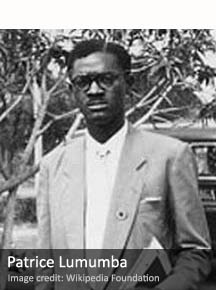
An historian whose book on British intelligence prompted the claim of Britain’s complicity in the 1961 assassination Patrice Lumumba has called for MI6 to declassify its secret files on the late Congolese Prime Minister. Calder Walton is a Cambridge University-educated intelligence historian whose first book, Empire of Secrets, examines the activities of British intelligence in the last days of the British Empire. A review of the book, published by Bernard Porter in The London Review of Books in March, prompted a claim that London had organized the assassination of the iconic pan-Africanist activist, who in 1960 had become Congo’s first democratically elected Prime Minister. Many believe that the United States had a hand in Lumumba’s assassination, which was aimed at preventing him from establishing close relations between uranium-rich Congo and the Soviet Union. But British Labour politician and Life peer Lord Lea of Crondall said in a letter published in response to the review of Walton’s book that Lumumba had been killed with the help of MI6, Britain’s primary external intelligence service. He claimed he had been told so by the late Baroness Park of Monmouth, who at the time of Lumumba’s death headed the Leopoldville station of MI6. In his book, Walton, who until 2009 served as research assistant for Professor Christopher Andrew’s authorized official history of MI5, Defence of the Realm, says it is unclear who organized Lumumba’s assassination. He argues that “at present, we do not know […] whether British plots to assassinate Lumumba […] ever amounted to anything”. But speaking to The London Times on Wednesday, the historian and author urged MI6 to declassify its internal archives on the Congolese leader. Read more of this post

Did MI6, not CIA, kill Congolese Prime Minister Patrice Lumumba?

Patrice LumumbaBy JOSEPH FITSANAKIS | intelNews.org |
The 1961 abduction and murder of iconic Congolese Prime Minister Patrice Lumumba was organized by British, not American, intelligence, according to a claim made this week by a British Labour politician and Life peer. Lord Lea of Crondall said in a letter published in the current edition of The London Review of Books that he was told so by Baroness Park of Monmouth, who at the time headed the Leopoldville station of MI6, Britain’s primary external intelligence service. Lumumba was a pan-Africanist activist who in 1958 helped found the Mouvement National Congolais, later becoming the organization’s leader. In 1960, he became Congo’s first democratically elected Prime Minister. However, his government soon became embroiled in the Cold-War rivalry between the United States and the Soviet Union. Many believe that Washington, fearing that Lumumba would attach uranium-rich Congo to the Soviet sphere of influence, tasked the Central Intelligence Agency with organize a coup d’état against him. It was carried out by Congolese Colonel Joseph Mobutu Sese Seko, who then ruled Congo with an iron fist until his death in 1997. In January 1961, pro-Mobutu soldiers, assisted by Belgian troops, abducted Lumumba and executed him following several days of beatings and torture. But according to Lord Lea, Baroness Park told him shortly before she died, in 2010, that she had orchestrated Lumumba’s killing on behalf of MI6. Known as Daphne Park until she entered the peerage, Park was often referred to as “the queen of spies” due to her four decades in the service of MI6. As one of the top female British intelligence officers, Park served as Second Secretary at the British Embassy in Moscow between 1954 and 1956, before being transferred to Congo in 1959. While there, she served as Consul and First Secretary at the British embassy in Leopoldville —renamed Kinshasa following Congo’s independence. Read more of this post

Court rejects release of spy records on iconic Canadian politician

Tommy DouglasBy JOSEPH FITSANAKIS | intelNews.org |
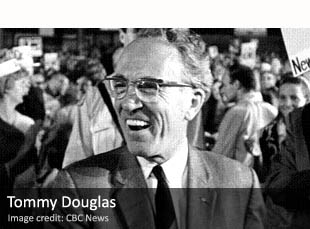
Canada’s highest court has rejected a legal argument in favor of releasing surveillance records on Tommy Douglas, an iconic Canadian politician who was monitored for most of his life by the security services. Douglas was a Scottish-born Baptist minister who later became the leader of the New Democratic Party and Premier of the Canadian province of Saskatchewan. Under his Premiership, which lasted from 1944 to 1961, Saskatchewan’s government became the first democratic socialist administration in North America and the first in the Americas to introduce a single-payer universal healthcare program. But Douglas, who is widely recognized as the father of Canada’s healthcare system, was under constant surveillance by Canadian intelligence throughout most of his life. Government records show that the now-defunct Security Service of the Royal Canadian Mounted Police (RCMP) began monitoring the socialist politician shortly before the outbreak of World War II. It appears that, in the political context of the Cold War, Douglas had drawn the attention of Canada’s security establishment by supporting antiwar causes, which led some to suspect him of holding pro-communist sympathies. The government surveillance, which was at times extensive, lasted until shortly before the politician’s death in 1986. Under Canada’s legal system, security dossiers on individuals are typically released 20 years after the target’s death. However, even though several hundred pages from Douglas’ dossier have already been released, many hundreds more remain secret. In 2005, Canadian Press reporter Jim Bronskill launched a legal campaign aimed at securing the release of the remaining pages in Douglas’ dossier. His campaign is supported by Douglas’ family, notably Douglas’ daughter, Shirley. But the Canadian government has resisted Bronskill’s effort from the very beginning. Read more of this post

British journalists worked for MI6 during the Cold War: investigation

George BlakeBy JOSEPH FITSANAKIS | intelNews.org |
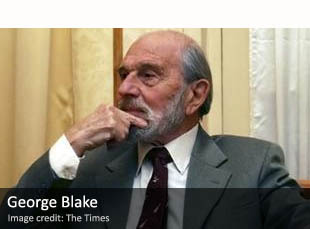
Numerous notable journalists working for some of Britain’s most prestigious publications routinely collaborated with British intelligence during the Cold War, according to a BBC investigation. In 1968, Soviet newspaper Izvestia published the contents of an alleged British government memorandum entitled “Liaison Between the BBC and SIS”. SIS, which stands for Secret Intelligence Service, also known as MI6, is Britain’s foremost external intelligence agency. The paper, which was the official organ of the Presidium of the Supreme Soviet of the USSR, claimed that the foreign correspondents of most leading British newspapers secretly collaborated with the British intelligence community. It also alleged that the BBC’s world radio service had agreed with MI6 to broadcast preselected sentences or songs at prearranged times. These signals were used by British intelligence officers to demonstrate to foreign recruits in the Eastern Bloc that they were operating on behalf of the UK. At the time, the BBC virulently rejected the Izvestia’s claims, calling them “black propaganda” aimed at distracting world opinion from the invasion of Czechoslovakia by Warsaw Pact troops, which had taken place some months earlier. But an investigation aired this week by the BBC Radio 4’s investigative Document program suggests that the memo published by the Soviet newspaper was probably genuine. The program says it discovered a memorandum in the BBC’s archives, which laments the embarrassment caused to MI6 by the Soviet claims. The memorandum, dated April 24, 1969, describes MI6 as “our friends”. The BBC program, which is available to listen to here, discusses the Soviets’ claims that several notable British journalists were MI6 agents. Read more of this post

News you may have missed #824 (India edition)

Tony MendezBy IAN ALLEN | intelNews.org |
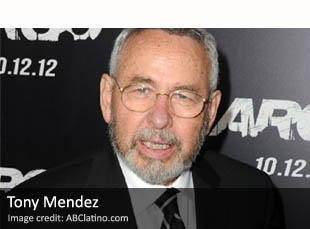
►►CIA honed ARGO exfiltration skills in India. The Oscar-winning movie Argo has popularized the 1980 exfiltration by the CIA of a group of American diplomats from Tehran. But few know that Tony Mendez, the CIA officer in charge of the Iran operation, cut his teeth exfiltrating CIA targets in India. In his book, titled Argo, Mendez mentions the 1970 exfiltration of a Soviet defector in India codenamed Nestor. He claims that Nestor was a “huge catch” for the CIA, as he provided the Agency with “invaluable intelligence on the KGB’s operations in Central and Southeast Asia”.
►►Ex-CIA officer says al-Qaeda wanted India-Pakistan nuclear war. In his latest book, Avoiding Armageddon: America, India, and Pakistan to the Brink and Back, former CIA officer Bruce Riedel says al-Qaeda helped plan the 2008 Mumbai attacks. Its goal was to “spark a nuclear war between India and Pakistan in order to polarize the world between Islam and the ‘Crusader-Zionist-Hindu’ conspiracy”. But the group’s plan was hampered by India’s restraint and refusal to strike back using force, he argues.
►►Man passing defense info to Pakistan held in India. Reports suggest that Sumer Khan, 34, from Rajasthan’s Jaisalmer district, has been arrested for sending strategic information to Pakistan’s ISI intelligence agency via emails and mobile calls for the past three years. A source said that Khan was caught after his calls to Pakistan were intercepted by Indian military intelligence and Intelligence Bureau. The arrest comes just two days after the conclusion of India’s biggest-ever air exercise, ‘Iron Fist’, in Jaisalmer.

Philby’s son, widow, speak on 50th anniversary of his defection

Philby interview c.1967 By IAN ALLEN | intelNews.org |
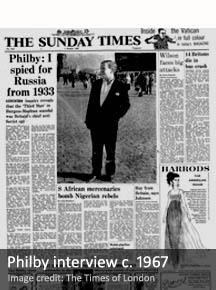
For most of us, January 23, 2013, was a day like any other. But for intelligence history aficionados it marked the 50th anniversary of the escape to Moscow of notorious double spy Harold Adrian Russell Philby. Known as ‘Kim’ to his friends, Philby secretly defected to the USSR from his home in Beirut, Lebanon, in 1963. He is widely considered history’s most successful double spy. While working as a senior member of British intelligence, he spied on behalf of the Soviet NKVD and KGB from the early 1930s until his defection. In 1965, he was awarded the Order of the Red Banner. When he died, in 1988, he was buried with honors by the Soviet authorities. Philby’s defection sent ripples of shock across Western intelligence and is often described as one of the most dramatic moments of the Cold War. On the 50th anniversary of Philby’s defection to Moscow, British newspaper The Daily Telegraph carried an article with excerpts of interviews with one of Philby’s sons, Dudley Thomas Philby, and his Russian widow, Rufina Pukhova Philby. Born in 1946, Dudley ‘Tommy’ Philby is the third of Kim’s five children with his second of four wives, Aileen Furse Philby. Aileen died in 1957, when Tommy was just 11 years old; his contact with his father was cut off as soon as the double spy defected to the USSR in January 1963. But it was resumed a few months later, when he received a letter from his father in Moscow. Eventually, Tommy visited Kim five times in Moscow in the 1970s. Speaking on the anniversary of his late father’s defection, he described him as “a very kind man” and “a very good father”, who “had his belief [in] communism [and] carried it out”. He told The Telegraph that he personally did not agree with his father’s political views, but added: “he was what he was, what could I do?”. He told the paper that Kim eventually came to think that “it was all wrong”, implying that Philby grew disillusioned with the Soviet system. Read more of this post

Closed-door trial of Soviet/Russian sleeper agents starts in Germany

The Anschlags' house in MeckenheimBy JOSEPH FITSANAKIS | intelNews.org |
A married couple accused of spying on Germany on behalf of the Soviet Union and Russia for over two decades has gone on trial in Stuttgart. Andreas Anschlag, 54, and his wife, Heidrun, 48, were arrested in October 2011 by GSG-9, the elite counter-terrorism and special operations unit of the German Federal Police. They were later charged with having spied since at least 1990 for the Soviet KGB’s First Chief Directorate and its post-Soviet successor organization, the SVR. German federal prosecutors also accuse the couple of document forgery, since their Austrian passports, which they used to enter West Germany from Mexico in 1988 (Andreas) and 1990 (Heidrun) are believed to be counterfeit. There is also speculation that the couple’s surname may in fact be an alias given to them by their intelligence handlers. Upon entering West Germany in 1988 and 1990, the Anschlags initially settled in Aachen, on the German-Belgian border, before moving to Meckenheim, a small town with a population of less than 30,000 located a few miles southwest of Bonn. They concentrated on blending into German society, while raising their son daughter and leading what their neighbors describe as a “discreet life”. Over the years, they managed to recruit a number of informants, including a Dutch diplomat identified by authorities in Holland only as ‘Raymond P’. The diplomat, who was arrested last June, is believed to have given the Anschlags nearly 500 classified documents originating from the German armed forces, the North Atlantic Treaty Organization and the European Union. Read more of this post

Soviets used civilian airliners to gather intelligence, documents show

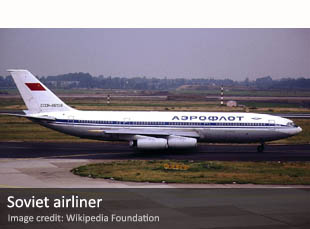
Soviet Aeroflot airlinerBy JOSEPH FITSANAKIS | intelNews.org |
Soviet spy agencies routinely used civilian airplanes to collect aerial intelligence over Western military installations, according to newly declassified documents. The revelation is contained in British government files from 1982 that were declassified on Friday, following the expiration of the United Kingdom’s 30-year classification rule. According to Bloomberg’s Robet Hutton and Thomas Penny, who accessed the files, they include a detailed memorandum addressed to Conservative Party politician Margaret Thatcher, who was serving as Britain’s Prime Minister at the time. The memorandum, which was authored by then Secretary of State for Defence, John Nott, informed Mrs. Thatcher that the airborne behavior of airliners belonging to Aeroflot, the Soviet Union’s state-owned civilian air carrier, appeared suspicious. Secretary Nott wrote in the memo that Britain’s Royal Air Force had “established that some [Soviet] aircraft deviated from their flight-plan routes” when flying over Western military bases. He goes on to describe an “incident of particular interest”, in which an Aeroflot Ilyushin IL62 airplane descended without authorization from 35,000 feet to 10,000 feet right above the village of Boulmer. Located in Northumberland, England, Boulmer is adjacent to a Royal Air Force base, which at the time featured a newly modernized radar system. The same Aeroflot airplane behaved in similar fashion while flying over a United States Navy base in Groton, Connecticut, which at the time hosted the first US submarine equipped with Trident Ballistic Missiles. The memorandum states that the circumstances surrounding the flight patterns of Aeroflot airliners had led the Royal Air Force to assume that the Soviet airplanes “were gathering intelligence” on Western military targets. Read more of this post

Illegal spy agency operated in West Germany, new book claims

Willy BrandtBy JOSEPH FITSANAKIS | intelNews.org |
Conservative politicians in Cold-War West Germany set up an illegal domestic intelligence agency in order to spy on their political rivals, a forthcoming book claims. In Destroy After Reading: The Secret Intelligence Service of the CDU and CSU, German journalist Stefanie Waske exposes what she says was an elaborate plot to undermine West Germany’s rapprochement with Soviet-dominated Eastern Europe. The book, which is scheduled for publication in February of 2013, claims that the illegal intelligence agency, known as ‘the Little Service’, was set up by politicians from Germany’s conservative Christian Democratic Union (CDU) and its sister organization, the Christian Social Union of Bavaria (CSU). The two parties allegedly founded ‘the Little Service’ in 1969, in response to the election of Willy Brandt as German Chancellor in 1969. Brandt, who was leader of the center-left Social Democratic Party of Germany (SDP), was elected based on a program of normalizing West Germany’s relations with Eastern Europe. Under this policy, which became known as ‘Neue Ostpolitik’ (‘new eastern policy’), Brandt radically transformed West German foreign policy on Eastern Europe. In 1970, just months after his election, he signed an extensive peace agreement with the Soviet Union, known as the Treaty of Moscow, which was followed later that year by the so-called Treaty of Warsaw. Under the latter agreement, West Germany officially recognized the existence and borders of the People’s Republic of Poland. Brandt’s Neue Ostpolitik, which continued until the end of his tenure in the Chancellery in 1974, earned him the Nobel Peace Prize for his efforts to achieve reconciliation between West Germany and the countries of the Soviet bloc, primarily East Germany. But Brandt’s policy of rapprochement alarmed the CDU/CSU coalition, says Waske, which quickly set up ‘the Little Service’ by enlisting former members of Germany’s intelligence community. Read more of this post

News you may have missed #812

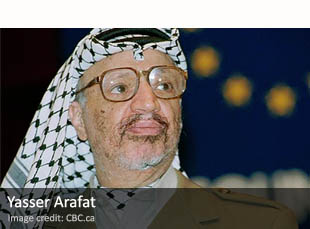
Yasser ArafatBy IAN ALLEN | intelNews.org |
►►Russia to help probe Yasser Arafat’s death. Russia will join an international investigation to determine whether the first Palestinian president, Yasser Arafat, was murdered, the current Palestinian leader, Mahmoud Abbas, has said. French and Swiss experts are due to exhume Arafat’s body in Ramallah later this month in an attempt to discover how he died after an al-Jazeera documentary in July suggested he was killed by a rare radioactive poison. Abbas asked Russian foreign minister Sergei Lavrov for Moscow’s help during talks in Jordan, Palestinian sources said.
►►Revisiting the foiled 1984 Nigerian kidnap plot. In London in 1984, a team of Nigerians and Israelis attempted to kidnap and repatriate the exiled former Nigerian minister Umaru Dikko. Mr. Dikko, who had fled Nigeria after a military coup, was accused of stealing $1bn (£625m) of government money. The plot was foiled by a young British customs officer and, as a result, diplomatic relations between the UK and Nigeria broke down and were only fully restored two years later. The Nigerian and Israeli governments have always denied involvement in the kidnapping.
►►Putin congratulates KGB double spy on his birthday. Russian President Vladimir Putin has congratulated famous double agent George Blake on his 90th birthday, the Kremlin press office has said. Blake betrayed British intelligence starting in the 1950s; he was found out in 1961 and sentenced to 42 years in prison. But he escaped five years later using a ladder of rope and knitting needles, made his way to the Soviet Union and has been living out his last years serenely in a cottage outside Moscow. After his escape from the Wormwood Scrubs prison in London, he was smuggled to Berlin in a wooden box in the back of a van. In the interview published last week, he said he then presented himself to border guards in East Berlin, asked to speak to a Soviet officer, and when told to wait, immediately fell into a deep sleep.

Canadian diplomats spied for the CIA in Cuba, claims new book

Embassy of Canada in Havana, CubaBy JOSEPH FITSANAKIS | intelNews.org |
Several accredited Canadian diplomats were recruited by the United States Central Intelligence Agency to spy on Cuba in the aftermath of the 1962 missile crisis, according to a new book. Authored by Canadian retired diplomat John Graham, the book, entitled Whose Man in Havana? Adventures from the Far Side of Diplomacy, is to be published this week by Penumbra Press. In it, Graham claims that he was among a number of Canadian diplomats stationed in Cuba, who were secretly recruited by the CIA. The US agency had been essentially forced out of the island after Washington and Havana terminated diplomatic relations in 1961, soon after the government of Fidel Castro declared itself a proponent of Marxism. The closure of the US embassy meant that the CIA had no base from which to operate in the Caribbean island. Two years later, in May 1963, US President John F. Kennedy personally asked Canadian Prime Minister Lester Pearson for assistance in intelligence-gathering efforts in Cuba. The Canadian leader consented and, according to Graham, Canadian diplomatic officials actively assisted the CIA until at least 1970. The author states in his book that he himself operated in Cuba for two years, from 1962 until 1964, under the official cover of Political Officer at the Canadian embassy in Havana. Prior to that, he says, he was provided with rudimentary training by the CIA, which consisted of spending “just a few days” at the Agency’s headquarters in Langley, VA. He was then tasked with conducting physical surveillance of Soviet military bases on Cuba and, if possible, identifying weapons and electronic security measures, and noting troop movements. Read more of this post

News you may have missed #782 (history edition)

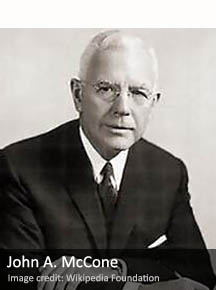
John A. McConeBy IAN ALLEN | intelNews.org |
►►Did US DCI McCone authorize CIA assassinations? By the CIA’s own admission, we do know the Agency was involved in attempts to kill or overthrow several Third World leaders during the Cold War. But the doctrine of plausible deniability meant there is no paper trail identifying those who ordered such operations. Evidence is reasonably clear that Allen W. Dulles, who served as Director of Central Intelligence (DCI) for nearly nine years, sanctioned them. But what about John A. McCone (pictured), whom Kennedy appointed as DCI in 1961? Is it possible that the CIA carried out assassination plots without his approval or even in the face of his disapproval? Newly discovered notes from a cryptic telephone call McCone made to Secretary of State Dean Rusk on August 21, 1962, support the claim that, while McCone opposed any open discussion of assassination proposals, he did not oppose the efforts as a matter of principle.
►►Ronald Reagan was FBI informant (Note: this is not new information, but it helps to refresh one’s memory from time to time). In the early stages of the Cold War, FBI Director J. Edgar Hoover feared a ‘Kremlin-controlled conspiracy’ to infiltrate Hollywood and use the world’s largest producer of motion pictures to manipulate public opinion against America. In 1945, Ronald Reagan, then an actor, passed along some political gossip of special interest to Hoover. Eventually, Reagan served as an informer in the Bureau’s investigation of alleged communist infiltration of the radio and television industry. He was listed as “Confidential Informant T-36”. Agents described him as “reliable”.
►►Senior Black Panther member was FBI informant. Prominent 1960s Black Panther Party member Richard Masato Aoki, who gave the Black Panthers some of their first firearms and weapons training, was an undercover FBI informer in California, a former agent and FBI report reveal. Aoki’s role inside the Black Panthers was discovered by Seth Rosenfeld while researching his book Subversives: The FBI’s War on Student Radicals, and Reagan’s Rise to Power, which was published today by Farrar, Straus and Giroux. Aoki’s life in the Black Panthers was documented in a 2009 film, Aoki and a 2012 biography titled Samurai Among Panthers. Neither mentioned his work with the FBI. Rosenfeld said Aoki had contended in a 2007 interview it wasn’t true he was an informant, but added: “people change. It is complex. Layer upon layer”.

Missing section of Cold War spy tunnel unearthed in Germany

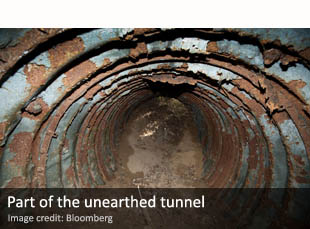
Part of the unearthed tunnelBy JOSEPH FITSANAKIS | intelNews.org |
A missing section of a secret tunnel, constructed by British and American intelligence agencies to spy on Soviet and East German government communications during the Cold War has been unearthed in Germany. The tunnel, believed to be nearly half a kilometer (1/3 mile) long, was part of the Central Intelligence Agency’s Operation GOLD, also known as Operation STOPWATCH in Britain. It was based on an idea initially suggested to the Americans in the early 1950s by Britain’s Secret Intelligence Service (MI6), which had carried out a similar scheme in Soviet-occupied Austria. The CIA adopted and funded the program at the cost of nearly $7 million. At its completion, the underground tunnel connected a secret entry-point in Rudow, West Berlin, to a location beneath Alt-Glienicke in East Berlin. The aim behind the project was to tap into underground telephone cables facilitating Soviet and East German military and civilian government communications. But the KGB, the Soviet Union’s foremost intelligence agency during the Cold War, was aware of the project almost from its infancy, thanks to George Blake, a British informant who was later convicted to 42 years in prison, but managed to escape to Moscow in 1966. Interestingly, the KGB did not reveal the tunnel’s existence to the Soviet and East German militaries, fearing that a sudden rerouting of communications cables would expose Blake as a Soviet mole. Instead, they allowed the tunnel to operate for nearly a year before publicly exposing its existence in 1956. At that time, Soviet and East German authorities dug up the eastern section of the tunnel and bussed in hundreds of international reporters, as well as tens of thousands of East Germans, to view the tunnel, in a massive propaganda campaign. In 1997, part of the tunnel that crossed West Berlin was excavated and transported to the Allied Museum in Berlin. Read more of this post

News you may have missed #777

KH-9 HexagonBy IAN ALLEN | intelNews.org |
►►Egypt sacks spy chief after border attacks.  Egypt’s President Mohamed Morsi sacked the Director of the General Intelligence Directorate, Murad Muwafi, two generals and the governor of north Sinai region on Wednesday, after gunmen killed 16 border guards there on Sunday before last. Mowafi was the most high-profile official who lost his job, forced into early retirement as Egypt’s intelligence agencies were criticized for missing or ignoring warnings about the attack.
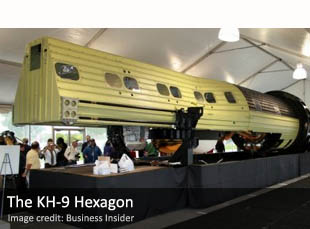
►►Photos reveal CIA deep-sea rescue of a spy satellite. On July 10, 1971, America’s newest photo reconnaissance satellite, the KH-9 Hexagon, dropped a capsule loaded with film toward the Earth. Due to a technical error, the capsule sunk in the Pacific Ocean. Last week, the CIA declassified documents and photographs showing how it went 16,000 feet into the sea to recover the Hexagon capsule.
►►Pre-inquest review into death of ex-KGB officer Litvinenko. A British High Court judge will soon hold a pre-inquest review into the death of Russian spy Alexander Litvinenko, officials have said. Litvinenko, who was working for MI6 following his defection from Russia, is believed to have been poisoned with radioactive polonium-210 in London, in November 2006. British prosecutors accuse former KGB operatives Andrei Lugovoy and Dmitry Kovtun for the murder. However, earlier this year Lugovoy reportedly passed a lie detector test on the subject of Litvinenko’s death, which was administered in Moscow by the British Polygraph Association.