Spy equipment discovered near Russian military base in Syria
April 1, 2013 10 Comments
 By JOSEPH FITSANAKIS | intelNews.org |
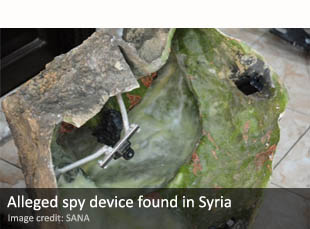
Sophisticated intelligence-collection devices hidden inside faux boulders have been discovered on an island situated across from a Russian naval base in Syria. The devices were found on Al-Naml, an uninhabited islet of only 150 square meters, which overlooks the Syrian port of Tartus, site of a major Russian naval military facility. According to Al-Manar, a satellite television station affiliated with the Lebanese Shiite militant group Hezbollah, the fake boulders were carefully placed on Al-Naml by Israeli commandos during a nighttime operation. Television images showed a system of satellite dishes and cameras, which appear to be connected to custom-made batteries via a series of cables. The imitation boulders, which conceal the electronic surveillance devices, seem to have been carefully designed in order to blend in with the surrounding rocks and brushes on Al-Nami. Al-Manar said on its website that at least three such devices were “discovered by local fishermen”. It added that the camouflaged contraptions appear to be aimed at tracking the movements of Russian vessels sailing to and from Tartus. Moreover, the devices appear to be capable of transmitting pictures of vessels to Israel in real time, via satellite. The naval base at Tartus was first leased to the Soviet Navy by the Syrian government in 1971. In response, the Kremlin forgave a multi-billion dollar debt owed by Damascus. Today, Tartus constitutes Russia’s sole military facility situated outside the regions of the former Soviet Union. It is also Russia’s only naval base in the Mediterranean, and many strategic analysts consider it as the primary geopolitical justification behind Moscow’s support for the regime of Syrian President Bashar al-Assad. Read more of this post


















Diplomat jailed in biggest Dutch spy affair in recent times
April 24, 2013 by Joseph Fitsanakis 4 Comments
A court in the Netherlands has sentenced a diplomat to 12 years in prison for spying for Russia, in what security observers have called one of the worst espionage scandals in recent Dutch history. Raymond Poeteray, who had worked for Holland’s Ministry of Foreign Affairs since 1978, was convicted on Tuesday of spying for the Russian Foreign Intelligence Service (SVR). Poeteray was arrested in June of 2012 at Amsterdam’s Schiphol International Airport, following an extensive investigation by German counterintelligence. The diplomat was captured as he was boarding a flight to Vienna, Austria, the first leg in a return journey to Bangkok, Thailand. Dutch prosecutors claimed during Poeteray’s trial that he had arranged to meet his Russian handlers in Bangkok and give them three USB drives loaded with classified information, which were found on in his possessions upon his arrest at Schiphol. The three-judge panel that sentenced Poeteray at The Hague said he had spied on Holland “for years [while] on assignment from the Russian Foreign Intelligence Service”, in the course of which he damaged the interests of his home country in a “substantial” way. The Dutch prosecutor’s office said Poeteray had provided Moscow with sensitive information, including military and political intelligence on the European Union, inside material on the North Atlantic Treaty Organization, as well as documents belonging to the Dutch Foreign Affairs Ministry. The court heard that, in recent years, the diplomat had given the SVR information about Dutch involvement in the Libyan Civil War, classified data from European-Union-sponsored fact-finding missions in the Republic of Georgia, as well as intelligence on Dutch peacekeeping operations in Afghanistan, Kosovo, and elsewhere. Read more of this post
Filed under Expert news and commentary on intelligence, espionage, spies and spying Tagged with counterintelligence, espionage, lawsuits, Netherlands, News, Raymond P., Raymond Poeteray, Raymond Valentino Poeteray, SVR (Russia)