Colombian intelligence spied on Russian and Cuban diplomats, reports claim
January 18, 2023 1 Comment
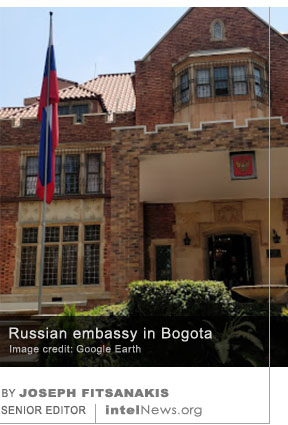 COLOMBIAN INTELLIGENCE CARRIED OUT surveillance operations against Russian and Cuban diplomats stationed in Colombia between 2016 and 2019, according to media reports that surfaced earlier this week. The reports claim that Colombia’s National Intelligence Directorate (DNI) was behind the operations, which involved physical, as well as electronic, surveillance.
One of the operations was reportedly codenamed CATEDRA, and targeted three senior staff members of the Russian embassy in the Colombian capital Bogota. In addition to the diplomats themselves, DNI agents allegedly spied on the diplomats’ spouses and their children. In some cases, DNI agents disguised themselves as “street vendors” in order to spy on the homes of the diplomats. The agency also planted electronic devices in hotels around Colombia —notably in the resort town of Melgar in central Colombia, where over a dozen staff members of the Russian embassy holidayed in 2017.
Allegedly, Operation CATEDRA also involved the interception of communications of at least two Russian diplomats. These were identified as Denis Viktorovich Khromov, who served as the second secretary at the Russian embassy in Bogota, as well as Aleksandr Nikolayevich Belousov, who in late 2020 was declared persona non grata and expelled by the Colombian government on charges of espionage. Colombian media said at the time that Belousov had been outed as an intelligence officer, following a two-year DNI operation codenamed ENIGMA.
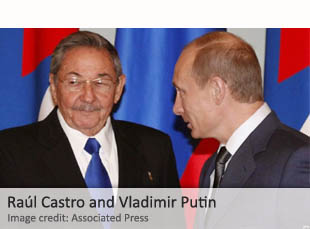
The DNI also spied on at least 10 Cuban diplomats and other members of the embassy of Cuba in Bogota, according to the same reports. The operation, codenamed MATIAS, investigated alleged “Cuban interference” in Colombia, and took place while the Cuban government was hosting peace talks between the Colombian government of then-president Juan Manuel Santos and leaders of the country’s largest militant groups, the Revolutionary Armed Forces of Colombia (FARC) and the National Liberation Army (ELN).
According to the reports, the DNI recruited a Cuban embassy worker, instructing her to “install [surveillance] devices and extract information from the building where control targets [were] located”. This eventually enabled the DNI to gain “access to security cameras and rooms throughout the building” of the Cuban embassy, the reports claim. Operations MATIAS and CATEDRA were reportedly concluded in 2019.
► Author: Joseph Fitsanakis | Date: 18 January 2023 | Permalink
 A NEW REPORT BY the United States National Academies of Sciences, Engineering, and Medicine, has found that the so-called ‘Havana Syndrome’, which afflicted American and Canadian diplomats in Cuba and China in 2016 and 2017, was likely caused by directed microwave radiation. The study, which was commissioned by the US Department of State, is the latest in a
 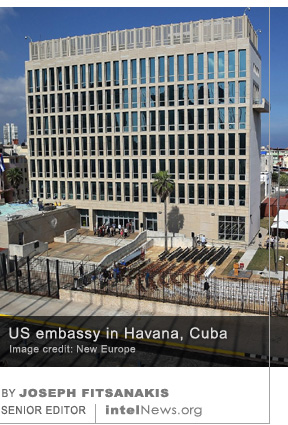 A series of alleged “sonic attacks” by a mysterious weapon may have caused the brains of American diplomats who served at the United States embassy in Cuba to shrink, according to a new scientific study. In 2017 Washington
  Documents that were allegedly leaked by a Cuban intelligence insider show that Cuban spies targeted the Miami International Airport (MIA) and may have acquired MIA internal files, passwords and other sensitive information. The documents were
  A Russian-made device caused the mystery ailments that affected more than two dozen American diplomats in Cuba and China, according to United States government officials who have been briefed on the matter. Since September of last year, Washington has recalled the majority of its personnel from its embassy in Havana and at least
  The government of Canada has announced plans to evacuate family members of its diplomats serving in Cuba, because of medical issues caused by an alleged espionage-related technological device. These concerns have persisted among United States and Canadian diplomatic staff since the fall of 2016, when several members of staff at the US embassy in Havana
  A public event has been held for the first time in Havana to demand the release
 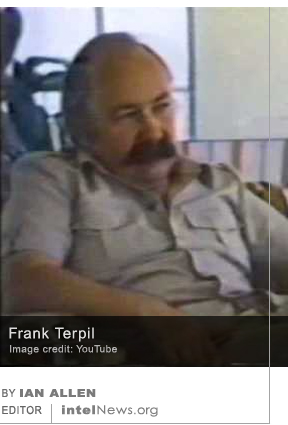 Frank Terpil, a former operative of the United States Central Intelligence Agency, who defected to Cuba in 1981 to avoid charges of criminal conspiracy, has died. He was 76. Terpil resigned from the CIA in 1970, allegedly after he was caught running a pyramid scheme in India, where he had been posted by the CIA. Soon after his forced resignation from the Agency, US federal prosecutors leveled criminal charges on Terpil and his business partner. The former CIA operative was also charged with conspiracy to commit murder, after it was found that he had helped facilitate the illegal transfer of over 20 tons of plastic explosives to the government of Libya.







 intelNews.org
United States consistently underestimates Cuban intelligence, sources say
March 18, 2024 by Ian Allen 5 Comments
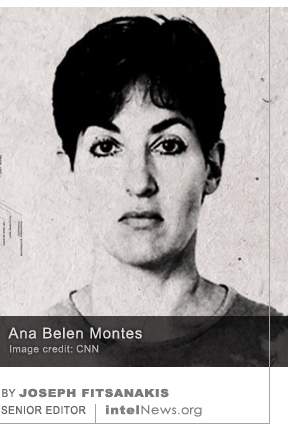
Among the strengths of the Cuban intelligence service is its ability to recruit Americans who are motivated by ideological reasons, rather than by financial gain. The Cubans have historically approached Americans at a young age, usually at universities in the United States or other countries in the Americas. They cultivate those relationships by employing strategic patience that pays off many years —even decades— later. By recruiting ideological sympathizers, the Cubans rarely need to pay their agents large amounts of money, as the cases of Defense Intelligence Agency analyst Ana Belén Montes and State Department diplomat Manuel Rocha suggest. Many Cuban agents enter military service in the United States, which means they acquire Secret or Top-Secret clearances. Others are instructed to penetrate anti-communist groups of Cuban-Americans in southern Florida, according to The Wall Street Journal.
The U.S. counterintelligence strategy prioritizes Russia and China, which means that Cuban intelligence operations are treated as “an afterthought,” claims the paper. The Federal Bureau of Investigation (FBI), America’s primary counterintelligence agency, dedicates relatively few resources to investigating Cuban intelligence. Its efforts are chronically “understaffed and outmatched” by Havana, according to former counterintelligence officers who spoke to The Wall Street Journal. The paper notes that the FBI is often aware of several dozen cases of “actual or potential” Cuban agents operating in the U.S. However, it routinely lacks the requisite resources to investigate them.
► Author: Ian Allen | Date: 18 March 2024 | Permalink
Filed under Expert news and commentary on intelligence, espionage, spies and spying Tagged with counterintelligence, Cuba, Dirección de Inteligencia (Cuba), News