Operation Guardian of the Walls: Israel’s double intelligence failure
May 14, 2021 4 Comments
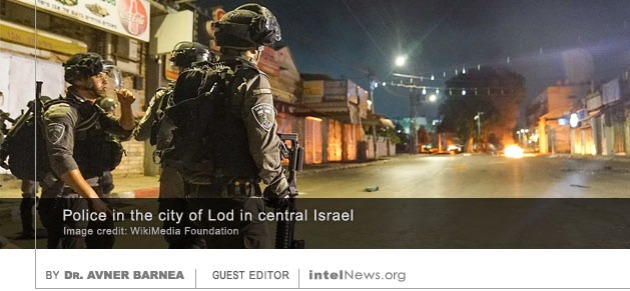
For several days now, a war has been going on between the State of Israel and the Hamas organization that controls the Gaza Strip. The confrontation began after unrest broke out among Palestinians in Judea and Samaria, who raised allegations of Israeli damage to the Temple Mount and the Al-Aqsa Mosque. In firing missiles at Israel, Hamas tries to portray itself as protecting the sanctuaries of Islam in Jerusalem. In doing so, it seeks to strengthen its political position in Judea and Samaria against the Palestinian Liberation Organization (PLO), which is leading the Palestinian Authority. Since then, Israel has been using airstrikes against targets in Gaza, while Hamas has been firing hundreds of missiles at Israel daily. Israel is desperately trying to undermine Hamas’ military and operational capabilities, including armaments factories, while also eliminating senior commanders of the organization.
Hamas’ missile attacks managed to surprise Israel. Israeli intelligence (the Israeli Military Intelligence, known as IMI, and the Israeli Security Agency, ISA) previously estimated that Hamas’ goal was to maintain the status quo, and was not ready to initiate attacks against Israel. Not only did Israeli intelligence err in assessing Hamas’ intentions, but Hamas  surprised observers with its range of weapons, such as long-range missiles with a reach that is in excess of 150 miles. This constitutes a strategic surprise for Israel. So far (May 13, 2021), Hamas has fired about 1,500 missiles at Israel, most of which have been intercepted by Israel’s air defense system called the Iron Dome.
At the same time, extensive riots broke out within Israel between Palestinian Israeli Arabs and Israeli far-right groups. The attacks have spread throughout the country, and the Israeli police appear unable to control them. The ISA is responsible for monitoring terrorism-related developments in the area of political subversion, including assessing the intentions of Israeli Arabs and the level of threat posed by these intentions. It appears that the ISA, was completely surprised by recent developments. The spontaneous mobilization of Israeli Arabs stems from fears that Israel intends to harm the Temple Mount and the Al-Aqsa Mosque. It is also a form of identification with their brethren in the Gaza Strip. At present, the government of Israel has not managed to restrain the mobilization of the Israeli Arabs.
In conclusion, Israeli intelligence demonstrates two blind spots. One concerns Hamas’ intentions and offensive capabilities. The other concerns misreading the intentions and degree of threat to public order in Israel by Israeli Arabs. This is why the military clash between Israel and Hamas, as well as the riots by Israeli Arabs, have not yet ended.
Dr. Avner Barnea is research fellow at the National Security Studies Center of the University of Haifa in Israel. He served as a senior officer in the Israel Security Agency (ISA).
► Author: Avner Barnea | Date: 14 May 2021 | Permalink
 • Analysis: The outstanding issue of the Libyan intelligence services. The post of Chief of the Libyan Intelligence Service of Tripoli’s Government of National Accord (GNA) is still vacant. Therefore, this is an optimal situation for the Head of Tripoli’s government, who is currently pro tempore Director of the GNA agencies, while the struggle for the next Intelligence Service director is
  A leaked report authored by the Palestinian National Authority’s intelligence service warns that economic depression and lack of opportunity may soon spark a popular uprising in the occupied territories. The report was submitted to the PNA’s leadership in early August. It was accessed by Yedioth Ahronoth, Israel’s highest-selling newspaper, which is based in Tel Aviv. It
  An undercover Israeli team that clashed with Hamas in Gaza on November 11 —an incident that brought the region to the brink of war— was installing an advanced surveillance system, according to Palestinian sources. Local media reports said that the Israeli undercover team —believed to be members of the Israel Defense Forces (IDF)— killed seven members of Izz ad-Din al-Qassam Brigades, the military arm of Hamas’ armed wing. The IDF troops eventually escaped into Israel with the help of air support, having lost one team member. The incident was followed by a barrage of nearly 500 rockets and mortars fired from the Gaza Strip into Israel. The Israelis responded by firing more than 160 missiles that fell throughout the Palestinian enclave. Hostilities were halted on November 13, when Hamas declared a unilateral ceasefire brokered by Egypt. The incident prompted the
 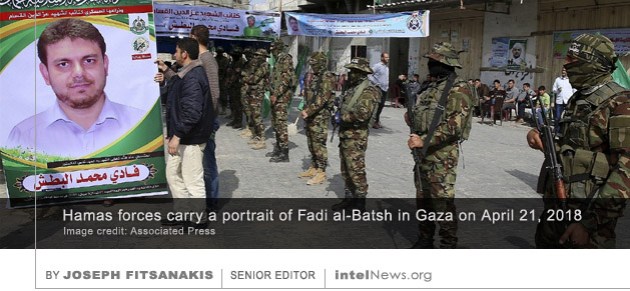 Militants in the Gaza Strip have accused Israel of assassinating a Palestinian engineer based in Malaysia, who was shot dead on Saturday by unknown assailants riding motorcycles. The victim has been identified as Dr. Fadi M. al-Batsh, 35, from the town of Jabalia in the Gaza Strip, a Palestinian enclave controlled by the militant group Hamas. Al-Batsh is believed to have completed undergraduate and Master’s degrees in electrical engineering at the Islamic University of Gaza. In 2011 he enrolled as a PhD student at the University of Malaya in Kuala Lumpur, from where he subsequently received his doctorate in electrical engineering. He was then employed as a lecturer by the University of Kuala Lumpur’s British Malaysian Institute. The Institute is located in the Jalan Gombak neighborhood of the Malaysian capital, where al-Batsh lived with his wife and three children. Some reports from Israel said that al-Batsh worked on drone technology and that he had authored scientific articles on the development of drone technology, as well as on the technical specifications of transmitters used to remotely control drones.
 Media reports from Lebanon claim that Israel was behind a
 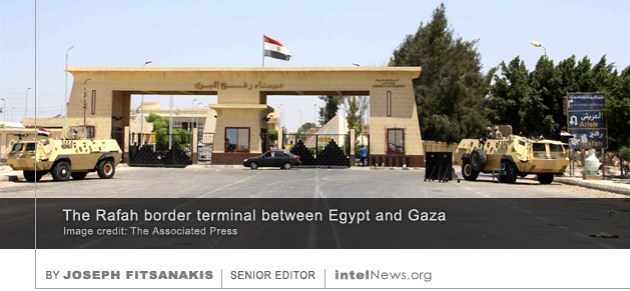 The Islamic State in Egypt’s Sinai Province has declared war on the Palestinian militant group Hamas, in a move that experts say will furhter-complicate an already volatile security situation in eastern Egypt. Many observers see the group, Wilayat Sinai, as the
 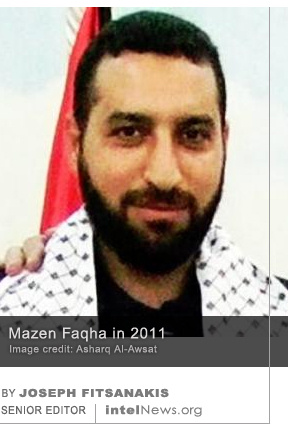 The sophistication behind the killing of a senior Hamas official, who was assassinated in his home in the Gaza Strip on Friday evening, points almost certainly to Israel, according to observers. Mazen Faqha, 38, helped plan several lethal operations by the Palestinian militant group, including a 2002 suicide bombing that killed nine and wounded over 50. Following an extensive manhunt, Israeli authorities arrested Faqha in the West Bank and in 2003 convicted him to nine life sentences. But in 2011, Faqha was among 1,027 Palestinian and Arab-Israeli prisoners that Israel released in exchange for Gilad Shalit, a soldier in the Israel Defense Forces, who was held prisoner by Hamas. Since that time, Faqha had lived in the Gaza Strip, the Hamas-controlled Palestinian enclave that has been under strict Israeli blockade since 2006.
 The Israel Defense Forces told a press conference on Wednesday that hackers belonging to the Palestinian militant group Hamas lured Israeli soldiers by posing as young women online. Wednesday’s press conference was led by an IDF spokesman who requested to remain anonymous, as is often the case with the Israeli military. He told reporters that the hackers used carefully crafted online profiles of real Israeli women, whose personal details and photographs were expropriated from their publicly available social media profiles. The hackers then made contact with members of the IDF and struck conversations with them that in many cases became intimate over time. At various times in the process, the hackers would send the Israeli soldiers photographs of the women, which were copied from the women’s online public profiles.
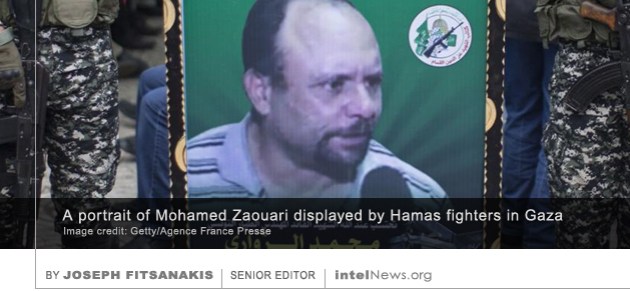 Despite persistent silence from Tel Aviv, commentators there seem increasingly convinced that Israeli spies were behind last week’s killing of an aviation engineer who worked for the Palestinian militant group Hamas. The man, Mohamed Zaouari, 49, was a Tunisian national who had spent over a decade creating an innovative aerial drone program for the Palestinian group that controls the Gaza Strip. He was
  A senior aviation engineer who headed the unmanned aerial vehicle program of the Palestinian militant group Hamas, has been shot dead outside his home in Tunisia by a group of assailants using gun silencers. Mohamed Zaouari, 49, was a Tunisian national who had spent over a decade creating an innovative aerial drone program for Hamas, the Palestinian group that today controls the Gaza Strip. He had lived outside of Tunisia for much of his life, most recently in Syria, where he is believed to have worked as an engineer in a private firm, while also consulting with the Palestinian group. He had returned to Tunisia in 2011, following the upheaval in the country that sparked the so-called Arab Spring.
 A senior member of the military wing of Hamas, the Palestinian militant group that governs the Gaza Strip, is believed to have defected to Israel. News of the rumored defection first appeared on the website of Al-Hayat al-Jadida, the official newspaper of the Palestinian Authority, which is based in the West Bank. On Tuesday, Al-Hayat said that the man, a member of the Izz ad-Din al-Qassam Brigades, Hamas’ military wing, had not been seen for several days.
 A former director of Israel’s Mossad intelligence agency has called on the Israeli government to reach out to Hamas, arguing that the Palestinian group is now ready to accept a peace settlement. Efraim Halevy directed the Mossad, Israel’s primary external intelligence agency, for five years before retiring in 2002. He is best known for helping forge a historic peace treaty between Israel and Jordan in 1994, which made the Hashemite Kingdom the second Arab country, after Egypt, to sing a peace accord with the Jewish state.







 intelNews.org
Hamas publishes photo, name and address of Israel’s incoming security chief
September 28, 2021 by Joseph Fitsanakis 1 Comment
THE PALESTINIAN MILITANT GROUP Hamas has published the name, address and photograph of an individual believed to be the incoming director of Israel’s security service. Known as Shin Bet, and referred also by its Hebrew acronym Shabak, the organization is among the leading agencies of Israel’s intelligence community, which also includes the Mossad and Aman. As is the case with other intelligence agencies, Israeli media are not permitted to publicize the identity of the Shin Bet’s director without permission from the government.
The incoming head of the Shin Bet has been referred to in Israeli media reports simply as “R”. He reportedly is in his mid-50s and he and his wife have three children. He is a graduate of Tel Aviv University, where he studied political science and philosophy, and has a Master’s degree from Harvard University in the United States. He rose through the ranks of the Shin Bet, and has been serving as the agency’s deputy director since 2018. Earlier this month, Israel’s Prime Minister, Naftali Bennett, nominated him to replace the Shin Bet’s current director, Nadav Argaman (pictured), who is set to retire in two weeks’ time.
On Sunday evening, following the outbreak of heavy clashes between Palestinians and Israeli forces in the West Bank, several pro-Hamas Palestinian websites published R’s alleged name, address and photograph, alongside the phrase “wanted criminal”. An accompanying article, published in Arabic and Hebrew, said the information about R. was “leaked by the Palestinian resistance” and warned that the senior leadership of the Shin Bet was being “monitored by us in the resistance”. The article went on to claim that R. “is on the wanted list and the arms of the resistance will pursue him”.
According to Israeli newspaper The Jerusalem Post, which published news of the leak, Israeli security forces are not concerned. An anonymous government source told Israel’s KAN news agency that, despite the official ban imposed by the state, R. is “widely known in Israel’s security sector” and the photograph of him that was published by Palestinian websites was “taken at a public event, [so] there is no cause for concern”.
► Author: Joseph Fitsanakis | Date: 28 September 2021 | Permalink
Filed under Expert news and commentary on intelligence, espionage, spies and spying Tagged with Hamas, Israel, Nadav Argaman, News, Palestine, Shin Bet