Researcher seeks access to classified US document about Gandhi killing

Mahatma GandhiA researcher is seeking access to a potentially revealing classified telegram sent by a United States diplomat who witnessed the assassination of Indian leader Mahatma Gandhi in 1948. Gandhi, the leader of the Indian movement for independence, and a towering civil rights figure of the 20th century, was assassinated on January 30, 1948, as he was about to hold a prayer meeting in downtown New Delhi. His assassin, Nathuram Vinayak Godse, was a member of a Hindu nationalist paramilitary group, who blamed Gandhi for the bloody partition of India. He and a co-conspirator, Narayan Apte, were arrested for Gandhi’s murder and put to death in 1949.

But there are many who claim that Gandhi’s assassination resulted from a far larger conspiracy, involving many more people and groups, but was covered up. One such proponent is Mumbai-based researcher Dr Pankaj Phadnis, who has been pushing for a new official investigation into Gandhi’s assassination since 1996. Last week, Dr Phadnis petitioned India’s Supreme Court, arguing that an American intelligence officer was present during Gandhi’s assassination and filed a report that may point to a broader conspiracy to kill the Indian civil rights leader. Dr Phadnis also argues that American intelligence agencies may have been involved in a secret effort to protect Gandhi from physical danger.

The Mumbai-based researcher told the Indian Supreme Court that he was able to obtain access to American diplomatic documents during one of his recent visits to the US National Archives and Research Administration in Washington, DC. Among them were telegrams sent to the Department of State by the US embassy in New Delhi before and after Gandhi’s assassination. The two most telling telegrams, said Dr. Phadnis, were written shortly after the assassination by a longtime American diplomat, Herbert Tom Reiner. According to many eyewitness accounts, including Reiner’s own, Reiner was present during Gandhi’s assassination, and was standing no more than five feet from the Indian leader when he was shot by Godse. The American diplomat helped apprehend the assassin before he and others surrendered him to the authorities.

Reiner submitted two telegrams to Washington as soon as he returned to the US embassy following Gandhi’s assassination, which Dr Phadnis was able to access. But a third one, sent at 8:00 p.m. that same evening, remains classified and out of the reach of researchers. Dr Phadris said he filed a Freedom of Information Act request with the US government and is expecting an answer. Now he is trying to get the Indian courts to agree that the existence of new evidence, including Reiner’s telegrams, justify the reopening of the probe into Gandhi’s assassination.

Reiner left India in the summer of 1949 and served briefly as assistant attaché in Budapest, Hungary, before being transferred again, this time to Seoul, South Korea. He then held posts in Sierra Leone, South Africa and Canberra. He died in 1999 in the US state of Massachusetts.

Author: Joseph Fitsanakis | Date: 02 October 2017 | Permalink

“External attack” may have caused crash that killed UN secretary general in 1961

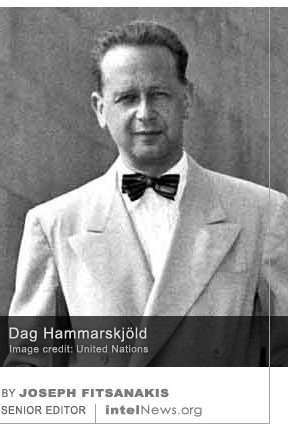
Dag HammarskjöldA deliberate attack by another aircraft may have caused the plane crash that killed the United Nations Secretary General in 1961, according to a report commissioned by the intergovernmental organization. On September 17, 1961, a Douglas DC-6 transport aircraft carrying United Nations Secretary General Dag Hammarskjöld crashed in the British-administered territory of Northern Rhodesia (now Zambia). The crash killed everyone onboard. At the time of his death, Hammarskjöld was flying to the Congo’s mineral-rich Katanga region to meet European-supported chieftains who in 1960 had seceded from the nationalist government of Congolese Prime Minister Patrice Lumumba. Ironically, Lumumba had been assassinated in a Western-backed coup exactly eight months before Hammarskjöld’s death.

Three successive investigations into the crash, conducted by the Rhodesian Board of Investigation, the Rhodesian Commission of Inquiry, and the United Nations Commission of Investigation, pointed to “pilot error” as the most likely cause of the tragedy. However, research carried out in recent years, including by the Hammarskjöld Commission, which was composed of a diplomat and three judges from the Netherlands, the United Kingdom, South Africa, and Sweden, has shown that the crash could have been the result of deliberate actions. In February of this year, following a recommendation by a UN-appointed three-member expert panel, the organization tasked Mohamed Chande Othman, a former Tanzanian chief justice, to research the topic in depth. Othman reportedly delivered his final report to the UN Secretary General António Guterres in August. However, it has not yet been made public.

On Tuesday, however, British newspaper The Guardian said it had seen an executive summary of Othman’s report. Read more of this post
Secret documents passed to the KGB by Kim Philby displayed in Moscow

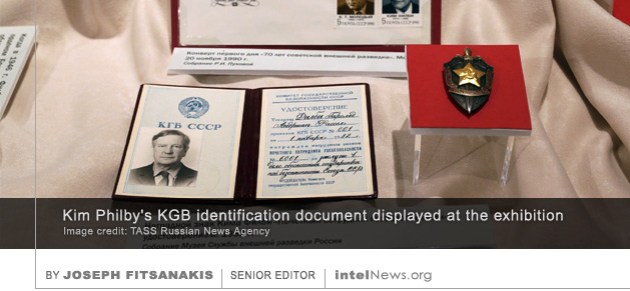
Kim PhilbyThe life of Kim Philby, one of the Cold War’s most recognizable espionage figures, is the subject of a new exhibition that opened last week in Moscow. Items displayed at the exhibition include secret documents stolen by Philby and passed to his Soviet handlers during his three decades in the service of Soviet intelligence. While working as a senior member of British intelligence, Harold Adrian Russell Philby, known as ‘Kim’ to his friends, spied on behalf of the Soviet NKVD and KGB. His espionage lasted from about 1933 until 1963, when he secretly defected to the USSR from his home in Beirut, Lebanon. Philby’s defection sent ripples of shock across Western intelligence and is often seen as one of the most dramatic incidents of the Cold War.
Now a new exhibition in Moscow has put on display some of Philby’s personal belongings, as well as a fraction of the many classified documents he passed on to his Soviet handlers during his 30 years of espionage. Entitled “Kim Philby: His Intelligence Work and Personal Life”, the exhibition is organized by the Russian Historical Society. The majority of the new documents appear to date from 1944, by which time Philby had been working for the NKVD for over a decade. Some of the documents are cables sent by Italian, Japanese or German diplomats prior to and during World War II, which were intercepted by British intelligence. Copies of some of these intercepts, which Philby passed to Moscow, are displayed in the exhibition. One document clearly bears the English-language warning: “Top Secret. To be kept under lock and key: never to be removed from this office”. Another document appears to be part of a report that Philby produced after teaching a seminar for KGB intelligence officers about how to operate in the West. It is dated 1982, by which time Philby had been living in Russia for nearly two decades.

Philby died in the Soviet capital in 1988, aged 76, and was survived by his fourth wife, Rufina Ivanovna Pukhova, whom he met after he defected to the USSR. Pukhova attended the opening of the exhibition in Moscow last week, as did over a dozen of Philby’s students at the former KGB. Russian media reported that the director and several officials of the Foreign Intelligence Service (SVR), one of the KGB’s successor agencies, were also present during the official opening of the exhibition.

Author: Joseph Fitsanakis | Date: 26 September 2017 | Permalink

Cold War files show CIA support for guerrilla warfare inside USSR (Part II)

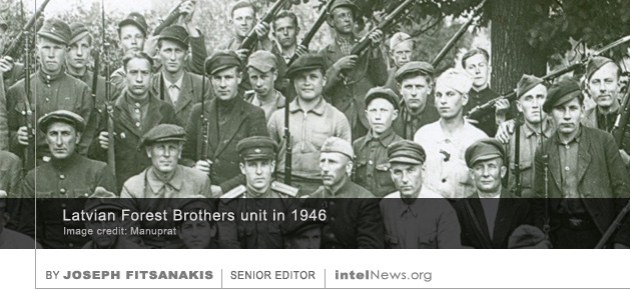
Latvia Forest BrothersThe role of the CIA in funding and helping to organize anti-Soviet groups inside the USSR has been known for decades. But, as intelNews explained in part I of this article, a batch of recently released documents, unearthed by Russian-language service of Latvian state television, sheds light into the CIA’s early understanding of the identity, strength and operations of these groups. They also contain new information about the background and structure of underground anti-Soviet groups like the Forest Brothers in Latvia.
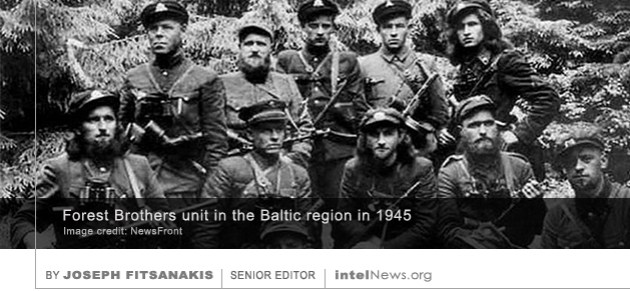
Judging that Latvia’s anti-Soviet underground movement could be “of considerable operational value”, the CIA initiated project ZRLYNCH in the summer of 1950. Operated out of the CIA’s Munich station in Germany, ZRLYNCH was intended as a long-term project supervised by the Office of Policy Coordination, an early Cold War covert operations outfit that in 1952 was absorbed into the CIA’s Directorate of Operations. The Latvia operation was part of a wider effort by the CIA, which was aimed at subverting Soviet power in Eastern Europe.

For the first year of ZRLYNCH, the CIA’s Office of Policy Coordination asked for —and received— a budget of $30,000. The top-secret document unearthed recently by Latvian state television states that the budget was to be used primarily for intelligence collection inside Soviet territory, as well as for covert operations by the Forest Brothers (for information about the group, see part I of this post). The latter were to conduct sabotage activities as part of organized guerrilla warfare. These activities are not specified in the CIA documents. By the end of the first year, it appears that the CIA had recruited three Latvian agents in Europe (one in Sweden and two in Germany), who were acting as mediators between the CIA and the Forest Brothers inside the USSR. Less than three years later, the ZRLYNCH budget had risen to $134,000, with $52,000 going toward covert —mostly psychological— operations and the rest being used to fund intelligence collection efforts. The CIA was also funding the travel expenses of leading Latvian émigré figures in the US, and was diverting tens of thousands of dollars toward Latvian émigré conferences in America, which aimed to unite the various political factions of the fragmented Latvian community in the States.

But the CIA officers behind ZRLYNCH were extremely concerned about operational security. They did not want the Kremlin finding out that the Agency was behind efforts to stir up armed resistance against Soviet power in the Baltic region. One CIA document states that there would be no tolerance for “any breaches of security” that compromised ZRLYNCH. Consequently, any action that uncovered the link between the US government and the Forest Bothers would lead “to an immediate cessation of financial support” for ZRLYNCH, states the memo.

Ultimately, ZRLYNCH failed to seriously challenge Soviet power in Latvia. Most of the members of the Forest Brothers were killed during Red Army counterinsurgency operations, and much of the organization’s structure was penetrated by agents of Soviet intelligence. Eventually, the Forest Brothers became extinct in 1957, when their last members emerged from the forest and surrendered to Latvian and Soviet authorities.

Author: Joseph Fitsanakis | Date: 11 August 2017 | Permalink

Cold War files show CIA support for guerrilla warfare inside USSR (Part I)

Latvian Forest BrothersRecently declassified documents from the archive of the Central Intelligence Agency detail financial and material support given by the United States to groups of armed guerrillas in Soviet Latvia in the 1950s. The documents, initially marked ‘Top Secret’ but now declassified, show that the CIA was aware and supported the activities of an anti-Soviet guerrilla army known as ‘the Forest Brothers’. Known also as ‘the Forest Brethren’, the group was formed in the Baltic States in 1944, as the Soviet Red Army established Soviet control over the previously German-occupied states of Estonia, Latvia and Lithuania. The Soviet Union had previously occupied and annexed the three Baltic countries, in a failed attempt to pre-empt Germany’s eastward military expansion. Groups like the Forest Brothers consisted of the most militant members of anti-Soviet groups in the Baltic States, many of whom were ideologically opposed to Soviet Communism.
The role of the CIA in funding and helping to organize anti-Soviet groups inside the USSR has been known for decades. But the recently released documents, unearthed by Russian-language service of Latvian state television, shed light into the CIA’s early understanding of the identity, strength and operations of these groups. They also contain new information about the background and structure of underground anti-Soviet groups like the Forest Brothers in Latvia.

The first declassified CIA document that contains information on anti-Soviet resistance in Latvia is dated November 29, 1949, and is titled “The Organization of the Underground Resistance Movement in Eastern Europe”. It was soon followed by two other documents, entitled “Latvian Resistance to Russian Occupation” and “Request for [Support] to the Latvian Resistance Movement”. The latter document was produced in mid-1950, after the CIA was able to establish contact with anti-Soviet Latvian expatriates living in Germany and Sweden. From these contacts, the CIA was able to determine that active (and possibly armed) resistance to the Soviet Red Army in Latvia was limited to approximately 5,000 individuals, many of whom conducted periodic guerrilla attacks against Soviet troops or installations. However, the CIA report said that, as of 1950, the majority of these armed guerrillas remained dormant, “waiting for a more opportune moment” to return to action. The CIA memorandum also stated that clandestine radio communication existed between the leadership of Latvia’s anti-Soviet underground in Riga and exile Latvian communities in Sweden.

Note: Part II of this report can be found here.

Author: Joseph Fitsanakis | Date: 10 August 2017 | Permalink

Headstone for unmarked grave of Nazi spy who died undetected in wartime Britain

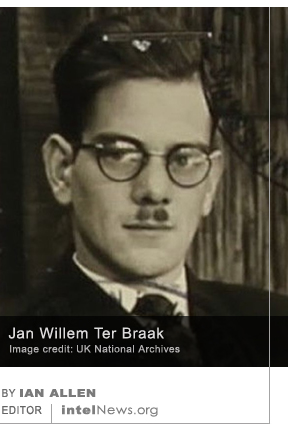
Jan Willem Ter BraakThe unmarked grave of a Dutch-born Nazi spy, who killed himself after spending several months working undercover in wartime Britain, will be marked with a headstone, 76 years after his death by suicide. Born in 1914 in The Hague, Holland, Englebertus Fukken joined the National Socialist Movement in the Netherlands, the Dutch affiliate of the National Socialist German Workers’ Party led by Adolf Hitler, in 1933. In 1940, shortly after the German invasion of Holland, Fukken, who had been trained as a journalist, was recruited by the Abwehr, Nazi Germany’s military intelligence. Abwehr’s leadership decided to include Fukken in the ranks of undercover agents sent to Britain in preparation for Operation SEA LION, Germany’s plan to invade Britain.
Between October 31 and November 2, 1940, the 26-year-old Fukken was secretly parachuted over the Buckinghamshire village of Haversham in central England. British authorities found his discarded parachute a few days later, but by that time Fukken had made his way on foot to the city of Cambridge. Fukken’s precise mission remains unknown. Speculation that he was sent to Britain to assassinate the country’s wartime leader, Sir Winston Churchill, is dismissed as fantastical by most historians. What is known is that Fukken carried with him false Dutch papers identifying him as Jan Willem Ter Braak, and a suitcase that contained a radio transmitter supplied to him by the Abwehr.

In Cambridge, Fukken took lodgings with a local family, posing as a member of the Free Dutch Forces, anti-Nazi Dutch officials who had fled to London after the German invasion of Holland and formed a government in exile. Fukken spent the next four months living undercover in Cambridge, and did not register with the authorities, as required. He traveled on most days to locations in England bombed by the Luftwaffe, inspecting the damage and reporting back to his Abwehr handlers in Hamburg by radio or by mail, using secret writing techniques. But his failure to register with the authorities meant that he had no access to ration cards, which were required to purchase food in wartime Britain. He then attracted the attention of the local authorities, after presenting them with a forged ration card that was detected during inspection by a police officer. Fearing arrest, he quickly moved lodgings, but was unable to solve the problem of access to food. Repeated attempts to get the Abwehr to exfiltrate him failed, and his calls for money and usable ration cards were not facilitated, as the Nazi leadership in Berlin had begun to shelve Operation SEA LION. Read more of this post

French spy who helped bomb Rainbow Warrior tracked down 32 years later

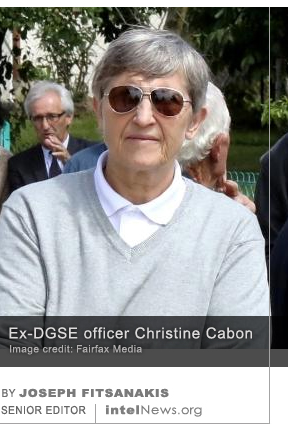
Christine CabonA French spy who infiltrated the environmentalist group Greenpeace and in 1985 helped bomb the organization’s flagship, the Rainbow Warrior, has spoken to the media for the first time. The British-based activist organization had purchased the trawler from the British government in 1977 and used it to carry out maritime research and other operations. In July 1985, the Rainbow Warrior, captained by the American environmental activist Peter Wilcox, was docked at the port of Auckland, New Zealand. It was being prepared to lead a flotilla of vessels to the French Polynesian atoll of Mororoa, in order to try to stop a planned nuclear test by the French military.

But on the night of July 10, 1985, two large explosions nearly split the ship in two, causing it to sink in less than five minutes. One of the Rainbow Warrior’s passengers, the Portuguese photographer Fernando Pereira, drowned after he boarded the sinking ship in order to retrieve his cameras and lenses. Greenpeace blamed the government of France for the attack on the ship, but Paris denied any involvement. It later emerged, however, that the blasts had been caused by two plastic-wrapped explosive devices that had been placed on the exterior of the Rainbow Warrior’s engine room and on its propeller blades. The explosive mechanisms had been placed there by two divers working for the Direction Generale de la Securite Exterieure (DGSE), France’s external intelligence service. Read more of this post

Yuri Drozdov, handler of Soviet undercover spies during Cold War, dies at 91

Yuri DrozdovGeneral Yuri Ivanovich Drozdov, who held senior positions in the Soviet KGB for 35 years, and handled a global network of Soviet undercover officers from 1979 until 1991, has died at the age of 91. Drozdov was born in Minsk, Soviet Belarus, in 1925. His father, Ivan Dmitrievich Drozdov, was an officer in the tsarist army who sided with the communists in the 1917 Bolshevik Revolution. After serving in World War II, Yuri Drozdov joined the KGB in 1956. Following his training, he was appointed liaison officer between the KGB and East Germany’s Ministry of State Security, commonly known as the Stasi.
His knowledge of East German intelligence affairs prompted his involvement in the famous 1962 spy-swap between the United States and the Soviet Union. The Soviets surrendered the American pilot Francis Gary Powers, who had been captured in May 1960, when the U-2 spy plane he was piloting was shot down over Soviet airspace. In return, they received Rudolf Abel (real name Vilyam Fisher) a Soviet undercover spy who was captured in New York in 1957, posing as an American citizen. From 1964 until 1968, Drozdov was stationed in Beijing, China, where he served as the KGB rezident, effectively the agency’s chief of station. He returned to Moscow and in 1975 was posted under diplomatic cover in the United States, where he commanded the KGB’s station in New York until 1979.

Upon his return to the USSR, Drozdov was promoted to chief of the KGB’s Directorate S, which handled the agency’s worldwide network of so-called illegals —intelligence officers serving abroad without official cover or formal connection to the Soviet Union. Shortly after his return to Moscow, Drozdov also headed Operation STORM-333, a daring attack on the presidential palace in Afghanistan, during which Soviet special forces killed Afghan President Hafizullah Amin and essentially fired the opening shots of the decade-long Soviet-Afghan war. The experience prompted Drozdov to recommend to his superiors the establishment of a new KGB special-forces unit. It was created in 1981 under the name Vympel (Pennant) and headed by Drozdov himself. He commanded several Vympel missions in and out of the USSR before resigning from the KGB in 1991.

Little is known about the specifics of Drozdov’s death. It is believed that he died on June 21, surrounded by his family. The Russian Foreign Intelligence Service (SVR), a successor agency of the KGB, issued a brief statement commemorating Drozdov’s service. It was followed by a statement issued by the office of the Russian President Vladimir Putin, which praised Drozdov as “a legendary spy, outstanding professional […], incredible person and true patriot”.

Author: Joseph Fitsanakis | Date: 26 June 2017 | Permalink

Canada suspected Soviets of stealing prime minister’s private diary

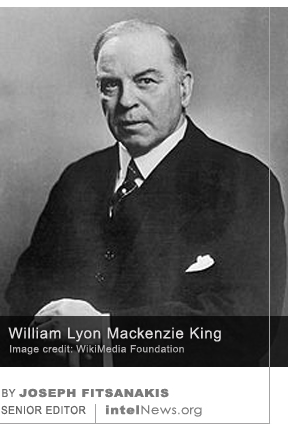
William Lyon Mackenzie KingCanadian officials speculated that Soviet spies stole a missing volume from the private diary collection of William Lyon Mackenzie King, Canada’s longest-serving prime minister, who led the country in the run-up to the Cold War. A liberal anticommunist, Mackenzie King was Canada’s prime minister from 1925 to 1948, with a break from 1930 to 1935. He is known for having led the establishment of Canada’s welfare state along Western European standards.
When King died in 1950, he left behind instructions asking for his private diaries to be destroyed. However, the executioners of his will decided instead to turn over King’s private papers —including his diaries— to the Canadian state. In 1975, the Library and Archives of Canada began releasing King’s private diaries to the public. The diaries contain daily entries that span over half a century, up until King’s death. One crucial volume, however, is missing. It covers the last two months of 1945, when Canada was engaged in intensive deliberations with the Allies about the shape of postwar Europe and Asia. These deliberations also involved frank discussions between King and his British and American counterparts about the atom bomb, and possibly measures to uncover suspected infiltration of Western government institutions by communist sympathizers.

Now a new book, written by Trent University history professor Christopher Dummitt, reveals
that Soviet spies were suspected of stealing the missing volume. The book, Unbuttoned: A History of Mackenzie King’s Secret Life, claims that the Canadian Security Intelligence Service (CSIS) was notified of the missing diary volume in 1969. Shortly afterwards, the CSIS launched an investigation into the missing memoir. In 1985, says Dr. Dummitt, a CSIS memo speculated that an agent of the Soviet KGB might have stolen the diary, because it contained information that was of interest to Moscow. Interestingly, however, the previous diary volume, which covers the case of Igor Gouzenko, is not missing. Gouzenko was a cipher clerk at the Soviet embassy in Ottawa, whose 1945 defection to Canada is sometimes credited with starting the Cold War. Why would a Soviet spy not steal that volume as well, the skeptics ask?

Professor Dummitt entertains a simpler idea in his book, which is that Jean-Louis Daviault, an employee of the Library and Archives of Canada, may have stolen the volume. Daviault, who had been tasked with photographing King’s diary collection, was caught trying to sell parts of the diary to a Canadian newspaper. It was probably he who stole the missing volume, in order to sell it to the press, or a rival intelligence agency, argues Dr. Dummitt.

Author: Joseph Fitsanakis | Date: 17 May 2017 | Permalink

New book reveals how MI5 infiltrated the British communist party

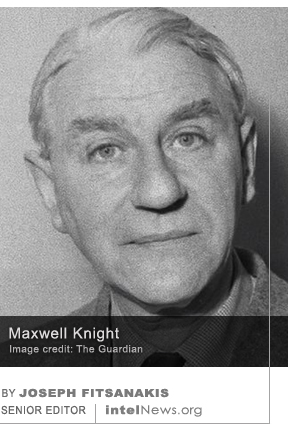
Maxwell KnightA new biography of famed British Security Service spymaster Maxwell Knight reveals that a number of prominent British communists were secret government agents in the 1930s. After serving in the British Royal Navy during World War I, Knight was recruited by the Security Service, Britain’s domestic intelligence agency, which is commonly known as MI5. He eventually rose to lead the agency’s Section B5(b), which was responsible for using agents to infiltrate political groups deemed radical by the authorities. During the interwar years, under Knight’s leadership, Section B5(b) focused largely on British fascist organizations, but also infiltrated the Communist Party of Great Britain. Knight, who died in 1968, left an indelible mark on the character and operations of MI5. He also served as a model for the character of ‘M’, the fictional director of the British Secret Intelligence Service (MI6) in the novels of Ian Fleming, creator of James Bond.
Now Preface Publishing has issued a new biography of Knight, authored by British author Henry Hemming. The book, entitled M: Maxwell Knight, MI5’s Greatest Spymaster, is largely based on the diaries of Knight. It reveals the identities of a number of MI5 agents that worked for the late spymaster in Section B5(b). They included British intellectuals, artists, activists and at least one barrister, Vivian Hancock-Nunn. A leftwing legal counsel, Hancock-Nunn provided pro-bono legal services to the publications of the Communist Party of Great Britain. However, is is now believed that he was agent M/7, run by Knight’s Section B5(b). Another agent, codenamed M/1 by Knight, was Graham Pollard, son of a highly respected British historian, who broke ranks with his wealthy family to join the Communist Party in the 1920s. By 1933, Pollard was a prominent and influential member of the Party, and regularly penned fiery articles in the Daily Worker, the Party’s newspaper. Hemming’s book, however, reveals that Pollard was an agent of MI5, who went as far as marrying a prominent communist activist in order to build his cover.

Hemming notes that some of the most prolific agents run by Knight were women. Three of them, Kathleen Tesch, Olga Grey and Mona Maund, infiltrated various levels of the Communist Party, which was known for its relatively inclusive treatment of women at the time. Knight relied on them for regular reports about the Party’s activity, despite the objections of his superiors, who believed that women should have no place in intelligence operations. The book’s author also notes that he was not able to confirm the identities of these agents in MI5 archives, because they remain classified. However, he told British newspaper The Guardian that he was “99.9 percent certain” of the accuracy of his information.

Author: Joseph Fitsanakis | Date: 12 May 2017 | Permalink

Werner Stiller, one of the Cold War’s most notable defectors, dies

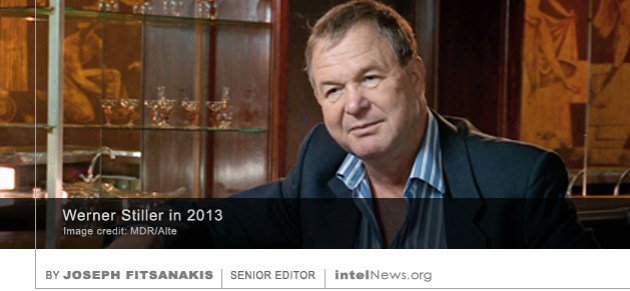
Werner StillerWerner Stiller, also known as Klaus-Peter Fischer, whose spectacular defection to the West in 1979 inflicted one of the Cold War’s most serious blows to the intelligence agency of East Germany, has died in Hungary. Stiller, 69, is believed to have died on December 20 of last year, but his death was not reported in the German media until last week. Born in 1947 in the German Democratic Republic, Stiller excelled in the sciences from an early age and eventually studied physics at the University of Leipzig, which was known at the time as Karl Marx Universitat. Shortly after graduating, he joined the GDR’s Ministry of State Security, commonly known as the Stasi. Within a few years, he was working as a case officer for the Main Directorate for Reconnaissance, the Stasi’s foreign intelligence division, where he was in charge of scientific espionage in the West. By the late 1970s, Stiller was handling nearly 30 spies —most of them abroad— who were regularly providing him with intelligence relating to nuclear research, weapons technologies, and biomedical research.
However, the Stasi vehemently disapproved of Stiller’s promiscuous lifestyle —he was married five times in his life and was reputed to have had many more affairs— which was one of the reasons why he decided to seek a new life in the West. In January of 1979, with the help of a waitress he was having an affair with, Stiller defected to West Germany along with a packet of microfiche containing hundreds of classified Stasi documents. He later helped the waitress escape to the West with her young son and an estimated 20,000 more pages of classified documents. The West German Federal Intelligence Service (BND) eventually shared the information from Stiller’s defection with the United States Central Intelligence Agency. It led to the dramatic arrests of 17 Stasi agents and officers in Europe and the US, while at least 15 others escaped arrest at the last minute, after being urgently recalled back to East Germany. The Stasi is believed to have recalled an additional 40 operatives from several Western countries as a precaution in response to Stiller’s defection. The information that Stiller gave to the BND also helped visually identify the longtime director of the Stasi’s Main Directorate for Reconnaissance, Markus Wolf. Previously, Western intelligence services had no photographs of Wolf, who was known as ‘the man without a face’, due to the many decades he spent as an undercover officer.

In 1981, Stiller moved to the US, where the CIA provided him with a new identity, using the fake name Klaus-Peter Fischer, a Hungarian émigré. He studied economics at Washington University in St. Louis, Missouri, before working as an investment banker for Goldman Sachs in the US and eventually an exchange broker for Lehman Brothers in Germany. It is believed that the Stasi kept looking for Stiller until the dissolution of the GDR in 1990, with the intent of abducting him or killing him. In 1999, Stiller moved to Hungary, where he stayed until the end of his life. He is survived by a son and a daughter.

Author: Joseph Fitsanakis | Date: 04 April 2017 | Permalink

Mossad had prior knowledge of Six-Day War plans, says Israeli ex-spy chief

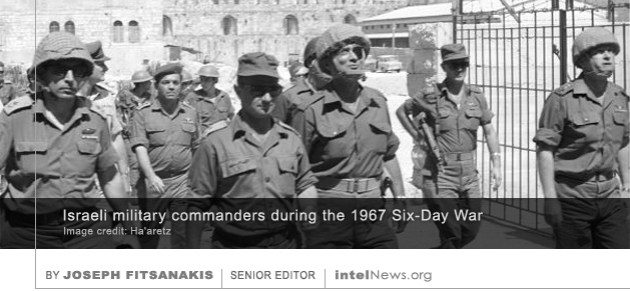
first-post-hIsrael’s intelligence services had access to recordings of secret talks between Arab heads of state in 1965, which helped the Jewish state win the Six-Day War, according to the former director of the country’s Military Intelligence Directorate. The brief but important conflict, which is also known as the Third Arab-Israeli War, broke out on June 5, 1967, when the Egyptian, Syrian and Jordanian armies attacked Israel. But within hours the Jewish state had managed to decimate the assailants’ air forces, and went on to deliver fatal blows to its adversaries. By the end of the war, Israel’s territory had increased threefold and Israeli troops were in control of the West Bank, the Gaza Strip and the Sinai Peninsula, among other areas.

But according to Major General Shlomo Gazit, who directed Israel’s Military Intelligence Directorate in the 1970s, Israel’s victory was sealed in September 1965. At that time, a conference of Arab heads of state was held in Casablanca, Morocco, with the participation of senior Arab military commanders and intelligence chiefs. The centerpiece of the conference was a secret meeting where preparations were made for a war with the Jewish state. Participants discussed plans for setting up a joint Arab military command to coordinate the war and shared insights on the strength and state of readiness of their respective militaries.

Major General Gazit told the Israeli newspaper Yedioth Ahronoth that Morocco’s King Hassan II, who was mistrustful of his fellow Arab heads of state, invited the Israeli intelligence services to monitor the conference. Speaking to Yedioth Ahronoth’s military correspondent Ronen Bergman, Gazit said that a team of spies from the Mossad, Israel’s external intelligence service, and the Shin Bet, its domestic equivalent, arrived in Casablanca prior to the start of the conference. Acting on the King’s orders, Moroccan authorities designated an entire floor in the luxury hotel where the conference was held for the use of the Israelis. After the conference ended, King Hassan gave the Mossad copies of secret recordings of all closed-door meetings. These were promptly transcribed and translated into Hebrew by the Research Unit of Israel’s Military Intelligence Directorate, said Gazit.

According to the former spy chief, these transcripts produced “massive amounts of intelligence”. They were combined with other sources of information and crucially helped Israel anticipate the Six-Day War. Thanks to these recordings, said Gazit, Israel “was in full knowledge of how unprepared [the Arab forces] were for war”, especially the Egyptian forces, which were “in a terrible shape”. Israeli military commanders were thus certain that the Jewish state would prevail in an armed conflict with its Arab neighbors.

The public disclosure of the fact that the Mossad had access to the content of the secret negotiations between Arab leaders in 1965 is not new. Bergman and his fellow author Shlomo Nakdimon revealed it in a 2015 article about the broader intelligence relationship between Israel and Morocco in the 1960s and 1970s. But the latest revelation highlights the significance of the secret recordings for Israel’s military posture during the Six-Day War. Indeed, Bergman reports that, after the end of the war, Meir Amit, who was the then director of the Mossad, drafted a letter to Israel’s Prime Minster Levi Eshkol, in which he described the Casablanca operation as “one of the greatest moments of Israeli intelligence”.

Author: Joseph Fitsanakis | Date: 17 October 2016 | Permalink

British judge denies request to name alleged new member of Cambridge spy ring

Corpus Christi College CambridgeA document that allegedly contains the name of a man who could be connected to one of the most sensational spy rings of the Cold War is to remain secret after a judge rejected a request to have it released. The man is believed by some to have been associated with the so-called ‘Cambridge spy ring’, a group of upper-class British graduates of Cambridge University, who spied for the USSR from the 1930s until the 1960s. Among them was Guy Burgess, Donald Maclean and H.A.R. “Kim” Philby, all of whom eventually defected to the Soviet Union. In 1979, it was revealed that Anthony Blunt, an art history professor who in 1945 became Surveyor of the King’s Pictures and was knighted in 1954, was also a member of the group. A fifth member, career civil servant and former intelligence officer John Cairncross, was publicly outed as a Soviet in 1990, shortly before his death.
Over the years, more individuals have been suggested by historians as potential members of the group, including intelligence officers Leo Long and Guy Liddell, academics Ludwig Wittgenstein and Andrew Gow, and physicist Wilfrid Mann. But according to British newspaper The Daily Mail, another individual may be identified in a classified document as a possible member of the Cambridge spy ring. The document was allegedly traced by Andrew Lownie, who authored the recently published Stalin’s Englishman: The Lives of Guy Burgess. Lownie filed a Freedom of Information request to have the document, which is held at the National Archives in London, released. But the request was denied, and a judge has now upheld the decision.

In denying the request, the judge argued that the man named in the document is still alive and that a possible release of the document could “jeopardize […] personal relationships”. He also contended that the case is too old to warrant immediate public interest, and thus there was “no pressing need” to declassify the file. The Mail speculates that the individual named in the document could have cooperated with the British government in the past in return for protection, or that the file in question may contain details that could embarrass the British government.

Author: Joseph Fitsanakis | Date: 20 September 2016 | Permalink

Soviet memoirs suggest KGB abducted and murdered Swedish diplomat

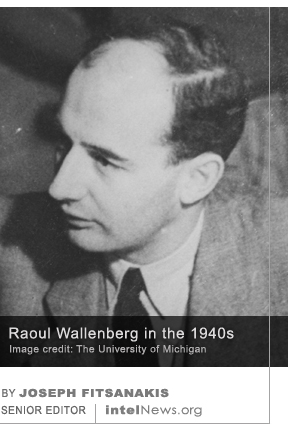
Raoul WallenbergThe recently discovered memoirs of a former director of the Soviet KGB suggest that a senior Swedish diplomat, who disappeared mysteriously in the closing stages of World War II, was killed on the orders of Joseph Stalin. The fate of Swedish diplomat Raoul Wallenberg is one of the 20th century’s unsolved espionage mysteries. In 1944 and 1945, the 33-year-old Wallenberg was Sweden’s ambassador to Budapest, the capital of German-allied Hungary. During his time there, Wallenberg is said to have saved over 20,000 Hungarian Jews from the Nazi concentration camps, by supplying them with Swedish travel documents, or smuggling them out of the country through a network of safe houses. He also reportedly dissuaded German military commanders from launching an all-out armed attack on Budapest’s Jewish ghetto.

But Wallenberg was also an American intelligence asset, having been recruited by a US spy operating out of the War Refugee Board, an American government outfit with offices throughout Eastern Europe. In January of 1945, as the Soviet Red Army descended on Hungary, Moscow gave orders for Wallenberg’s arrest on charges of spying for Washington. The Swedish diplomat disappeared, never to be seen in public again. Some historians speculate that Joseph Stalin initially intended to exchange Wallenberg for a number of Soviet diplomats and intelligence officers who had defected to Sweden. According to official Soviet government reports, Wallenberg died of a heart attack on July 17, 1947, while being interrogated at the Lubyanka, a KGB-affiliated prison complex in downtown Moscow. Despite the claims of the official Soviet record, historians have cited periodic reports that Wallenberg may have managed to survive in the Soviet concentration camp system until as late as the 1980s.

But the recently discovered memoirs of Ivan Serov, who directed the KGB from 1954 to 1958, appear to support the prevalent theory about Wallenberg’s demise in 1947. Serov led the feared Soviet intelligence agency under the reformer Nikita Khrushchev, who succeeded Joseph Stalin in the premiership of the USSR. Khrushchev appointed Serov to conduct an official probe into Wallenberg’s fate. Serov’s memoirs were found in 2012 by one of his granddaughters, Vera Serova, inside several suitcases that had been secretly encased inside a wall in the family’s summer home. According to British newspaper The Times, the documents indicate that Wallenberg was indeed held for two years in the Lubyanka, where he was regularly interrogated by the KGB. The latter were certain that the Swedish diplomat was an American spy who had also been close to Nazi Germany’s diplomatic delegation in Hungary. Soviet Premier Joseph Stalin considered exchanging him for Soviet assets in the West. But eventually Wallenberg “lost his value [and] Stalin didn’t see any point in sending him home”, according to Serov’s memoirs. The KGB strongman adds that “undoubtedly, Wallenberg was liquidated in 1947”. Further on, he notes that, according to Viktor Abakumov, who headed the MGB —a KGB predecessor agency— in the mid-1940s, the order to kill Wallenberg came from Stalin himself.

In 2011, Lt. Gen. Vasily Khristoforov, Chief Archivist for the Russian Federal Security Service (FSB), one of two successor agencies to the old Soviet KGB, gave an interview about Wallenberg, in which he said that most of the Soviet documentation on the Swedish diplomat had been systematically destroyed in the 1950s. But he said that historical reports of Wallenberg’s survival into the 1980s were “a product of […] people’s imagination”, and insisted that he was “one hundred percent certain […] that Wallenberg never was in any prison” other than the Lubyanka. An investigation by the Swedish government into the diplomat’s disappearance and eventual fate is ongoing.

Author: Joseph Fitsanakis | Date: 13 September 2016 | Permalink

Palestinian leader Mahmoud Abbas was KGB agent, researchers claim

Mahmoud Abbas

Mahmoud Abbas

Two Israeli researchers claim that a document from the archives of the Cold-War-era KGB identifies the current president of the Palestine Authority, Mahmoud Abbas, as a Soviet agent. The document was found in the United Kingdom, and was smuggled out of Russia by a former senior archivist of the Soviet KGB. Abbas is the leader of the largely secular Palestinian group Fatah, which controls the West Bank. Unlike Hamas, which is designated a terrorist group by Israel and its allies, Fatah is seen by Tel Aviv as the legitimate representative of the Palestinian people. That is disputed by Hamas, a religiously inspired group, which controls the Gaza Strip and maintains a tense relationship with Fatah and Abbas himself.

The allegation about Abbas’ past emerged on Wednesday in the Israeli media, after two local academic researchers disclosed the contents of a KGB document discovered at Cambridge University’s Churchill Archives Centre in Britain. The researchers, Gideon Remez and Isabella Ginor, of the Truman Institute at the Hebrew University of Jerusalem, said the document dates from 1983. It was found among thousands of similar documents that were secretly smuggled out of Russia in the early 1990s by British intelligence, following the defection of Vasili Mitrokhin, an archivist in the First Chief Directorate of the KGB during the Cold War. Some of the documents later formed the basis of a two-volume edition on the activities of Soviet intelligence, which was edited by Cambridge University Professor Christopher Andrew.

According to Remez and Ginor, the document identifies Mahmoud Abbas as a “KGB agent” based in Damascus, Syria, codenamed krotov, which in Russian means ‘mole’. Abbas was born in Palestine in 1935, but his family fled to Syria in 1948, following the establishment of the state of Israel and the outbreak of the first Arab-Israeli war. The young Abbas grew up in Damascus, where he went to university and joined the local branch of the PLO, the Palestinian Liberation Organization, of which Fatah is a member. If true, the allegation that Abbas worked for the KGB will not come as a surprise to observers of Palestinian politics. For most of the Cold War, the PLO was known to be close to Moscow, while Abbas was intimately involved with the Palestinian-Soviet Friendship Association, a pro-Moscow group that was widely seen as an agent of communist influence in the Palestinian territories. But the document from the Mitrokhin archives may be the first concrete evidence that Abbas was handled by the KGB.

Palestinian officials quickly dismissed the document on Wednesday as a fabrication and a deliberate slander. Mohammed al-Madani, a member of the central committee of Fatah, and a close associate of Abbas, said the allegation was part of a “clear effort to damage [Abbas] by various actors, including the government of Israel”.

Author: Joseph Fitsanakis | Date: 08 August 2016 | Permalink