Technical analysis offers first clues about Boston Marathon bomber(s)
April 16, 2013 16 Comments
 By JOSEPH FITSANAKIS | intelNews.org |
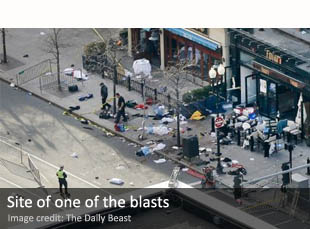
Counterterrorism experts probing Monday’s bombings at the Boston Marathon are bound to start searching for the culprits by focusing on the technical specifications of the attacks. According to the Boston Police Department, three people were killed and at least 144 were injured —many of them critically— by the blasts, which rocked downtown Boston at 2:45 p.m. local time. The second explosion was carefully timed to coincide with the initial blast, and occurred just ten seconds later, fewer than 100 yards down the road from the site of the first explosion. At least one report stated that law enforcement teams found and dismantled up to five additional devices at the site, which had failed to detonate. But one police official later denied these reports, saying that “closer examinations led [the police] to doubt that [the devices] were bombs”. If additional devices were indeed present at the site of the blast, it is likely that they failed to detonate due to the collapse of the wireless network in Boston, which was knocked down by a sudden spurt in usage following the initial blasts. If, as it appears, these bombs were types of improvised explosive devices (IEDs), and if suicide terrorism was not involved, chances are the devices were remotely triggered using the diodes commonly found inside the speakers of inexpensive cell phones. Depending on the constitution of the bombs themselves, they could contain ball bearings, screws, or other metal fragments stuffed inside a container around some type of explosive. Read more of this post








 intelNews.org
Analysis: Five dangerous myths about the Boston Marathon bombings
April 17, 2013 by Joseph Fitsanakis 10 Comments
The endless opinion pieces about the Boston bombings that have flooded the media-sphere since Monday have one thing in common: they are highly speculative and, for the most part, unreliable. At this early stage, nobody outside the security or intelligence establishments has any idea about the identity or motives behind the attacks —and if they say they do, they are lying. Even those on the inside routinely refer to the ongoing investigation as one of the most complex in the country’s post-9/11 history. As the probe continues, and the nation deals with the meaning of the Boston bombings, it is critical that some of the dangerously misinformed and premature notions about the attacks are dispelled.
To begin with, the Boston Marathon bombings were not necessarily terrorism. They were clearly calculated and indiscriminate, but in order for them to qualify as terrorism, their planners must have a broad political or ideological objective. Terrorism is a tactic used to further a political goal. There is a reason why we don’t refer to school shootings, such as the one that took place on December 14, 2013, at Sandy Hook Elementary in Newtown, Connecticut, as terrorism. They are calculated and extremely violent, but they do not contain a political motive. Before we can attach a terrorist label to the Boston bombings, we have to uncover the motive of the perpetrator(s). Barring that, the incident must be treated simply as a criminal act. Read more of this post
Filed under Expert news and commentary on intelligence, espionage, spies and spying Tagged with 2013 Boston Marathon attacks, Analysis, Boston, improvised explosive devices, Joseph Fitsanakis, terrorism, United States