Dutch technical experts helped US bug foreign embassies in Cold War
January 6, 2016 2 Comments
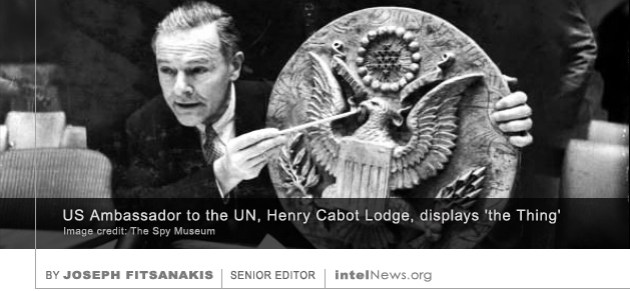 A tightly knit group of Dutch technical experts helped American spies bug foreign embassies at the height of the Cold War, new research has shown. The research, carried out by Dutch intelligence expert Cees Wiebes and journalist Maurits Martijn, has brought to light a previously unknown operation, codenamed EASY CHAIR. Initiated in secret in 1952, the operation was a collaboration between the United States Central Intelligence Agency and a small Dutch technology company called the Nederlands Radar Proefstation (Dutch Radar Research Station).
According to Dutch website De Correspondent, which published a summary of the research, the secret collaboration was initiated by the CIA. The American intelligence agency reached out to the Dutch technical experts after interception countermeasures specialists discovered a Soviet-made bug inside the US embassy in Moscow. The bug, known as ‘the Thing’, had been hidden inside a carved wooden ornament in the shape of the Great Seal of the United States. It had been presented as a gift to US Ambassador W. Averell Harriman by the Young Pioneer organization of the Soviet Union in 1945, in recognition of the US-Soviet alliance against Nazi Germany in World War II. But in 1952, the ornament, which had been hanging in the ambassador’s office in Moscow for seven years, was found to contain a cleverly designed listening device. The bug had gone undetected for years because it contained no battery and no electronic components. Instead it used what are known as ‘passive techniques’ to emit audio signals using electromagnetic energy fed from an outside source to activate its mechanism.
Wiebes and Martijn say the CIA reached out to the Dutch in 1952, soon after the discovery of ‘the Thing’, in fear that “the Soviets were streets ahead of the Americans when it came to eavesdropping technology”. According to the authors, the approach was facilitated by the BVD, the Cold War predecessor of the AIVD, Holland’s present-day intelligence agency. In the following years, technical specialists in the Netherlands produced the West’s answer to ‘the Thing’ —a device which, like its Soviet equivalent, used ‘passive techniques’ to emit audio signals. Moreover, the Americans are believed to have used the Dutch-made device to but at least two foreign embassies in The Hague, the Soviet Union’s and China’s, in the late 1950s and early 1960s.
The work by Wiebes and Martijn was initially published in Dutch by De Correspondent in September of last year. An English-language version of the article, which was published in December, can be read here.
► Author: Joseph Fitsanakis | Date: 06 January 2016 | Permalink
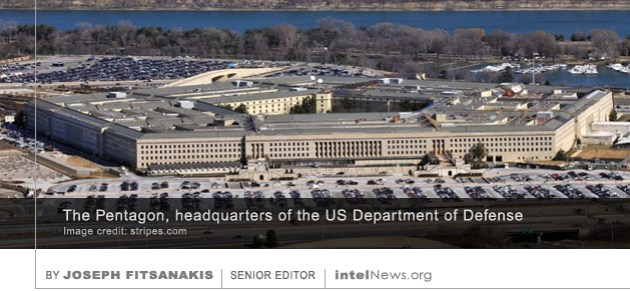 The United States Department of Defense has been secretly sharing intelligence with the Syrian government of President Bashar al-Assad without authorization by the White House, according to an American journalist. Officially, the US government is opposed to the Assad regime in Damascus and has repeatedly stated that peace in Syria can only be achieved if the Assad family leaves power. But in a report published yesterday in The London Review of Books, the veteran American investigative journalist Seymour Hersh claims that America’s military leadership has been secretly aiding the Assad family’s efforts to defeat Islamist groups in Syria.
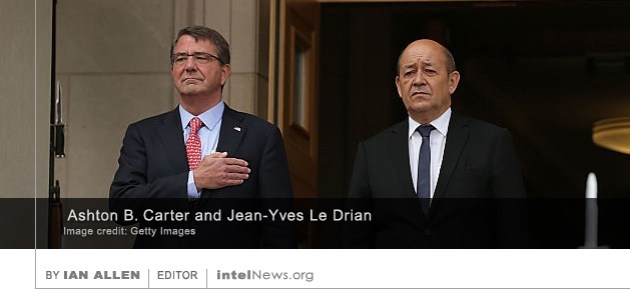
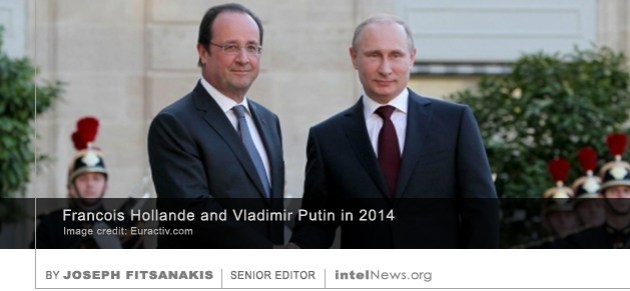 The United States and Russia, which have traditionally been cautious about sharing Middle East-related intelligence with France, have both announced that they will begin giving classified information to Paris. On Wednesday, France’s Defense Minister Jean-Yves Le Drian
  The Iraqi government is now using intelligence supplied by the Russian military in its war against the Islamic State, according to officials in Baghdad. As intelNews
 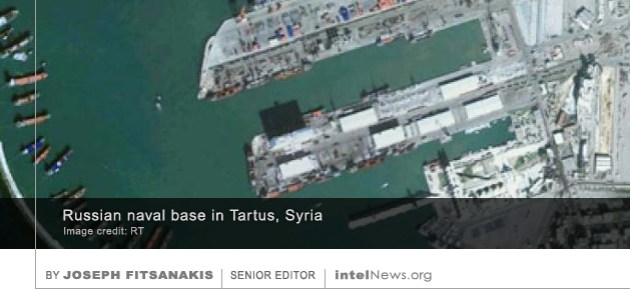 The governments of Russia, Syria and Iran have entered a formal intelligence-sharing agreement with Iraq, in an effort to defeat the Islamic State, it has been announced. Intelligence-sharing has been practiced for a while between Russia, Syria and Iran; but this is the first time that Iraq, an American ally, has entered the alliance. According to the Baghdad-based Iraqi Joint Forces Command, the agreement entails the establishment of a new intelligence-sharing center in the Iraqi capital. It will be staffed with intelligence analysts from all four participating countries, who will be passing on shared information to their respective countries’ militaries.
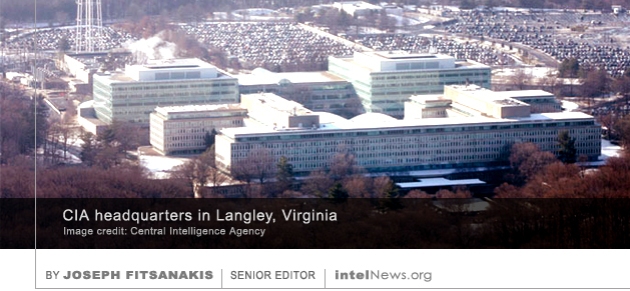 The United States Central Intelligence Agency had direct and unfiltered access to telecommunications data exchanged between German citizens, according to a new document that has surfaced in the German press. The program, codenamed GLOTAIC, was a collaboration between the CIA and Germany’s Federal Intelligence Service, known as BND. According to German newsmagazine Der Spiegel, which
 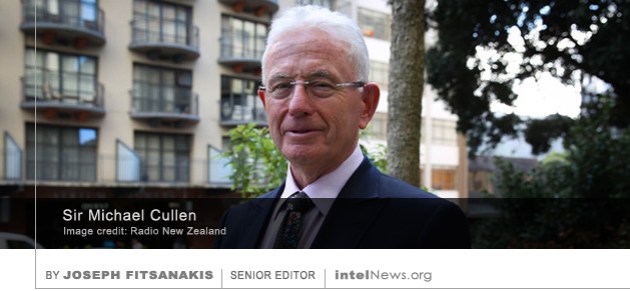 A former deputy prime minister of New Zealand, who is heading a major review of intelligence practices in the country, has said in an interview that spy agencies hurt their mission by practicing excessive secrecy. Sir Michael Cullen served as finance minister, education minister and attorney-General before serving as deputy prime minister of New Zealand, from 2002 to 2008. He was recently appointed by the government to co-chair a broad review of state intelligence agencies, with particular focus on updating the applicable legislative framework and evaluating the oversight exercised by lawmakers and the executive. The review is expected to affect the work of New Zealand’s two most visible intelligence agencies, the Security Intelligence Service and the Government Communications and Security Bureau.
 A fortnight ago, I gave an
 The office of the Swiss Federal Prosecutor has launched an investigation into claims that the country’s largest telecommunications provider was spied on by a consortium of German and American intelligence agencies. The spy project was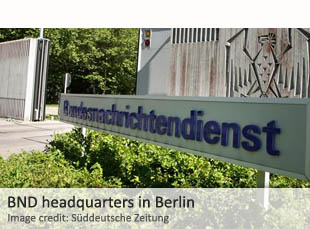








 intelNews.org
Moscow is working with Taliban against ISIS, says Russian envoy
January 8, 2016 by Joseph Fitsanakis 1 Comment
For the past two years, allegations have surfaced in the world’s media that Russia, fearing the continuing growth of ISIS in Central Asia, has reached out to the Taliban in hopes of halting ISIS’ popularity. Last week, however, Zamir Kabulov, Moscow’s special envoy to Afghanistan, openly admitted that Russia is collaborating with the Taliban against ISIS. “The interests of the Taliban completely coincide with ours”, said Kabulov, and added that Moscow maintains “communication channels with the Taliban to exchange intelligence”. It is important to note that Kabulov, who was born in Soviet Uzbekistan, is arguably the most knowledgeable Russian diplomat on matters relating to Afghanistan. Until 2009, he served as Russia’s ambassador to Afghanistan, having also served in Iran and Pakistan. Western observers believe that Kabulov is not simply a “career diplomat”, as he presents himself, but a former officer in the KGB, the USSR’s foremost intelligence agency. He is also believed to have served as the KGB’s chief of station in Kabul during the Soviet occupation of the 1980s, and to have worked closely with Khad, the intelligence agency of Soviet-dominated Afghanistan.
Kim Sengupta, a defense correspondent of British broadsheet The Independent, argues that Kabulov’s announcement reflects the growing ties between the Federal Security Service (FSB), one of the KGB’s successor agencies, and the National Directorate of Security (NDS), Afghanistan’s current intelligence agency. The latter maintains open lines of communication with the Taliban. There is also a question about the extent of Russia’s collaboration with the Taliban in pursuit of common goals. Kabulov implied last week that the collaboration centers on intelligence-sharing. But Sengupta suggests that Moscow may also be supplying weapons and ammunition to the Taliban, through Russian ally Tajikistan. He also notes that other regional powers, including China and Iran, are warming up to the Taliban, which they increasingly view as a more reasonable alternative to ISIS.
► Author: Joseph Fitsanakis | Date: 08 January 2016 | Permalink
Filed under Expert news and commentary on intelligence, espionage, spies and spying Tagged with Afghanistan, intelligence cooperation, Islamic State, News, Russia, Taliban, Zamir Kabulov