UK charges three Bulgarians with spying for Russia in ‘major national security’ case
August 15, 2023 4 Comments
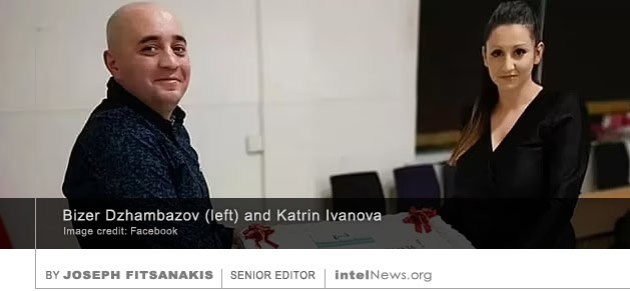 AUTHORITIES IN BRITAIN HAVE charged three Bulgarian nationals with spying for Russia, as part of “a major national security investigation” that led to at least five arrests as early as last February. Two of the Bulgarians appear to be legally married. They have been identified as Bizer Dzhambazov, 41, and Katrin Ivanova, 31, who live in Harrow, a northwestern borrow of Greater London. The third Bulgarian, Orlin Roussev, 45, was arrested in Great Yarmouth, a seaside town in the east coast identity dof England. None of the suspect appears to have a formal diplomatic connection to either Bulgaria or Russia.
The Bulgarians were reportedly arrested in February of this year by the Counter-Terrorism Command of the Metropolitan Police, whose law enforcement mandate includes working on counterespionage cases. Two other individuals who were arrested at the time have not been charged or named. The three suspects have been charged under Section 4 of the United Kingdom’s Identity Documents Act 2010, which prohibits the possession of fake identity documents with “improper intention” and with the owner’s knowledge that they are fake. According to British government prosecutors, the suspects possessed forged passports and identity cards for Spain, France, the United Kingdom, Croatia, Italy, Greece, Bulgaria, the Czech Republic, and Slovenia.
Dzhambazov and Ivanova are believed to have moved to the United Kingdom as a couple in 2013. Both worked in the British healthcare sector —Ivanova as a laboratory assistant for a private company and Dzhambazov as a driver for a hospital. Roussev moved to the United Kingdom in 2009 and worked on the technical side of the financial services industry. He claims to have worked as an adviser for the Ministry of Energy of Bulgaria. He also claims to have previously owned a private company that operated in the area of signals intelligence (SIGINT), which involves the interception of electronic communications.
Bulgaria was one of the Soviet Union’s closest allies during the Cold War. Relations between Bulgaria and Russia plummeted in the 2000s, but pro-Russian sentiments continue to survive among some nationalist segments of the Bulgarian electorate. In June of this year, Kiril Petkov, the leader of Bulgaria’s We Continue the Change party, which today backs Bulgaria’s Prime Minister, Nikolai Denkov, spoke publicly about “Moscow-backed agents” operating inside Bulgaria’s intelligence services. Petkov proposed an ambitious plan to reform the Bulgarian intelligence services in order to “diminish the influence of Russia”. He proposed to do this through the administration of “integrity and ethical tests” to intelligence personnel.
► Author: Joseph Fitsanakis | Date: 15 August 2023 | Permalink








 intelNews.org
Two arrested in Britain for spying for China, report reveals
September 11, 2023 by Ian Allen 2 Comments
A third address, located in an eastern borough or London, was also searched by the Counter-Terrorism Command of the Metropolitan Police, which is leading the investigation into the two suspects. Notably, the parliamentary researcher had worked for prominent members of the Conservative Party, including members of parliament. These reportedly included Alicia Kearns, who chairs the Foreign Affairs Select Committee of the British House of Commons. The Times reported that the suspect had also worked for the Minister of State for Security Tom Tugendhat. The Guardian newspaper reported that Tugendhat said he had not been in touch with the suspect since he assumed his current ministerial role in September of 2022. Kearns did not comment on the case.
The last time a British newspaper reported claims of Chinese espionage was in February of 2021, when The Telegraph reported on the expulsion of three Chinese citizens, who were working as journalists. The paper claimed that the three had been “quietly expelled” after they were caught carrying out espionage. Citing an anonymous “government source”, The Telegraph said that, according to Britain’s Security Service (MI5), the three Chinese journalists were in reality employees of China’s Ministry of State Security. The report did not provide details about when the three Chinese citizens had been expelled, saying only that the expulsions had occurred at different times in the previous year.
According to The Times, the two suspects who were arrested in last March were initially transferred to a south London police station, where they were arraigned. They were then released on bail and are expected to appear in court in October.
► Author: Ian Allen | Date: 11 September 2023 | Permalink
Filed under Expert news and commentary on intelligence, espionage, spies and spying Tagged with Alicia Kearns, China, London Metropolitan Police Counter-Terrorism Command, News, Tom Tugendhat, UK, UK House of Commons