US, UK, had secret plan to bomb Middle East oil facilities if Soviets invaded
June 24, 2016 Leave a comment
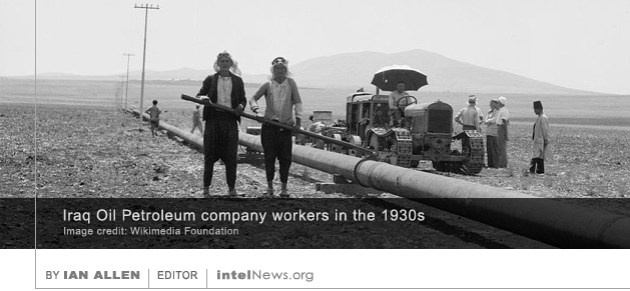 Recently uncovered documents shed further light on an ultra-secret plan, devised by the British and American governments, to destroy oil facilities in the Middle East in the event the region was invaded by Soviet troops. The documents, published on Thursday by George Washington University’s National Security Archive, were found in the British government archives and date from 1951 to 1955. They describe a top-secret United States plan known as NSC 26/2, which was approved by the National Security Council in 1949 and authorized by President Harry Truman. The plan aimed to prevent the use of Middle East oil facilities by Soviet troops if the latter were able to successfully invade the region.
American documents from the 1950s describe NSC 26/2 as a “denial policy”, which called for a secret collaboration between Middle East-based American and British oil companies. The goal was to sabotage or completely destroy oil facilities and equipment that were in British and American hands, before the Soviets could take them over. The most sensitive part of the plan was the need to keep it secret from the governments of Middle Eastern countries like Iran, Iraq, and Saudi Arabia, even though most of them were allies of the West at the time.
The existence of NSC 26/2 was first revealed in 1996, when the American newspaper Kansas City Star published an extensive article about it, written by Steve Everly. But the recently unearthed British documents shed more light than ever before on the intelligence aspects of the secret plan. Specifically, they reveal the leading role played by the Central Intelligence Agency in implementing the details of the plan in nearly every Middle Eastern country, including Kuwait, Bahrain, Qatar, Iran, Iraq, and Saudi Arabia. As part of the plan, the CIA systematically inserted what the National Security Archive describes as “undercover operatives” into posts in American and British oil companies. Their mission was to collect inside information and recruit other oil employees to facilitate the requirements of NSC 26/2. In essence, says the National Security Archive, the CIA created “a paramilitary force ready to execute the denial policy”.
Some of the documents also show that American and British leaders discussed the possibility of bombing —in some cases using nuclear weapons— some oil facilities in countries like Iraq and Iran that were state-owned and thus had no Western connections. In 1953, NSC 26/2 was updated and replaced with NSC 176, which was later renamed NSC 5401. The plan continued to call for the destruction of oil facilities in the Middle East, using “direct action”, if they were close to being seized by Soviet troops.
► Author: Ian Allen | Date: 24 June 2016 | Permalink
 Two recently declassified United States government documents suggest that Pakistani intelligence officers may have been behind a suicide attack that killed seven employees of the Central Intelligence Agency in Afghanistan. The
 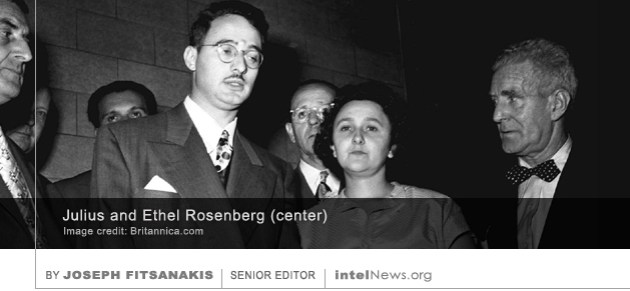 The final piece of sealed testimony in one of the most important espionage cases of the Cold War has been released, 64 years after it was given. The case led to the execution in 1953 of Julius and Ethel Rosenberg, an American couple who were convicted of spying for the Soviet Union. The Rosenbergs were arrested in 1950 for being members of a larger Soviet-handled spy ring, which included Ethel’s brother, David Greenglass. Greenglass agreed to testify for the US government in order to save his life, as well as the life of his wife, Ruth, who was also involved in the spy ring. He subsequently fingered Julius Rosenberg as a courier and recruiter for the Soviets, and Ethel as the person who retyped the content of classified documents before they were surrendered to their handlers. That piece of testimony from Greenglass the primary evidence used to convict and execute the Rosenbergs.







 intelNews.org
Report reveals deeper CIA role in 1963 Vietnam coup and Diem’s assassination
April 30, 2018 by intelNews Leave a comment
The report (.pdf), one of the 19,000 JFK assassination documents released by the US National Archives on Thursday, also contains new details about the South Vietnamese generals’ decision to assassinate Diem that contradict a conclusion of the coup’s history written by the CIA station in Saigon. The majority of the generals, said the CIA at the time, “desired President Diem to have honorable retirement from the political scene in South Vietnam and exile”. According to a newly declassified portion of the 49-page document written by the CIA’s Inspector General, an unidentified field-grade South Vietnamese officer who provided the CIA station with pictures of the bloodied bodies of Diem and his brother and advisor, Ngo Dinh Nhu, said that “most of the generals” favored their immediate execution: “The ultimate decision was to kill them. A Captain Nhung was designated as executioner”.
A redacted version of the Inspector General’s report, dated May 31, 1967, was released by the National Archives in November 2017. In that version of the report, the paragraphs related to the use of CIA funds and the generals’ decision to murder Diem were excised.
* William J. Rust is the author of four books about US relations with Southeast Asia countries during the cold war, including Kennedy in Vietnam. He is currently completing a book about US relations with Indonesia.
Filed under Expert news and commentary on intelligence, espionage, spies and spying Tagged with CIA, Cold War, declassification, Lucien E. Conein, National Security Archive, News, South Vietnam, United States, Vietnam War