Sweden arrests man for spying for Russia; diplomatic expulsions expected soon

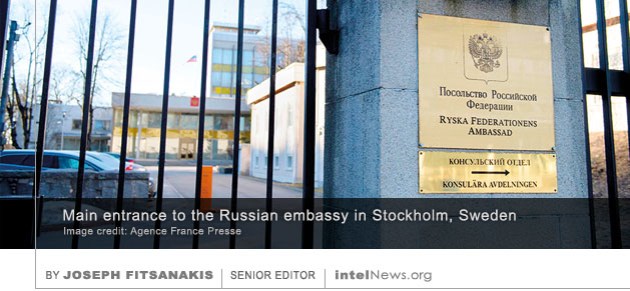
Russian Embassy SwedenAuthorities in Sweden have announced the arrest of a man who is accused of spying for Russia. The man was reportedly apprehended while meeting with a Russian diplomat in central Stockholm. The alleged spy, who has not been identified in media reports, is believed to be working for an unnamed technology company in Sweden. A report by Swedish police said that the man is working “in a field that is known to be of interest to the intelligence services of foreign powers”.

The unnamed man is suspected of having been recruited by intelligence officers of Russia in 2017 or earlier. He is believed to have met with his Russian handlers on a regular basis since his recruitment, and to have passed classified information to the Russian government. He was reportedly arrested on Tuesday evening as he was meeting his alleged Russian handler in a downtown area of the Swedish capital. Both he and his alleged handler were detained by officers of the Swedish Security Service, known as SÄPO. The alleged handler was a member of staff of the Russian embassy in Stockholm and has diplomatic immunity. SÄPO said that the Russian embassy officer is believed to be a Russian intelligence officer who works under diplomatic cover. Swedish media said on Tuesday that the diplomat’s expulsion from the country was imminent.

However, SÄPO declined to provide information on the identity of the alleged spy, who is not believed to have diplomatic immunity and is therefore liable to prosecution. Daniel Stenling, head of SÄPO’s counterespionage directorate, said that Tuesday’s arrest was the result of a prolonged probe that took “a substantial period of time” and involved “intensive intelligence and investigation work”. SÄPO spokesman Gabriel Wernstedt said on Wednesday that the agency did not believe that the alleged spy is a member of a ring involving other suspects. He warned, however, that espionage threats against Sweden “are now more far reaching than [they have] been for many years”.

The alleged spy is scheduled to be placed in pre-trial detention on Thursday or Friday at the latest. British newspaper The Daily Telegraph, which reported Tuesday’s arrest, said it reached out to the Russian embassy in Stockholm but received no response.

Author: Joseph Fitsanakis | Date: 28 February 2019 | Permalink

Destabilization fears grow as hundreds of armed ISIS fighters enter Iraq from Syria

Islamic State ISISIntelligence officials warn that Iraq’s fragile stability may be at risk, following reports that as many as a thousand armed Islamic State fighters have entered Iraq from Syria in recent weeks. The organization calling itself the Islamic State (known also as the Islamic State of Iraq an Syria, or ISIS) is on its last legs in Baghouz, a Syrian village located on the banks of the Euphrates River near the Syrian-Iraqi border. Its fighters are report by a large number of American-backed forces led by Syrian Kurds, in what appears to be the Islamic State’s last territorial stronghold in the Middle East.

Many or the militant Sunni group’s fighters, however, have managed to slip past the American-led coalition’s offensive lines and are now making their way across the border into Iraq’s Sunni-majority northwestern provinces. To prevent this, the Shiite-led Iraqi army has reportedly deployed more than 20,000 soldiers across the 370-mile border with Syria. But the size of the border, as well as the region’s rugged and inhospitable terrain, are making it very difficult to police it. A major surrounded published by the Associated Press late last week claims that hundreds of Islamic State fighters are slipping across the border into Iraq at night, or using tunnels that were constructed by the Islamic State in 2013 and 2014. Others are making their way into Iraq disguised as women or local farmers. Most are armed, says the Associated Press, or know where to go to dig up weapons caches and money, which the Islamic State buried as it retreated into Syria last year under concerted attacks by the Iraqi army.

The Associated Press report quotes three Iraqi intelligence officials and a United States military official, who say that more than 1,000 ISIS fighters entered Iraq from Syria since last September. Iraqi intelligence sources allegedly estimate that between 5,000 and 7,000 armed ISIS fighters are now present in Iraq. Many of them remain in hiding, but others are engaged in systematic efforts to revitalize the group’s presence in Iraq’s Sunni-majority provinces. This was confirmed in a recent press briefing by a senior Iraqi Army spokesman, Brigadier General Yahya Rasoul, who warned that “ISIS is trying to assert itself in Iraq, because of the pressure it is under in Syria”. At least nine major ISIS attacks were recorded in Iraq in January, and several have taken place in February, including the recent killing of five fishermen in Najaf Province, which prompted officials to warn that ISIS may be making a comeback in the region. Iraqi intelligence officials told the Associated Press that the attacks are aimed at warning locals not to share intelligence with the Iraqi military, and to “restore the extortion rackets that financed the group’s rise to power six years ago”.

Author: Joseph Fitsanakis | Date: 26 February 2019 | Permalink

Pakistan’s ex-spy chief stripped of army pension for writing controversial book

Asad DurraniThe former director of Pakistan’s powerful intelligence agency has been stripped of his military pension and associated benefits for co-authoring a controversial book about intelligence with his Indian counterpart. Lieutenant General Asad Durrani (ret.) served as director-general of Pakistan’s Directorate for Military Intelligence between 1988 and 1989. From 1990 to 1992 he was director of the Inter-Services Intelligence Directorate, which is arguably Pakistan’s most powerful government institution. Durrani, 78, has been severely criticized in some Pakistani nationalist circles for co-authoring a book entitled The Spy Chronicles: RAW, ISI and the Illusion of Peace, with his Indian counterpart, A.S. Daulat. Daulat, 79, headed India’s Research and Analysis Wing from 1999 to 2000.

The book was edited by the widely respected Indian journalist Aditya Sinha. It contains details about Pakistan’s systematic efforts to foment armed unrest in the heavily Muslim Indian state of Kashmir, for instance by funding and training a host of Islamist paramilitary organizations that operate in the disputed region. The book also claims that the Pakistani government was aware of the whereabouts of Osama bin Laden in 2011, and that it worked closely with the United States to kill the co-founder of al-Qaeda. Islamabad has consistently denied allegations that it knew of bin Laden’s hideout in the city of Abbottabad, and that it gave permission to US Special Forces troops to raid his compound.

Last Friday, Pakistan Army spokesman Major General Asif Ghafoor announced that a military court had found Durrani guilty of having violated the military code of conduct of the Pakistan Armed Forces. Consequently, he said, the retired general would be stripped of his Army pension and all associated benefits. The military court had conferred behind closed doors, said Ghafoor, adding that he was unable to provide further details on the case. Meanwhile, the Islamabad High Court announced on Thursday that it rejected a plea by Durrani’s lawyers to have his name removed from Pakistan’s Exit Control List. The list contains names of individuals who are prohibited from leaving Pakistan for reasons relating to corruption, economic crime, as well as terrorism and drug-related activity, among other violations. Durrani was placed on that list in March of last year, shortly after his controversial book was published in India.

During the same press briefing on Friday, Ghafoor also said that two Pakistani military officers had been placed in custody facing espionage charges. The Pakistan Army spokesman gave no information about the officers’ names or the countries for which they allegedly spied for.

Author: Joseph Fitsanakis | Date: 25 February 2019 | Permalink

Libya gave French ex-president Sarkozy $8 million, says Gaddafi’s spy chief

Abdullah al-SenussiA senior intelligence advisor to Libya’s late ruler Muammar al-Gaddafi has reportedly told French investigators that the Libyan government gave $8 million to the election campaign of France’s ex-President Nicolas Sarkozy. Sarkozy’s 30-year political legacy has been marred by a series of financial scandals, for which he is currently under investigation. In March of last year, the former French president issued strong denials of accusations that he accepted an illicit multi-million monetary donation from Gaddafi during his 2007 campaign for the presidency. During a 20-minute television interview, Sarkozy described the investigation into the allegations that he acted as an agent of influence for Libya as “a waste of time”, arguing that it was over an alleged donation of less than $45,000, which represented a tiny fraction of his campaign budget.

But according to the French investigative news website Mediapart, a team of French judges was told by Gaddafi’s former spy chief that Sarkozy was given millions of dollars in secret by the Libyan state. Abdullah al-Senussi, who oversaw the Libyan intelligence agencies under Gaddafi, reportedly told the French investigators that the funding was part of a secret deal between the two parties. In 1979, Senussi married the sister of Gaddafi’s wife and remained a trusted confidante of the Libyan leader until his violent death in 2011. According to Mediapart, he told the French judges that he personally supervised the transfer of funds to Sarkozy’s election campaign. He said that the payments entered the campaign’s coffers via a French government minister who received the funds from Libyan agents in two separate installments in 2006. In return, Sarkozy promised to help reinstate Gaddafi’s international image if he was elected president. He also promised to impede attempts by Western countries to arrest Gaddafi and some of his senior government aides —including Senussi— for terrorist crimes. Senussi allegedly said that Sarkozy himself promised him that his international arrest warrants would be quelled with the help of the French president’s personal lawyers. Sarkozy later hosted Gaddafi in Paris in a lavish setting in 2007.

Mediapart said that it accessed Senussi’s testimony before the French judges after getting hold of extracts from his formal statements during his interviews. It added that the information provided by Senussi appears to confirm similar claims made by other witnesses in the investigation about Sarkozy’s alleged illegal campaign funding. The former French president is currently involved in a separate legal dispute concerning alleged illegal spending during his failed campaign for the presidency in 2012.

Author: Ian Allen | Date: 21 February 2019 | Permalink

Lithuania widens espionage probe, several now in custody for spying for Russia

Algirdas PaleckisA growing number of individuals are in custody in Lithuania, as the Baltic state continues a probe into an alleged Russian espionage ring whose members reportedly included a former diplomat and member of one of the country’s most revered political families. On Tuesday, government prosecutors asked for an eight-year prison sentence for Roman Sheshel, who stands accused for giving Moscow classified information on Lithuania’s naval forces. Sheshel, a Russian-born Lithuanian citizen, is also believed to have given his Russian handlers intelligence regarding warships belonging to the North Atlantic Treaty Organization, of which Lithuania is a member. He is accused of having worked for the Russians from early 2015 until his capture by Lithuanian authorities in December of 2017. His trial has been taking place behind closed doors in order to protect state secrets.

Government prosecutors allege that Sheshel was part of a sizeable spy network of Lithuanians who were recruited by Russia in the past five years and whose “activities threatened Lithuanian national security”. Among them is allegedly Alģirds Paleckis, a former parliamentarian and diplomat, Paleckis was born in 1971 in Switzerland, where his father, Justas Vincas, served as a Soviet diplomat. His grandfather, Justas Paleckis, was a towering figure in the Communist Party of Lithuania, which in 1940 spearheaded Lithuania’s amalgamation into the Soviet Union. But his son, Paleckis’ father, broke ranks with the family’s communist past and became a leading nationalist parliamentarian in 1990, when the country seceded from the USSR. Paleckis followed in his father’s footsteps and joined the diplomatic service before entering parliament. But in 2008, after a successful career as a pro-Western reformist politician, Paleckis began to veer to the left, eventually founding the Lithuanian Socialist People’s Front, a small leftist party that is often accused of being too close to Moscow. The party is a vocal opponent of Lithuania’s membership in the European Union and NATO. Paleckis’ critics also note that he is married to a Russian woman whose father is reportedly a Russian intelligence officer.

The German news agency Deutsche Welle reported last week that Paleckis attracted the attention of Lithuanian counterintelligence investigators after he “fully paid back the mortgage on a house too quickly”. He is now accused of giving his Russian handlers information about a Lithuanian government investigation into Soviet-era informant networks in the small Baltic country. He has been in custody since last October, along with an undisclosed number of other alleged members of a purported Russian spy ring. Earlier this week, Lithuanian authorities said that evidence collected from the unnamed detainees are helping them broaden their probe into alleged Russian espionage.

Author: Joseph Fitsanakis | Date: 20 February 2019 | Permalink

Senior Belgian counterintelligence officer arrested on suspicion of spying for Russia

NATO HQ BrusselsA senior counterintelligence official in Belgium’s external intelligence service is under house arrest on suspicion of sharing classified documents with Russian spies, according to a Belgian newspaper. Additionally, the chief of the agency’s counterintelligence directorate has been barred from his office while an internal investigation is underway on allegations that he illegally destroyed government documents. These allegations surfaced last Thursday in a leading article in De Morgen, a Flemish-language daily based in Brussels.

Citing anonymous sources from the General Information and Security Service —Belgium’s military intelligence agency— the paper said that the arrestee has the equivalent rank of major in the General Intelligence and Security Service. Known as GISS, the agency operates as the Belgian equivalent of the United States Central Intelligence Agency or Britain’s Secret Intelligence Service —better known as MI6. GISS officers collect information abroad and are not permitted to operate within Belgium’s borders. The man, a career counterintelligence official, is suspected of having passed secrets to Russia with the help of a woman who claims to be Serbian, but who is in fact believed to be an operative for Russian intelligence. It is not known whether the compromised information included secrets involving the North Atlantic Treaty Organization, of which Belgium is a founding member. In the same article, De Morgen also said that Clement Vandenborre, who serves as chief of GISS’s counterintelligence directorate, has been barred from his office while an investigation is taking place into allegations of mismanagement. He is also accused of having shredded classified government documents without permission. It is not believed that this case is connected with the alleged Russian penetration.

De Morgen quoted a spokesperson for Belgium’s Ministry of Defense, who confirmed that an investigation into alleged foreign espionage targeting a GISS employee was underway, but added that “no comment” would be made on the subject so as “not to hinder” the probe. Ironically, German newspaper Die Welt am Sonntag reported last week that the European Union’s diplomatic agency warned officials in Belgium to watch out for “hundreds of spies” from various foreign countries, including from Russia and China. The warning, issued by the European Union’s diplomatic agency, the European External Action Service (EEAS), said that “approximately 250 Chinese and 200 Russian spies” were operating in Brussels.

Author: Joseph Fitsanakis | Date: 18 February 2019 | Permalink

Alleged third suspect in Skripal poison attack identified by investigative website

Diplomatic Academy of RussiaAn investigative website has linked a graduate of an elite intelligence academy in Moscow with the attempted assassination of a Russian former double spy in Britain last year. Reports last year identified Dr. Alexander Yevgenyevich Mishkin (cover name ‘Alexander Petrov’) and Colonel Anatoliy Chepiga (cover name ‘Ruslan Boshirov’) as the two men that tried to kill Sergei Skripal in the English town of Salisbury in March 2018. Skripal, a former officer in Russia’s military intelligence service, the GRU, was resettled in Salisbury in 2010, after spending several years in a Russian prison for spying on behalf of Britain. But he and his daughter Yulia almost died last March, after they were poisoned with a powerful nerve agent that nearly killed them. The Kremlin denies that Mishkin and Chepiga —believed to be GRU officers— had any role in the attack.

Last week, the Russian investigative news site Bellingcat alleged that a third man may have been involved in the attempt to assassinate Skripal. The man used the name Sergey Fedotov, said Bellingcat, but added that the name was probably a cover that was concocted by Russia’s intelligence services. On Thursday, the website said it was able to identify the so-called third man as Denis Vyacheslavovich Sergeev, a graduate of the Diplomatic Academy of the Russian Ministry of Foreign Affairs. The Diplomatic Academy is one of the most prominent educational institutions in the country and its graduates enter the Foreign Service. However, many of its graduates are elite members of Russian intelligence, said Bellingcat. Earlier this month, the investigative website said that Sergeev traveled extensively in the Middle East, Asia and Europe between 2010 and 2015, using the operational name Sergey Fedotov. It also claimed that Sergeev/Fedotov was in Bulgaria in late April 2015, when Emilian Gebrev, a wealthy local defense industry entrepreneur, fell violently ill. Gebrev was hospitalized for signs of poisoning along with his son and one of his company’s executives for several days. All three made a full recovery.

Bellingcat added that it was able to name the alleged Russian intelligence operative following a four-month investigation that was aided by another Russian news website known as The Russia Insider, Czech newspaper Respekt, and Finland’s Helsingin Sanomat daily. But it also acknowledged that Fedotov’s alleged role in the Skripal assassination remained “unclear” and that authorities in the United Kingdom had not publicly identified a third suspect in the attempted murder. Meanwhile, British newspaper The Guardian said yesterday that it was told by Bulgaria’s Prime Minister Boyko Borisov that a team of British investigators were “on the ground” in Sofia to investigate possible links between the Skripal and Gebrev cases.

Author: Joseph Fitsanakis | Date: 15 February 2019 | Permalink

FBI seeks arrest of US counterintelligence officer who defected to Iran

Monica WittAn American intelligence officer, who held the highest level of security clearance for over a decade, defected to Iran in 2012 and has been spying against the United States ever since, it was revealed yesterday. Monica Witt, 39, was a counterintelligence officer for the United States Air Force from 1997 until 2008, specializing in the Middle East. Throughout her career, she was deployed by the US military to the Middle East on several occasions, in order to carry out counterintelligence missions the details of which remain classified to this day.

According to the US government, one of these missions involved her attendance of an international conference organized by New Horizon Organization. The group is believed to operate as a public relations arm of the Quds Force —the intelligence and paramilitary wing of Iran’s Islamic Revolutionary Guards, whose mission is to spread the ideals of the Islamic Revolution around the world. Witt’s mission was allegedly to monitor the conference proceedings and collect information on attendees. It was while attending that conference that, according to US government documents, Witt started to become attracted to the Iranian government’s world view. She left the US Air Force in 2008 and moved to Central Asia, initially teaching English in Afghanistan and later in Tajikistan. A year later, she vanished. She allegedly reemerged in Iran in 2013, where she appeared on several television programs in which she renounced United States policy on the Middle East and publicly espoused Shi’a Islam. According to the Federal Bureau of Investigation, soon after she defected to Iran, Witt used social media to identify and then compile lists of the whereabouts of several of her colleagues in US Air Force counterintelligence. She then gave this information to the Iranian intelligence services, which used it to launch a series of operations targeting current and former US intelligence personnel.

At a press conference held yesterday in Washington, DC, officials from the FBI, the Department of State and the Department of Treasury announced criminal charges against Witt and New Horizon Organization, which they accused of conducting espionage against the US. They also announced charges against employees of the Iranian-registered Net Peygard Samavat Company, which they said used Witt’s information to launch targeted information operations against American government personnel. Witt remains at large and is believed to reside in Iran.

Author: Joseph Fitsanakis | Date: 14 February 2019 | Permalink

German chancellor inaugurates world’s largest spy agency headquarters in Berlin

BND GermanyThe chancellor of Germany has officially inaugurated the largest headquarters of any spy agency in the world. Last Friday, Angela Merkel led the public ceremony that marked the opening of the Zentrale des Bundesnachrichtendienstes, which is the new headquarters of the German Federal Intelligence Service. Known by the initials BND, the agency operates as Germany’s primary foreign intelligence service. It employs close to 7,000 people in more than 300 locations around the world, and its annual budget is approximately €1 billion ($1.13 billion).

Until recently, the BND was headquartered in the outskirts Munich, in the southern German state of Bavaria. But as of last week, the spy agency has officially moved to its new headquarters in downtown Berlin. The massive new complex is located in the German capital’s affluent Mitte district, just a stone’s throw from a section of what used to be the Berlin War —a major symbol of the Cold War. The new complex spans 3 million sq. ft., making it the largest headquarters of any intelligence agency in the world. The United States Central Intelligence Agency’s headquarters at Langley, Virginia, comes a close second. Construction on the site in Mitte began in 2006 and was initially scheduled for completion in 2011, but was finally finished in 2017, 12 years after it began. It cost approximately €1 billion ($1.13 billion). British newspaper The Guardian reports that the new complex consists of 20,000 tons of steel and has 14,000 windows and 12,000 doors. The land on which the new BND headquarters is built used to be the site of police barracks, until it was heavily damaged by bombing carried out by the Allied forces in 1945. Following the partition of Germany, East German authorities built a sports complex and stadium on the site, which was demolished in 1999, in preparation for Germany’s unsuccessful bid to host the 2000 Summer Olympic Games.

According to reports in the German media, just over 3,000 BND employees have already relocated from Munich to the new BND headquarters, while another 800 are expected to relocate there in the coming year. During her speech on Friday, Chancellor Merkel said that the world was becoming “increasingly confusing”, which made the need for a “strong and efficient [German] foreign intelligence service […] more urgent than ever”. Interestingly, the new complex features a sizeable visitor’s center that is open to the public, making the BND the world’s first foreign intelligence agency with a public-access visitors’ facility.

Author: Ian Allen | Date: 13 February 2019 | Permalink

Hundreds of foreign spies in Brussels, European diplomatic agency warns

European Commission buildingThe European Union’s diplomatic agency has warned officials who are active in Belgium to watch out for “hundreds of spies” from various foreign countries, according to a German news report. The report appeared last weekend in Germany’s Welt am Sonntag newspaper, which cited a report from the European External Action Service (EEAS). Based in Brussels, the EEAS operates as the European Union’s diplomatic agency and is headed by Federica Mogherini, an Italian former government minister who has been serving as the European Union’s High Representative for Foreign Affairs and Security Policy since 2014.

According to Die Welt, the EEAS estimates that “approximately 250 Chinese and 200 Russian spies” are operating in Brussels. Most of these intelligence officers are allegedly embedded in their countries’ embassies, trade missions, cultural centers and other outreach facilities in the Belgian capital. There are also many intelligence operatives from Western agencies, including those of the United States, as well as from Iran, Turkey and Morocco, among other foreign nations. The report in Die Welt adds that the EEAS advised European Union diplomats to avoid certain establishments in the European Quarter of Brussels, which are believed to be heavily frequented by international spies. Among them are “a popular steakhouse and café” that are “within walking distance of the Berlaymont building” —the headquarters of the European Commission. The same building houses the offices of the EEAS.

Such warnings are not new. In June of last year, Peter Gridling, head of Austria’s main counterintelligence agency, said during a rare public appearance that Vienna —the spy capital of the world— no longer topped the list of preferred destinations for the world’s spies. He said that the Austrian capital had been overtaken by Brussels as the spy capital of Europe and added that, according to his agency’s calculations, there was a greater density of spies in Brussels than in any other European capital. When asked to specify the number of foreign intelligence operatives that are active in Vienna, Gridling said it was “in the neighborhood of hundreds of people, but certainly fewer than 1,000”. In 2012, Alain Winants, former Director of Belgium’s State Security Service (SV/SE), claimed that Brussels was home to more spies than any other city in the world.

Author: Ian Allen | Date: 12 February 2019 | Permalink

Reports allege third man was involved in poisoning of Sergei Skripal

Sergei SkripalNew reports from Russian investigative sites claim that a third man using a fake name was involved in the attempted assassination of former double spy Sergei Skripal in England last year. Skripal, a former military intelligence officer, was resettled in the English town of Salisbury in 2010, after spending several years in a Russian prison for spying on behalf of Britain. But he and his daughter Yulia almost died in March 2018, after they were poisoned with a powerful nerve agent that nearly killed them. The attack has been widely blamed on the Russian government, though the Kremlin denies it had any role in it. Two assailants have so far been identified by British intelligence. They have been named as Dr. Alexander Yevgenyevich Mishkin —cover name ‘Alexander Petrov’— and Colonel Anatoliy Chepiga —cover name ‘Ruslan Boshirov’. Both are said to be employees of the Russian military intelligence agency known as the Main Directorate of the General Staff of the Armed Forces, commonly referred to as the GRU. The two men spoke on Russian television last year, denying any involvement in the attack on the Skripals. Their whereabouts since their television interview remain unknown. Moscow denies that it had any role in the attack.

In October of last year, the Russian investigative news site Fontanka claimed that a third man under the name of Sergey Fedotov, may have been involved in the attack on Skripal. Last Thursday, another Russian investigative news site, Bellingcat, said that the name Sergey Fedotov appears to have been created out of thin air for operational purposes by Russia’s intelligence services. According to Bellingcat, Fedotov appears to have no past prior to 2010, when his identity was invented using the same techniques that the fake identities of ‘Petrov’ and ‘Boshirov’ were concocted by the GRU. Moreover, Fedotov’s records show that he traveled extensively in the Middle East, Asia and Europe between 2010 and 2015. The Russian news site claims that he was in Bulgaria in late April 2015, when Emilian Gebrev, a wealthy local defense industry entrepreneur, fell violently ill. Gebrev was hospitalized for signs of poisoning along with his son and one of his company’s executives for several days, eventually making a full recovery. As the Bulgarian businessman was being taken to hospital, Fedotov skipped his return flight out of Sofia and instead drove to Istanbul, Turkey, where he bought a one-way airline ticket to Moscow, says Bellingcat.

The BBC’s Gordon Corera said he contacted the Russian embassy in London and the Kremlin in Moscow. Both sources strongly refuted the Bellingcat report. A Kremlin spokesman cautioned the BBC to be skeptical about Bellingcat’s report, since “we don’t know what [its] authors based their work on [or] how competent they are”. British Police told Corera that they were “still investigating whether further suspects were involved” in the attack on Skripal and were “not prepared to discuss” details pertaining to “an ongoing investigation”.

Author: Joseph Fitsanakis | Date: 11 February 2019 | Permalink

US weapons given to UAE and Saudi Arabia are diverted to al-Qaeda-linked groups

Shabwani EliteWeapons supplied to the Saudi and Emirati governments by the United States and other Western nations are ending up in the hands of al-Qaeda-linked Sunni militias in Yemen, according to two separate investigations. The weapons are being supplied to the militaries of Saudi Arabia and the United Arab Emirates by the West on the understanding that they will be used in the war in Yemen. The war has been going on since 2015, when a alliance of rebel groups from Yemen’s Shiite communities formed the Houthi movement, which quickly seized control of much of the country. The Houthis effectively toppled the government, prompting a reaction by a coalition of Sunni Arab states, which see the Shiite movement as an Iranian front. In an effort to restore Yemen’s Sunni-dominated government, Western countries have supplied Saudi Arabia and the United Arab Emirates with more than $5 billion-worth of weaponry.

However, a report published this week by Amnesty International alleges that some of that weaponry, including machine guns, mortars and even armored vehicles, are being deliberately diverted to Sunni militia groups in Yemen. Among them are three militias that are known to be supported by the government of the Emirates, namely the Giants, the Security Belt and the Shabwani Elite. These groups, says Amnesty, have been seen using Western-supplied weaponry in the field of battle and in their compounds throughout Yemen. In its report, the human-rights group says that these groups are not accountable to any government and have been linked to serious war crimes against civilians. Meanwhile, a separate investigation aired this week by CNN claims that American-manufactured weaponry and materiel given by Washington to the Saudi and Emirati militaries is ending up in the hand of Salafist militias in Yemen. The report names the Sunni Abu al-Abbas Brigade, which is closely linked to al-Qaeda in the Arabian Peninsula (AQAP). The CNN report also claims that some of the American weaponry has fallen in the hands of Houthi fighters.

On Wednesday the BBC quoted a senior American general who said that the Pentagon plans to investigate whether American and other Western-supplied weapons are being illegally diverted into the hands of non-state Sunni militias in Yemen. The government of the United Arab Emirates has not commented on the reports. As intelNews reported last August, an investigative report published by the Associated Press claimed that senior AQAP commanders were on the payroll of US-backed Sunni militias in Yemen and that its fighters were being recruited to fight against the Houthis. The report also argued that Washington was privy to the secret agreements between Yemen’s Sunni militias and AQAP.

Author: Joseph Fitsanakis | Date: 08 February 2019 | Permalink

Japanese police investigate online sale of uranium on Yahoo! auction website

Uranium yellow cakePolice in Japan are investigating how a man was able to offer uranium for sale through an online auction website operated by Yahoo!, a California-based provider of Internet services. Japanese news agencies reported on Friday that the alleged product was displayed packed inside a transparent glass tube on the online auctions site. It was advertised as “Uranium 99.9%”. There was no information about the sale’s starting price on Yahoo! Auctions. The website, Yahoo! Kantan Kessai, is a rare remnant of the California-based company’s worldwide auction service, which terminated its operations in most countries between 2002 and 2008. But smaller segments survive in Taiwan, Japan and Hong Kong.

In November 2017, Japan’s Nuclear Regulation Authority was notified by a user that a product described as “Uranium 99.9%” was on offer on the auction website. After investigating the case, the agency notified the police in January of the following year, which in turn contacted Yahoo! and brought the auction to its attention. The incident was not disclosed to the media at the time, so that the police and intelligence services could investigate whether a network of individuals was involved in the case. Meanwhile, the seller and several individuals who had made bids on the product were arrested and questioned. The substance was confiscated and given to the Japan Atomic Energy Agency for tests. According to local media reports, initial tests conducted by the Japan Atomic Energy Agency showed that the substance is indeed radioactive. Further tests showed that the material is uranium, as advertised, though a question remains as to whether it is depleted uranium or uranium concentrate. It is not known whether the uranium is enriched (thus having an increased percent composition of uranium-235 through isotope separation) or depleted (the less radioactive byproduct of the process of isotope separation).

Reports also suggest that the main suspect in the case told authorities that he acquired the uranium from a seller located outside Japan, who sold it on an international auction website. Reports suggest that, depending on the outcome of ongoing laboratory results, the seller of the substance faces imprisonment of up to a year and a fine of up to ¥1 million (less than $10,000).

Author: Ian Allen | Date: 04 February 2019 | Permalink

Pakistan dismantled ‘major international spy network’, say media reports [updated]

Pakistan Federal Investigation AgencyMedia reports in Pakistan claimed yesterday that “an international spying network” had been dismantled in the country following the arrests of at least five intelligence officials who were working for foreign interests. According to The News International, Pakistan’s largest English-language newspaper, the arrests were carried out earlier this week by the Federal Investigation Agency, the country’s primary counterintelligence agency. Those arrested were allegedly members of Pakistan’s intelligence and security forces, it said. They reportedly include a Pakistani official with diplomatic credentials who was serving in a Pakistani embassy “in a European capital”. [Update: by 1700 EST on Friday, the article on The News International website had been taken down; but an English-language summary of the article can still be found on this website].

The report did not specify the foreign intelligence agency for which the Pakistani officials were allegedly working. But it said that it belonged to one of “the world’s most powerful countries”. It added that the network had been “completely dismantled” following a counterintelligence operation that an unnamed source described to the paper as “remarkable”. As a result, the adversary spy network in Pakistan had been “crippled […] completely”, added The News International.

The conservative-leaning paper, which supports Pakistan’s new center-right Prime Minister Imran Khan, hinted that the alleged spy network may have been working for the United States Central Intelligence Agency. It said that the agency that was involved in running the spy ring had been allowed by the government of Pakistan to “roam free” inside Pakistan after the attacks of September 11, 2001. Its case officers had been allowed to recruit agents in Pakistan’s Federally Administered Tribal Areas, a region in the northwest of the country that is seen as a Taliban stronghold. The paper also protested against prior arrangements that permitted the foreign agency’s case officers to enter and leave Pakistan “with no scrutiny of their luggage”. It added that the government of Prime Minister Khan decided to move against this and other spy networks run by the foreign intelligence agency after it determined that these networks were “working for the interests of that agency in Pakistan and not for Pakistan’s national interests”.

Author: Joseph Fitsanakis | Date: 01 February 2019 | Permalink

Morton Sobell, convicted of conspiracy in the Rosenberg espionage case, dies at 101

Morton SobellMorton Sobell, an American radar engineer who in 1951 was convicted of conspiracy alongside Julius and Ethel Rosenberg in one of the Cold War’s most prominent espionage cases, has died at 101 years old. His death was announced yesterday by his son, Mark, who also said that his father died on December 26 last year at a nursing home, but that the family had not alerted the media.

Sobell was born in New York’s Manhattan Island in 1917 and worked on radar tracking systems for defense contractors. During college, he and several of his friends, including fellow-engineer Julius Rosenberg, joined the United States Communist Party, partly in reaction to the Great Depression. When the Federal Bureau of Investigation began to arrest members of what the United States government claimed was a Soviet atomic spy ring led by Rosenberg, Sobell escaped with his family to Mexico, where he used a fake identity to evade the authorities. But he was dramatically abducted by a paramilitary force and surrendered to the FBI.

He was then tried alongside Rosenberg and his wife Ethel for conspiracy to commit acts of espionage. The Rosenbergs refused to cooperate with the FBI and were sentenced to death. Both were executed in 1953 and remain to this day the only American citizens to have been executed for espionage after the Civil War. Sobel was found guilty of the lesser charge of conspiracy and no evidence was presented in court that connected him to atomic espionage. He was therefore sentenced to 30 years in prison and served 18 of those, following a successful public-relations campaign organized by his wife, Hellen. He was released from prison in 1969 and continued to insist that he had never been a spy and had been wrongly convicted of conspiracy.

But in 2008, at the age of 91, Sobell spoke to The New York Times and publicly admitted for the first time that he had been a spy for the Soviet Union. He said that he had worked systematically to provide Moscow with information on weapons systems and other classified technologies. However, he had “never thought of it” as spying, he said. He also told The Times that he had developed a favorable impression of Soviet communism during the Great Depression, when he and many others saw the Soviet economic system as an antidote to crisis-ridden capitalism. “Now I know it was an illusion”, he told the paper.

Author: Joseph Fitsanakis | Date: 31 January 2019 | Permalink