Ion Pacepa, Cold War’s highest-ranking Soviet Bloc defector, dies of COVID-19
February 17, 2021 5 Comments
 ION MIHAI PACEPA, WHO defected to the West as acting head of the Romanian intelligence service, making him the Cold War’s highest-ranking defector from the Soviet Bloc , has reportedly died in the United States of COVID-19. There has been no official announcement of Pacepa’s passing. However, a number of American and Romanian news outlets have reported his death in the past week, noting that he passed away on February 14. He reportedly died in hospital at “an undisclosed location”, having lived under protection from the Central Intelligence Agency’s National Resettlement Operations Center since his defection in 1978. He was 92.
Pacepa was born in Bucharest in 1928. He joined the Securitate, Romania’s secret police and intelligence service, in 1951, having earlier graduated with a degree in engineering from the Bucharest Polytechnic Institute. From his initial post in the Securitate’s Counter-Sabotage Directorate —a domestic assignment— Pacepa was moved to its Foreign Intelligence Directorate in 1955. He gradually reached the rank of station chief, serving in Frankfurt, West Germany. By the early 1970s Pacepa had reached the equivalent rank of a two-star general, and served as advisor to the Romanian President Nicolae Ceauşescu on matters of industrial and technological innovation. In 1978 he was appointed assistant secretary of the Ministry of the Interior and acting director of the Securitate.
But in July of that year, Pacepa defected to the United States while on assignment in Bonn, West Germany. He simply presented himself to the United States embassy there and was soon granted political asylum by Washington. Since that time, he lived under an assumed identity in a series of undisclosed locations in the United States. He reportedly had to change his living arrangements and assume new identities at least twice after his defection, in order to escape Romanian assassination squads who had been tasked with killing him. Among Pacepa’s aspiring assassins was Carlos the Jackal, who had allegedly been promised $1 million by Ceauşescu in return for killing the high-ranking defector.
Pacepa authored several books since his defection, with this first one, Red Horizons: Chronicles of a Communist Spy Chief, being the most notable. Translated from the original English into Romanian, the book was used by the prosecutors that argued in favor of the death penalty for Ceauşescu and his wife, Elena. Both were executed by firing squad in December 1989.
► Author: Joseph Fitsanakis | Date: 17 February 2021 | Permalink
 Isaac Shoshan, an Israeli undercover operative, who was involved in some of Israel’s most daring and controversial intelligence operations for over 40 years,
 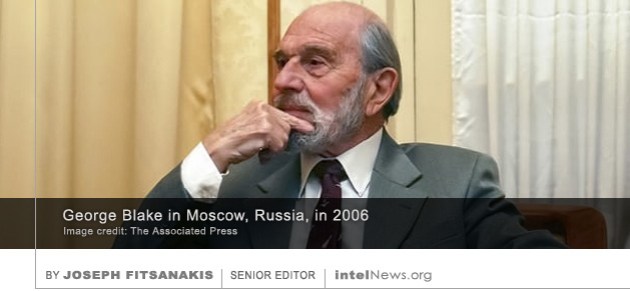 GEORGE BLAKE, A DUTCH-born British intelligence officer, whose espionage for the Soviet Union gained him notoriety in the West and hero status in Moscow, has died aged 98. His death was
  Victor Ivanovich Sheymov, who is often referred to as one of the most important intelligence defectors of the Cold War, has reportedly died in the American state of Virginia. He was one of the most senior officials in the Soviet Union’s Committee for State Security (KGB) to ever defect to the West, and revealed important KGB secrets to the United States.
 Morton Sobell, an American radar engineer who in 1951 was convicted of conspiracy alongside Julius and Ethel Rosenberg in one of the Cold War’s most prominent espionage cases, has died at 101 years old. His death was
 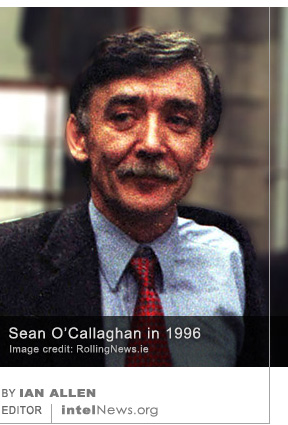 Sean O’Callaghan, one of the most contentious figures in the history of the Provisional Irish Republican Army, has died in Jamaica. He was born in County Kerry, Republic of Ireland, in a strongly republican family, which sided with opponents of the Ango-Irish treaty and fought against the official Irish government in the Irish Civil War of 1922-1923. In 1971, aged just 17, O’Callaghan joined the Provisional Irish Republican Army, which fought to unite British-controlled Northern Ireland with the independent Republic of Ireland. Not long after, O’Callaghan was arrested by the Garda Síochána (Irish police) in his home county of Kerry, when a small quantity of explosives he was hiding in his parents’ house accidentally detonated.
 General Yuri Ivanovich Drozdov, who held senior positions in the Soviet KGB for 35 years, and handled a global network of Soviet undercover officers from 1979 until 1991,
  Werner Stiller, also known as Klaus-Peter Fischer, whose spectacular defection to the West in 1979 inflicted one of the Cold War’s most serious blows to the intelligence agency of East Germany, has died in Hungary. Stiller, 69, is believed to have died on December 20 of last year, but his death was not
 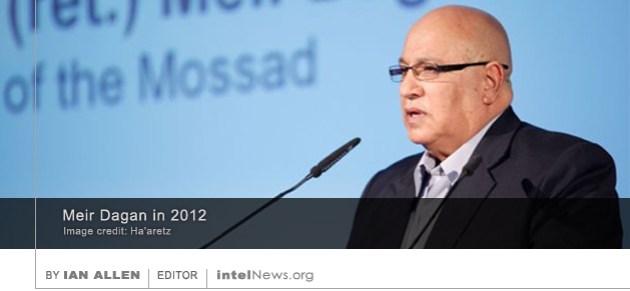 Meir Dagan, who directed the Israeli intelligence agency Mossad for a decade and emerged as a vocal critic of the Israeli government after his retirement, has died. A statement from his family said he died of liver cancer, a disease that prompted him to undergo a complex
  Frank Terpil, a former operative of the United States Central Intelligence Agency, who defected to Cuba in 1981 to avoid charges of criminal conspiracy, has died. He was 76. Terpil resigned from the CIA in 1970, allegedly after he was caught running a pyramid scheme in India, where he had been posted by the CIA. Soon after his forced resignation from the Agency, US federal prosecutors leveled criminal charges on Terpil and his business partner. The former CIA operative was also charged with conspiracy to commit murder, after it was found that he had helped facilitate the illegal transfer of over 20 tons of plastic explosives to the government of Libya.
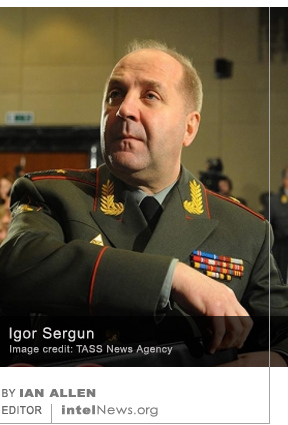 The director of Russia’s powerful military intelligence agency has died unexpectedly at 58, according to the Kremlin, which has yet to release precise information about the circumstances of his death. General Igor Sergun had led the Main Intelligence Directorate, known as GRU, since 2011, when he replaced his predecessor, Colonel General Aleksandr Shlyakhturov, in a Kremlin-instigated reshuffle. The Russian government
 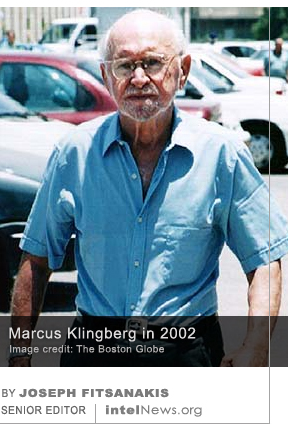 Marcus Klingberg, who is believed to be the highest-ranking Soviet spy ever caught in Israel, and whose arrest in 1983 prompted one of the largest espionage scandals in the Jewish state’s history, has died in Paris. Born Avraham Marek Klingberg in 1918, Klingberg left his native Poland following the joint German-Soviet invasion of 1939. Fearing persecution by the Germans due to his Jewish background, and being a committed communist, he joined the Soviet Red Army and served in the eastern front until 1941, when he was injured. He then received a degree in epidemiology from the Belarusian State University in Minsk, before returning to Poland at the end of World War II, where he met and married Adjia Eisman, a survivor of the Warsaw Ghetto uprising. Together they moved to Sweden, from where they emigrated to Israeli in 1948. It is believed that Klingberg was recruited by the Soviet KGB while in Sweden, and that he moved to Israel after being asked to do so by his Soviet handlers –though he himself always denied it.
 General Hamid Gul, a controversial Pakistani spymaster who helped facilitate America’s covert involvement during the closing stages of the Soviet-Afghan war,







 intelNews.org
Russian sleeper agent Mikhail Vasenkov reportedly dead at 79
April 22, 2022 by Joseph Fitsanakis Leave a comment
In 1979, Lazaro applied for, and was granted, Peruvian citizenship. A few years later, he met and married Peruvian journalist Vicky Pelaez, with whom he had a son. In 1985, the Lazaros moved to New York, along with their child and a son Pelaez had from a previous relationship. The couple were arrested by the FBI in 2010, and later admitted being in the service of Russian intelligence. They were among 10 Russian non-official-cover intelligence officers, who were swapped for a number of Western-handled intelligence agents held in Russian prisons.
In January of 2020, the Russian Foreign Intelligence Service (SVR), which is one of the KGB’s successor agencies, admitted for the first time that Vasenkov had been an intelligence officer. This unusual announcement directly contradicted Vasenkov’s own claims 10 years earlier: the spy had allegedly said that he was not Russian, did not understand or speak Russian, and wanted to move to Peru.
On April 6 of this this month, the SVR announced Vasenkov’s death, saying he was 79 years old. The announcement gave no cause of death. It added that Vasenkov had served in the so-called “special reserve staff” of the organization, which refers to spies who do not operate under diplomatic cover abroad. The obituary noted that Vasenkov had “created and headed an illegal residency”, which “obtained valuable political information, that was highly appreciated” by Russian decision-makers. It also said that Vasenkov had acquired the rank of colonel in 2005.
► Author: Joseph Fitsanakis | Date: 22 April 2022 | Permalink
Filed under Expert news and commentary on intelligence, espionage, spies and spying Tagged with KGB, Mikhail Vasenkov, non-official-cover, obituaries, Russia, Russian illegals program spy ring, sleeper agents, SVR (Russia), Vicky Pelaez